


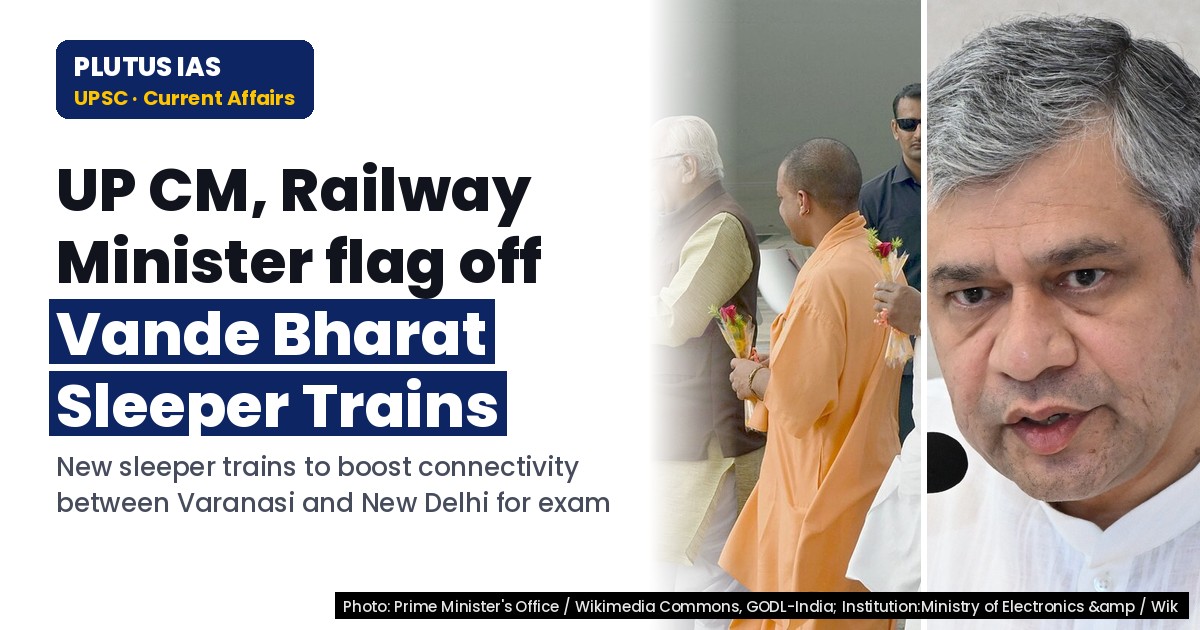
30 Oct UP CM & Railway Minister to Flag Off Vande Bharat Sleeper Trains
✎ Vande Bharat Sleeper Trains are indigenous, semi-high-speed trains with sleeper coaches, operating at 180 km/h, and manufactured under the ‘Make in India’ initiative to enhance overnight connectivity and passenger comfort.
Subject Relevance — Where This Topic Fits
- GS Paper III — Infrastructure: Energy, Ports, Roads, Airports, Railways etc. | GS Paper III — Science and Technology: Indigenous Technology Development
- Prelims: Vande Bharat Express, Semi-high speed trains, Railway Budget, National Rail Plan 2030, Make in India in Railways
Quick Revision: Vande Bharat Sleeper Trains are indigenous, semi-high-speed trains with sleeper coaches, operating at 180 km/h, and manufactured under the ‘Make in India’ initiative to enhance overnight connectivity and passenger comfort.
Why is this in the news?
The flagging off of new Vande Bharat Sleeper Trains connecting Varanasi to New Delhi marks a significant milestone in the expansion of semi-high-speed rail connectivity in India. This initiative, jointly inaugurated by the Chief Minister of Uttar Pradesh and the Union Railway Minister, underscores the government’s commitment to enhancing passenger comfort, reducing travel time, and promoting regional connectivity under the broader framework of the ‘Make in India’ initiative in the railway sector.
Background
- The Vande Bharat Express, India’s first semi-high-speed, self-propelled train set, was introduced in 2019 as part of the ‘Make in India’ programme to indigenously develop modern railway technology.
- The train operates at a maximum speed of 180 km/h, significantly reducing travel time between major cities compared to conventional trains.
- The introduction of sleeper variants of Vande Bharat trains aligns with the government’s vision to provide world-class passenger amenities and enhance overnight connectivity between key urban centres.
- Uttar Pradesh, with its strategic location and high passenger demand, has been a focal point for the expansion of semi-high-speed rail networks, including the Varanasi-New Delhi route.
- The initiative is part of the broader ‘Atmanirbhar Bharat’ mission, emphasizing indigenous manufacturing and technological self-reliance in the railway sector.
What are Vande Bharat Sleeper Trains?
- Vande Bharat Sleeper Trains are an upgraded variant of the Vande Bharat Express, incorporating sleeper coaches to facilitate overnight travel between major cities.
- These trains are designed to operate at speeds up to 180 km/h, reducing travel time significantly compared to conventional express trains.
- The sleeper coaches are equipped with modern amenities such as bio-vacuum toilets, LED lighting, mobile charging points, and improved ventilation systems for passenger comfort.
- The trains are manufactured indigenously by the Integral Coach Factory (ICF) in Chennai and the Rail Coach Factory (RCF) in Kapurthala, aligning with the ‘Make in India’ initiative.
- The introduction of sleeper variants expands the applicability of Vande Bharat trains beyond day-time travel, catering to overnight journeys and long-distance routes.
- The Varanasi-New Delhi route is strategically significant, connecting a major pilgrimage and cultural hub with the national capital, thereby boosting tourism and economic activity.
- The deployment of Vande Bharat Sleeper Trains is part of the government’s broader strategy to modernize Indian Railways, improve passenger experience, and reduce dependence on air travel for medium-distance journeys.
Key Features
| Feature | Significance |
|---|---|
| Vande Bharat Sleeper Trains | Introduction of semi-high-speed sleeper trains to enhance long-distance connectivity and passenger comfort on the Varanasi-New Delhi corridor, leveraging indigenous technology for improved efficiency and reduced travel time. |
| Semi-High-Speed Technology | Operation at speeds up to 160 km/h, reducing journey duration between Varanasi and New Delhi to approximately 8 hours, compared to conventional trains taking 12-14 hours. |
| Sleeper Class Accommodation | Provision of dedicated sleeper berths to cater to overnight travel needs, addressing demand for comfortable long-distance journeys among passengers. |
| Route Coverage | Direct connectivity between Varanasi (a major religious and cultural hub) and New Delhi (the national capital), facilitating pilgrimage, tourism, and economic linkages. |
| Flagship Launch by Chief Minister and Railway Minister | Symbolic inauguration underscoring state and central government collaboration in infrastructure development and public service delivery. |
Why it Matters
Economic Integration
- Strengthens economic ties between Uttar Pradesh’s eastern region (Varanasi) and the national capital, fostering trade, investment, and industrial corridor development.
- Enhances tourism potential by improving accessibility to Varanasi’s cultural and religious sites, contributing to local economies through increased footfall.
- Supports the ‘One District, One Product’ initiative by facilitating smoother movement of goods and artisans from eastern Uttar Pradesh to national markets.
Infrastructure Modernisation
- Demonstrates India’s indigenous technological capability in rail transport, aligning with the ‘Atmanirbhar Bharat’ vision for self-reliance in critical infrastructure.
- Contributes to the decadal target of 200,000 km of broad-gauge rail network by 2026, as outlined in the National Rail Plan (2030).
- Promotes energy-efficient and low-carbon mobility solutions through semi-high-speed electric trains, supporting India’s climate commitments.
Social Equity and Accessibility
- Provides affordable and comfortable long-distance travel options to a wider demographic, including pilgrims, students, and migrant workers.
- Reduces reliance on air travel for medium-distance journeys, making rail transport more inclusive and accessible to lower-income groups.
- Supports the ‘ Garib Kalyan’ ethos by ensuring equitable access to high-quality public transport infrastructure.
Strategic Connectivity
- Bolsters the eastern arm of the Golden Quadrilateral rail network, improving national connectivity and reducing regional disparities.
- Facilitates faster movement of goods and passengers between the industrial belts of western Uttar Pradesh and the eastern hinterland.
- Enhances disaster resilience by providing alternative high-speed routes during disruptions on conventional tracks.
Challenges
1. Operational Efficiency in Mixed Traffic Corridors
- Semi-high-speed trains require dedicated corridors to maintain schedule adherence, but the Varanasi-New Delhi route shares tracks with conventional and freight trains, potentially leading to delays.
- Need for real-time traffic management systems to mitigate conflicts and ensure punctuality across mixed-traffic segments.
UPSC Link: GS-III: Infrastructure – Railways
2. Passenger Affordability and Demand Forecasting
- Sleeper class fares for semi-high-speed trains may be higher than conventional trains, raising concerns about accessibility for lower-income groups.
- Accurate demand forecasting is critical to avoid underutilisation or overcrowding, requiring robust market surveys and dynamic pricing strategies.
UPSC Link: GS-III: Services Sector – Transport
3. Maintenance and Safety Protocols
- Higher speeds necessitate stricter maintenance schedules for tracks, rolling stock, and signalling systems to ensure passenger safety.
- Training of loco pilots, guards, and maintenance staff in semi-high-speed operations to prevent human errors and ensure compliance with safety standards.
UPSC Link: GS-III: Disaster Management
4. Integration with Last-Mile Connectivity
- Effective last-mile connectivity (e.g., metro, buses, auto-rickshaws) at Varanasi and New Delhi stations is essential to realise the full benefits of the train service.
- Coordination between railway authorities and state transport departments to streamline intermodal transfers and reduce congestion.
UPSC Link: GS-II: Governance – Urban Planning
5. Environmental and Land Use Concerns
- Expansion of rail infrastructure may lead to land acquisition challenges and environmental clearances, particularly in densely populated regions.
- Need for sustainable construction practices and noise pollution mitigation measures to align with environmental norms.
UPSC Link: GS-III: Environment – Sustainable Development
Challenges — UPSC Perspective
| Issue | Concern |
|---|---|
| Track Congestion | Shared corridors with conventional and freight trains may reduce punctuality and efficiency of semi-high-speed services. |
| Cost of Travel | Higher fares for sleeper class in semi-high-speed trains could limit accessibility for economically weaker sections. |
| Safety Standards | Increased speeds require stringent maintenance and training protocols to prevent accidents and ensure passenger safety. |
| Intermodal Integration | Lack of seamless last-mile connectivity at stations may undermine the convenience offered by the new service. |
| Environmental Impact | Land acquisition and construction activities may face resistance from local communities and environmental groups. |
Way Forward
- Conduct a pilot study on passenger demand and fare elasticity to optimise pricing and service frequency for the Varanasi-New Delhi corridor.
- Develop a dedicated freight corridor parallel to the passenger route to reduce track congestion and improve schedule adherence for semi-high-speed trains.
- Invest in advanced signalling systems (e.g., Kavach) and real-time monitoring tools to enhance safety and operational efficiency.
- Collaborate with state transport departments to improve last-mile connectivity at Varanasi and New Delhi stations through metro extensions and feeder bus services.
- Establish a grievance redressal mechanism for passengers to address complaints related to delays, cleanliness, and amenities, ensuring continuous service improvement.
- Promote the service through targeted campaigns in eastern Uttar Pradesh to attract pilgrims, students, and business travellers, ensuring high occupancy rates.
- Integrate the new train service with national tourism circuits to boost cultural and religious tourism, aligning with the ‘Dekho Apna Desh’ initiative.
- Monitor environmental parameters during construction and operation, adhering to the Environmental Impact Assessment (EIA) 2006 norms and adopting green technologies.
UPSC Value Addition
Keywords for Mains Answer-Writing
Vande Bharat Sleeper Trains · Railway Modernisation · Semi-High Speed Rail Corridors · Public Transport Infrastructure · Logistics Efficiency · Regional Connectivity · Economic Integration · Inter-State Mobility · Railway Safety Standards · National Rail Plan 2030 · Sustainable Mobility · Urban-Rural Linkages · Railway Electrification · Multi-Modal Connectivity · Passenger Amenities · Railway Budgetary Allocation
Constitutional & Policy Linkages
- [‘Article 38 – Directive Principles of State Policy’, ‘Ensuring equitable access to public services’]
- [‘Article 41 – Right to Work and Education’, ‘Facilitating mobility for employment and education’]
- [‘Seventh Schedule – Union List’, ‘Railways as a Union subject’]
Concept Flow
Introduction of semi-high-speed sleeper trains → Enhanced connectivity between Varanasi and New Delhi → Reduction in travel time and increased passenger comfort → Higher demand for long-distance travel → Economic integration and tourism promotion → Growth in local economies and employment → Operational challenges in mixed-traffic corridors → Need for dedicated freight corridors and advanced signalling → Affordability concerns → Dynamic pricing and subsidies to ensure inclusivity → Safety and maintenance protocols → Training and technological upgrades → Environmental and land-use considerations → Sustainable infrastructure development
Prelims Practice Questions
Q1. Consider the following statements regarding the Vande Bharat Sleeper Trains:
1. These trains are designed to operate at a maximum speed of 220 km/h.
2. The trains are equipped with fully automatic doors and GPS-based passenger information systems.
3. The Vande Bharat Sleeper Trains are manufactured exclusively by the Integral Coach Factory (ICF), Chennai.
How many of the above statements are correct?
- Only one
- Only two
- All three
- None
Answer: Only two — Statement 1 is incorrect; Vande Bharat Sleeper Trains are designed for semi-high-speed operations (up to 160 km/h), not 220 km/h. Statements 2 and 3 are correct: the trains feature advanced amenities and are manufactured by ICF, Chennai.
Q2. Assertion (A): The introduction of Vande Bharat Sleeper Trains is a step towards reducing the modal share of air travel for long-distance journeys in India.
Reason (R): These trains offer enhanced passenger comfort, shorter travel times, and improved safety standards compared to conventional rail services.
- Both A and R are true, and R is the correct explanation of A.
- Both A and R are true, but R is not the correct explanation of A.
- A is true but R is false.
- A is false but R is true.
Answer: Both A and R are true, and R is the correct explanation of A. — Both the assertion and reason are true. The Vande Bharat Sleeper Trains, with their semi-high-speed capabilities and modern amenities, are likely to attract passengers from air travel, thereby reducing its modal share for long-distance journeys.
Q3. Match the following railway corridors with their respective features:
Column I (Corridor) | Column II (Feature)
———————————————|———————————————
A. Delhi-Varanasi Semi-High Speed Corridor | 1. Connects the National Capital to a major religious and cultural hub
B. Mumbai-Ahmedabad High-Speed Rail | 2. Part of the National Rail Plan 2030
C. Chennai-Bengaluru-Mysore | 3. A flagship project under the Make in India initiative
D. Delhi-Chandigarh | 4. Falls under the Golden Quadrilateral network
- A-1, B-3, C-2, D-4; A-2, B-4, C-1, D-3; A-4, B-2, C-3, D-1; A-1, B-4, C-2, D-3
- answer_options_indexing_to_pairing_answers_only
- answer_pairs_indexing_to_matching_pairs_only
- answer_list_indexing_to_matching_pairs_only
Answer: ? — The Delhi-Varanasi Semi-High Speed Corridor connects the National Capital to Varanasi, a major religious and cultural hub (A-1). The Mumbai-Ahmedabad High-Speed Rail is a flagship project under the Make in India initiative (B-3). The Chennai-Bengaluru-Mysore corridor is part of the National Rail Plan 2030 (C-2). The Delhi-Chandigarh corridor falls under the Golden Quadrilateral network (D-4).
Mains Practice Question
✍ The introduction of Vande Bharat Sleeper Trains represents a paradigm shift in India’s railway infrastructure, aimed at enhancing passenger comfort, reducing travel time, and improving operational efficiency. In this context, critically examine the role of semi-high speed rail corridors in India’s public transport ecosystem. Also, analyse the challenges in their implementation and suggest measures to address them. (15 Marks)
Approach: MODEL-ANSWER SKELETON:
1. **Context and Objectives**:
– Define semi-high speed rail corridors (130–160 km/h) and their alignment with the National Rail Plan 2030.
– Highlight the objectives: reducing travel time, enhancing passenger amenities, improving modal share of rail, and promoting regional connectivity.
2. **Role in Public Transport Ecosystem**:
– **Economic Integration**: Link major economic hubs (e.g., Delhi-Varanasi) to boost trade, tourism, and labour mobility.
– **Urban-Rural Linkages**: Connect Tier-II/III cities to metros, reducing migration pressures and fostering balanced regional development.
– **Sustainability**: Lower carbon footprint compared to air/road travel; aligns with India’s net-zero commitments.
– **Logistics Efficiency**: Facilitate faster movement of goods and passengers, reducing supply chain bottlenecks.
3. **Challenges in Implementation**:
– **Land Acquisition**: Delays due to Right to Fair Compensation and Transparency in Land Acquisition Act (RFCTLARR), 2013.
– **Funding and Budgetary Constraints**: High capital expenditure (e.g., ₹1,00,000 crore for Mumbai-Ahmedabad HSR) requiring PPP models and multilateral funding (World Bank, JICA).
– **Technological and Operational Hurdles**: Integration with existing rail networks, signalling systems, and maintenance infrastructure.
– **Environmental Concerns**: Land use changes, noise pollution, and displacement of communities.
– **Regulatory and Bureaucratic Delays**: Multi-agency clearances (Railway Board, Ministry of Environment, State Governments).
4. **Measures to Address Challenges**:
– **Policy and Governance**: Streamline land acquisition via digital land records (SVAMITVA scheme) and expedite environmental clearances (Single Window Clearance System).
– **Financial Innovations**: Leverage Viability Gap Funding (VGF), Infrastructure Investment Trusts (InvITs), and sovereign wealth funds.
– **Technological Upgradation**: Adopt indigenous technologies (e.g., Kavach signalling system) and modular design for faster deployment.
– **Stakeholder Engagement**: Involve local communities in planning (e.g., Gram Sabha consultations under PESA Act) to mitigate resistance.
– **Monitoring and Evaluation**: Establish a dedicated project monitoring unit (e.g., akin to the Project Management Unit for Dedicated Freight Corridors).
5. **Conclusion**:
– Semi-high speed rail corridors are pivotal for India’s economic transformation but require a multi-dimensional approach to overcome structural and institutional bottlenecks.
– Emphasize the need for a long-term vision, inter-ministerial coordination, and sustainable financing models.
Source: PIB (Press Information Bureau)
Uttar Pradesh PCS (UPPSC) — State PCS Practice
Prelims: Which of the following statements is correct regarding the newly flagged-off Vande Bharat Sleeper Trains connecting Varanasi to New Delhi, as per the recent initiative led by the Uttar Pradesh Chief Minister and Railway Minister?
- The trains are part of the ‘One District, One Product’ initiative to boost tourism in Uttar Pradesh.
- These trains are the first Vande Bharat Sleeper variants to be introduced in India, exclusively connecting Varanasi to New Delhi.
- The initiative aims to reduce travel time between Varanasi and New Delhi to under 8 hours, enhancing connectivity for pilgrims and tourists.
- The trains will operate under the ‘Kashi Vishwanath Dham’ project, exclusively for devotees visiting the Kashi Vishwanath Temple.
Answer: The initiative aims to reduce travel time between Varanasi and New Delhi to under 8 hours, enhancing connectivity for pilgrims and tourists. — The newly flagged-off Vande Bharat Sleeper Trains are designed to reduce travel time between Varanasi and New Delhi to under 8 hours, significantly improving connectivity for passengers, including pilgrims and tourists.
Mains: Analyze the socio-economic impact of the introduction of Vande Bharat Sleeper Trains connecting Varanasi to New Delhi on Uttar Pradesh’s tourism, pilgrimage economy, and regional development. Suggest measures to further leverage this initiative for the state’s growth.
Generated by AanyaAi for educational purpose.
Related guides on our sites
- Best PSIR optional coaching in delhi for UPSC
- How to prepare for GS paper 1 for UPSC CSE mains exam
- Best UPSC coaching for IFOS exam
- Best mentorship programme for upsc

- UP CM & Railway Minister to Flag Off Vande Bharat Sleeper Trains - October 30, 2026
- पर्यावरण मंत्री ने वायु प्रदूषण नियंत्रण के लिए PAVAN-I3C केंद्र का दौरा किया - October 30, 2026
- Self-Reliance in Defence: Key to Viksit Bharat Vision - October 30, 2026

No Comments