


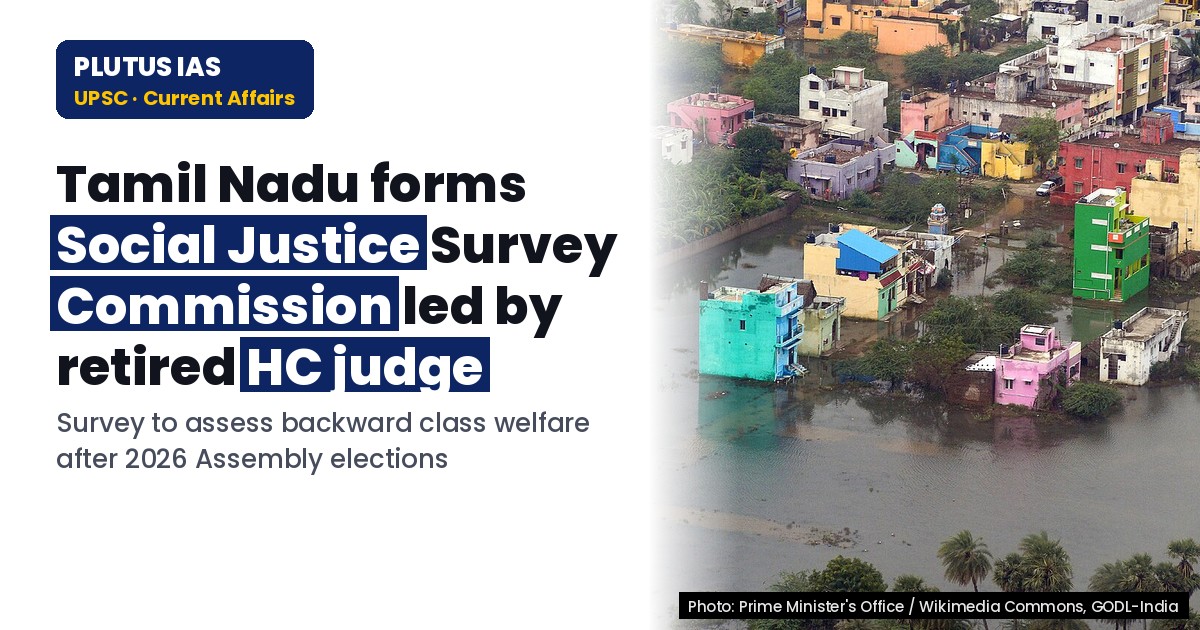
29 Oct Tamil Nadu to Form Social Justice Survey Commission Headed by Retired HC Judge
✎ The Social Justice Survey in Tamil Nadu is a constitutional-compliant, judicially supervised exercise to assess socio-economic disparities among marginalised communities, with findings intended to inform evidence-based policy…
Subject Relevance — Where This Topic Fits
- GS Paper II — Constitutional and Non-Constitutional Bodies | GS Paper II — Government Policies and Interventions for Development in various sectors | GS Paper IV — Ethics and Governance: Accountability and Citizen Charter
- Prelims: Social Justice Survey, Constitutional provisions for social justice, Backward Classes Commission, Reservation policy, Poramboke land, Northeast monsoon preparedness, Industrial policy and land use, Review petition in Supreme Court
- Essay: The Role of Constitutional Commissions in Ensuring Social Justice, Balancing Development and Equity: Policy Challenges in India
Quick Revision: The Social Justice Survey in Tamil Nadu is a constitutional-compliant, judicially supervised exercise to assess socio-economic disparities among marginalised communities, with findings intended to inform evidence-based policy interventions and affirmative action measures.
Why is this in the news?
The Tamil Nadu Cabinet’s decision to constitute a commission headed by a retired High Court judge for conducting a Social Justice Survey has gained prominence as it aligns with the state’s commitment to evidence-based policymaking for social equity. The survey follows the state’s announcement in the Governor’s address to the Assembly and is positioned as a key governance instrument to address disparities among Backward Classes, Most Backward Classes, De-notified Communities, and Scheduled Castes. Concurrently, the Cabinet’s deliberations on the Supreme Court’s recent judgment on reservation benefits for converted communities and the long-standing issue of illegal land grants in Thalambur highlight the intersection of judicial pronouncements, executive action, and land governance in Tamil Nadu.
Background
- The concept of social justice in India is enshrined in the Directive Principles of State Policy (Articles 38, 39, 46) and reinforced through constitutional provisions for reservations (Articles 15(4), 16(4), 340) and commissions such as the National Commission for Backward Classes (NCBC) and State Backward Classes Commissions.
- Tamil Nadu has historically been a pioneer in affirmative action policies, with the introduction of the ‘Mandal Commission’ recommendations in the 1980s and subsequent expansions of reservation quotas for Backward Classes, Most Backward Classes, and Scheduled Castes.
- The state’s reservation policy has faced judicial scrutiny, particularly regarding the extension of benefits to converted communities, with the Supreme Court in *Indra Sawhney v. Union of India* (1992) and subsequent judgments clarifying the limits of such extensions.
- The issue of poramboke (government-owned) land encroachments has been a persistent challenge in Tamil Nadu, with the state government periodically addressing illegal land grants through legislative and executive measures, including the Tamil Nadu Land Reforms Act, 1961.
- The Northeast monsoon, critical for Tamil Nadu’s agriculture and water security, requires proactive preparedness to mitigate risks of flooding, waterlogging, and infrastructure damage, as evidenced by past events such as the 2015 Chennai floods.
- Industrial development in Tamil Nadu, a key driver of economic growth, necessitates streamlined land acquisition and regulatory compliance, particularly in peri-urban areas like Thalambur.
What is the Social Justice Survey in Tamil Nadu?
- The Social Justice Survey is a state-led initiative aimed at collecting comprehensive socio-economic data on marginalised communities, including Backward Classes (BC), Most Backward Classes (MBC), De-notified Communities (DNC), and Scheduled Castes (SC) in Tamil Nadu.
- The survey is designed to identify disparities in access to education, employment, healthcare, housing, and other essential services, thereby informing targeted policy interventions and resource allocation.
- A retired High Court judge will head the multi-member commission, ensuring judicial oversight and adherence to constitutional principles of fairness and equity in data collection and analysis.
- The commission will frame specific rules and regulations for the survey, including methodologies for data collection, verification, and dissemination, in consultation with experts from sociology, economics, and public administration.
- The survey’s findings are expected to guide the state government in revisiting and rationalising reservation policies, welfare schemes, and affirmative action measures to address evolving socio-economic realities.
- The initiative reflects Tamil Nadu’s commitment to evidence-based governance, aligning with global best practices in social inclusion and equity measurement, such as the Sustainable Development Goals (SDG) 10 (Reduced Inequalities).
- The survey may also serve as a model for other states, particularly those with similar demographic profiles and historical contexts of social stratification.
Key Features
| Feature | Significance |
|---|---|
| Constitution of a multi-member commission | Ensures impartiality and expertise in conducting the Social Justice Survey, leveraging judicial experience to maintain objectivity. |
| Headed by a retired High Court judge | Provides constitutional and legal credibility to the survey, ensuring adherence to due process and fairness. |
| Conduct after Census completion | Avoids duplication of data collection efforts and ensures the survey is based on updated demographic information. |
| Review of Supreme Court judgment on reservation benefits | Highlights the State’s commitment to addressing legal ambiguities in reservation policies for marginalised communities. |
| Resolution of poramboke land disputes | Addresses long-standing governance failures in land records, protecting livelihoods and educational institutions. |
Why it Matters
Governance and Institutional Strengthening
- Demonstrates Tamil Nadu’s proactive approach to evidence-based policymaking through structured surveys and data-driven governance.
- Reinforces the role of judicial oversight in social welfare initiatives, aligning with constitutional principles of fairness and equity.
- Sets a precedent for other States to adopt similar mechanisms for assessing social justice indicators.
Legal and Constitutional Implications
- The decision to file a review petition in the Supreme Court underscores the State’s commitment to resolving constitutional ambiguities in reservation policies.
- The survey’s findings could inform future amendments to the Tamil Nadu Backward Classes, Most Backward Classes, Denotified Communities, and Scheduled Castes (Reservation of Seats in Educational Institutions and of Appointments or Posts in the Services under the State) Act, 1993.
Land Governance and Public Welfare
- The resolution of poramboke land disputes addresses systemic failures in land record management, a critical issue for rural and peri-urban communities.
- Protects the rights of approximately 3,000 individuals and 15 educational institutions affected by illegal land grants.
Economic and Industrial Development
- Approval of eight new industrial proposals aligns with Tamil Nadu’s industrial growth strategy, potentially boosting employment and revenue generation.
- The Chief Minister’s directive to expedite welfare schemes ensures timely delivery of public services, enhancing governance efficiency.
Disaster Preparedness
- Review of Northeast monsoon preparedness in districts reflects a focus on proactive disaster management, reducing vulnerability to climate-induced risks.
Challenges
1. Legal Ambiguity in Reservation Policies
- The Supreme Court’s dismissal of the State’s appeal highlights the need for clarity in extending reservation benefits to converted communities.
- A review petition may face procedural delays, prolonging uncertainty for affected groups.
UPSC Link: GS-II: Fundamental Rights and Reservations
2. Land Governance and Poramboke Land Disputes
- Long-standing disputes over poramboke land indicate systemic inefficiencies in land record management and adjudication.
- Restoring rights to affected parties requires coordination between revenue, judicial, and administrative authorities.
UPSC Link: GS-II: Land Reforms and Governance
3. Data Collection and Survey Implementation
- Conducting the survey post-Census may face logistical challenges in ensuring timely and accurate data collection.
- Ensuring representation of marginalised groups in the survey design is critical to avoid exclusion.
UPSC Link: GS-II: Social Justice and Welfare Schemes
4. Industrial and Economic Growth Constraints
- Approval of industrial proposals does not guarantee timely implementation due to regulatory and environmental clearances.
- Balancing industrial growth with environmental sustainability remains a persistent challenge.
UPSC Link: GS-III: Industrial Policy and Sustainable Development
5. Disaster Preparedness and Public Grievance Redressal
- Ensuring district-level preparedness for the Northeast monsoon requires sustained funding and inter-departmental coordination.
- Addressing public grievances without delay demands robust institutional mechanisms for accountability.
UPSC Link: GS-III: Disaster Management and Governance
Challenges — UPSC Perspective
| Issue | Concern |
|---|---|
| Legal ambiguity in reservation policies | Prolonged uncertainty for converted communities seeking reservation benefits. |
| Poramboke land disputes | Systemic failures in land records and adjudication affecting livelihoods and education. |
| Survey implementation post-Census | Logistical challenges in data collection and ensuring representativeness. |
| Industrial proposal approvals | Potential delays in implementation due to regulatory and environmental hurdles. |
| Disaster preparedness | Need for sustained funding and coordination to mitigate climate risks. |
Way Forward
- Constitute the multi-member commission with a retired High Court judge as Chairperson by March 2027, ensuring diverse representation of stakeholders.
- Develop a detailed framework for the Social Justice Survey, including data collection methods, sampling techniques, and timelines, in consultation with experts.
- File a review petition in the Supreme Court within the stipulated timeframe, accompanied by a comprehensive legal strategy to address constitutional ambiguities.
- Establish a dedicated task force to resolve poramboke land disputes, prioritising affected individuals and institutions, and streamlining land record corrections.
- Accelerate the implementation of approved industrial proposals through a single-window clearance mechanism to enhance ease of doing business.
- Conduct district-wise reviews of Northeast monsoon preparedness, identifying gaps in infrastructure and resource allocation, and addressing them proactively.
- Strengthen public grievance redressal mechanisms by digitising complaint tracking and ensuring timely resolution through designated nodal officers.
UPSC Value Addition
Keywords for Mains Answer-Writing
Social Justice Survey · Backward Classes reservation · Constitutional provisions for reservation · Supreme Court on reservation · Poramboke land encroachment · Thalambur land dispute · Northeast monsoon preparedness · State-level commissions · Judicial review of executive actions · Government surveys and policy formulation
Constitutional & Policy Linkages
- Article 15(4) – Special provisions for socially and educationally backward classes
- Article 16(4) – Reservation in public employment
- Article 46 – Promotion of educational and economic interests of Scheduled Castes, Scheduled Tribes, and other weaker sections
- Seventh Schedule – State List (Entry 18: Land revenue, land records)
Concept Flow
State government’s election promise → Formation of a multi-member commission headed by a retired High Court judge → Conduct of Social Justice Survey post-Census → Data-driven policymaking → Addressing legal ambiguities in reservation policies → Resolution of poramboke land disputes → Industrial and economic growth initiatives → Disaster preparedness and public welfare.
Prelims Practice Questions
Q1. Consider the following statements regarding the Social Justice Survey in Tamil Nadu:
1. The survey will be conducted by a commission headed by a retired High Court judge.
2. The survey is scheduled to be conducted in 2027, after the completion of the ongoing Census.
3. The survey aims to identify beneficiaries for reservation benefits under the Backward Classes category.
How many of the above statements are correct?
- Only one
- Only two
- All three
- None
Answer: All three — Statements 1 and 2 are correct. Statement 3 is incorrect as the survey’s purpose is broader and not limited to reservation benefits alone.
Q2. Assertion (A): The Supreme Court recently dismissed the Tamil Nadu government’s appeal seeking confirmation of a government order extending reservation benefits to members of Backward Classes who had converted to Islam.
Reason (R): The Supreme Court held that a Hindu belonging to a Backward Class cannot claim the same reservation benefits as a Muslim Backward Class merely by converting to Islam.
In the context of the above two statements, which one of the following is correct?
- Both A and R are true, and R is the correct explanation of A.
- Both A and R are true, but R is not the correct explanation of A.
- A is true, but R is false.
- A is false, but R is true.
Answer: Both A and R are true, and R is the correct explanation of A. — Both the assertion and reason are factually accurate and the reason correctly explains the assertion as per the Supreme Court’s judgment.
Q3. Match the following pairs related to governance and constitutional provisions in India:
Column I (Concept/Provision)
A. Social Justice Survey
B. Reservation for Backward Classes
C. Poramboke land
D. Northeast monsoon preparedness
Column II (Relevant Constitutional/Statutory Provision)
1. Article 15(4) and 16(4)
2. Article 371-A (for Northeast states)
3. Tamil Nadu Government Order (2024)
4. Land Revenue Code, Tamil Nadu
Select the correct match:
- A-3, B-1, C-4, D-2
- A-1, B-2, C-3, D-4
- A-4, B-1, C-2, D-3
- A-2, B-3, C-1, D-4
Answer: A-3, B-1, C-4, D-2 — A-3: Social Justice Survey is a state-specific initiative; B-1: Reservation for Backward Classes is covered under Articles 15(4) and 16(4); C-4: Poramboke land is governed by the Tamil Nadu Land Revenue Code; D-2: Northeast monsoon preparedness is relevant to states under Article 371-A.
Mains Practice Question
✍ Examine the constitutional and administrative dimensions of the Social Justice Survey proposed by the Tamil Nadu government. In your answer, critically analyse the legal and policy framework governing such surveys, and discuss their significance in addressing social inequalities. Also, evaluate the challenges in implementing such surveys in the context of federalism and judicial review. (15 Marks)
Approach: MODEL-ANSWER SKELETON:
1. **Introduction (2 Marks)**
– Define Social Justice Survey: A state-led initiative to assess socio-economic disparities, identify marginalised groups, and inform policy interventions.
– Constitutional basis: Reference to Directive Principles of State Policy (Articles 38, 39, 46) and Fundamental Rights (Article 14, 15, 16) as guiding principles.
2. **Legal and Policy Framework (4 Marks)**
– **Constitutional Provisions:**
– Article 15(4) and 16(4): Empower states to make special provisions for advancement of socially and educationally backward classes.
– Article 46: Duty of the State to promote educational and economic interests of weaker sections.
– **Administrative Basis:**
– Tamil Nadu Government Order (2024) and subsequent judicial scrutiny (Supreme Court judgment on reservation for converted Backward Classes).
– Role of commissions: Reference to the proposed commission headed by a retired High Court judge, ensuring independence and credibility.
– **Data Governance:**
– Census 2021 (delayed) as a precursor; linkage with National Data Governance Framework Policy (NDGFP).
3. **Significance in Addressing Social Inequalities (4 Marks)**
– **Identification of Marginalised Groups:**
– Mapping of Scheduled Castes (SCs), Scheduled Tribes (STs), Other Backward Classes (OBCs), De-notified Communities, and religious minorities.
– Data-driven policymaking: Example of Tamil Nadu’s historical use of caste-based surveys (e.g., 1980s caste census).
– **Targeted Welfare Schemes:**
– Alignment with schemes like PM-KISAN, Ayushman Bharat, and state-specific initiatives (e.g., Tamil Nadu’s Dr. Muthulakshmi Reddy Scheme).
– **Accountability and Transparency:**
– Reducing exclusion errors in welfare delivery; addressing issues like poramboke land encroachments (Thalambur case).
4. **Challenges in Implementation (4 Marks)**
– **Federalism and Centre-State Relations:**
– Conflict with Union government’s exclusive domain over census and large-scale surveys (Article 246, Seventh Schedule).
– Potential resistance from Union government if survey overlaps with national data collection exercises.
– **Judicial Review and Legal Constraints:**
– Recent Supreme Court rulings on reservation (e.g., 2024 judgment on converted Backward Classes) may limit state autonomy in defining beneficiary criteria.
– Risk of surveys being challenged on grounds of exceeding executive powers (Article 162 vs. Article 246).
– **Operational Challenges:**
– Logistical hurdles: Conducting surveys post-Census; ensuring data privacy under the Digital Personal Data Protection Act, 2023.
– Political and administrative delays: Example of Thalambur land dispute pending for over 20 years.
5. **Conclusion (1 Mark)**
– Summarise the dual role of surveys: as tools for social justice and as subjects of constitutional and judicial scrutiny.
– Emphasise the need for collaborative federalism and robust legal safeguards to ensure surveys achieve their intended objectives without overreach.
Source: The Hindu
Tamil Nadu PCS (TNPSC) — State PCS Practice
Prelims: Which of the following is the primary objective of the newly formed Social Justice Survey Commission in Tamil Nadu, as decided by the State Cabinet?
- A. To assess the implementation of welfare schemes for marginalized communities
- B. To conduct a census of all government employees in Tamil Nadu
- C. To evaluate the performance of private educational institutions
- D. To review the financial audits of urban local bodies
Answer: A. To assess the implementation of welfare schemes for marginalized communities — The commission is specifically tasked with conducting a Social Justice Survey to assess welfare schemes for marginalized communities in Tamil Nadu.
Mains: Examine the significance of forming a commission headed by a retired High Court judge to conduct a Social Justice Survey in Tamil Nadu. Discuss how this initiative aligns with the state’s commitment to social justice and equity.
Generated by AanyaAi for educational purpose.
Related guides on our sites
- Best economics services coaching
- Anthropology VS PSIR
- Best PSIR optional coaching
- Best PSIR optional coaching online

- Madras HC seeks liquor sale norms near colleges to curb underage drinking - October 30, 2026
- कोलकाता पुलिस द्वारा मानवाधिकार उल्लंघन: एनएचआरसी ने लिया स्वत: संज्ञान, जारी किया नोटिस - October 30, 2026
- ट्राई ने गुजरात के कच्छ क्षेत्र में मोबाइल नेटवर्क गुणवत्ता का आकलन किया - October 30, 2026

No Comments