


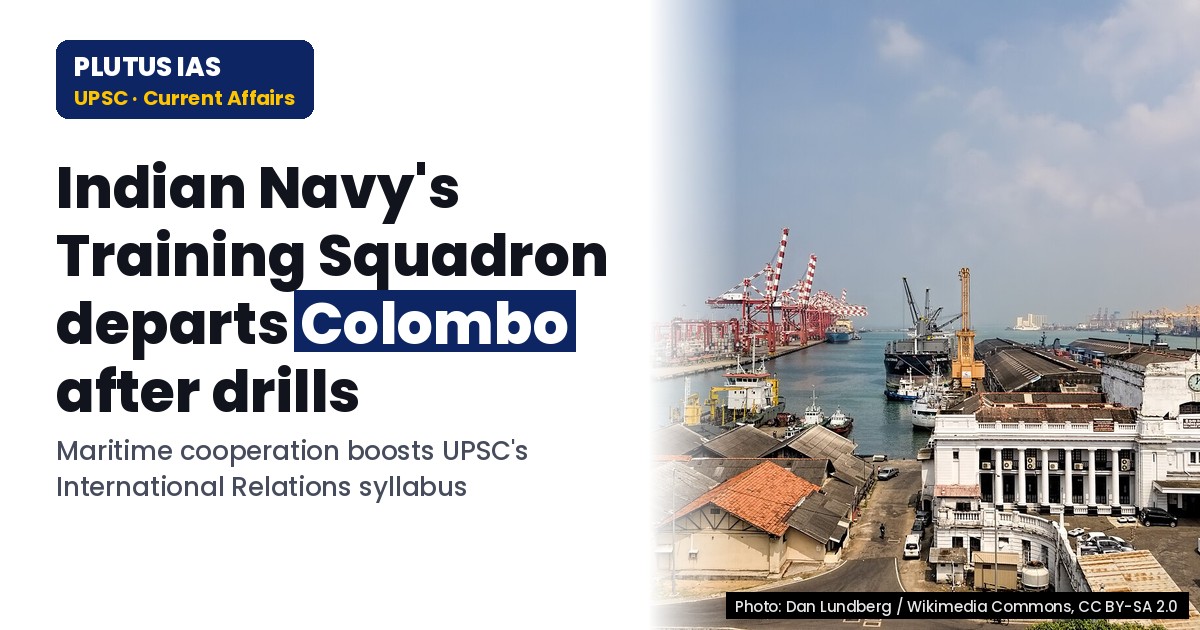
30 Oct Indian Navy’s First Training Squadron Departs Colombo After Joint Exercises
✎ The First Training Squadron of the Indian Navy enhances operational readiness and maritime diplomacy through long-duration deployments, including port visits and joint exercises in the Indian Ocean Region.
Subject Relevance — Where This Topic Fits
- GS Paper II — International Relations — India and its Neighbourhood: Relations with Sri Lanka | GS Paper III — Security — Role of Armed Forces in Diplomacy and Capacity Building | GS Paper III — Security — Maritime Security and Blue Economy
- Prelims: Training Squadron, First Training Squadron, Indian Navy operational deployments, Indian Ocean Region (IOR), Sri Lanka strategic partnerships, Blue Economy, Maritime security, INS Vikrant, INS Vikramaditya
- Essay: India’s Strategic Role in the Indian Ocean Region: Challenges and Opportunities, Maritime Security: A Pillar of National Power and Economic Development
Quick Revision: The First Training Squadron of the Indian Navy enhances operational readiness and maritime diplomacy through long-duration deployments, including port visits and joint exercises in the Indian Ocean Region.
Why is this in the news?
The departure of the First Training Squadron of the Indian Navy from Colombo, Sri Lanka, marks a significant operational milestone in India’s maritime diplomacy and capacity-building initiatives. This deployment underscores the Indian Navy’s expanding role in fostering regional stability, enhancing operational readiness, and strengthening strategic partnerships in the Indian Ocean Region (IOR), particularly with littoral states.
Background
- The Indian Navy’s Training Squadron is a dedicated fleet tasked with providing operational training to midshipmen and cadets, ensuring sustained readiness and operational competence.
- Sri Lanka occupies a critical geostrategic position in the Indian Ocean, making it a key partner for India in maritime security and regional stability.
- India’s ‘Neighbourhood First’ policy and ‘SAGAR’ (Security and Growth for All in the Region) doctrine prioritise collaborative maritime engagement with Indian Ocean littoral states.
- The Indian Navy has progressively enhanced its operational footprint in the IOR through joint exercises, training deployments, and capacity-building initiatives.
- Maritime security threats, including piracy, illegal fishing, and transnational crime, necessitate sustained naval presence and cooperative frameworks in the region.
What is the First Training Squadron of the Indian Navy?
- The First Training Squadron is a dedicated operational unit of the Indian Navy tasked with providing sea training to midshipmen, cadets, and junior officers, ensuring their preparedness for frontline duties.
- It typically comprises a mix of training ships and operational vessels, including destroyers and frigates.
- The squadron conducts long-duration deployments, including port visits, joint exercises, and training cruises, to enhance operational exposure and interoperability.
- Training missions are designed to simulate real-world operational scenarios, including navigation, damage control, and tactical manoeuvres.
- The deployment to Sri Lanka aligns with the Indian Navy’s broader strategy of ‘Maritime Diplomacy’ and ‘Capacity Building’ in the Indian Ocean Region.
- Such deployments foster goodwill, strengthen bilateral ties, and provide opportunities for joint training with partner navies.
- The Indian Navy’s training fleet plays a pivotal role in nurturing naval leadership and operational excellence, contributing to India’s maritime security architecture.
Key Features
| Feature | Significance |
|---|---|
| First Training Squadron of the Indian Navy | Demonstrates operational readiness and capability of the Indian Navy in maritime training and regional cooperation. |
| Deployment to Colombo, Sri Lanka | Highlights India’s strategic engagement in the Indian Ocean Region (IOR) under the ‘Neighbourhood First’ and ‘SAGAR’ initiatives. |
| Training Squadron Composition | Indicates the integration of diverse naval assets (ships, submarines, aircraft) for joint training and interoperability. |
| Diplomatic Engagement | Reinforces maritime diplomacy and confidence-building measures with littoral states in the IOR. |
| Operational Flexibility | Showcases the Indian Navy’s ability to project power and conduct multi-domain operations in distant waters. |
Why it Matters
Strategic Significance
- Enhances India’s maritime security posture in the Indian Ocean Region (IOR) by fostering partnerships with littoral states.
- Demonstrates the Indian Navy’s operational reach and capability to conduct training missions beyond territorial waters.
- Supports India’s ‘SAGAR’ (Security and Growth for All in the Region) doctrine, emphasizing collective security and sustainable development.
- Strengthens maritime domain awareness and counter-piracy operations in the IOR through collaborative training.
Operational Significance
- Validates the readiness of the Indian Navy’s training infrastructure, including ships, submarines, and aircraft, for extended deployments.
- Facilitates joint exercises with foreign navies, improving interoperability and standard operating procedures.
- Provides real-world training scenarios for naval personnel, enhancing tactical and strategic decision-making skills.
- Serves as a platform for testing new doctrines, technologies, and logistics support in distant operational environments.
Diplomatic Significance
- Reinforces India’s commitment to regional stability and maritime security through proactive engagement with neighbouring countries.
- Acts as a confidence-building measure, reducing geopolitical tensions and fostering trust among IOR nations.
- Supports India’s ‘Neighbourhood First’ policy by prioritizing cooperation with Sri Lanka and other littoral states.
- Enhances India’s soft power in the IOR by showcasing its naval prowess and commitment to shared security challenges.
Economic Significance
- Promotes maritime trade and connectivity by ensuring safe and secure sea lanes in the IOR.
- Supports the blue economy by protecting critical maritime resources and infrastructure from non-traditional threats.
- Encourages foreign investment in India’s maritime sector through enhanced operational capabilities and regional partnerships.
Challenges
1. Logistical Challenges in Extended Deployments
- Sustaining operational readiness and crew welfare during prolonged deployments in distant waters.
- Ensuring seamless logistics support, including fuel, provisions, and maintenance, for training missions.
- Managing crew fatigue and rotation schedules to maintain high operational standards over extended periods.
UPSC Link: GS Paper 3: Infrastructure – Logistics
2. Geopolitical Sensitivity in the Indian Ocean Region
- Navigating complex geopolitical dynamics involving major powers and regional stakeholders in the IOR.
- Balancing strategic partnerships with littoral states while avoiding perceptions of hegemony or unilateralism.
- Addressing maritime boundary disputes and ensuring non-interference in the internal affairs of neighbouring countries.
UPSC Link: GS Paper 2: International Relations – IOR
3. Technological and Doctrinal Adaptation
- Integrating advanced technologies (e.g., AI, unmanned systems) into traditional naval training and operations.
- Updating doctrines to address emerging threats such as cyber warfare, hybrid threats, and climate change impacts.
- Ensuring interoperability with foreign navies while maintaining operational security and sovereignty.
UPSC Link: GS Paper 3: Science & Technology – Defence
4. Environmental and Sustainability Concerns
- Minimizing the ecological footprint of naval operations, including fuel consumption and waste management.
- Adapting to climate change impacts such as rising sea levels, extreme weather events, and ocean acidification.
- Promoting sustainable practices in maritime training and exercises to align with global environmental standards.
UPSC Link: GS Paper 3: Environment – Climate Change
5. Human Resource Development
- Ensuring a steady pipeline of skilled naval personnel to meet operational demands and technological advancements.
- Providing continuous professional development and specialized training to enhance crew competencies.
- Addressing recruitment and retention challenges in a competitive job market for skilled maritime professionals.
UPSC Link: GS Paper 3: Human Resource Development
Challenges — UPSC Perspective
| Issue | Concern |
|---|---|
| Extended Deployments | Sustaining crew welfare and operational readiness over long periods. |
| Geopolitical Dynamics | Balancing strategic partnerships while avoiding regional tensions. |
| Technological Integration | Adapting doctrines and training to incorporate emerging technologies. |
| Environmental Impact | Minimizing ecological footprint of naval operations. |
| Human Resource Management | Ensuring a skilled workforce to meet operational demands. |
| Logistics Support | Maintaining seamless supply chains for fuel, provisions, and maintenance. |
Way Forward
- Enhance bilateral and multilateral naval exercises with IOR countries to improve interoperability and regional security.
- Invest in advanced training simulators and virtual reality tools to modernize naval training methodologies.
- Develop a robust logistics support framework for extended deployments, including pre-positioned supply hubs.
- Promote research and development in maritime technologies, such as unmanned systems and AI-driven decision-making tools.
- Strengthen maritime domain awareness through satellite surveillance, AI-based threat detection, and data-sharing mechanisms.
- Establish a dedicated training program for naval personnel focused on climate resilience and sustainable operations.
- Foster public-private partnerships to support the blue economy and maritime infrastructure development.
- Conduct regular reviews of naval doctrines to incorporate lessons learned from operational deployments and emerging threats.
UPSC Value Addition
Keywords for Mains Answer-Writing
Indian Navy · First Training Squadron · Colombo · Sri Lanka · Naval diplomacy · Indo-Pacific strategy · Maritime security cooperation · Regional maritime partnerships · Blue Economy · Capacity building · Naval training exercises · International maritime law · UNCLOS · SAGAR initiative · Maritime domain awareness · Defence diplomacy
Concept Flow
Indian Navy’s operational readiness → Deployment of First Training Squadron to Colombo → Maritime diplomacy under ‘SAGAR’ doctrine → Enhanced regional security and interoperability → Strengthened blue economy and trade routes → Sustainable development in the Indian Ocean Region.
Prelims Practice Questions
Q1. Consider the following statements about the First Training Squadron of the Indian Navy:
1. It is a dedicated unit for training midshipmen of the Indian Navy.
2. The squadron recently concluded a port call at Colombo, Sri Lanka.
3. The deployment is part of India’s ‘Act East Policy’ to enhance maritime security in the Indian Ocean Region.
How many of the above statements are correct?
- Only one
- Only two
- All three
- None
Answer: All three — Statements 1 and 2 are correct. Statement 3 is partially correct but the ‘Act East Policy’ is a broader foreign policy framework; the deployment aligns with India’s maritime security and diplomatic engagements in the Indian Ocean Region.
Q2. Assertion (A): The Indian Navy’s First Training Squadron operates under the Western Naval Command.
Reason (R): The Western Naval Command is headquartered in Mumbai and oversees naval operations in the Arabian Sea and the western Indian Ocean.
In the context of the above two statements, which one of the following is correct?
- Both A and R are true, and R is the correct explanation of A
- Both A and R are true, but R is not the correct explanation of A
- A is true, but R is false
- A is false, but R is true
Answer: Both A and R are true, but R is not the correct explanation of A — Both the Assertion and Reason are true. The First Training Squadron is indeed part of the Western Naval Command, which is headquartered in Mumbai and responsible for naval operations in the Arabian Sea and western Indian Ocean.
Q3. Match the following naval exercises with their respective regions:
Column I (Naval Exercise) Column II (Region)
A. MILAN 1. Indian Ocean Region
B. IBSAMAR 2. Bay of Bengal
C. SIMBEX 3. Andaman Sea
D. AUSINDEX 4. South China Sea
Select the correct match using the codes below:
- A-1, B-2, C-3, D-4
- A-2, B-1, C-4, D-3
- A-1, B-3, C-2, D-4
- A-4, B-2, C-1, D-3
Answer: A-1, B-2, C-3, D-4 — Correct matches: A (MILAN) – 1 (Indian Ocean Region), B (IBSAMAR) – 2 (Bay of Bengal), C (SIMBEX) – 4 (South China Sea), D (AUSINDEX) – 3 (Andaman Sea).
Mains Practice Question
✍ The deployment of the First Training Squadron of the Indian Navy to Colombo, Sri Lanka, underscores the evolving role of naval diplomacy in India’s foreign policy. Critically examine the significance of such deployments in the context of India’s maritime security strategy and regional partnerships in the Indian Ocean Region. (15 Marks)
Approach: MODEL-ANSWER SKELETON:
1. **Introduction**: Define naval diplomacy and its role in contemporary foreign policy. Briefly introduce the First Training Squadron and its objectives.
2. **Significance of Naval Diplomacy**:
– **Maritime Security**: Highlight India’s ‘SAGAR’ (Security and Growth for All in the Region) initiative and its alignment with UNCLOS for ensuring freedom of navigation and overflight.
– **Regional Partnerships**: Discuss India’s engagement with littoral states in the Indian Ocean Region (IOR) through joint exercises (e.g., MILAN, IBSAMAR), port calls, and capacity-building initiatives.
– **Capacity Building**: Emphasise the role of training squadrons in enhancing interoperability and professional exchanges with partner navies.
3. **Strategic Dimensions**:
– **Indo-Pacific Strategy**: Link naval diplomacy to India’s broader Indo-Pacific strategy, including partnerships with QUAD, ASEAN, and Indian Ocean Rim Association (IORA) member states.
– **Counter-Piracy and HADR**: Discuss the squadron’s role in counter-piracy operations (e.g., Gulf of Aden) and Humanitarian Assistance and Disaster Relief (HADR) missions.
4. **Challenges and Constraints**:
– **Geopolitical Rivalries**: Address the impact of great-power competition (e.g., China’s presence in the IOR) on India’s naval diplomacy.
– **Logistical and Operational Constraints**: Highlight challenges such as basing rights, fueling stops, and maintenance in foreign ports.
5. **Conclusion**: Summarise the importance of naval diplomacy in projecting soft power, ensuring regional stability, and advancing India’s strategic interests. Provide a balanced view, acknowledging both opportunities and limitations.
Key terms to include: UNCLOS, SAGAR, Indo-Pacific, QUAD, IORA, HADR, maritime domain awareness.
Source: PIB (Press Information Bureau)
Generated by AanyaAi for educational purpose.

- Indian Navy’s First Training Squadron Departs Colombo After Joint Exercises - October 30, 2026
- ISRO का GSLV-F18 मिशन: NVS-03 नेविगेशन सैटेलाइट का प्रक्षेपण आज रात - October 30, 2026
- Jaishankar Attends G20 Atlanta Meet: Key Agenda for UPSC & State PCS - October 30, 2026

No Comments