


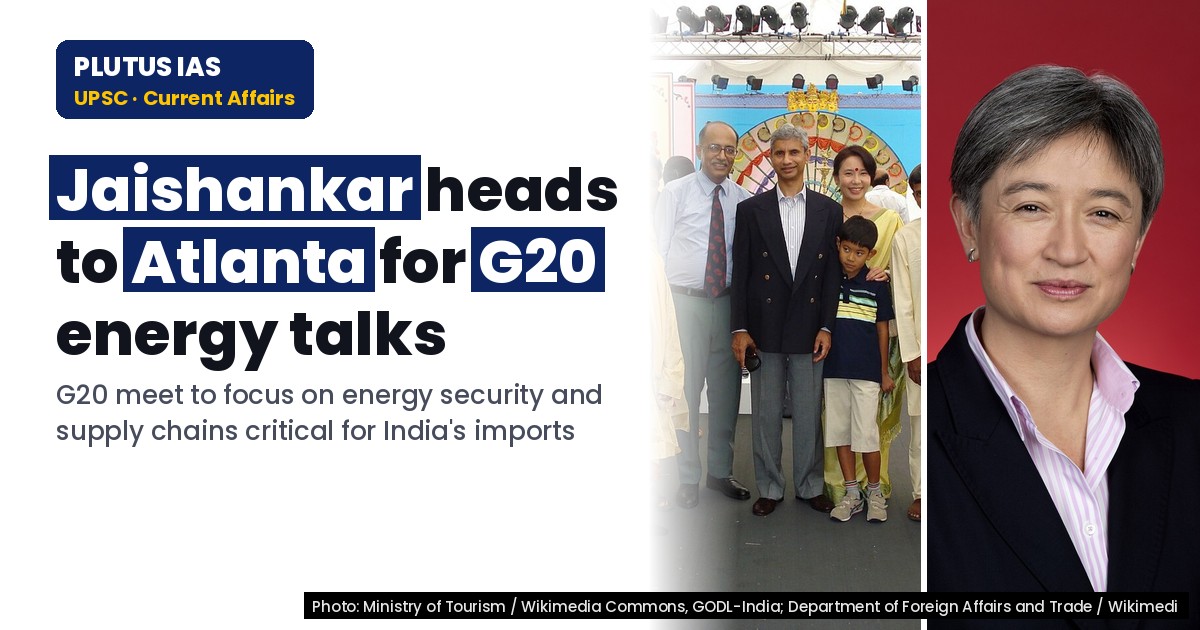
30 Oct Jaishankar Attends G20 Atlanta Meet: Key Agenda for UPSC & State PCS
✎ The G20 Atlanta Ministerial underscores India’s strategic focus on energy security, supply chain resilience, and maritime route stability—three pillars critical to sustaining economic growth and mitigating geopolitical risks.
Subject Relevance — Where This Topic Fits
- GS Paper II — International Relations | GS Paper III — Economy
- Prelims: G20, Quadrilateral Security Dialogue (Quad), Energy Security, Critical Mineral Supply Chains, Freedom of Navigation, Strait of Hormuz, LNG imports, Fertiliser imports
- Essay: Geopolitics and Economic Sovereignty: Navigating Supply Chain Disruptions, Multilateralism in an Era of Fragmented Global Trade
Quick Revision: The G20 Atlanta Ministerial underscores India’s strategic focus on energy security, supply chain resilience, and maritime route stability—three pillars critical to sustaining economic growth and mitigating geopolitical risks.
Why is this in the news?
External Affairs Minister S. Jaishankar’s participation in the G20 Foreign Ministers’ Meeting in Atlanta (October 30–31, 2026) assumes significance amid heightened global concerns over energy security, supply chain resilience, and the security of maritime trade routes. The meeting, hosted by the United States, focuses on critical issues such as the stability of sea lanes, affordable energy access, and the uninterrupted flow of essential commodities like oil, LNG, and fertilisers—key vulnerabilities for India’s import-dependent economy. The Quad foreign ministers’ meeting on the sidelines further underscores the geopolitical alignment of like-minded democracies on these challenges.
Background
- India is the world’s third-largest oil importer, with over 80% of its crude oil and nearly 50% of its LNG requirements sourced internationally, making energy security a cornerstone of its economic policy.
- The Strait of Hormuz, a critical chokepoint for global oil transit, has witnessed repeated disruptions due to geopolitical tensions in West Asia, directly impacting India’s energy imports and price stability.
- Supply chain disruptions, exacerbated by the COVID-19 pandemic and geopolitical rivalries, have highlighted the fragility of global trade networks, particularly for critical minerals and fertilisers essential for agriculture and manufacturing.
- The Quad (India, US, Japan, Australia) has emerged as a platform for addressing shared concerns over maritime security, technological resilience, and supply chain diversification in the Indo-Pacific.
- The G20, representing 80% of global GDP, serves as a key forum for coordinating responses to systemic economic challenges, including energy transitions and trade facilitation.
What is the G20 Foreign Ministers’ Meeting in Atlanta?
- The G20 Foreign Ministers’ Meeting is a high-level diplomatic forum where member states discuss global economic governance, geopolitical stability, and collective responses to shared challenges.
- The Atlanta meeting (October 30–31, 2026) focuses on three critical themes: (1) energy security, (2) resilience of supply chains, and (3) the security of maritime trade routes, particularly in the context of rising geopolitical tensions.
- Energy security is framed as ‘foundational for economic growth,’ with emphasis on ensuring ‘affordable and abundant’ access to resources, including oil, LNG, and critical minerals required for advanced manufacturing and emerging technologies.
- Supply chain resilience is addressed through discussions on diversifying sources of critical minerals, fertilisers, and industrial raw materials, reducing dependency on single regions or suppliers.
- Maritime security is a recurring theme, with the US and allies advocating for the principle of ‘freedom of navigation’ and opposing unlawful fees or tolls that could disrupt global commerce.
- The meeting includes participation from major economies, including India, the US, China (represented by Executive Vice Foreign Minister Ma Zhaoxu), Russia, Japan, Australia, and the EU, reflecting the G20’s inclusive yet competitive diplomatic landscape.
- Parallel engagements, such as the Quad foreign ministers’ meeting, highlight the alignment of democratic nations on issues of mutual concern, including technological collaboration and supply chain security.
- The inclusion of Poland as a potential full G20 member underscores the forum’s evolving composition and the recognition of emerging economies with significant global economic influence.
Key Features
| Feature | Significance |
|---|---|
| G20 Ministerial Meeting in Atlanta (2026) | A high-level forum for 20 major economies to coordinate on global economic governance, energy security, and supply chain resilience. |
| Focus on Sea Lanes and Freedom of Navigation | Critical for uninterrupted trade flows, particularly for energy imports (oil, LNG) and exports (manufactured goods, fertilizers). |
| Energy Security Discussions | Addresses vulnerabilities in global energy markets, including disruptions in West Asia and the Strait of Hormuz. |
| Quad Foreign Ministers’ Meeting | A strategic dialogue among India, US, Japan, and Australia to enhance regional security and economic cooperation. |
| ‘No Fees/No Tolls’ Pledge | A collective stance against unlawful levies on maritime trade, ensuring cost-effective and predictable shipping routes. |
Why it Matters
Economic Security
- India’s energy imports (oil, LNG, fertilizers) are highly dependent on stable sea lanes, particularly the Strait of Hormuz and the South China Sea.
- Disruptions in energy supply chains can trigger inflation, industrial slowdowns, and fiscal strain, necessitating proactive diplomatic engagement.
- Ensuring affordable and abundant energy access is vital for sustaining economic growth and technological adoption (e.g., superintelligence, advanced manufacturing).
Geopolitical Dynamics
- The inclusion of Poland as a potential G20 member reflects evolving global economic power structures and the need for inclusive multilateralism.
- Divergent attendance (e.g., Russia’s Lavrov vs. China’s Vice Minister) highlights geopolitical fragmentation and the challenge of consensus-building in global governance.
- The Quad’s role underscores the strategic alignment of like-minded nations to counterbalance regional and global uncertainties.
Supply Chain Resilience
- Critical minerals, fertilizers, and LNG supply chains are essential for both energy security and advanced manufacturing sectors.
- Geopolitical tensions (e.g., West Asia conflicts) can disrupt these chains, necessitating diversification and contingency planning.
- Multilateral cooperation is required to mitigate risks such as trade barriers, sanctions, and infrastructure bottlenecks.
Maritime Governance
- Freedom of navigation is a cornerstone of global trade, with 90% of international trade transported via sea routes.
- Unlawful fees or tolls on sea lanes can distort trade costs, undermine sovereignty, and set dangerous precedents for maritime law.
- India’s active participation in such pledges aligns with its maritime security interests and its role as a net security provider in the Indian Ocean Region.
Challenges
1. Energy Import Dependence
- India imports ~85% of its oil and ~55% of its natural gas, making it highly vulnerable to supply disruptions and price volatility.
- Geopolitical conflicts in West Asia (e.g., Strait of Hormuz) can trigger supply chain shocks, impacting inflation and industrial output.
- Limited domestic refining capacity and storage infrastructure exacerbates vulnerability to external shocks.
UPSC Link: GS III: Energy Security
2. Supply Chain Vulnerabilities
- Critical minerals (e.g., lithium, cobalt) are essential for renewable energy and electronics but are concentrated in a few geographies (e.g., China, DRC).
- Disruptions in fertilizer supply chains (e.g., urea, potash) can threaten food security and agricultural productivity.
- Over-reliance on single-source suppliers for raw materials increases exposure to geopolitical risks and trade restrictions.
UPSC Link: GS III: Supply Chain Resilience
3. Maritime Security Threats
- Piracy, maritime terrorism, and state-sponsored disruptions (e.g., blockades) pose direct threats to global trade flows.
- Climate change-induced extreme weather events (e.g., cyclones, rising sea levels) can damage port infrastructure and disrupt shipping schedules.
- Regulatory fragmentation across jurisdictions complicates enforcement of maritime security norms.
UPSC Link: GS III: Maritime Security
4. Multilateral Consensus-Building
- Divergent national interests (e.g., US vs. Russia/China) hinder the formulation of unified global policies on energy and trade.
- Geopolitical rivalries (e.g., US-China tensions) can spill over into economic forums, complicating negotiations.
- Balancing sovereignty concerns with multilateral commitments remains a persistent challenge for emerging economies.
UPSC Link: GS II: International Organisations
5. Technological and Infrastructure Gaps
- Inadequate port infrastructure and logistics inefficiencies increase transit times and costs for Indian exporters.
- Limited domestic capacity in critical mineral processing and semiconductor manufacturing creates dependencies on foreign supply chains.
- Slow adoption of green shipping technologies (e.g., alternative fuels, carbon-neutral vessels) risks falling behind global standards.
UPSC Link: GS III: Infrastructure and Technology
Challenges — UPSC Perspective
| Issue | Concern |
|---|---|
| Oil Import Dependence | Vulnerability to geopolitical shocks and price volatility in global oil markets. |
| Critical Mineral Shortages | Over-reliance on a few suppliers for minerals essential to renewable energy and high-tech industries. |
| Fertilizer Supply Chain Disruptions | Risk to agricultural productivity and food security due to import dependencies. |
| Maritime Chokepoints | Exposure to disruptions in critical sea lanes (e.g., Strait of Hormuz, Malacca Strait). |
| Regulatory Fragmentation | Inconsistent maritime and trade regulations across jurisdictions complicating global commerce. |
| Climate-Induced Disruptions | Increased frequency of extreme weather events threatening port operations and shipping schedules. |
Way Forward
- Strengthen strategic petroleum reserves to buffer against short-term supply disruptions and price shocks.
- Diversify energy import sources by expanding partnerships with non-West Asian suppliers (e.g., Russia, Africa, Latin America).
- Invest in domestic refining and storage infrastructure to reduce import dependence and enhance energy security.
- Develop a national critical minerals strategy to secure supply chains for renewable energy and advanced manufacturing.
- Enhance maritime domain awareness through technology (e.g., satellite monitoring, AI-driven threat detection) and international collaborations.
- Promote public-private partnerships to modernize port infrastructure and reduce logistics costs.
- Advocate for multilateral frameworks that ensure freedom of navigation and prohibit unlawful fees on sea lanes.
- Accelerate adoption of green shipping technologies to align with global decarbonization goals and reduce long-term costs.
UPSC Value Addition
Keywords for Mains Answer-Writing
G20 Foreign Ministers’ Meeting Atlanta 2026 · Global energy security · Maritime supply chain resilience · Freedom of navigation in international law · Quadrilateral Security Dialogue (Quad) · Critical minerals and energy transition · Geopolitical disruptions and economic security · India’s energy import dependence · United Nations Convention on the Law of the Sea (UNCLOS) · Multilateral diplomacy and economic blocs · Supply chain diversification strategies · Geoeconomic alliances and strategic autonomy
Concept Flow
Geopolitical tensions in West Asia → Disruptions in Strait of Hormuz → Supply chain shocks for oil/LNG imports → Inflation and industrial slowdowns → Need for multilateral energy security frameworks → G20 and Quad engagements to coordinate responses → Policy measures for diversification and resilience → Long-term energy and economic security
Prelims Practice Questions
Q1. Consider the following statements regarding the Quadrilateral Security Dialogue (Quad):
1. It is a strategic forum comprising India, the United States, Japan, and Australia.
2. The Quad was formally established in 2017 with the signing of a joint strategic vision document.
3. One of the primary objectives of the Quad is to ensure freedom of navigation and maritime security in the Indo-Pacific region.
4. The Quad has been explicitly acknowledged as a military alliance by all member states.
How many of the above statements are correct?
- Only one
- Only two
- Only three
- All
Answer: Only three — Statements 1 and 3 are correct. Statement 2 is incorrect as the Quad was not formally established in 2017 but evolved through informal meetings starting in 2007. Statement 4 is incorrect as the Quad is not a military alliance but a strategic partnership.
Q2. Assertion (A): The United Nations Convention on the Law of the Sea (UNCLOS) provides the legal framework for the freedom of navigation and overflight in the exclusive economic zones (EEZs) of coastal states.
Reason (R): Under UNCLOS, coastal states have the right to regulate, authorize, and conduct marine scientific research in their EEZs, but not to impede the freedom of navigation.
Options:
A. Both A and R are true, and R is the correct explanation of A.
B. Both A and R are true, but R is not the correct explanation of A.
C. A is true, but R is false.
D. A is false, but R is true.
Answer: ? — Assertion (A) is true as UNCLOS does provide the legal framework for freedom of navigation in EEZs. Reason (R) is also true but does not correctly explain (A) because the regulation of marine scientific research is a separate provision under UNCLOS and does not directly relate to the freedom of navigation.
Q3. Match the following international maritime zones with their respective legal definitions under the United Nations Convention on the Law of the Sea (UNCLOS):
Column I (Maritime Zone)
1. Territorial Sea
2. Contiguous Zone
3. Exclusive Economic Zone (EEZ)
4. Continental Shelf
Column II (Legal Definition)
A. Extends up to 200 nautical miles from the baseline; coastal state has sovereign rights for resource exploitation.
B. Extends up to 12 nautical miles from the baseline; coastal state exercises full sovereignty.
C. Extends up to 24 nautical miles from the baseline; coastal state may enforce customs, fiscal, immigration, and sanitary laws.
D. Extends up to 350 nautical miles from the baseline or to the outer edge of the continental margin; coastal state has sovereign rights for resource exploitation.
Options:
A. 1-B, 2-C, 3-A, 4-D
B. 1-C, 2-B, 3-A, 4-D
C. 1-B, 2-A, 3-C, 4-D
D. 1-A, 2-B, 3-C, 4-D
Answer: ? — The correct match is: 1-B (Territorial Sea), 2-C (Contiguous Zone), 3-A (Exclusive Economic Zone), and 4-D (Continental Shelf).
Mains Practice Question
✍ The recent G20 Foreign Ministers’ Meeting in Atlanta highlighted the criticality of maritime supply chains, energy security, and freedom of navigation for global economic stability. In this context, critically examine the role of multilateral forums like the G20 and the Quad in addressing these geoeconomic challenges. Also, discuss the implications of geopolitical disruptions in critical maritime chokepoints for India’s energy and food security. (15 Marks)
Approach: MODEL-ANSWER SKELETON:
1. **Introduction (2 Marks)**: Define geoeconomic challenges—supply chain resilience, energy security, and freedom of navigation—framed as existential for global trade and India’s developmental imperatives.
2. **Role of Multilateral Forums (6 Marks)**:
– **G20**: Explain its mandate as an economic coordination platform; highlight its focus on supply chain diversification, critical minerals, and energy transition under the 2026 Atlanta agenda. Cite India’s leadership in advocating for inclusive energy access and maritime security.
– **Quadrilateral Security Dialogue (Quad)**: Analyse its strategic role in ensuring freedom of navigation, maritime domain awareness, and infrastructure development in the Indo-Pacific. Reference the Quad’s 2021-2026 evolution from a dialogue to a functional partnership.
3. **Geopolitical Disruptions and Implications (5 Marks)**:
– Identify key chokepoints: Strait of Hormuz, Bab-el-Mandeb, Malacca Strait.
– Discuss India’s import dependence: crude oil (85%), LNG (50%), and fertiliser imports.
– Analyse the impact of disruptions: price volatility, supply chain bottlenecks, and inflationary pressures.
– Highlight India’s policy responses: strategic petroleum reserves, diversification of supply sources (e.g., Russia, UAE, USA), and bilateral agreements (e.g., IMEC).
4. **Conclusion (2 Marks)**: Weigh the efficacy of multilateralism in addressing geoeconomic challenges; argue for a balanced approach combining diplomacy, strategic autonomy, and domestic resilience-building.
Source: orissapost.com
Generated by AanyaAi for educational purpose.
Related guides on our sites
- Best PSIR optional coaching for upsc
- Best PSIR optional teacher for upsc
- Best teacher of PSIR optional for upsc
- Best PSIR optional coaching in delhi for UPSC

- Jaishankar Attends G20 Atlanta Meet: Key Agenda for UPSC & State PCS - October 30, 2026
- विशेष अभियान 6.0: वस्त्र समिति की उपलब्धियाँ और संस्थागत सुधार - October 30, 2026
- Supreme Court Directs Parties to Submit Documents in Dhar Bhojshala Case - October 30, 2026

No Comments