


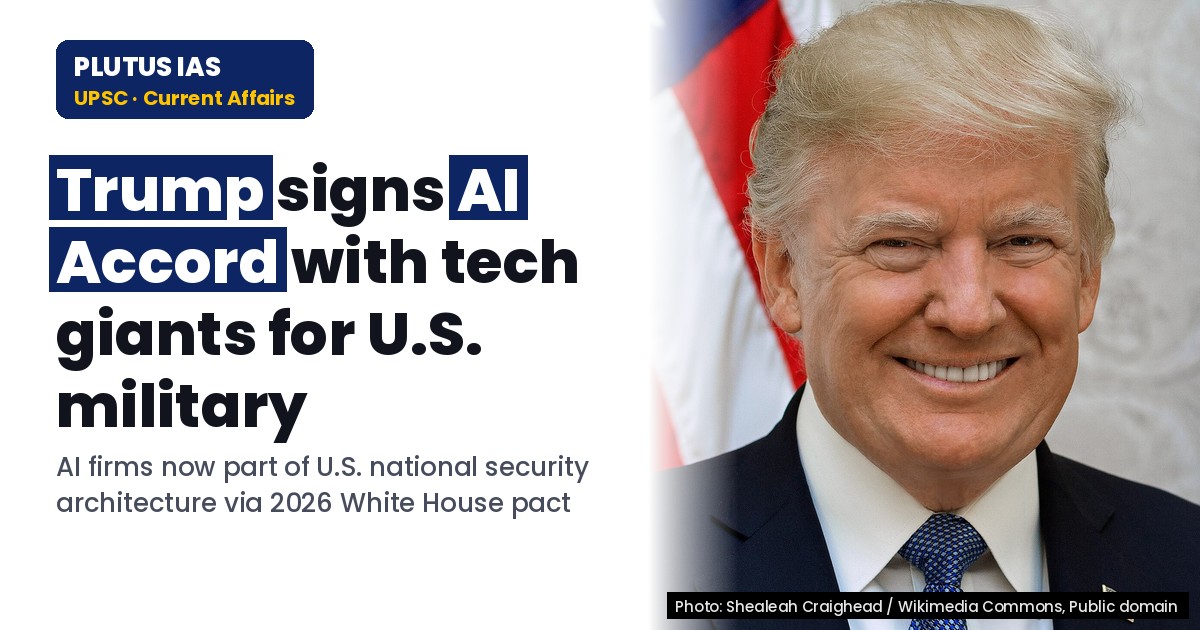
31 Oct AI Revolution in U.S. Military Industrial Complex: UPSC & PCS Insights
✎ AI’s integration into the Military Industrial Complex transforms warfare from hardware-centric to software-defined, necessitating governance frameworks that balance innovation, security, and ethical compliance.
Subject Relevance — Where This Topic Fits
- GS Paper II — International Relations (Global Strategic Trends, Defence Technology Transfers) | GS Paper III — Science and Technology (Emerging Technologies, Defence Manufacturing) | GS Paper III — Economy (Defence Industrial Base, Public Procurement)
- Prelims: Military-Industrial Complex, Artificial Intelligence (AI), Defence Procurement, National Security Architecture, Software-Defined Warfare, Defence Technology Transfer, AI Ethics in Governance
- Essay: The Role of Emerging Technologies in Shaping National Security Paradigms, Ethical Governance in the Age of AI-Driven Defence Systems
Quick Revision: AI’s integration into the Military Industrial Complex transforms warfare from hardware-centric to software-defined, necessitating governance frameworks that balance innovation, security, and ethical compliance.
Why is this in the news?
The report highlights the structural transformation of the U.S. Military Industrial Complex (MIC) from hardware-centric production to software and AI-driven capabilities, formalised through the White House Accord on Super Intelligence (2026). This shift underscores the integration of civilian AI firms into classified military networks, reflecting a broader global trend toward algorithmic warfare and the reconfiguration of defence procurement paradigms. The development is significant for UPSC aspirants as it intersects with governance, technology policy, and national security strategy, demanding an understanding of AI’s role in modern defence architectures.
Background
- The concept of the Military Industrial Complex (MIC) was popularised by President Dwight D. Eisenhower in 1961, who warned against the undue influence of the defence industry on public policy. The MIC traditionally comprised defence contractors, government agencies, and legislative bodies collaborating to produce military hardware.
- The advent of digital technologies in the late 20th century introduced software-defined systems in warfare, such as precision-guided munitions and network-centric operations, laying the groundwork for AI integration.
- The U.S. Department of Defense (DoD) has progressively adopted AI for logistics, predictive maintenance, and battlefield decision-making, with initiatives like Project Maven (2017) marking early institutional engagement with AI.
- The White House Accord on Super Intelligence (2026) represents a formal recognition of AI firms as critical nodes in national security infrastructure, aligning civilian technological innovation with military applications.
- Global defence industries are witnessing a shift from capital-intensive hardware production to knowledge-intensive software and AI services, driven by cost-efficiency and rapid deployment cycles.
- The classification of AI systems for military use (e.g., Impact Levels 6 and 7) reflects the sensitivity of operations, necessitating robust governance frameworks to balance innovation with security imperatives.
What is the Role of Artificial Intelligence in the Military Industrial Complex?
- AI integration into the MIC signifies a paradigm shift from mechanical warfare to cognitive and algorithmic warfare, where decision-making is augmented or automated by machine learning models.
- The White House Accord on Super Intelligence (2026) symbolically integrates AI firms—such as SpaceX, OpenAI, Google, Nvidia, and Microsoft—into the U.S. national security architecture, formalising their role in classified military networks.
- Software-defined warfare replaces traditional hardware dominance with algorithmic superiority, enabling real-time data processing, predictive analytics, and autonomous system coordination in combat scenarios.
- The inversion of war economics is evident as AI reduces marginal costs of operations (e.g., drone swarms, cyber operations) while increasing the speed and precision of military engagements, altering the cost-imposition calculus of warfare.
- Defence procurement is restructuring to prioritise software licences, AI model training, and cloud computing infrastructure over physical assets, reflecting the venture-velocity logic of capital in high-tech sectors.
- The architectural revolution in military technology involves the integration of AI into command-and-control systems, electronic warfare, and intelligence, surveillance, and reconnaissance (ISR) platforms, enabling adaptive and resilient defence systems.
- Ethical and governance challenges emerge from the militarisation of civilian AI, necessitating frameworks for accountability, transparency, and compliance with international humanitarian law (e.g., distinction, proportionality, and precaution in AI-driven targeting).
- The global defence industrial base is experiencing a bifurcation between traditional arms manufacturers and AI-centric firms, with implications for technology transfer, export controls, and strategic autonomy in emerging economies.
Key Features
| Feature | Significance |
|---|---|
| Shift from hardware to software-defined warfare | Reduces reliance on physical platforms, enabling rapid upgrades, modularity, and cost-efficiency in military capabilities. |
| Integration of AI firms into national security architecture | Formalises the role of algorithmic firms in defence strategy, blurring boundaries between civilian tech and military applications. |
| Classified network deployments at impact levels 6 and 7 | Enables real-time, high-security AI-driven decision-making for sensitive military operations. |
| Voluntary White House Accord on Super Intelligence | Establishes a symbolic but structured framework for AI governance in national security, prioritising ethical oversight and interoperability. |
| Venture-velocity logic of capital in defence procurement | Accelerates innovation cycles by leveraging private-sector investment and agile development models, reducing bureaucratic delays. |
Why it Matters
Economic Transformation
- Reallocation of defence budgets from traditional manufacturers to AI and data firms, altering global defence industrial supply chains.
- Emergence of a new class of defence contractors—AI-native firms—with higher profit margins and lower capital expenditure compared to legacy defence industries.
- Potential for reduced lifecycle costs of military systems through software updates and predictive maintenance, enhancing operational efficiency.
Strategic and Operational Implications
- Enhanced decision-making speed and precision through AI-driven analytics, reducing human latency in critical operations.
- Improved situational awareness via real-time data fusion from disparate sensors, enabling proactive and adaptive military responses.
- Shift in warfare paradigms from attrition-based to cognitive and information-centric models, where algorithmic superiority becomes a decisive factor.
Geopolitical and Industrial Rebalancing
- Accelerated arms race in AI-driven defence technologies, prompting allied and adversarial nations to prioritise AI integration in their military frameworks.
- Potential for new alliances or blocs centred around AI governance, export controls, and interoperability standards in defence systems.
- Redefinition of technological sovereignty, where access to advanced AI chips and algorithms becomes a critical determinant of military power.
Ethical and Governance Challenges
- Risk of algorithmic bias in military decision-making, particularly in target identification and autonomous weapons systems.
- Accountability gaps in AI-driven operations, necessitating clear legal frameworks for liability and oversight.
- Potential for dual-use technologies to be repurposed for offensive cyber operations or disinformation campaigns.
Challenges
1. Algorithmic Bias and Fairness
- Risk of discrimination in AI-driven targeting, training data biases, and unintended consequences in high-stakes military decisions.
- Lack of universally accepted standards for auditing AI systems in defence applications.
UPSC Link: GS3: Science & Tech
2. Cybersecurity and Resilience
- Vulnerability of AI systems to adversarial attacks, data poisoning, or manipulation in classified networks.
- Dependence on cloud infrastructure increases exposure to cyber espionage and supply-chain attacks.
UPSC Link: GS3: Cybersecurity
3. Accountability and Legal Frameworks
- Ambiguity in assigning responsibility for AI-driven actions, particularly in autonomous systems.
- Need for international treaties or domestic laws to govern the use of AI in warfare, including rules of engagement and escalation protocols.
UPSC Link: GS2: International Relations
4. Dual-Use Technology Governance
- Challenge of regulating AI technologies that have both civilian and military applications without stifling innovation.
- Risk of technology transfer to non-state actors or adversarial states through commercial channels.
UPSC Link: GS3: Science & Tech
5. Interoperability and Standardisation
- Lack of common protocols for AI integration across allied militaries, hindering coalition operations.
- Fragmentation in defence AI ecosystems due to proprietary algorithms and incompatible data formats.
UPSC Link: GS2: International Relations
6. Ethical and Societal Implications
- Public perception and trust deficits in AI-driven military systems, particularly regarding autonomous weapons.
- Potential for erosion of human agency in critical decision-making processes.
UPSC Link: GS4: Ethics
Challenges — UPSC Perspective
| Issue | Concern |
|---|---|
| AI-driven targeting errors | Risk of civilian casualties due to algorithmic misclassification or bias in high-stakes operations. |
| Supply-chain vulnerabilities in AI chips | Dependence on foreign semiconductor supply chains exposes military AI systems to espionage or sabotage. |
| Lack of global AI governance frameworks | Absence of binding international agreements to regulate military AI, leading to unchecked proliferation. |
| Over-reliance on private-sector AI firms | Potential conflicts of interest between profit motives and national security imperatives. |
| Data sovereignty and cross-border data flows | Legal and operational challenges in managing classified data across international cloud infrastructures. |
| Autonomous weapons proliferation | Risk of destabilising global security dynamics through unregulated deployment of lethal autonomous systems. |
Way Forward
- Establish national AI ethics boards with military representation to audit algorithms for bias, fairness, and compliance with international humanitarian law.
- Develop interoperable AI standards and protocols for allied militaries to ensure seamless coalition operations and data sharing.
- Invest in domestic AI chip manufacturing and secure supply chains to reduce dependence on foreign semiconductor technologies.
- Enact domestic legislation to define accountability frameworks for AI-driven military operations, including liability for autonomous systems.
- Promote international dialogues on AI governance in warfare, focusing on transparency, export controls, and conflict de-escalation protocols.
- Enhance cybersecurity protocols for AI systems deployed on classified networks, including zero-trust architectures and adversarial testing.
- Strengthen public-private partnerships to align commercial AI innovation with national security requirements while mitigating dual-use risks.
- Conduct regular stress tests and red-team exercises to evaluate the resilience of AI systems against adversarial attacks and edge-case scenarios.
UPSC Value Addition
Keywords for Mains Answer-Writing
Military Industrial Complex (MIC) · Artificial Intelligence in defence · Software-defined warfare · Defence procurement reforms · National security architecture · AI governance and ethics · Classified military networks · Voluntary regulatory frameworks in defence · Impact of AI on global defence industrial base · Public-private partnership in defence technology
Concept Flow
Technological advancement in AI → Shift in military industrial complex from hardware to software-defined systems → Integration of AI firms into national security architecture → Formalisation via White House Accord on Super Intelligence → Emergence of new governance and ethical challenges → Need for international regulatory frameworks → Rebalancing of global defence industrial base → Long-term transformation of warfare paradigms.
Prelims Practice Questions
Q1. Consider the following statements regarding the Military Industrial Complex (MIC) and its transformation due to AI:
1. The core of the U.S. MIC is shifting from traditional hardware manufacturers to AI and algorithm companies.
2. The White House Accord on Super Intelligence (2026) symbolically integrated AI firms into the national security architecture.
3. The U.S. Department of War agreements with AI companies in May 2026 were limited to unclassified networks for transparency.
4. The Accord is legally binding and mandates compliance from all AI firms globally.
How many of the above statements are correct?
- Only one
- Only two
- Only three
- All
Answer: Only two — Statements 1 and 2 are correct. Statement 3 is incorrect as the agreements involved classified networks at impact levels 6 and 7. Statement 4 is incorrect as the Accord is a voluntary framework and not legally binding.
Q2. Assertion (A): The integration of AI firms into the national security architecture is driven by the need to reduce the cost-imposition of traditional military hardware.
Reason (R): AI-driven systems enable faster decision-making and operational efficiency, reducing the economic burden of large-scale military deployments.
Options:
A. Both A and R are true, and R is the correct explanation of A.
B. Both A and R are true, but R is not the correct explanation of A.
C. A is true, but R is false.
D. A is false, but R is true.
Answer: ? — Both Assertion (A) and Reason (R) are true, and R correctly explains A. The economic logic of cost-imposition is a key driver for the shift towards AI in the MIC.
Q3. Match the following terms related to AI in defence with their correct descriptions:
Column I (Term) Column II (Description)
1. Software-defined warfare A. A voluntary framework integrating AI firms into national security
2. Impact levels 6 and 7 B. Highest classification tiers for sensitive military operations
3. White House Accord on Super Intelligence C. Warfare where software and algorithms define military capabilities
4. Military Industrial Complex (MIC) D. The ecosystem of private and public entities involved in defence production and innovation
Options:
A. 1-A, 2-B, 3-C, 4-D
B. 1-C, 2-B, 3-A, 4-D
C. 1-B, 2-C, 3-A, 4-D
D. 1-D, 2-A, 3-C, 4-B
Answer: ? — Correct matches: 1-C (Software-defined warfare), 2-B (Impact levels 6 and 7), 3-A (White House Accord on Super Intelligence), 4-D (Military Industrial Complex).
Mains Practice Question
✍ The integration of Artificial Intelligence into the Military Industrial Complex (MIC) represents a paradigm shift from hardware-centric to software-centric defence architectures. Critically analyse the implications of this transformation for global defence procurement, national security governance, and the ethical governance of AI in military applications. (15 Marks)
Approach: MODEL-ANSWER SKELETON:
1. **Introduction**: Define the Military Industrial Complex (MIC) and its traditional composition. Introduce the concept of AI-driven transformation in defence, citing the U.S. example (White House Accord on Super Intelligence, 2026) and the shift from hardware to software-defined warfare.
2. **Economic and Procurement Implications**:
– Discuss the inversion of war economics: reduced marginal costs of AI deployment vs. high capital expenditure on traditional hardware.
– Explain the venture-velocity logic of capital: rapid iteration and deployment cycles enabled by AI.
– Analyse how procurement processes are restructuring to accommodate AI-driven solutions (e.g., classified network agreements with AI firms like SpaceX, OpenAI, and Nvidia).
3. **National Security Governance**:
– Examine the integration of AI firms into the national security architecture through voluntary frameworks (e.g., White House Accord).
– Discuss the implications for sovereignty, data security, and the role of private entities in classified military operations.
– Highlight the shift in power dynamics within the MIC, where algorithmic capabilities become as critical as physical assets.
4. **Ethical Governance of AI in Military Applications**:
– Outline the ethical challenges: accountability, transparency, and the risk of autonomous systems in lethal decision-making.
– Reference global debates on AI ethics in defence (e.g., debates on the use of AI in autonomous weapons systems).
– Discuss the role of regulatory frameworks (e.g., voluntary accords vs. binding international treaties).
5. **Global Implications**:
– Analyse the impact on the global defence industrial base: how nations without AI capabilities may face strategic disadvantages.
– Discuss the potential for a new arms race driven by AI superiority.
6. **Conclusion**:
– Summarise the key transformations and their implications.
– Offer a balanced view: while AI enhances efficiency and decision-making, it also introduces new risks and ethical dilemmas.
– Conclude with the need for robust governance mechanisms to balance innovation with accountability.
Source: The Hindu
Generated by AanyaAi for educational purpose.
Related guides on our sites
- Current affairs for upsc 2026
- How to prepare for GS paper 1 for UPSC CSE mains exam
- Best UPSC coaching for IFOS exam
- Best mentorship programme for upsc

- ISRO launches NVS-03 satellite to strengthen India’s NavIC GPS system - October 31, 2026
- हिमाचल की मुख्यमंत्री सहारा योजना: 10 हजार लाभार्थियों को मिलेगी आर्थिक मदद, डीसी करेंगे सत्यापन - October 31, 2026
- Kerala CM Urges Protection of Vembanad Lake’s Ecology for UPSC - October 31, 2026

No Comments