


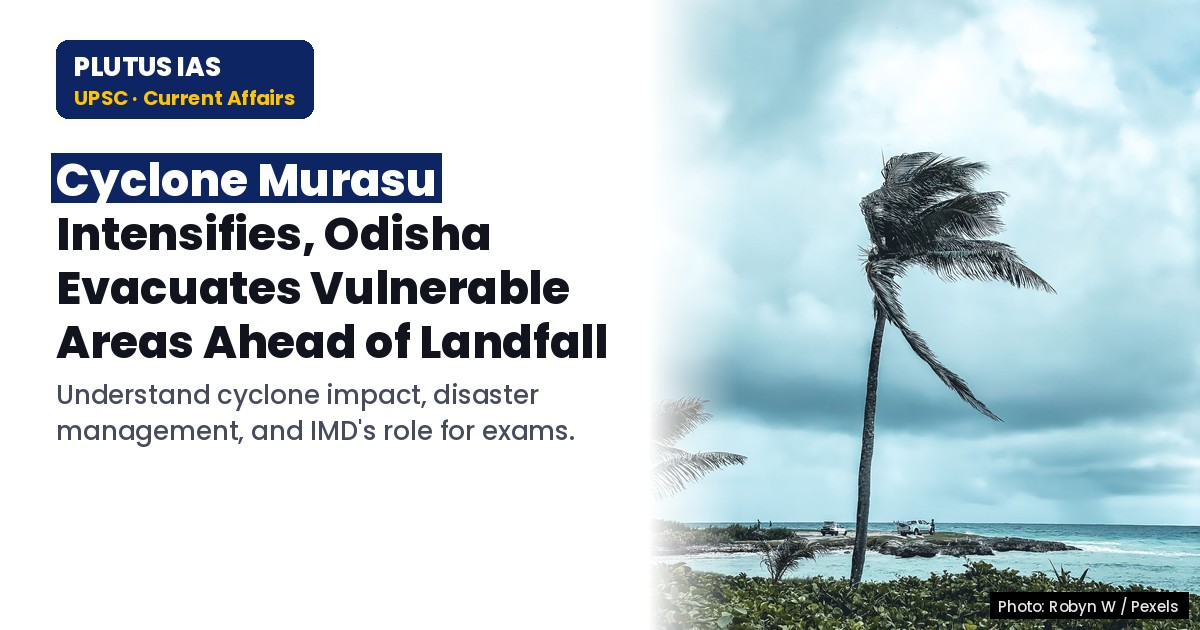
02 Nov Cyclone Murasu: Odisha Evacuation & Bay of Bengal Impact
✎ India's disaster management framework, spearheaded by the IMD and NDMA, emphasizes early warning systems, proactive evacuation, and coordinated response by NDRF and state forces to mitigate the impact of frequent tropical…
Subject Relevance — Where This Topic Fits
- GS Paper I — Geography (Physical Geography, Climatology, Important Geophysical Phenomena) | GS Paper III — Disaster Management (Disaster and Disaster Management)
- Prelims: Tropical Cyclones, Bay of Bengal, India Meteorological Department (IMD), National Disaster Response Force (NDRF), Odisha Disaster Rapid Action Force (ODRAF), Early Warning Systems, Disaster Mitigation, Evacuation Procedures
- Essay: The imperative of robust disaster management strategies in a climate-vulnerable nation., Technological advancements and community participation in enhancing disaster resilience.
Quick Revision: India’s disaster management framework, spearheaded by the IMD and NDMA, emphasizes early warning systems, proactive evacuation, and coordinated response by NDRF and state forces to mitigate the impact of frequent tropical cyclones, particularly along its vulnerable eastern coast.
Why is this in the news?
The Odisha government initiated extensive evacuation procedures and strengthened emergency response mechanisms in anticipation of Cyclone Murasu, which intensified into a severe cyclonic storm in the Bay of Bengal. Although the cyclone was projected to make landfall along the Andhra Pradesh coast, its peripheral impact, including heavy rainfall and strong winds, was expected to affect several southern districts of Odisha, necessitating proactive disaster preparedness measures.
Background
- India’s peninsular geography, particularly its eastern coast along the Bay of Bengal, renders it highly susceptible to tropical cyclones, with a significant number of these storms forming during the pre-monsoon (April-June) and post-monsoon (October-December) seasons.
- The Bay of Bengal is a major basin for cyclogenesis, contributing to a higher frequency and intensity of cyclones affecting coastal states such as Odisha, Andhra Pradesh, West Bengal, and Tamil Nadu.
- Over the past decades, India has significantly enhanced its disaster management capabilities, transitioning from a reactive relief-centric approach to a proactive, holistic strategy encompassing prevention, mitigation, preparedness, response, and recovery.
- The India Meteorological Department (IMD) serves as the nodal agency for forecasting tropical cyclones, providing crucial early warnings and advisories to state governments and disaster management authorities.
- Coastal states, particularly Odisha, have developed robust disaster preparedness frameworks, including dedicated state-level disaster response forces (e.g., ODRAF), community-based early warning systems, and well-rehearsed evacuation protocols.
- The National Disaster Management Authority (NDMA) provides policy guidelines and coordinates disaster management efforts across the country, working in tandem with the National Disaster Response Force (NDRF) for specialized rescue and relief operations.
Tropical Cyclones and Disaster Management in India
- Tropical cyclones are intense low-pressure systems forming over warm tropical oceans, characterized by strong winds, heavy rainfall, and storm surges, posing significant threats to coastal regions.
- The formation of a tropical cyclone requires specific atmospheric and oceanic conditions, including sea surface temperatures above 26.5°C, sufficient Coriolis force, and low vertical wind shear.
- The IMD classifies cyclones based on sustained wind speeds, ranging from ‘Depression’ to ‘Super Cyclonic Storm’, providing a standardized system for communication and response planning.
- Early warning systems, comprising satellite imagery, Doppler weather radars, and numerical weather prediction models, are critical for accurate cyclone forecasting and timely dissemination of information.
- Disaster preparedness involves a multi-pronged approach, including the identification of vulnerable areas, development of cyclone shelters, pre-positioning of rescue teams and equipment, and public awareness campaigns.
- Evacuation is a crucial component of disaster response, involving the systematic relocation of populations from high-risk zones to safer locations, often requiring extensive logistical coordination.
- The National Disaster Response Force (NDRF) is a specialized force equipped for search and rescue operations, providing immediate relief and assistance during and after natural disasters.
- Post-disaster recovery efforts focus on restoring essential services, rebuilding infrastructure, and providing humanitarian aid to affected populations, aiming for long-term resilience.
Key Features
| Feature | Significance |
|---|---|
| Cyclone Murasu | A severe cyclonic storm originating in the Bay of Bengal, necessitating immediate disaster preparedness and response. |
| Landfall Location | Expected between Nellore and Narsapur, close to Ongole, along the southern Andhra Pradesh coast, indicating the primary impact zone. |
| Wind Speed | Forecasted at 100-110 kmph gusting to 120 kmph, signifying potential for significant structural damage and disruption. |
| Impact on Odisha | Despite landfall in Andhra Pradesh, southern districts of Odisha (Ganjam, Gajapati, Rayagada, Koraput, Malkangiri) are expected to experience heavy rainfall and associated effects. |
| Evacuation Priority | The Odisha government’s proactive measure to evacuate residents from vulnerable areas, aiming to minimise human casualties. |
| Pre-positioned Response Teams | Deployment of NDRF, ODRAF, and Odisha Fire Service personnel to facilitate rapid rescue and relief operations. |
Why it Matters
Disaster Management
- Highlights the critical importance of early warning systems and proactive disaster preparedness in coastal regions prone to cyclonic activity.
- Demonstrates the efficacy of inter-state coordination in disaster response, even when the primary impact is in an adjoining state.
- Emphasises the role of dedicated disaster response forces (NDRF, ODRAF) in mitigating the impact of natural calamities through pre-positioning and rapid deployment.
Environmental
- Underscores the vulnerability of coastal ecosystems and human settlements to extreme weather events, which are potentially exacerbated by climate change.
- Illustrates the widespread meteorological influence of severe cyclones, affecting regions beyond their direct landfall point through rainfall and strong winds.
Governance and Administration
- Showcases the administrative machinery’s capacity for rapid decision-making and resource mobilisation during crisis situations.
- Reflects the state’s commitment to public safety through prioritised evacuation and strengthening of emergency response mechanisms.
Challenges
1. Effective Evacuation Logistics
- Ensuring complete evacuation from all vulnerable areas, particularly remote or difficult-to-access locations.
- Managing the logistics of temporary shelters, including sanitation, food, and medical supplies for evacuees.
UPSC Link: Disaster and Disaster Management
2. Inter-State Coordination
- Seamless coordination between Odisha and Andhra Pradesh for information sharing, resource allocation, and joint response efforts.
- Addressing potential cross-border impacts and ensuring a unified approach to relief and rehabilitation.
UPSC Link: Functions and Responsibilities of the Union and the States
3. Infrastructure Resilience
- Protecting critical infrastructure (power lines, communication networks, roads) from severe wind and rain damage.
- Rapid restoration of essential services post-cyclone to minimise disruption to daily life and economic activity.
UPSC Link: Infrastructure: Energy, Ports, Roads, Airports, Railways etc.
4. Post-Disaster Rehabilitation
- Providing timely relief, compensation, and rehabilitation support to affected populations, including housing and livelihood restoration.
- Assessing and addressing long-term impacts on agriculture, fisheries, and local economies.
UPSC Link: Disaster and Disaster Management
5. Public Awareness and Compliance
- Ensuring that all residents, especially in high-risk zones, receive and understand official warnings and evacuation orders.
- Overcoming reluctance or resistance to evacuation due to various socio-economic factors.
UPSC Link: Disaster and Disaster Management
Challenges — UPSC Perspective
| Issue | Concern |
|---|---|
| Forecasting Accuracy | Precision in predicting landfall location and intensity is crucial for targeted preparedness, though inherent uncertainties remain. |
| Resource Mobilisation | Ensuring adequate personnel, equipment, and financial resources are available for both pre-emptive actions and post-disaster response across affected regions. |
| Communication Breakdown | Maintaining robust communication channels during and after the storm to disseminate information and coordinate relief efforts, especially in areas with potential network disruption. |
| Vulnerable Populations | Protecting marginalised communities, the elderly, children, and persons with disabilities, who are disproportionately affected by disasters and require specialised assistance. |
| Climate Change Adaptation | Developing long-term strategies to enhance coastal resilience and adapt to the increasing frequency and intensity of extreme weather events. |
| Psychological Impact | Addressing the mental health and well-being of individuals and communities affected by the trauma and displacement caused by severe cyclones. |
Way Forward
- Strengthen the India Meteorological Department’s (IMD) forecasting capabilities through advanced technology and data analytics for more precise cyclone predictions.
- Invest in resilient infrastructure, including cyclone-resistant housing, robust communication networks, and elevated roads, particularly in coastal vulnerable zones.
- Enhance community-level disaster preparedness through regular drills, awareness campaigns, and training of local volunteers for effective first response.
- Improve inter-state and centre-state coordination mechanisms for seamless resource sharing and joint operational planning during multi-state disaster events.
- Develop comprehensive post-disaster rehabilitation and reconstruction plans, focusing on sustainable livelihoods and psychological support for affected populations.
- Integrate climate change adaptation strategies into urban and rural planning, promoting eco-friendly coastal protection measures like mangrove restoration.
- Utilise satellite imagery and Geographic Information Systems (GIS) for real-time damage assessment and efficient allocation of relief efforts post-cyclone.
UPSC Value Addition
Keywords for Mains Answer-Writing
Cyclone preparedness · Disaster management · Early warning systems · Evacuation protocols · National Disaster Response Force (NDRF) · Odisha Disaster Rapid Action Force (ODRAF) · India Meteorological Department (IMD) · Coastal vulnerability · Climate change impact · Inter-state coordination · Community-based disaster management · Resilience building
Concept Flow
Low-pressure system intensifies in Bay of Bengal → Forms Severe Cyclonic Storm Murasu → IMD issues warnings, forecasts landfall → Odisha Government evacuates vulnerable areas → NDRF, ODRAF teams pre-positioned for response → Cyclone makes landfall, impacts coastal regions
Prelims Practice Questions
Q1. Consider the following statements regarding tropical cyclones in the Bay of Bengal:
1. Tropical cyclones typically form over warm ocean waters with sea surface temperatures above 26.5°C.
2. The India Meteorological Department (IMD) is the nodal agency for cyclone forecasting and warning in India.
3. The ‘eye’ of a cyclone is characterised by strong winds and heavy rainfall.
How many of the above statements are correct?
- Only one
- Only two
- Only three
- None
Answer: Only two — Statement 1 is correct: Tropical cyclones require warm ocean waters for their formation and intensification. Statement 2 is correct: IMD is the designated agency for meteorological services, including cyclone warnings. Statement 3 is incorrect: The ‘eye’ of a cyclone is a relatively calm, clear area with light winds and no precipitation, surrounded by the eyewall which has the strongest winds and heaviest rainfall.
Q2. Which of the following bodies is primarily responsible for coordinating disaster response operations at the national level in India?
- National Disaster Management Authority (NDMA)
- National Institute of Disaster Management (NIDM)
- National Disaster Response Force (NDRF)
- State Disaster Management Authority (SDMA)
Answer: National Disaster Management Authority (NDMA) — The National Disaster Management Authority (NDMA) is the apex body for disaster management in India, responsible for laying down policies, plans, and guidelines for disaster management to ensure timely and effective response. NDRF is a specialised force for disaster rescue and relief operations.
Mains Practice Question
✍ Discuss the multi-pronged approach adopted by coastal states in India for effective cyclone disaster management. Examine the challenges that persist in ensuring comprehensive preparedness and response mechanisms. (15 Marks)
Approach: Introduction: Briefly define cyclone disaster management and its significance for coastal states like Odisha and Andhra Pradesh.
Multi-pronged Approach (Body Part 1):
1. Early Warning Systems: Role of IMD, Doppler Weather Radars, satellite imagery, and dissemination channels (SMS, TV, radio).
2. Evacuation and Shelter Management: Identification of vulnerable areas, pre-positioning of relief materials, cyclone shelters, and evacuation protocols.
3. Disaster Response Forces: Deployment and coordination of NDRF, ODRAF, State Fire Services, and local volunteers.
4. Infrastructure Development: Cyclone-resilient infrastructure, embankments, and mangrove plantations.
5. Community Participation: Awareness campaigns, mock drills, and involvement of local communities in preparedness.
6. Inter-state Coordination: Mechanisms for sharing information and resources between neighbouring states (e.g., Odisha and Andhra Pradesh).
Challenges (Body Part 2):
1. Last-mile connectivity and communication gaps in remote areas.
2. Behavioural resistance to evacuation among certain populations.
3. Inadequate infrastructure in some vulnerable regions.
4. Funding and resource constraints for long-term resilience building.
5. Impact of climate change leading to increased frequency and intensity of extreme weather events.
6. Coordination issues among various agencies and levels of government.
Conclusion: Summarise the importance of a holistic and adaptive approach, emphasising continuous improvement in preparedness and response strategies to mitigate cyclone impacts.
Source: The Hindu
Odisha PCS (OPSC (OAS)) — State PCS Practice
Prelims: Which of the following statements is/are correct regarding the Odisha Government’s preparedness for Cyclone Murasu?
1. The government initiated evacuation efforts primarily from coastal districts.
2. The State Disaster Response Force (SDRF) was deployed to assist in rescue operations.
3. Community shelters were activated to accommodate evacuated populations.
Select the correct answer using the code given below:
- A. 1 only
- B. 2 and 3 only
- C. 1, 2 and 3
- D. None of the above
Answer: C. 1, 2 and 3 — The topic states the Odisha Government evacuated people from vulnerable areas, implying comprehensive disaster preparedness measures including evacuation, deployment of response forces, and activation of shelters.
Mains: Discuss the proactive measures undertaken by the Odisha Government to mitigate the impact of Cyclone Murasu, specifically focusing on the evacuation strategies for vulnerable populations. (150 words)
Generated by AanyaAi for educational purpose.
Related guides on our sites
- Current affairs for upsc 2026
- Best geography optional coaching
- Best geography optional coaching
- Best geography optional teacher

- Cyclone Murasu: Odisha Evacuation & Bay of Bengal Impact - November 2, 2026
- वायुसेना स्कूलों में बाल डिजिटल सुरक्षा कार्यक्रम का क्रियान्वयन - November 2, 2026
- VB-G RAM JI Act: Grievance Redressal Rules, 2026 Notified - November 2, 2026

No Comments