


02 Nov VB-G RAM JI Act: Grievance Redressal Rules, 2026 Notified
✎ The VB-G RAM JI Grievance Redressal Rules, 2026, establish a multi-layered, time-bound, and digitally integrated mechanism for addressing citizen grievances related to rural employment and livelihood schemes, ensuring…
Subject Relevance — Where This Topic Fits
- GS Paper II — Governance, Constitution, Polity, Social Justice | GS Paper III — Indian Economy and Development
- Prelims: VB-G RAM JI Act, Ministry of Rural Development, Grievance Redressal Mechanism, Digital Public Infrastructure, Multi-layered redressal system, Time-bound grievance resolution
- Essay: Good Governance and Citizen-Centric Administration in India, Leveraging Digital Technology for Inclusive Development and Public Service Delivery
Quick Revision: The VB-G RAM JI Grievance Redressal Rules, 2026, establish a multi-layered, time-bound, and digitally integrated mechanism for addressing citizen grievances related to rural employment and livelihood schemes, ensuring transparency and accountability.
Why is this in the news?
The Ministry of Rural Development, Government of India, has notified the VB-G RAM JI Grievance Redressal Rules, 2026, under the Viksit Bharat–Gramin Rozgar and Ajeevika Mission (VB-G RAM JI) Act. These rules establish a structured, multi-layered, and time-bound mechanism for addressing grievances related to the implementation of the scheme, aiming to enhance accessibility, transparency, and accountability in the grievance redressal process.
Background
- The Viksit Bharat–Gramin Rozgar and Ajeevika Mission (VB-G RAM JI) Act is a legislative framework aimed at promoting rural employment and livelihoods.
- Effective implementation of large-scale government schemes necessitates robust grievance redressal mechanisms to ensure citizen satisfaction and scheme efficacy.
- Previous grievance redressal systems often faced challenges related to accessibility, transparency, and timely resolution, leading to public dissatisfaction.
- The notification of these rules underscores the government’s commitment to citizen-centric governance and the use of digital technology for improved public service delivery.
- The emphasis on a multi-layered system reflects a decentralised approach to grievance handling, empowering local administrative units.
- The inclusion of digital public infrastructure signifies a move towards modernising and streamlining administrative processes.
What are the VB-G RAM JI Grievance Redressal Rules, 2026?
- The rules establish a systematic, multi-layered, and time-bound grievance redressal mechanism for issues arising from the implementation of the VB-G RAM JI Act.
- State governments are mandated to establish multi-layered grievance redressal systems at the Gram Panchayat, Block, and District levels.
- Designated Grievance Redressal Officers (GROs) at each level are responsible for receiving, registering, investigating, and resolving complaints.
- District Programme Coordinators will oversee the grievance redressal system at the district level, ensuring adherence to established procedures and digital infrastructure.
- Multiple channels for lodging complaints are provided, including in-person submission, speed post, digital public infrastructure, telephone, and designated helplines.
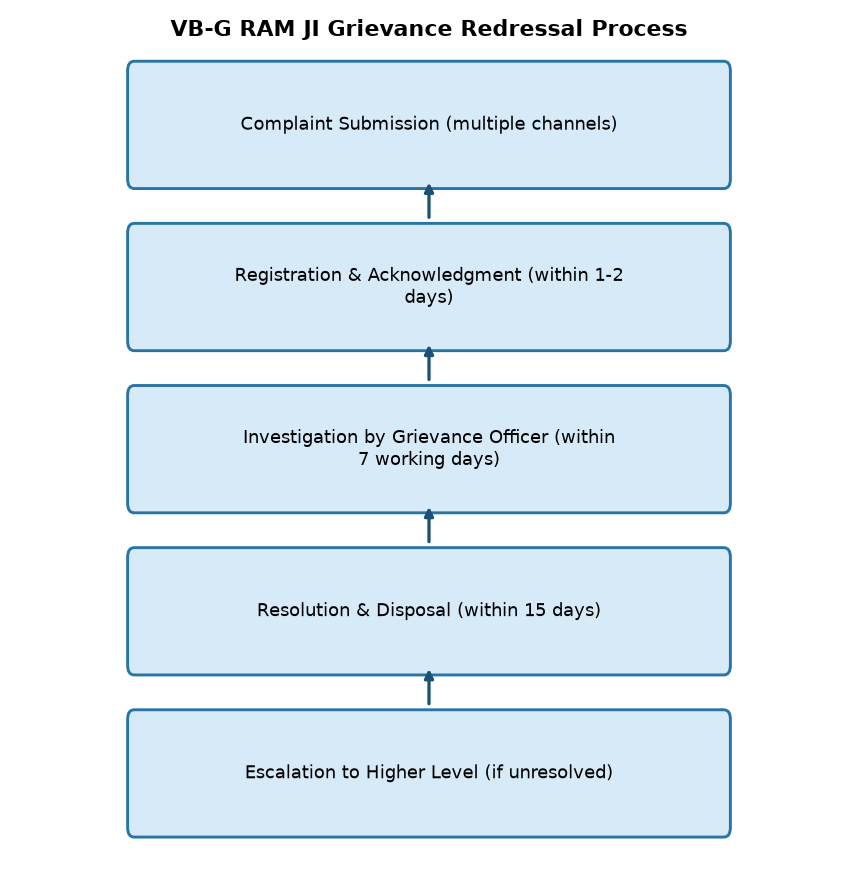
- Physical complaints must be registered on the digital public infrastructure on the same day or by the next working day, with an acknowledgement issued to the complainant.
- Complaints cannot be refused registration based on format, language, mode of submission, or any procedural deficiency, ensuring broad accessibility.
- A strict timeline mandates the completion of investigation within 7 working days from the date of receipt and final resolution within 15 days.
- GROs can request records, documents, and other necessary information from relevant authorities and must provide the complainant an opportunity to present their case if required.
Key Features
| Feature | Significance |
|---|---|
| Multi-tiered Grievance Redressal System | Establishes a structured mechanism at Gram Panchayat, Block, and District levels for comprehensive grievance resolution. |
| Digital Public Infrastructure | Integrates a digital platform for complaint registration, monitoring, and resolution, enhancing transparency and accountability. |
| Multiple Complaint Submission Channels | Offers diverse avenues for citizens to lodge grievances, including in-person, speed post, digital platforms, and helplines, ensuring accessibility. |
| Mandatory Digital Registration of Physical Complaints | Requires physical complaints to be digitized within one working day, streamlining record-keeping and processing. |
| Non-rejection based on Format/Language | Ensures that no complaint is refused registration due to procedural deficiencies, upholding citizen access to redressal. |
| Time-bound Investigation and Resolution | Stipulates a 7-working-day limit for investigation and a 15-day limit for final resolution, promoting efficiency and prompt action. |
Why it Matters
Governance and Public Administration
- Enhances accountability and transparency in the implementation of the Viksit Bharat–Gramin Rozgar and Ajeevika Mission (VB-G RAM JI) Act.
- Strengthens citizen-centric governance by providing accessible and efficient mechanisms for grievance redressal.
- Promotes administrative efficiency through time-bound processes and digital integration for complaint management.
Social Justice and Empowerment
- Ensures that beneficiaries of rural development schemes have a robust platform to address issues, thereby safeguarding their entitlements.
- Reduces barriers to justice for rural populations by simplifying complaint procedures and offering multiple submission channels.
- Fosters trust between citizens and government by demonstrating a commitment to resolving public grievances effectively.
Digital Transformation
- Leverages digital public infrastructure to modernize grievance redressal, aligning with broader e-governance initiatives.
- Facilitates data-driven monitoring and evaluation of scheme implementation by centralizing complaint information.
- Improves the responsiveness of public services through real-time tracking and digital communication with complainants.
Challenges
1. Digital Divide and Accessibility
- Ensuring equitable access to digital grievance redressal mechanisms for populations in remote areas with limited internet connectivity or digital literacy.
- Providing adequate support and training for individuals unfamiliar with digital platforms to prevent exclusion.
UPSC Link: Social Justice: Issues relating to development and management of Social Sector/Services relating to Health, Education, Human Resources.
2. Capacity Building of Grievance Redressal Officers
- Training designated grievance redressal officers at all levels (Gram Panchayat, Block, District) to effectively investigate, record, and resolve complaints within stipulated timelines.
- Ensuring officers possess the necessary legal and procedural knowledge to handle diverse grievances related to the VB-G RAM JI Act.
UPSC Link: Governance: Important aspects of governance, transparency and accountability, e-governance- applications, models, successes, limitations, and potential; citizens charters, transparency & accountability and institutional and other measures.
3. Ensuring Impartiality and Accountability
- Establishing robust oversight mechanisms to prevent bias or undue influence in the grievance redressal process.
- Implementing provisions for escalating unresolved or unsatisfactorily resolved complaints to higher authorities to maintain accountability.
UPSC Link: Ethics: Probity in Governance: Concept of Public Service; Philosophical basis of Governance and Probity; Information sharing and transparency in Government, Right to Information, Codes of Ethics, Codes of Conduct, Citizen’s Charters, Work culture, Quality of service delivery, Utilization of public funds, challenges of corruption.
4. Resource Allocation and Infrastructure
- Allocating sufficient financial and human resources to establish and maintain the multi-tiered grievance redressal system, including digital infrastructure.
- Ensuring the availability of necessary equipment and technical support at all levels, especially in rural areas.
UPSC Link: Indian Economy: Government Budgeting. Infrastructure: Energy, Ports, Roads, Airports, Railways etc.
Challenges — UPSC Perspective
| Issue | Concern |
|---|---|
| Digital Literacy Gap | Potential exclusion of digitally illiterate citizens from accessing online complaint mechanisms. |
| Bureaucratic Inertia | Risk of delays or procedural bottlenecks despite prescribed timelines, if not rigorously monitored. |
| Resource Constraints | Inadequate staffing or infrastructure at local levels hindering effective grievance processing. |
| Awareness and Outreach | Lack of public awareness regarding the new rules and available channels for complaint submission. |
| Data Security and Privacy | Ensuring the protection of personal data submitted through digital platforms. |
| Inter-departmental Coordination | Challenges in coordinating with various departments for information retrieval and resolution of complex grievances. |
Government Initiatives — Must-Memorise for Prelims
- Viksit Bharat–Gramin Rozgar and Ajeevika Mission (VB-G RAM JI)
Way Forward
- Launch comprehensive awareness campaigns, utilizing both traditional and digital media, to inform rural citizens about the new grievance redressal rules and available channels.
- Invest in digital literacy programs and establish common service centers (CSCs) in rural areas to bridge the digital divide and facilitate online complaint submission.
- Conduct regular capacity building and training programs for designated grievance redressal officers at all administrative levels to enhance their investigative and resolution skills.
- Implement a robust monitoring and evaluation framework, including independent audits, to assess the effectiveness and adherence to prescribed timelines for grievance resolution.
- Develop a feedback mechanism for complainants to rate the resolution process, enabling continuous improvement and accountability of grievance redressal officers.
- Ensure adequate allocation of financial and human resources to support the multi-tiered grievance redressal system, particularly at the Gram Panchayat and Block levels.
- Establish clear protocols for inter-departmental coordination to facilitate the timely retrieval of information and collaborative resolution of grievances involving multiple agencies.
UPSC Value Addition
Keywords for Mains Answer-Writing
Grievance Redressal Mechanism · Viksit Bharat–Gramin Rozgar aur Ajeevika Mission (VB-G RAM JI) Act · Digital Public Infrastructure · Multi-tiered grievance system · Transparency and Accountability · Citizen-centric governance · Timely resolution · Rural Development Ministry
Constitutional & Policy Linkages
- Article 38: State to secure a social order for the promotion of welfare of the people.
- Article 39: Certain principles of policy to be followed by the State (e.g., right to an adequate means of livelihood).
- Article 41: Right to work, to education and to public assistance in certain cases.
- Article 243G: Powers, authority and responsibilities of Panchayats (including implementation of schemes).
Concept Flow
Citizen faces issue with VB-G RAM JI Act implementation. → Citizen files complaint through multiple available channels. → Complaint registered on Digital Public Infrastructure. → Designated officer investigates within 7 working days. → Grievance resolved and action taken within 15 days. → Complainant informed of resolution and action taken.
Prelims Practice Questions
Q1. Consider the following statements regarding the VB-G RAM JI Grievance Redressal Rules, 2026:
1. The rules establish a multi-tiered grievance redressal system at the Gram Panchayat, Block, and District levels.
2. Complaints can only be registered through a dedicated digital public infrastructure.
3. The investigation of a complaint must be completed within 7 working days, and its resolution within 15 days from the date of receipt.
How many of the above statements are correct?
- Only one
- Only two
- All three
- None
Answer: Only two — Statement 1 is correct: The rules mandate the establishment of a multi-tiered system at Gram Panchayat, Block, and District levels. Statement 2 is incorrect: The rules provide for multiple channels for complaint registration, including in-person, speed post, digital platform, and telephone. Statement 3 is correct: The rules specify a 7-working-day timeline for investigation and a 15-day timeline for resolution.
Q2. Which of the following is NOT a stipulated medium for filing a grievance under the VB-G RAM JI Grievance Redressal Rules, 2026?
- In-person submission to a designated Grievance Redressal Officer
- Sending via speed post with proof of delivery
- Through social media platforms designated by the Central Government
- Utilizing the digital public infrastructure for grievance redressal
Answer: Through social media platforms designated by the Central Government — The rules specify in-person submission, speed post, digital public infrastructure, and telephone/helpline as valid mediums. Social media platforms are not explicitly mentioned as a stipulated medium.
Mains Practice Question
✍ The recent notification of the VB-G RAM JI Grievance Redressal Rules, 2026, by the Ministry of Rural Development aims to enhance citizen-centric governance. Discuss the key features of these rules and critically examine their potential impact on improving transparency and accountability in the implementation of rural development schemes. (15 Marks)
Approach: Introduction: Briefly introduce the VB-G RAM JI Act and the purpose of the newly notified Grievance Redressal Rules, 2026. Key Features: Detail the salient provisions of the rules, including the multi-tiered system (Gram Panchayat, Block, District levels), multiple channels for complaint registration (in-person, speed post, digital, telephone), the emphasis on digital public infrastructure, strict timelines for investigation (7 working days) and resolution (15 days), and the provision for not rejecting complaints based on procedural deficiencies. Potential Impact on Transparency and Accountability: Analyze how each feature contributes to greater transparency (e.g., digital registration, tracking, public disclosure of outcomes) and accountability (e.g., designated officers, time-bound resolution, escalation mechanism). Discuss the role of digital platforms in this regard. Critical Examination: Evaluate potential challenges or limitations, such as digital divide, capacity building for grievance officers, awareness among beneficiaries, and effective monitoring mechanisms. Suggest measures for effective implementation. Conclusion: Summarize the significance of these rules in strengthening governance and citizen participation in rural development, while acknowledging the need for robust execution.
Source: PIB (Press Information Bureau)
Generated by AanyaAi for educational purpose.
Related guides on our sites
- Best PSIR optional coaching for upsc
- Best PSIR optional teacher for upsc
- Best teacher of PSIR optional for upsc
- Best PSIR optional coaching in delhi for UPSC

- VB-G RAM JI Act: Grievance Redressal Rules, 2026 Notified - November 2, 2026
- पुणे में एआई शिखर सम्मेलन: उभरती प्रौद्योगिकियों पर छात्र परियोजनाएँ - November 2, 2026
- TRAI AI Cybersecurity Norms for Telecom: UPSC Analysis - November 2, 2026

No Comments