


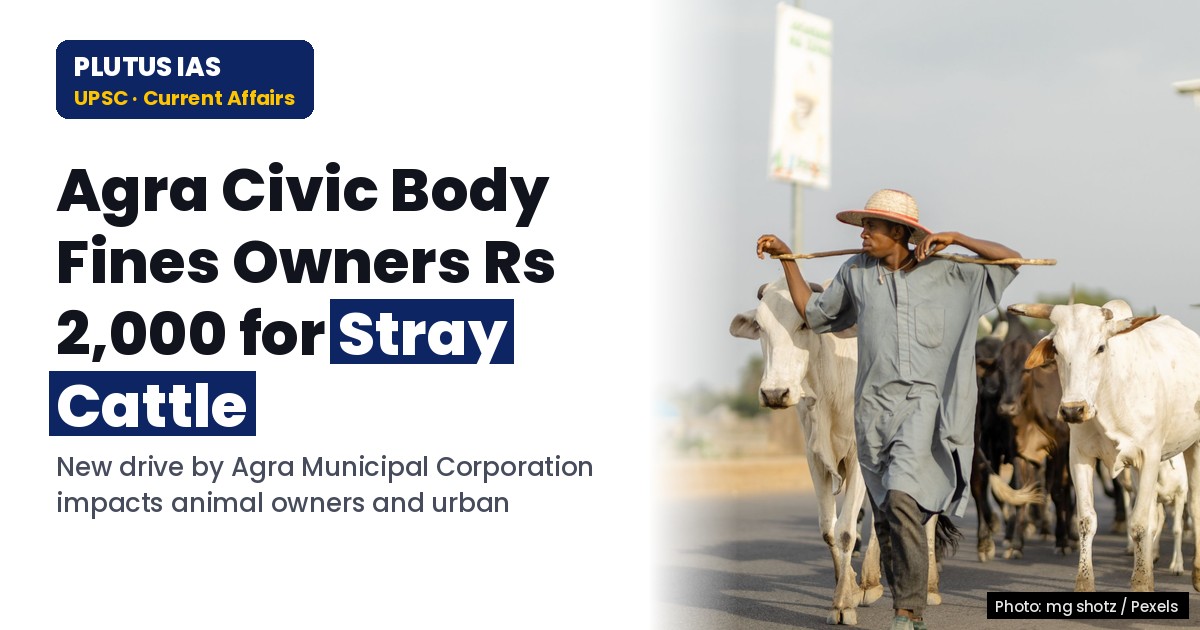
03 Nov Stray Cattle Fine: Agra Civic Body’s Drive & Penalties
✎ Municipal corporations are empowered to manage stray cattle through fines and impoundment to ensure public safety and hygiene, reflecting their role in local self-governance.
Subject Relevance — Where This Topic Fits
- GS Paper II — Governance, Welfare Schemes | GS Paper III — Environment, Animal Rearing
- Prelims: Stray cattle management, Municipal Corporation powers, Animal welfare, Public nuisance, Local self-governance
- Essay: The role of local governance in urban and rural development, Balancing human interests with animal welfare in a developing society
Quick Revision: Municipal corporations are empowered to manage stray cattle through fines and impoundment to ensure public safety and hygiene, reflecting their role in local self-governance.
Why is this in the news?
The Agra Municipal Corporation has initiated a campaign to address the issue of stray cattle on public roads, imposing a fine of INR 2,000 per animal on owners whose livestock are found unattended. This measure aims to deter irresponsible animal husbandry practices and mitigate the public nuisance and safety hazards posed by stray animals, with impounded cattle being sent to gaushalas and additional charges levied for their upkeep.
Background
- Stray cattle pose significant challenges in urban and semi-urban areas, including traffic disruptions, road accidents, and public health concerns due to indiscriminate waste disposal.
- The issue is exacerbated by traditional agricultural practices, where cattle are often left to graze freely, and by the abandonment of unproductive or aged livestock by owners.
- Municipal corporations and local bodies are typically mandated with the responsibility of public health, sanitation, and nuisance control, which includes managing stray animals.
- Various state governments and local authorities have implemented measures, including fines, impoundment, and the establishment of gaushalas (cow shelters), to tackle this problem.
- Animal welfare organisations and activists frequently advocate for humane treatment of stray animals, emphasising responsible ownership and adequate shelter facilities.
- The economic implications for cattle owners, particularly small-scale farmers, in managing their livestock responsibly are also a critical aspect of this issue.
The Role of Municipal Corporations in Animal Management
- Municipal Corporations, as institutions of local self-governance, are primarily responsible for urban administration and the provision of civic amenities.
- Their powers and functions are typically defined by state municipal acts, which often include provisions for public health, sanitation, and nuisance control.
- Regarding animal management, municipal bodies are empowered to frame bylaws for the regulation of domestic animals, including licensing, vaccination, and control of stray animals.
- They are authorised to impound stray animals, impose fines on owners for violations, and manage animal shelters or collaborate with non-governmental organisations for this purpose.
- The objective of such measures is to ensure public safety, maintain hygiene, prevent the spread of diseases, and promote responsible pet and livestock ownership within their jurisdiction.
- These responsibilities align with the broader constitutional mandate of local self-governance, as enshrined in the 74th Constitutional Amendment Act, which devolves powers and responsibilities to urban local bodies.
- Effective implementation often requires a multi-pronged approach involving public awareness campaigns, robust enforcement mechanisms, and adequate infrastructure for animal care.
Key Features
| Feature | Significance |
|---|---|
| Imposition of Fine | A penalty of INR 2,000 per animal is levied on owners whose cattle are found straying on public thoroughfares, aiming to deter irresponsible animal husbandry practices. |
| Additional Custodial Charges | A daily charge of INR 200 per feed is imposed if the impounded cattle remain in the gaushala for more than 24 hours, covering maintenance costs and incentivising prompt retrieval. |
| Cattle Catching Drives | Municipal corporations are conducting targeted operations to impound stray cattle from urban areas, specifically identifying locations prone to such occurrences. |
| Relocation to Gaushalas | Impounded cattle are transported to designated gaushalas (cow shelters) for care and temporary housing, ensuring their welfare and public safety. |
| Public Safety and Traffic Management | The initiative aims to mitigate risks posed by stray animals, such as traffic accidents and public health hazards, especially during periods of increased public movement. |
Why it Matters
Urban Governance and Public Safety
- Addresses the persistent issue of stray cattle in urban environments, which poses significant risks to vehicular traffic and pedestrian safety.
- Enhances the livability and orderliness of urban spaces by reducing impediments caused by wandering animals.
- Demonstrates proactive municipal administration in enforcing regulations pertaining to animal control and public nuisance.
Animal Welfare and Responsible Ownership
- Promotes responsible animal ownership by imposing financial penalties, thereby discouraging the abandonment or negligent supervision of livestock.
- Ensures the welfare of stray cattle by providing temporary shelter and care in gaushalas, preventing their exposure to urban hazards.
- Encourages livestock owners to maintain their animals within designated enclosures, aligning with principles of ethical animal management.
Economic and Environmental Implications
- Reduces economic losses associated with road accidents caused by stray animals, including damage to vehicles and potential human injury.
- Mitigates environmental concerns such as indiscriminate waste dispersal and sanitation issues arising from uncontrolled animal presence in public areas.
- Generates revenue through fines and charges, which can be reinvested into animal welfare initiatives and municipal services.
Challenges
1. Enforcement and Resource Allocation
- Sustaining regular cattle-catching drives requires significant human resources, logistical support, and financial investment, which can strain municipal budgets.
- Identifying and penalising cattle owners can be challenging, particularly in densely populated areas or where ownership is ambiguous.
- The capacity of existing gaushalas may be insufficient to accommodate a large influx of impounded animals, leading to overcrowding and welfare issues.
UPSC Link: Urban planning and development
2. Public Acceptance and Social Dynamics
- Implementation of fines may face resistance from local communities, particularly livestock owners, who might perceive it as an economic burden.
- Cultural and traditional practices related to cattle rearing in certain regions may conflict with strict urban animal control regulations.
- Ensuring equitable enforcement without disproportionately affecting vulnerable sections of society, such as small-scale dairy farmers, is crucial.
UPSC Link: Social justice and vulnerable sections
3. Long-term Sustainability of Gaushalas
- The financial viability of gaushalas relies on consistent funding, which often comes from government grants, donations, and charges, but can be inconsistent.
- Managing the health and well-being of a large number of diverse animals in gaushalas requires specialised veterinary care and infrastructure.
- Developing sustainable models for the care and rehabilitation of impounded cattle, including adoption programmes or productive utilisation, is essential.
UPSC Link: Animal husbandry and welfare
4. Legal and Regulatory Framework
- The existing legal framework for animal control may require periodic review and updates to address contemporary challenges effectively.
- Ensuring that municipal bylaws are consistent with state and national animal welfare laws to avoid legal ambiguities.
- Establishing clear protocols for the handling, identification, and release of impounded animals to maintain transparency and accountability.
UPSC Link: Governance and public policy
Challenges — UPSC Perspective
| Issue | Concern |
|---|---|
| Stray Cattle Menace | Risk of road accidents, traffic congestion, public health hazards, and damage to urban infrastructure. |
| Irresponsible Animal Ownership | Negligence by owners in confining their livestock, leading to animals roaming freely in public spaces. |
| Resource Strain on Municipalities | High operational costs, manpower requirements, and logistical challenges in conducting regular impoundment drives. |
| Gaushala Capacity and Management | Potential for overcrowding, inadequate facilities, and financial unsustainability in accommodating impounded animals. |
| Public Resistance to Fines | Community opposition to penalties, particularly from livestock owners, perceiving them as an economic burden. |
Way Forward
- Strengthen municipal enforcement mechanisms through enhanced training for personnel and deployment of adequate resources for cattle-catching operations.
- Implement public awareness campaigns to educate livestock owners about their responsibilities, the risks associated with stray animals, and the penalties for non-compliance.
- Develop and promote affordable and accessible cattle shelters and designated grazing areas to provide viable alternatives for animal owners.
- Explore technological solutions such as animal tagging and microchipping for easier identification of owners and tracking of impounded animals.
- Establish robust grievance redressal mechanisms for animal owners to address concerns regarding impoundment and fines transparently.
- Foster collaboration between municipal bodies, animal welfare organisations, and local communities to ensure a holistic approach to stray animal management.
- Review and update existing bylaws and regulations to align with contemporary animal welfare standards and ensure effective implementation.
- Invest in the long-term sustainability of gaushalas by diversifying funding sources, improving infrastructure, and promoting adoption or rehabilitation programmes.
UPSC Value Addition
Keywords for Mains Answer-Writing
Stray cattle management · Urban local bodies · Public nuisance · Animal welfare · Swachh Bharat Abhiyan · Sustainable urban development · Livestock management policies · Municipal Solid Waste Management
Concept Flow
Stray cattle on roads pose public safety risks. → Municipal Corporation initiates impoundment drives. → Cattle are caught and relocated to gaushalas. → Owners identified are fined INR 2,000 per animal. → Additional daily charges apply for extended gaushala stay. → Aims to deter negligence and promote responsible ownership. → Contributes to urban orderliness and public safety.
Prelims Practice Questions
Q1. Consider the following statements regarding urban local bodies in India:
1. Urban local bodies derive their powers and functions from the 74th Constitutional Amendment Act.
2. The management of stray animals falls under the purview of state governments, not urban local bodies.
3. Municipal corporations are responsible for public health and sanitation within their jurisdictions.
How many of the above statements are correct?
- Only one
- Only two
- Only three
- None
Answer: Only two — Statement 1 is correct: The 74th Constitutional Amendment Act, 1992, institutionalized urban local bodies and devolved powers and functions to them. Statement 2 is incorrect: Management of stray animals, including cattle, is typically a responsibility delegated to urban local bodies under municipal laws to ensure public safety and hygiene. Statement 3 is correct: Public health and sanitation are core functions of municipal corporations, as outlined in various municipal acts and the Twelfth Schedule of the Constitution.
Q2. Which of the following is a primary objective of municipal corporations imposing fines on owners of stray cattle?
- To generate revenue for urban development projects.
- To encourage dairy farming within city limits.
- To deter irresponsible animal ownership and ensure public safety.
- To promote the establishment of private gaushalas.
Answer: To deter irresponsible animal ownership and ensure public safety. — The primary objective of imposing fines on owners of stray cattle is to deter irresponsible animal ownership, which contributes to public nuisance, traffic hazards, and unsanitary conditions, thereby ensuring public safety and order.
Mains Practice Question
✍ The proliferation of stray cattle in urban areas poses significant challenges to public safety, sanitation, and traffic management. Examine the role of urban local bodies in addressing this issue and suggest comprehensive strategies for effective stray cattle management. (15 Marks)
Approach: Introduction: Briefly define the problem of stray cattle in urban areas and its multifaceted impact. Role of Urban Local Bodies (ULBs): Discuss the constitutional mandate (74th Amendment Act, Twelfth Schedule) and statutory powers of ULBs (e.g., municipal acts) related to public health, sanitation, and animal control. Mention specific actions like impounding, fining, and operating gaushalas. Challenges faced by ULBs: Resource constraints, lack of adequate infrastructure (gaushalas), public cooperation issues, and legal complexities. Comprehensive Strategies: Propose multi-pronged solutions including: 1. Legal and Regulatory Reforms: Stricter enforcement of existing laws, increased penalties, and clear ownership identification mechanisms. 2. Infrastructure Development: Establishment of well-equipped and adequately funded gaushalas/animal shelters, veterinary care facilities. 3. Community Engagement: Awareness campaigns for responsible animal ownership, promoting cattle tagging and registration. 4. Technological Solutions: Use of RFID tags for identification, GPS tracking. 5. Public-Private Partnerships: Collaboration with NGOs, animal welfare organizations, and private entities for shelter management and adoption programs. 6. Policy Integration: Linking stray cattle management with broader urban planning and waste management strategies. Conclusion: Summarize the need for a holistic and collaborative approach involving ULBs, state governments, and citizens for sustainable resolution.
Source: amarujala.com
Generated by AanyaAi for educational purpose.
Related guides on our sites
- Anthropology VS PSIR
- Best PSIR optional coaching
- Best PSIR optional coaching online
- Best PSIR optional teacher

- Stray Cattle Fine: Agra Civic Body’s Drive & Penalties - November 3, 2026
- दिल्ली-एनसीआर में पुराने वाहनों की समस्या: PARIVARTAN योजना की धीमी प्रगति - November 3, 2026
- Exercise Tiger Triumph: India-US Joint Humanitarian Drill - November 3, 2026

No Comments