


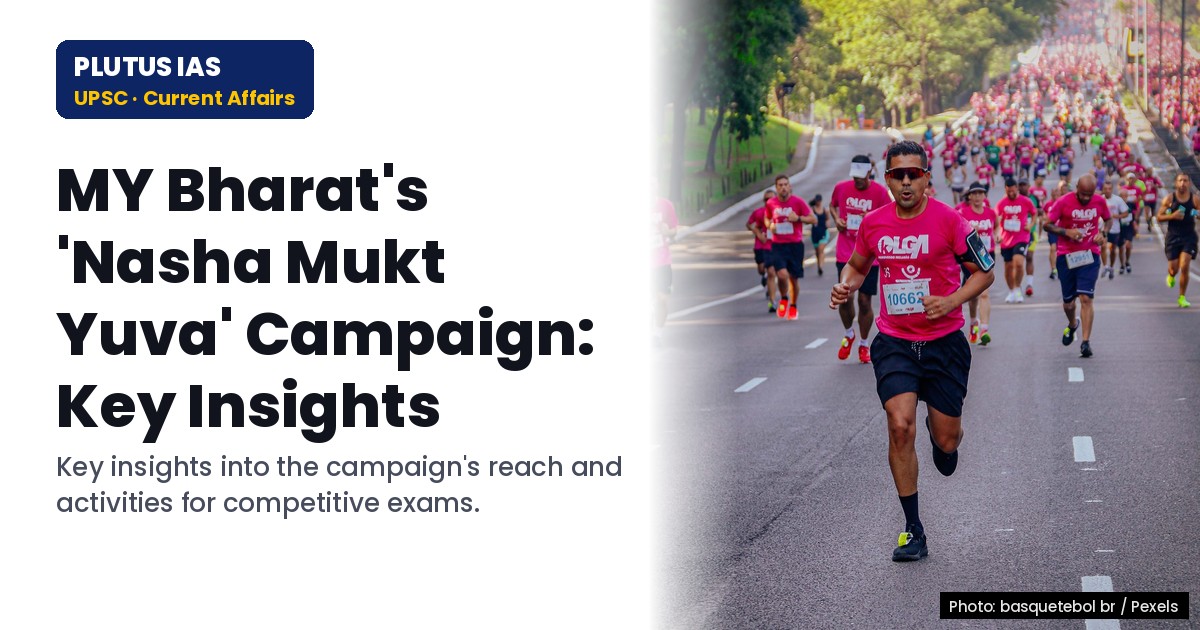
03 Nov MY Bharat’s ‘Nasha Mukt Yuva’ Campaign: Key Insights
✎ The 'Nasha Mukt Yuva Abhiyan', led by MyBharat, is a Ministry of Youth Affairs and Sports initiative to combat drug abuse among youth through awareness, fitness activities, and community engagement, contributing to the 'Viksit…
Subject Relevance — Where This Topic Fits
- GS Paper I — Social Issues; Role of women and women’s organization, population and associated issues, poverty and developmental issues, urbanization, their problems and their remedies. | GS Paper II — Governance; Welfare schemes for vulnerable sections of the population by the Centre and States and the performance of these schemes; mechanisms, laws, institutions and Bodies constituted for the protection and betterment of these vulnerable sections. | GS Paper III — Internal Security; Linkages between development and spread of extremism; Role of external state and non-state actors in creating challenges to internal security; Challenges to internal security through communication networks, role of media and social networking sites in internal security challenges, basics of cyber security; money-laundering and its prevention; Security challenges and their management in border areas; linkages of organized crime with terrorism.
- Prelims: MyBharat, Nasha Mukt Bharat Abhiyan, Ministry of Youth Affairs and Sports, Drug Abuse Prevention, Fit India Movement, Neighbourhood Youth Parliaments
- Essay: Youth as agents of change in nation-building: Addressing social challenges through collective action., The imperative of a drug-free society for ‘Viksit Bharat’: Challenges and strategies.
Quick Revision: The ‘Nasha Mukt Yuva Abhiyan’, led by MyBharat, is a Ministry of Youth Affairs and Sports initiative to combat drug abuse among youth through awareness, fitness activities, and community engagement, contributing to the ‘Viksit Bharat’ vision.
Why is this in the news?
The ‘Nasha Mukt Yuva Abhiyan’ (Drug-Free Youth Campaign), spearheaded by MyBharat under the Ministry of Youth Affairs and Sports, recently concluded its seventh week, reporting significant participation across 30 states and Union Territories. Over 93,000 individuals engaged in 447 programs and 1,002 activities, demonstrating a concerted effort to foster healthy lifestyles, raise awareness about substance abuse, and mobilize youth against drug addiction.
Background
- Drug abuse poses a significant public health and socio-economic challenge in India, impacting individuals, families, and communities.
- The Government of India has launched various initiatives, including the ‘Nasha Mukt Bharat Abhiyan’ (NMBA), to address the issue of substance abuse comprehensively.
- Youth, being a demographic segment particularly vulnerable to drug abuse, are also recognized as crucial stakeholders in prevention and rehabilitation efforts.
- MyBharat (My Youth India) serves as an autonomous body under the Ministry of Youth Affairs and Sports, focusing on youth development and engagement.
- The ‘Viksit Bharat’ (Developed India) initiative emphasizes holistic national development, where a healthy and productive youth population is considered fundamental.
- Community-level engagement, through platforms like Neighbourhood Youth Parliaments, is instrumental in fostering dialogue and collective action on social issues.
What is the ‘Nasha Mukt Yuva Abhiyan’?
- The ‘Nasha Mukt Yuva Abhiyan’ is a campaign focused on creating a drug-free environment for youth, aligning with the broader vision of ‘Viksit Bharat’.
- It is implemented by MyBharat, an autonomous body under the Ministry of Youth Affairs and Sports, Government of India.
- The campaign’s primary objectives include promoting healthy lifestyles, increasing awareness regarding the detrimental effects of drug abuse, and mobilizing young people to actively participate in drug prevention efforts.
- Activities conducted under the campaign encompass a diverse range, including mini-marathons, oath-taking ceremonies, symbolic youth parliaments, and slogan writing exercises.
- The initiative collaborates with various organizations, such as Fit India, the Sports Authority of India (SAI), Brahma Kumaris, Heartfulness, CIPU, ASSOCHAM, and FICCI, to amplify its reach and impact.
- A key component involves ‘Neighbourhood Youth Parliaments’ (NYP), which serve as platforms for youth to discuss challenges posed by drug abuse and deliberate on potential solutions.
- These NYP discussions are structured into multiple sessions covering topics such as the MyBharat portal, challenges faced by Indian youth due to drug abuse, strategies for transitioning from awareness to action, and inspiring stories towards a drug-free India.
- The campaign emphasizes collective action and community participation, involving local leaders and public representatives in its programs.
Key Features
| Feature | Significance |
|---|---|
| Pan-India Reach | The campaign’s presence across 30 states and Union Territories demonstrates a broad national commitment to addressing substance abuse among youth. |
| Multi-Stakeholder Collaboration | Involvement of MY Bharat, Fit India, SAI, and various non-governmental organizations like Brahma Kumaris, Heartfulness, CIPU, ASSOCHAM, and FICCI, indicates a comprehensive approach leveraging diverse expertise and outreach capabilities. |
| Diverse Activity Portfolio | The inclusion of mini-marathons, oath-taking ceremonies, symbolic youth parliaments, and slogan writing exercises caters to varied engagement preferences, enhancing participation and message retention. |
| Focus on Grassroots Engagement | Neighbourhood Youth Parliaments facilitate localized discussions, enabling youth to articulate challenges and propose solutions relevant to their specific contexts. |
| Emphasis on Awareness and Action | The campaign moves beyond mere information dissemination by encouraging collective action and fostering a sense of responsibility among participants to combat drug abuse. |
Why it Matters
Social Development
- A ‘Nasha Mukt Yuva’ (Drug-Free Youth) campaign directly contributes to the holistic development of the youth demographic, fostering healthier lifestyles and responsible citizenship.
- By engaging a large number of participants, the campaign strengthens community resilience against substance abuse, leading to improved social cohesion and reduced crime rates associated with drug use.
- The initiative aligns with national goals of harnessing demographic dividend by ensuring that the young population remains productive and free from debilitating addictions.
Public Health
- Promoting awareness about the detrimental effects of drug abuse is a crucial preventive public health measure, reducing the burden on healthcare systems.
- Encouraging healthy lifestyles through activities like mini-marathons contributes to overall physical and mental well-being, mitigating risks associated with sedentary habits and substance dependence.
- Early intervention and prevention strategies targeting youth are cost-effective in the long run, preventing chronic health issues and rehabilitation expenses.
Governance and Policy Implementation
- The campaign exemplifies effective inter-ministerial coordination and collaboration with civil society organizations, demonstrating a whole-of-government and whole-of-society approach to complex social issues.
- The involvement of elected representatives at various levels underscores political commitment to addressing drug abuse, potentially leading to stronger policy frameworks and resource allocation.
- Data gathered from such large-scale participatory campaigns can inform evidence-based policymaking, allowing for targeted interventions and resource optimization in future anti-drug initiatives.
Challenges
1. Sustaining Engagement and Impact
- Maintaining the momentum and enthusiasm generated during initial campaign phases over an extended period is crucial for long-term behavioural change.
- Translating awareness into sustained action requires continuous reinforcement and creation of supportive environments free from drug influences.
UPSC Link: Social Issues; Government Policies and Interventions
2. Addressing Root Causes of Drug Abuse
- The campaign primarily focuses on awareness and prevention, but deeper socio-economic factors like unemployment, peer pressure, mental health issues, and family dysfunction often drive drug abuse.
- Effective solutions require integrated approaches that address these underlying vulnerabilities alongside awareness campaigns.
UPSC Link: Social Issues; Vulnerable Sections
3. Reaching Diverse Youth Segments
- While the campaign has broad reach, ensuring effective engagement with marginalized youth, those in remote areas, or specific high-risk groups requires tailored strategies.
- Cultural and linguistic diversity across India necessitates localized communication strategies to maximize impact.
UPSC Link: Social Justice; Diversity
4. Measuring Long-term Outcomes
- Quantifying the long-term impact of awareness campaigns on actual drug consumption rates and related social indicators is inherently challenging.
- Developing robust monitoring and evaluation frameworks is essential to assess effectiveness and justify resource allocation.
UPSC Link: Governance; Monitoring and Evaluation
Challenges — UPSC Perspective
| Issue | Concern |
|---|---|
| Accessibility of Drugs | Despite awareness efforts, the illicit supply chain of drugs remains a significant challenge, undermining prevention initiatives. |
| Peer Pressure and Social Norms | Strong peer influence and evolving social norms can counteract anti-drug messaging, particularly among adolescents and young adults. |
| Mental Health Co-morbidity | A significant proportion of individuals with substance use disorders also suffer from co-occurring mental health conditions, requiring integrated treatment approaches. |
| Resource Allocation for Rehabilitation | While prevention is key, adequate resources and infrastructure for de-addiction and rehabilitation services are crucial for those already affected. |
| Digital Influence and Online Drug Trade | The increasing prevalence of online platforms and social media can expose youth to drug-related content and facilitate illicit drug transactions. |
Government Initiatives — Must-Memorise for Prelims
- Nasha Mukt Bharat Abhiyaan
- Fit India Movement
- My Bharat (MYBharat)
Way Forward
- Integrate drug prevention education into school curricula from an early age, focusing on life skills, critical thinking, and resistance to peer pressure.
- Strengthen community-based intervention models by empowering local youth groups, self-help groups, and community leaders to act as change agents.
- Enhance collaboration between law enforcement agencies and public health departments to disrupt drug supply chains while simultaneously expanding access to treatment and rehabilitation services.
- Leverage digital platforms and social media for targeted awareness campaigns, utilizing innovative content formats to engage youth effectively and counter pro-drug narratives.
- Invest in mental health support services for youth, recognizing the strong link between mental health issues and substance abuse, and ensuring accessible counselling and therapy.
- Develop robust monitoring and evaluation frameworks with clear indicators to assess the long-term impact of campaigns and inform adaptive policy adjustments.
- Promote vocational training and skill development programs for youth, offering constructive alternatives and reducing vulnerability to drug abuse stemming from unemployment and idleness.
UPSC Value Addition
Keywords for Mains Answer-Writing
Nasha Mukt Bharat Abhiyaan · Youth engagement · Drug abuse prevention · Viksit Bharat · Community participation · Public health initiatives · Ministry of Youth Affairs and Sports · MY Bharat platform · Neighbourhood Youth Parliaments · Fit India Movement · Multi-stakeholder collaboration · Social awareness campaigns
Constitutional & Policy Linkages
- {‘article’: ‘Article 47’, ‘note’: ‘Duty of the State to improve public health’}
Concept Flow
Government launches ‘Nasha Mukt Yuva’ campaign. → MY Bharat coordinates diverse activities across states. → Youth participation in awareness and fitness events. → Neighbourhood Youth Parliaments facilitate discussions. → Increased awareness and collective action against drug abuse. → Promotion of healthy lifestyles and responsible citizenship.
Prelims Practice Questions
Q1. Consider the following statements regarding the ‘Nasha Mukt Yuva Abhiyaan’:
1. The campaign aims to promote healthy lifestyles and raise awareness about drug abuse among youth.
2. It is an initiative primarily driven by the Ministry of Health and Family Welfare.
3. Activities under the campaign include mini-marathons, oath-taking ceremonies, and Neighbourhood Youth Parliaments.
How many of the above statements are correct?
- Only one
- Only two
- Only three
- None
Answer: Only two — Statement 1 is correct as the campaign’s objective is to promote healthy lifestyles and raise awareness about drug abuse. Statement 2 is incorrect; the campaign is under the Ministry of Youth Affairs and Sports. Statement 3 is correct as the mentioned activities are part of the campaign’s implementation.
Q2. Which of the following bodies is primarily responsible for implementing the ‘Nasha Mukt Yuva Abhiyaan’ as per the news report?
- National Anti-Doping Agency (NADA)
- Sports Authority of India (SAI)
- My Youth India (MY Bharat)
- National Institute of Social Defence (NISD)
Answer: My Youth India (MY Bharat) — The news report explicitly states that ‘Mera Yuva Bharat (MYBharat)’ under the Ministry of Youth Affairs and Sports is responsible for the implementation of the ‘Nasha Mukt Yuva Abhiyaan’.
Mains Practice Question
✍ Discuss the significance of youth engagement platforms like ‘MY Bharat’ in addressing contemporary social challenges such as drug abuse. To what extent can multi-stakeholder collaborations enhance the effectiveness of such national campaigns? (15 Marks)
Approach: MODEL-ANSWER SKELETON:
1. **Introduction**: Briefly introduce MY Bharat as a youth-centric platform and its role in national development, specifically mentioning its involvement in the ‘Nasha Mukt Yuva Abhiyaan’.
2. **Significance of Youth Engagement Platforms (MY Bharat)**:
* **Direct Participation**: Facilitates direct involvement of youth in national initiatives (e.g., mini-marathons, Neighbourhood Youth Parliaments).
* **Awareness Generation**: Acts as a crucial channel for disseminating information and raising awareness on critical issues like drug abuse.
* **Skill Development**: Provides opportunities for leadership, communication, and community organizing among youth.
* **Behavioral Change**: Promotes positive lifestyle choices and discourages detrimental habits through peer influence and structured activities.
* **Grassroots Mobilization**: Enables reach to remote areas and diverse demographics, ensuring wider impact.
* **Feedback Mechanism**: Potentially offers a platform for youth voices and feedback on policy implementation.
3. **Enhancing Effectiveness through Multi-Stakeholder Collaborations**:
* **Resource Pooling**: Combines financial, human, and logistical resources from various entities (e.g., MY Bharat, Fit India, SAI, Brahma Kumaris, FICCI, ASSOCHAM).
* **Diverse Expertise**: Integrates varied perspectives and specialized knowledge from government, NGOs, civil society, and corporate sectors.
* **Wider Reach**: Leverages the networks and outreach capabilities of different partners to cover more geographical areas and target groups.
* **Sustainability**: Ensures long-term impact and continuity of campaigns beyond government cycles through sustained partnerships.
* **Credibility and Trust**: Enhances public trust and acceptance of campaigns through endorsement and participation of respected organizations.
* **Innovation**: Fosters creative solutions and diverse approaches to complex social problems.
4. **Challenges/Limitations (Briefly)**: Potential for coordination issues, differing objectives among partners, ensuring equitable resource distribution.
5. **Conclusion**: Summarize the vital role of youth platforms and multi-stakeholder approach in fostering a ‘Viksit Bharat’ by tackling social challenges effectively and inclusively.
Source: PIB (Press Information Bureau)
Generated by AanyaAi for educational purpose.
Related guides on our sites
- Anthropology VS PSIR
- Best PSIR optional coaching
- Best PSIR optional coaching online
- Best sociology optional coaching

- MY Bharat’s ‘Nasha Mukt Yuva’ Campaign: Key Insights - November 3, 2026
- भारत में स्वास्थ्य, वित्तीय और एआई साक्षरता की कमी: एक गंभीर चुनौती - November 3, 2026
- Stray Cattle Fine: Agra Civic Body’s Drive & Penalties - November 3, 2026

No Comments