


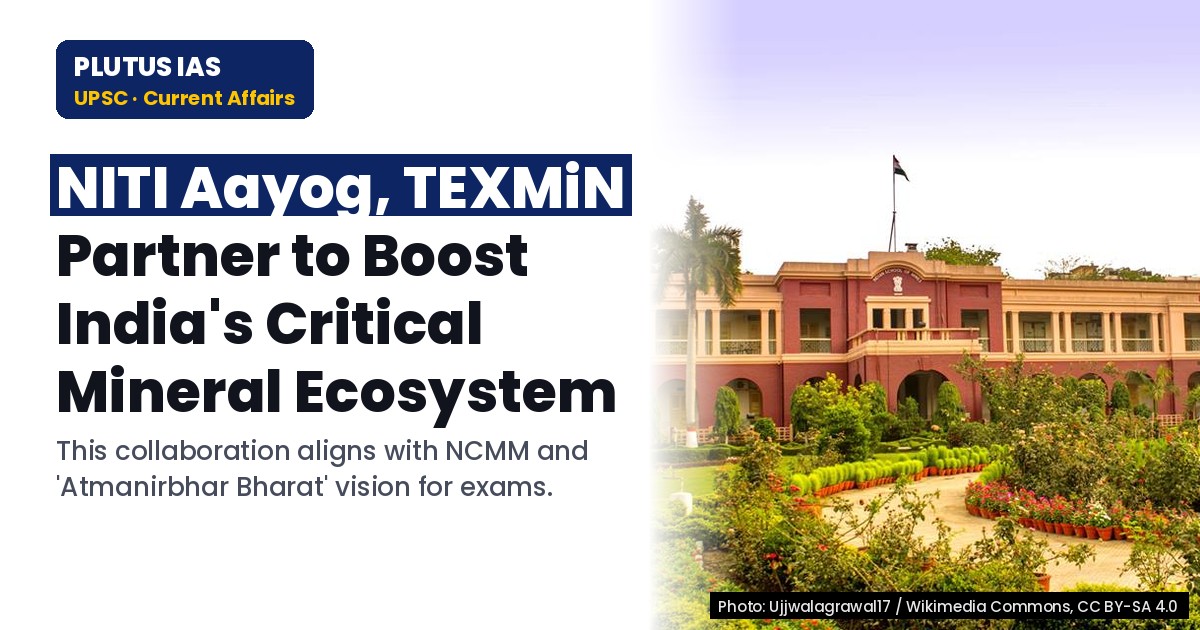
04 Nov NITI Aayog, TEXMiN Partner for Critical Minerals Ecosystem
✎ The NITI Aayog-TEXMiN collaboration aims to strengthen India's critical and strategic mineral ecosystem through indigenous technological advancement, research, and sustainable value chain development, aligning with 'Atmanirbhar…
Subject Relevance — Where This Topic Fits
- GS Paper III — Economy: Infrastructure (Energy, Minerals), Investment Models, Science and Technology, Indigenization of Technology, Resource Mobilization, Environmental Conservation | GS Paper III — Science and Technology: Developments and their Applications and Effects in Everyday Life, Indigenization of Technology and Developing New Technology | GS Paper III — Security: Critical Mineral Supply Chain Security, Strategic Minerals
- Prelims: NITI Aayog, TEXMiN (Technology Translation Research Park), Critical Minerals, Strategic Minerals, National Critical Mineral Mission (NCMM), Atmanirbhar Bharat, Vikshit Bharat 2047, Indian Institute of Technology (Indian School of Mines) Dhanbad, Department of Science & Technology (DST), Rare Earth Elements
- Essay: The imperative of self-reliance in critical resources for national security and economic sovereignty., Leveraging technological innovation and collaborative frameworks for sustainable resource management and industrial growth.
Quick Revision: The NITI Aayog-TEXMiN collaboration aims to strengthen India’s critical and strategic mineral ecosystem through indigenous technological advancement, research, and sustainable value chain development, aligning with ‘Atmanirbhar Bharat’ and ‘Vikshit Bharat 2047’ objectives.
Why is this in the news?
NITI Aayog and TEXMiN (Technology Translation Research Park), an initiative of the Department of Science & Technology (DST) at IIT (ISM) Dhanbad, have signed a joint Statement of Intent (SoI). This collaboration aims to bolster cooperation in the critical and strategic minerals sector, fostering indigenous technological capabilities, promoting research and innovation, and supporting the development of resilient and sustainable critical mineral value chains in India. This initiative aligns with the objectives of the National Critical Mineral Mission (NCMM) and the broader vision of ‘Atmanirbhar Bharat’ and ‘Vikshit Bharat 2047’.
Background
- Critical minerals are essential for economic development and national security, serving as fundamental components in various advanced technologies, including renewable energy systems, electric vehicles, electronics, and defence applications.
- India’s reliance on imports for a significant portion of its critical mineral requirements poses strategic vulnerabilities, necessitating a robust domestic ecosystem for exploration, extraction, processing, and recycling.
- The ‘Atmanirbhar Bharat’ initiative underscores the importance of self-reliance across all sectors, including critical minerals, to reduce import dependency and enhance strategic autonomy.
- The ‘Vikshit Bharat 2047’ vision envisages India as a developed nation by 2047, which requires a strong industrial base supported by secure and sustainable access to critical raw materials.
- The National Critical Mineral Mission (NCMM) was established to create a comprehensive framework for securing critical minerals, encompassing policy formulation, research and development, and strategic partnerships.
- Secondary sources such as coal fly ash, red mud, mine tailings, and electronic waste represent significant untapped potential for the recovery of critical minerals, offering avenues for resource efficiency and circular economy principles.
What are Critical Minerals?
- Critical minerals are those elements that are essential for the economy and national security, the supply chain of which is vulnerable to disruption.
- Their scarcity or concentration in a few geographical locations, coupled with their indispensable role in high-tech industries, makes their supply critical.
- These minerals are vital for manufacturing advanced technologies such as electric vehicle batteries, solar panels, wind turbines, semiconductors, and defence equipment.
- Examples include Lithium, Cobalt, Nickel, Rare Earth Elements (REEs), Graphite, and Gallium, among others.
- Disruptions in their supply can have severe economic consequences, impacting industrial production, technological advancement, and strategic capabilities.
- India has identified a list of critical minerals, recognizing their strategic importance for the nation’s industrial and technological growth.
- The focus extends beyond primary extraction to encompass the entire value chain, including exploration, processing, refining, advanced material development, and recycling.
- The recovery of critical minerals from secondary sources, such as industrial waste and electronic scrap, is gaining prominence as a sustainable and circular economy approach.
Key Features
| Feature | Significance |
|---|---|
| Collaborative Research and Technology Development | Aims to advance indigenous technological capabilities and foster innovation in critical and strategic minerals. |
| Technical and Strategic Studies | Provides foundational knowledge and analytical insights for informed policy formulation and strategic planning. |
| Policy and Institutional Support | Facilitates the creation of an enabling regulatory and administrative environment for the critical minerals sector. |
| Capacity Building and Knowledge Exchange | Enhances human capital and disseminates best practices across government, academia, research, and industry stakeholders. |
| Integrated Value Chain Approach | Emphasises a holistic strategy encompassing exploration, processing, refining, advanced materials, and recycling, moving beyond a singular mining focus. |
| Secondary Resource Utilisation | Explores the potential for critical mineral recovery from waste streams such as fly ash, red mud, mine tailings, and electronic waste, promoting circular economy principles. |
Why it Matters
National Security
- Ensures a stable and uninterrupted supply of essential minerals crucial for defence, aerospace, and other strategic industries, reducing reliance on volatile international markets.
- Mitigates geopolitical risks associated with global supply chain disruptions and monopolistic control over critical mineral resources.
Technological Self-Reliance (Atmanirbharta)
- Fosters indigenous research and development, leading to the creation of advanced materials and technologies necessary for high-tech manufacturing and innovation.
- Reduces import dependency for critical minerals, thereby strengthening domestic industrial capabilities and promoting ‘Make in India’ initiatives in strategic sectors.
Economic Development and ‘Viksit Bharat 2047’
- Supports the growth of sunrise industries such as electric vehicles, renewable energy, and advanced electronics, which are foundational to future economic prosperity.
- Creates new employment opportunities across the entire critical mineral value chain, from exploration and mining to processing, manufacturing, and recycling.
- Contributes to a resilient and sustainable economy by diversifying resource acquisition and promoting efficient resource utilisation.
Environmental Sustainability
- Promotes the recovery of critical minerals from secondary sources, reducing the environmental impact associated with primary mining and waste disposal.
- Encourages the development of cleaner processing technologies and sustainable mining practices, aligning with environmental protection goals.
Challenges
1. Exploration and Resource Assessment
- Limited comprehensive geological data and advanced exploration technologies hinder the accurate identification and quantification of critical mineral reserves.
- The high capital investment and long gestation periods associated with mineral exploration pose significant financial risks.
UPSC Link: Geography: Mineral Resources; Economy: Investment Models
2. Technological Gaps in Processing and Refining
- Lack of advanced indigenous processing and refining technologies for complex critical mineral ores, leading to reliance on foreign expertise and infrastructure.
- Challenges in developing cost-effective and environmentally friendly extraction methods for low-grade or unconventional deposits.
UPSC Link: Science & Technology: Indigenous Technology; Economy: Industrial Development
3. Supply Chain Vulnerabilities
- Global critical mineral supply chains are often concentrated in a few countries, making them susceptible to geopolitical disruptions and price volatility.
- Absence of a robust domestic critical mineral value chain, from mining to end-product manufacturing, creates dependencies.
UPSC Link: International Relations: Geopolitics; Economy: Supply Chain Management
4. Regulatory and Policy Framework
- Need for a dynamic and adaptive regulatory framework that balances environmental protection, social equity, and economic development in the critical minerals sector.
- Challenges in streamlining clearances and approvals for mining and processing projects to reduce delays and attract investment.
UPSC Link: Governance: Government Policies & Interventions; Environment: Environmental Impact Assessment
5. Skill Development and Human Capital
- Shortage of skilled personnel in advanced exploration, extraction, processing, and recycling technologies for critical minerals.
- Need for specialised educational and training programmes to build a competent workforce for the emerging critical minerals industry.
UPSC Link: Human Resources: Skill Development; Economy: Demographics
Challenges — UPSC Perspective
| Issue | Concern |
|---|---|
| Limited Domestic Reserves | India’s known reserves of several critical minerals are insufficient to meet future demand, necessitating strategic imports or accelerated exploration. |
| High Processing Costs | The energy-intensive and technologically complex nature of critical mineral processing often results in high operational costs, affecting competitiveness. |
| Environmental and Social Impacts | Mining and processing activities can lead to land degradation, water pollution, and displacement of local communities, requiring careful mitigation strategies. |
| Recycling Infrastructure Deficiencies | Inadequate infrastructure and technological capabilities for efficient collection, sorting, and extraction of critical minerals from end-of-life products. |
| Market Volatility | Fluctuations in global demand and supply, coupled with speculative trading, can lead to significant price volatility for critical minerals, impacting investment decisions. |
Government Initiatives — Must-Memorise for Prelims
- National Critical Mineral Mission (NCMM)
Way Forward
- Intensify geological exploration using advanced techniques (e.g., airborne surveys, deep drilling) to identify new critical mineral deposits and accurately assess existing resources.
- Invest significantly in research and development for indigenous, cost-effective, and environmentally sustainable processing and refining technologies for critical minerals.
- Develop a comprehensive policy framework that incentivises private sector participation, streamlines regulatory clearances, and ensures environmental and social safeguards.
- Establish dedicated centres of excellence and skill development programmes to create a highly skilled workforce in critical mineral exploration, extraction, processing, and recycling.
- Promote circular economy principles by developing robust infrastructure and technologies for recycling critical minerals from electronic waste and other secondary sources.
- Foster international collaborations for technology transfer, joint exploration ventures, and diversification of critical mineral supply chains.
- Create a strategic reserve of critical minerals to buffer against global supply disruptions and ensure national security requirements are met.
- Encourage public-private partnerships to leverage expertise, capital, and innovation for the rapid development of the critical minerals sector.
UPSC Value Addition
Keywords for Mains Answer-Writing
Critical Minerals · Strategic Minerals · National Critical Mineral Mission (NCMM) · Atmanirbhar Bharat · Vikshit Bharat 2047 · Mineral Value Chain · Resource Recycling · Technological Self-Reliance · NITI Aayog · TEXMiN
Constitutional & Policy Linkages
- {‘Article 39(b) and (c)’: ‘Distribution of material resources for common good’}
- {‘Seventh Schedule, List I (Union List), Entry 54’: ‘Regulation of mines and mineral development’}
- {‘Seventh Schedule, List II (State List), Entry 23’: ‘Regulation of mines and mineral development (subject to List I)’}
Concept Flow
Identification of Critical Mineral Dependence → Realisation of National Security and Economic Vulnerabilities → Formulation of National Critical Mineral Mission (NCMM) → NITI Aayog-TEXMiN Collaboration for R&D and Policy Support → Development of Indigenous Capabilities and Value Chains → Achieving ‘Atmanirbhar Bharat’ and ‘Viksit Bharat 2047’ Goals
Prelims Practice Questions
Q1. Consider the following statements regarding Critical Minerals:
1. Critical minerals are essential for economic development and national security.
2. India is entirely self-sufficient in all critical minerals.
3. The National Critical Mineral Mission (NCMM) aims to strengthen India’s critical mineral ecosystem.
How many of the above statements are correct?
- Only one
- Only two
- Only three
- None
Answer: Only two — Statement 1 is correct: Critical minerals are indeed vital for economic growth and national security, underpinning various advanced technologies. Statement 2 is incorrect: India is not entirely self-sufficient in all critical minerals and relies on imports for many. Statement 3 is correct: The NCMM is specifically designed to bolster India’s critical mineral ecosystem, promoting indigenous capabilities and sustainable value chains.
Q2. Which of the following institutions recently signed a Joint Statement of Intent (SoI) with NITI Aayog to strengthen cooperation in the critical and strategic minerals sector?
- Geological Survey of India (GSI)
- Indian Bureau of Mines (IBM)
- TEXMiN (Technology Translation Research Park)
- Ministry of Mines
Answer: TEXMiN (Technology Translation Research Park) — NITI Aayog and TEXMiN (Technology Translation Research Park), an initiative of the Department of Science & Technology (DST) at IIT (ISM) Dhanbad, signed a Joint SoI to enhance collaboration in the critical and strategic minerals sector.
Q3. Match the following terms with their descriptions:
List I (Term)
1. Critical Minerals
2. Atmanirbhar Bharat
3. Secondary Resources
List II (Description)
A. Minerals vital for modern technologies and national security, often with supply chain risks.
B. The vision of a self-reliant India, encompassing various sectors including strategic resources.
C. Materials like fly ash, red mud, or electronic waste from which valuable minerals can be extracted.
Which of the following pairs is correctly matched?
- 1-A, 2-B, 3-C
- 1-B, 2-A, 3-C
- 1-C, 2-B, 3-A
- 1-A, 2-C, 3-B
Answer: 1-A, 2-B, 3-C — Critical Minerals (1) are correctly described as minerals vital for modern technologies and national security, often with supply chain risks (A). Atmanirbhar Bharat (2) correctly refers to the vision of a self-reliant India (B). Secondary Resources (3) are correctly defined as materials like fly ash, red mud, or electronic waste from which valuable minerals can be extracted (C).
Mains Practice Question
✍ Critically examine the strategic importance of critical minerals for India’s national security and economic development. Discuss the measures being undertaken to build a resilient and sustainable critical mineral value chain in the country. (15 Marks)
Approach: Introduction: Define critical minerals and briefly state their significance for India.
Strategic Importance:
– National Security: Role in defence technologies, aerospace, strategic autonomy.
– Economic Development: Essential for high-tech industries (electronics, EVs, renewable energy), digital economy, manufacturing competitiveness.
– Geopolitical Leverage: Impact of global supply chain disruptions, reducing import dependence.
Measures to Build a Resilient and Sustainable Value Chain:
– Policy Frameworks: National Critical Mineral Mission (NCMM), recent policy initiatives by Ministry of Mines.
– Exploration and Mining: Enhanced geological surveys, incentives for private sector participation, deep-sea mining initiatives.
– Processing and Refining: Investment in indigenous processing technologies, reducing reliance on foreign refining capacities.
– Advanced Materials and Manufacturing: Promoting R&D for value-added products.
– Recycling and Circular Economy: Focus on extracting critical minerals from secondary sources (e-waste, industrial by-products like fly ash, red mud, mine tailings).
– International Collaborations: Strategic partnerships for diversified sourcing and technology transfer.
– Institutional Support: Role of NITI Aayog, TEXMiN, IITs, and other research institutions in R&D and capacity building.
Challenges: Technological gaps, environmental concerns, capital intensity, regulatory hurdles.
Conclusion: Summarize the ongoing efforts and reiterate the long-term vision of ‘Atmanirbhar’ and ‘Vikshit Bharat’ through critical mineral self-reliance.
Source: PIB (Press Information Bureau)
Generated by AanyaAi for educational purpose.
Related guides on our sites
- Anthropology VS PSIR
- Best PSIR optional coaching
- Best PSIR optional coaching online
- Best PSIR optional teacher

- NAMASTE Scheme: Enhancing Sanitation Workers’ Livelihoods & Safety - November 14, 2026
- एमएसएमई का विशेष अभियान 6.0: स्वच्छता और लंबित मामलों का निपटारा - November 14, 2026
- Sea Vigil-26: Coastal Defence Drills Off Visakhapatnam - November 14, 2026

No Comments