


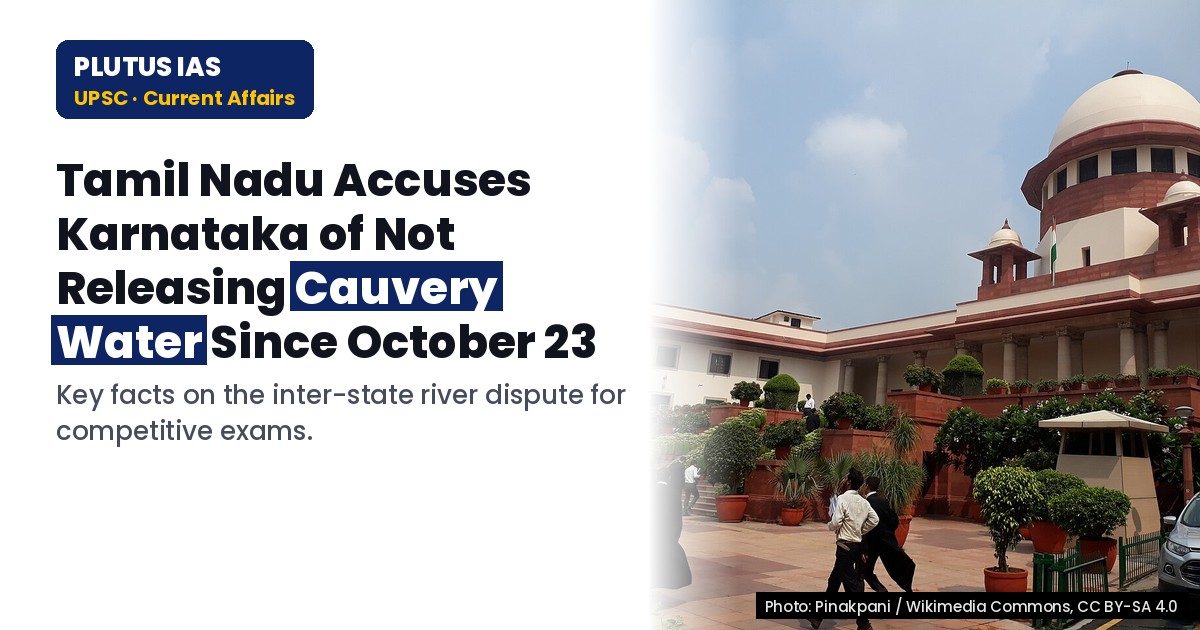
05 Nov Cauvery Water Dispute: TN Seeks SC Intervention
✎ Inter-state river water disputes in India are adjudicated by tribunals constituted under the Inter-State River Water Disputes Act, 1956, with the Supreme Court playing an oversight role, as exemplified by the ongoing Cauvery…
Subject Relevance — Where This Topic Fits
- GS Paper II — Polity and Governance (Inter-State Relations, Dispute Resolution Mechanisms) | GS Paper III — Environment (Water Resources, Sustainable Development)
- Prelims: Cauvery River, Cauvery Water Management Authority (CWMA), Cauvery Water Regulation Committee (CWRC), Inter-State River Water Disputes Act, 1956, Supreme Court of India, Article 262 of the Constitution
- Essay: Federalism and Inter-State Relations in India, Water Scarcity and Sustainable Water Management
Quick Revision: Inter-state river water disputes in India are adjudicated by tribunals constituted under the Inter-State River Water Disputes Act, 1956, with the Supreme Court playing an oversight role, as exemplified by the ongoing Cauvery dispute.
Why is this in the news?
The Tamil Nadu government has approached the Supreme Court of India seeking an urgent hearing regarding the alleged non-release of Cauvery river water by Karnataka. This action follows an accusation by Tamil Nadu that Karnataka has not complied with an order from the Cauvery Water Management Authority (CWMA) to release 3,000 cusecs of water daily since October 23, 2026, posing a significant threat to agricultural lands in Tamil Nadu.
Background
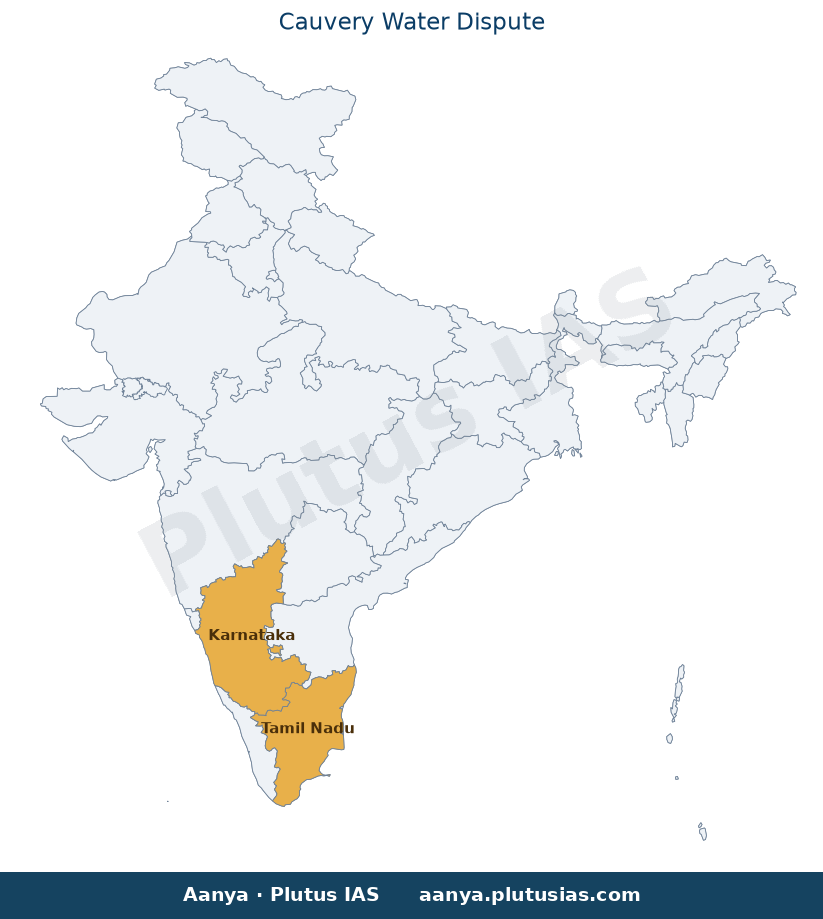
- The Cauvery River is a major peninsular river, originating in Talakaveri, Kodagu district, Karnataka, and flowing through Karnataka and Tamil Nadu, with a basin also covering parts of Kerala and Puducherry.
- The dispute over the sharing of Cauvery waters dates back to agreements between the erstwhile princely state of Mysore and the Madras Presidency in 1892 and 1924.
- Post-independence, the Inter-State River Water Disputes Act, 1956, was enacted to provide for the adjudication of disputes relating to waters of inter-state rivers and river valleys.
- The Cauvery Water Disputes Tribunal (CWDT) was constituted in 1990, delivering its final order in 2007, which allocated water shares among the basin states.
- The Supreme Court of India, in its 2018 judgment, largely upheld the CWDT’s final order with some modifications, notably increasing Karnataka’s share and directing the Union Government to constitute a scheme for the implementation of the award.
- In compliance with the Supreme Court’s directive, the Cauvery Water Management Authority (CWMA) and the Cauvery Water Regulation Committee (CWRC) were established in 2018 to ensure the implementation of the final award.
What is the Inter-State River Water Disputes Act, 1956?
- The Inter-State River Water Disputes Act, 1956, is a parliamentary enactment under Article 262 of the Indian Constitution, which empowers Parliament to legislate on the adjudication of disputes relating to waters of inter-state rivers and river valleys.
- Article 262(1) states that Parliament may by law provide for the adjudication of any dispute or complaint with respect to the use, distribution or control of the waters of, or in, any inter-State river or river valley.
- Article 262(2) further provides that Parliament may by law declare that neither the Supreme Court nor any other court shall exercise jurisdiction in respect of any such dispute or complaint.
- The Act provides for the constitution of a Tribunal by the Central Government to adjudicate such disputes, if negotiations between the concerned states fail.
- The decision of the Tribunal is final and binding on the parties to the dispute, and its implementation is overseen by the Central Government.
- The Act has been amended multiple times, with significant amendments in 2002 and a proposed Inter-State River Water Disputes (Amendment) Bill, 2019, aiming to streamline the adjudication process by establishing a single permanent tribunal with multiple benches.
Key Features
| Feature | Significance |
|---|---|
| Inter-State River Water Dispute | Highlights the persistent challenges in managing shared natural resources among states, necessitating robust institutional mechanisms. |
| Supreme Court’s Role | Underscores the judiciary’s critical function as an arbiter in inter-state disputes, particularly when statutory bodies’ directives are allegedly not followed. |
| Cauvery Water Management Authority (CWMA) | Illustrates the role of a statutory body established to implement the final award of the Cauvery Water Disputes Tribunal and subsequent Supreme Court directives. |
| Agricultural Impact | Emphasises the direct and severe consequences of water scarcity on agricultural livelihoods and food security in riparian states. |
| Urgent Oral Mentioning | Reflects the gravity and immediacy of the situation, prompting a direct appeal to the highest court for expedited intervention. |
Why it Matters
Governance and Federalism
- The dispute highlights the complexities of cooperative federalism in resource sharing, particularly concerning vital natural resources like water.
- It underscores the need for effective implementation and enforcement mechanisms for decisions made by statutory bodies like the CWMA to maintain inter-state harmony.
- The Supreme Court’s intervention reinforces the principle of judicial review and its role in upholding constitutional principles related to dispute resolution.
Economic Implications
- Water scarcity directly impacts agricultural productivity, potentially leading to crop losses and economic distress for farmers in the affected regions.
- Disruptions in water supply can have cascading effects on the rural economy, including employment, income generation, and food security.
- The dispute can deter investment and long-term planning in agricultural sectors of the riparian states due to uncertainty over water availability.
Environmental and Ecological Concerns
- Unregulated or insufficient water flow can impact riverine ecosystems, affecting biodiversity and the overall health of the river basin.
- The long-term sustainability of water resources in the Cauvery basin is crucial for both human consumption and ecological balance.
- Climate change impacts, such as altered rainfall patterns, are likely to exacerbate existing water disputes, necessitating adaptive management strategies.
Social Impact
- Water scarcity can lead to social unrest and discontent among agricultural communities dependent on river water for their livelihoods.
- The dispute affects the socio-economic fabric of the region, potentially leading to migration and increased vulnerability for marginalized farmers.
- Equitable distribution of water is essential for ensuring social justice and preventing disparities among different sections of the population.
Challenges
1. Inter-State Water Dispute Resolution
- Implementing awards and directives from tribunals and authorities remains a significant challenge, often requiring judicial intervention.
- Lack of consensus and political will among riparian states can hinder effective dispute resolution and cooperative management.
UPSC Link: Indian Constitution – Federalism
2. Data and Information Asymmetry
- Discrepancies in data related to water availability, rainfall, and storage levels can fuel disagreements and mistrust between states.
- Accurate and transparent data sharing is crucial for informed decision-making and equitable water allocation.
UPSC Link: Resource Management
3. Climate Change and Water Scarcity
- Changing rainfall patterns, increased frequency of droughts, and extreme weather events exacerbate water stress in river basins.
- Adapting existing water management strategies to account for climate variability is a complex and urgent requirement.
UPSC Link: Environment and Ecology – Climate Change
4. Institutional Effectiveness
- Ensuring that bodies like the Cauvery Water Management Authority have the necessary enforcement powers and political backing to implement their decisions effectively.
- Strengthening the institutional framework for inter-state water governance to prevent recurring disputes.
UPSC Link: Governance – Institutions
Challenges — UPSC Perspective
| Issue | Concern |
|---|---|
| Non-compliance with CWMA Order | Undermines the authority of statutory bodies established for dispute resolution and resource management. |
| Impact on Agriculture | Potential for widespread crop failure and significant economic losses for farmers, threatening food security. |
| Inter-State Relations | Perpetuates tensions and mistrust between riparian states, hindering cooperative federalism. |
| Judicial Burden | Frequent recourse to the Supreme Court for implementation issues places an additional burden on the judiciary. |
| Water Scarcity Management | Highlights the ongoing difficulty in equitably sharing scarce water resources, especially during lean periods. |
Way Forward
- Strengthening the enforcement mechanisms of the Cauvery Water Management Authority (CWMA) to ensure compliance with its directives.
- Promoting dialogue and collaborative decision-making between riparian states to foster a spirit of cooperative federalism in water management.
- Investing in advanced hydrological data collection and sharing systems to ensure transparency and build trust among states regarding water availability.
- Implementing water-efficient agricultural practices, such as micro-irrigation and crop diversification, to reduce overall water demand.
- Developing and promoting water conservation and rainwater harvesting initiatives across the basin to augment water resources.
- Exploring inter-basin water transfer possibilities where feasible and environmentally sound, to address regional water deficits.
- Establishing a robust monitoring and evaluation framework for water allocation and usage to ensure accountability and optimal resource utilization.
- Encouraging public awareness campaigns on responsible water usage and the importance of water conservation.
UPSC Value Addition
Keywords for Mains Answer-Writing
Inter-State Water Disputes Act · Cauvery Water Management Authority · Supreme Court’s original jurisdiction · Article 262 · River Boards Act · federalism · water governance · equitable water sharing · riparian rights · distress formula · judicial review of tribunal awards · cooperative federalism
Constitutional & Policy Linkages
- {‘article’: ‘Article 262’, ‘note’: ‘Adjudication of inter-state river disputes’}
- {‘article’: ‘Entry 17, State List’, ‘note’: ‘Water supply, irrigation, canals, drainage’}
- {‘article’: ‘Entry 56, Union List’, ‘note’: ‘Regulation of inter-state rivers’}
Concept Flow
Cauvery Water Management Authority issues water release order. → Allegation of non-compliance by one riparian state. → Affected state seeks urgent Supreme Court intervention. → Supreme Court agrees to early hearing of the plea. → Judicial process initiated for dispute resolution and compliance.
Prelims Practice Questions
Q1. Consider the following statements regarding inter-state river water disputes in India:
1. The Parliament is empowered to make laws for the adjudication of any dispute or complaint with respect to the use, distribution, or control of waters of any inter-state river or river valley.
2. The Inter-State Water Disputes Act, 1956, mandates the establishment of a tribunal by the Central Government if negotiations fail.
3. The decision of a River Water Disputes Tribunal is binding on the parties to the dispute and cannot be challenged in the Supreme Court.
- Only one
- Only two
- Only three
- None
Answer: Only two — Statement 1 is correct as per Article 262(1) of the Constitution. Statement 2 is correct, as the Act provides for the constitution of a tribunal. Statement 3 is incorrect; while the tribunal’s award is final and binding, it can be challenged in the Supreme Court under its special leave petition jurisdiction (Article 136).
Q2. Which of the following bodies is responsible for implementing the Cauvery Water Disputes Tribunal’s award and managing the Cauvery water resources?
- Cauvery River Authority
- Cauvery Water Management Authority
- Cauvery Water Regulation Committee
- Ministry of Jal Shakti
Answer: Cauvery Water Management Authority — The Cauvery Water Management Authority (CWMA) was constituted by the Central Government in 2018 to implement the final award of the Cauvery Water Disputes Tribunal (CWDT) as modified by the Supreme Court.
Mains Practice Question
✍ Critically examine the efficacy of institutional mechanisms, such as the Cauvery Water Management Authority and the Supreme Court, in resolving inter-state river water disputes in India. Discuss the challenges encountered in ensuring equitable water distribution. (15 Marks)
Approach: Introduction: Briefly introduce the significance of inter-state river water disputes and the constitutional framework (Article 262).
Body Part 1: Efficacy of Institutional Mechanisms.
* Cauvery Water Management Authority (CWMA): Discuss its mandate (implementation of tribunal awards, water regulation, distress formula), successes (e.g., structured decision-making), and limitations (e.g., challenges in enforcement, political pressures, data discrepancies).
* Supreme Court: Role in adjudicating disputes, interpreting tribunal awards, and issuing directions. Mention its original jurisdiction and appellate powers. Highlight the challenges of judicial intervention in what is often a complex technical and political issue.
* Inter-State Water Disputes Act, 1956: Briefly mention its provisions for tribunal formation and awards.
Body Part 2: Challenges in Ensuring Equitable Water Distribution.
* Data and Methodology: Issues with accurate assessment of water availability, rainfall, and crop water requirements.
* Distress Sharing Formula: Difficulties in implementing distress sharing mechanisms during lean years, leading to accusations of non-compliance.
* Political Will and Federalism: Lack of consensus among riparian states, political considerations overriding technical solutions, and challenges to cooperative federalism.
* Climate Change: Impact of changing rainfall patterns and increased frequency of droughts/floods on water availability.
* Socio-economic Factors: Competing demands from agriculture, industry, and domestic sectors, and the livelihood implications for farmers.
Conclusion: Summarize the need for a balanced approach involving robust institutional frameworks, scientific data, political consensus, and a spirit of cooperative federalism for sustainable resolution of inter-state water disputes.
Source: The Hindu
Tamil Nadu PCS (TNPSC) — State PCS Practice
Prelims: Which of the following bodies did Tamil Nadu recently approach for an urgent oral mentioning regarding the Cauvery water issue?
- Madras High Court
- Cauvery Water Management Authority
- Supreme Court of India
- National Green Tribunal
Answer: Supreme Court of India — Tamil Nadu sought an urgent oral mentioning in the Supreme Court concerning the Cauvery water dispute.
Mains: Discuss the significance of Tamil Nadu seeking an urgent oral mentioning in the Supreme Court regarding the Cauvery water issue, highlighting the potential implications for inter-state water disputes in the Indian federal structure.
Generated by AanyaAi for educational purpose.
Related guides on our sites
- Anthropology VS PSIR
- Best PSIR optional coaching
- Best PSIR optional coaching online
- Best PSIR optional teacher

- Cauvery Water Dispute: TN Seeks SC Intervention - November 5, 2026
- पश्चिम बंगाल की नई भूमि नीति: ‘सिंगूर या नंदीग्राम नहीं’ - November 5, 2026
- India Extends $500M Credit to Guyana for Defence, Infra - November 5, 2026

No Comments