


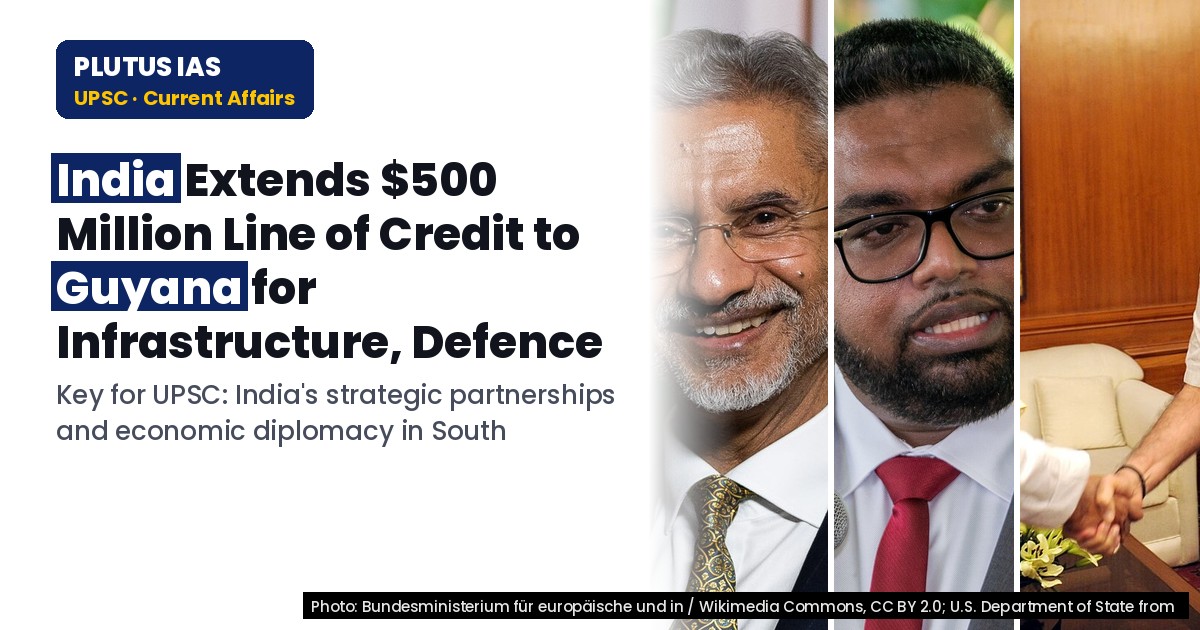
05 Nov India Extends $500M Credit to Guyana for Defence, Infra
✎ India's extension of a USD 500 million Line of Credit to Guyana for infrastructure and defence projects signifies a strengthening of bilateral ties and a commitment to South-South Cooperation, leveraging economic diplomacy for…
Subject Relevance — Where This Topic Fits
- GS Paper II — International Relations: India’s foreign policy, bilateral relations, impact of policies and politics of developed and developing countries on India’s interests, Indian diaspora. | GS Paper III — Economy: Mobilisation of resources, infrastructure, investment models.
- Prelims: Line of Credit (LoC), Commonwealth Heads of Government Meeting (CHOGM), Digital Public Infrastructure (DPI), Unified Payments Interface (UPI), India-Guyana relations, South-South Cooperation, Indian diaspora, External Affairs Minister (EAM), Quick Impact Projects (QIPs)
- Essay: India’s growing global influence and its role in fostering South-South Cooperation., The significance of diaspora in strengthening bilateral ties and economic diplomacy.
Quick Revision: India’s extension of a USD 500 million Line of Credit to Guyana for infrastructure and defence projects signifies a strengthening of bilateral ties and a commitment to South-South Cooperation, leveraging economic diplomacy for mutual development.
Why is this in the news?
India has extended a Line of Credit (LoC) amounting to USD 500 million to Guyana for the development of public and defence infrastructure, including roads and health projects. This announcement was made during a meeting between India’s External Affairs Minister and the Guyanese President on the sidelines of the Commonwealth Heads of Government Meeting (CHOGM) 2026, underscoring the deepening strategic partnership and development cooperation between the two nations.
Background
- India and Guyana have maintained close and cordial diplomatic relations since Guyana’s independence in May 1966, characterised by a high degree of mutual understanding.
- Prime Minister Narendra Modi’s landmark state visit to Guyana in November 2024, the first by an Indian Prime Minister in 56 years, marked a significant milestone in bilateral ties, during which he was conferred Guyana’s highest national award, the ‘Order of Excellence’.
- Bilateral cooperation spans various sectors, including energy, healthcare, digital innovation, capacity building, and sustainable development, rooted in shared history and democratic values.
- Recent engagements include the presentation of credentials by India’s High Commissioner to Guyana, emphasising the strengthening of multi-dimensional relationships and the need to tap vast untapped potential.
- The 60th anniversary of Guyana’s independence and 60 years of India-Guyana diplomatic relations were celebrated in August, with India reaffirming its commitment to a trusted and forward-looking partnership.
- Agreements were also signed on the supply and installation of Micro and Small Enterprises (MSEs) manufacturing projects, grant assistance for Quick Impact Projects, and cooperation in Digital Public Infrastructure (DPI), including a UPI-like system in Guyana.
What is a Line of Credit (LoC)?
- A Line of Credit (LoC) is a ‘soft loan’ provided by one government to another, or by a financial institution to a sovereign entity, for specific developmental projects.
- These loans are typically extended at concessional interest rates and with longer repayment periods compared to commercial loans, making them attractive for developing nations.
- LoCs are a key instrument of India’s economic diplomacy, enabling partner countries to procure goods, services, and expertise from India, thereby promoting Indian exports and fostering economic linkages.
- The projects funded through LoCs often include infrastructure development (roads, railways, power), industrialisation, agriculture, and social sector initiatives (health, education).
- The terms and conditions of each LoC are negotiated bilaterally, specifying the sectors, project eligibility, procurement procedures, and repayment schedules.
- India’s LoCs are administered primarily by the Export-Import Bank of India (EXIM Bank) on behalf of the Government of India, facilitating project implementation and financial management.
- Beyond financial assistance, LoCs contribute to capacity building in recipient countries by involving Indian companies and experts, transferring technology, and creating employment opportunities.
- The extension of LoCs aligns with India’s ‘Act East’ and ‘Act West’ policies, as well as its broader commitment to South-South Cooperation, supporting sustainable development in partner nations.
Key Features
| Feature | Significance |
|---|---|
| Extension of $500 Million Line of Credit | A substantial financial commitment from India to Guyana, facilitating diverse developmental projects. |
| Focus on Infrastructure Development | Allocation of funds towards critical sectors such as roads and health, enhancing Guyana’s public services and connectivity. |
| Inclusion of Defence Projects | Diversification of cooperation into the defence sector, potentially strengthening Guyana’s security capabilities and fostering strategic alignment. |
| Agreements on MSEs Manufacturing Projects | Promotion of micro and small enterprises, contributing to local industrial growth and employment generation in Guyana. |
| Cooperation in Digital Public Infrastructure (DPI) and UPI-like System | Facilitation of digital transformation and financial inclusion through the adoption of India’s successful digital payment models. |
| Grant Assistance for Quick Impact Projects | Provision of immediate, tangible benefits to local communities, enhancing goodwill and addressing pressing needs. |
Why it Matters
Economic Significance
- The Line of Credit (LoC) provides a crucial financial impetus for Guyana’s economic development, particularly in infrastructure, which is a key driver of growth.
- Support for Micro and Small Enterprises (MSEs) manufacturing projects can stimulate local production, create employment opportunities, and foster economic diversification.
- Cooperation in Digital Public Infrastructure (DPI) and a UPI-like system can enhance financial inclusion, streamline transactions, and boost the digital economy in Guyana.
Strategic Significance
- The extension of the LoC, including defence projects, strengthens India’s strategic footprint in the South American region, aligning with its broader foreign policy objectives.
- Enhanced bilateral ties with Guyana, a resource-rich nation, contribute to India’s energy security and access to critical raw materials.
- Deepening engagement with Commonwealth nations, as evidenced by the meeting on the sidelines of CHOGM, reinforces India’s multilateral diplomacy and influence.
Diplomatic Significance
- The consistent high-level engagements, including the Prime Minister’s visit and ministerial interactions, underscore the robust and cordial nature of India-Guyana relations.
- The conferment of Guyana’s highest national award to the Indian Prime Minister signifies the mutual respect and importance attached to the bilateral partnership.
- Cooperation across diverse sectors demonstrates a comprehensive and forward-looking partnership, moving beyond traditional areas of engagement.
Developmental Significance
- Investment in roads and health infrastructure directly addresses critical developmental needs in Guyana, improving quality of life and access to essential services.
- The implementation of Quick Impact Projects (QIPs) offers a mechanism for rapid, community-level development interventions, demonstrating tangible benefits of cooperation.
- Sharing expertise in digital innovation, particularly a UPI-like system, can accelerate Guyana’s digital transformation journey, mirroring India’s success in this domain.
Challenges
1. Effective Project Implementation
- Ensuring timely and efficient execution of infrastructure and defence projects funded by the Line of Credit, overcoming potential logistical and administrative hurdles.
- Monitoring the quality and sustainability of projects to ensure long-term benefits and optimal utilization of financial assistance.
UPSC Link: Government policies and interventions
2. Debt Sustainability for Recipient Nation
- Managing the debt burden associated with the Line of Credit to ensure it remains sustainable for Guyana’s economy.
- Balancing the immediate developmental needs with long-term fiscal prudence and economic stability.
UPSC Link: Indian Economy and issues relating to planning
3. Geopolitical Dynamics in South America
- Navigating the complex geopolitical landscape of South America, which may involve competing interests from other global powers.
- Maintaining a balanced foreign policy that serves India’s strategic interests while respecting regional sensitivities.
UPSC Link: India and its neighbourhood- relations
4. Capacity Building and Technology Transfer
- Ensuring effective transfer of technology and expertise in defence and digital infrastructure projects to empower local capabilities in Guyana.
- Addressing potential skill gaps and ensuring adequate training for the operation and maintenance of new systems and infrastructure.
UPSC Link: Science and Technology-developments
Challenges — UPSC Perspective
| Issue | Concern |
|---|---|
| Project Management and Oversight | Potential for delays, cost overruns, and quality control issues in large-scale infrastructure and defence projects. |
| Economic Viability of Projects | Ensuring that funded projects generate sufficient economic returns or social benefits to justify the investment and contribute to Guyana’s growth. |
| Local Content and Employment | Maximizing the involvement of Guyanese businesses and workforce in project execution to foster local economic development and skill enhancement. |
| Sustainability of Digital Initiatives | Ensuring the long-term adoption, maintenance, and cybersecurity of Digital Public Infrastructure and UPI-like systems in Guyana. |
| Regional Power Dynamics | Potential for external influence or competition from other international actors in the South American region impacting bilateral cooperation. |
Way Forward
- Prioritize robust project management frameworks and transparent monitoring mechanisms for all Line of Credit projects to ensure efficient execution and accountability.
- Conduct thorough feasibility studies and impact assessments for proposed projects to ensure their economic viability and alignment with Guyana’s national development priorities.
- Focus on capacity building initiatives alongside infrastructure development, including training programs and skill transfer, to empower local human resources in Guyana.
- Explore avenues for joint ventures and public-private partnerships to enhance resource mobilization and leverage expertise from both nations.
- Diversify cooperation beyond traditional sectors to include emerging areas such as renewable energy, climate resilience, and blue economy initiatives.
- Strengthen cultural and people-to-people exchanges to foster deeper understanding and goodwill, complementing economic and strategic partnerships.
- Regularly review and adapt the cooperation framework to respond to evolving needs and global challenges, ensuring the partnership remains dynamic and relevant.
- Promote greater engagement with regional organizations in South America to foster a collaborative approach to regional development and stability.
UPSC Value Addition
Keywords for Mains Answer-Writing
Line of Credit · Economic Diplomacy · South-South Cooperation · Infrastructure Development · Defence Cooperation · Bilateral Relations · Commonwealth Heads of Government Meeting (CHOGM) · Digital Public Infrastructure · UPI-like System · Strategic Partnerships · Geopolitical Significance · Capacity Building
Concept Flow
India extends Line of Credit to Guyana → Funds allocated for infrastructure, defence, digital projects → Guyana’s public services and security enhanced → Economic growth and digital inclusion fostered → Bilateral relations and strategic partnership strengthened
Prelims Practice Questions
Q1. Consider the following statements regarding India’s Lines of Credit (LoC):
1. Lines of Credit are concessional loans extended by the Government of India to developing countries.
2. The Export-Import Bank of India (EXIM Bank) is the primary institution for administering these LoCs.
3. LoCs are typically tied to the procurement of goods and services from India.
How many of the above statements are correct?
- Only one
- Only two
- All three
- None
Answer: All three — Statement 1 is correct: LoCs are indeed concessional loans provided by India to partner countries, often with favourable interest rates and repayment terms. Statement 2 is correct: EXIM Bank plays a crucial role as the nodal agency for operationalising and administering the LoCs extended by the Government of India. Statement 3 is correct: A significant feature of India’s LoCs is the ‘tying’ clause, which mandates that a certain percentage of the goods and services for the projects must be sourced from India, thereby promoting Indian exports and expertise.
Q2. Match the following Indian diplomatic initiatives with their primary focus:
List I (Initiative)
(A) Act East Policy
(B) Neighbourhood First Policy
(C) SAGAR Doctrine
(D) Lines of Credit
List II (Primary Focus)
(1) Enhancing maritime security and cooperation in the Indian Ocean region
(2) Strengthening economic and strategic ties with Southeast Asian nations
(3) Providing concessional financing for development projects in partner countries
(4) Prioritising relations with immediate neighbours
Select the correct matching using the codes given below:
- A-2, B-4, C-1, D-3
- A-4, B-2, C-3, D-1
- A-2, B-1, C-4, D-3
- A-3, B-4, C-1, D-2
Answer: A-2, B-4, C-1, D-3 — Act East Policy (A) focuses on strengthening engagement with Southeast Asian nations (2). Neighbourhood First Policy (B) prioritises relations with immediate neighbours (4). SAGAR Doctrine (C) (Security and Growth for All in the Region) is aimed at enhancing maritime security and cooperation in the Indian Ocean region (1). Lines of Credit (D) are a tool of economic diplomacy providing concessional financing for development projects (3).
Mains Practice Question
✍ Examine the role of Lines of Credit as a significant instrument of India’s economic diplomacy in fostering bilateral relations and promoting its strategic interests. Discuss with reference to recent engagements, particularly with countries in the Global South. (15 Marks)
Approach: MODEL-ANSWER SKELETON:
1. **Introduction:** Define Lines of Credit (LoC) as concessional financial assistance extended by India to developing countries, primarily through EXIM Bank, for specific development projects. Briefly state their dual objective: economic development in recipient countries and promotion of India’s strategic and commercial interests.
2. **Role as an Instrument of Economic Diplomacy:**
* **Market Access and Export Promotion:** LoCs facilitate the export of Indian goods, services, and expertise, creating market opportunities for Indian companies.
* **Infrastructure Development:** Support for critical infrastructure projects (roads, energy, health) in partner countries, aligning with their developmental priorities.
* **Capacity Building:** Often includes technical assistance and training components, enhancing human resource capabilities in recipient nations.
* **Soft Power Projection:** Builds goodwill and strengthens political ties, projecting India as a reliable development partner.
* **Debt Sustainability:** Offers an alternative to commercial loans, often with more favourable terms, contributing to the debt sustainability of developing nations.
3. **Fostering Bilateral Relations:**
* **Deepening Engagement:** LoCs provide a tangible framework for long-term cooperation and dialogue.
* **Strategic Partnerships:** Used to cultivate alliances and strengthen ties with strategically important nations, particularly in regions like Africa, South Asia, and Latin America.
* **Multilateral Alignment:** Encourages alignment on global issues and strengthens India’s position in multilateral forums.
4. **Promoting Strategic Interests (with reference to Global South):**
* **Energy Security:** Investments in energy projects in resource-rich countries (e.g., Guyana, African nations) secure access to vital resources.
* **Maritime Security:** Support for defence and coastal infrastructure projects in littoral states contributes to regional security and India’s SAGAR doctrine.
* **Digital Public Infrastructure:** Promotion of Indian models like UPI in partner countries (e.g., Guyana) enhances digital connectivity and interoperability.
* **Counterbalancing Influence:** Offers an alternative development partnership model amidst increasing geopolitical competition.
* **Recent Engagements (e.g., Guyana):** Cite the $500 million LoC to Guyana for infrastructure and defence, agreements on Digital Public Infrastructure, and UPI-like systems as concrete examples of these objectives in action.
5. **Challenges/Limitations (Briefly):** Mention potential issues like project implementation delays, recipient country’s absorption capacity, and the need for rigorous project appraisal.
6. **Conclusion:** Reiterate that LoCs are a versatile and effective tool of India’s foreign policy, enabling it to pursue both developmental and strategic objectives, particularly in strengthening its position and influence within the Global South.
Source: orissapost.com
Generated by AanyaAi for educational purpose.
Related guides on our sites
- Best PSIR optional coaching for upsc
- Best PSIR optional teacher for upsc
- Best teacher of PSIR optional for upsc
- Best PSIR optional coaching in delhi for UPSC

- India Extends $500M Credit to Guyana for Defence, Infra - November 5, 2026
- NHRC हस्तक्षेप: हैदराबाद जेल में लैंगिक-तटस्थ प्रकोष्ठ की स्थापना - November 5, 2026
- Treasury Bills Auction: RBI Releases Full Results for UPSC Exam - November 5, 2026

No Comments