


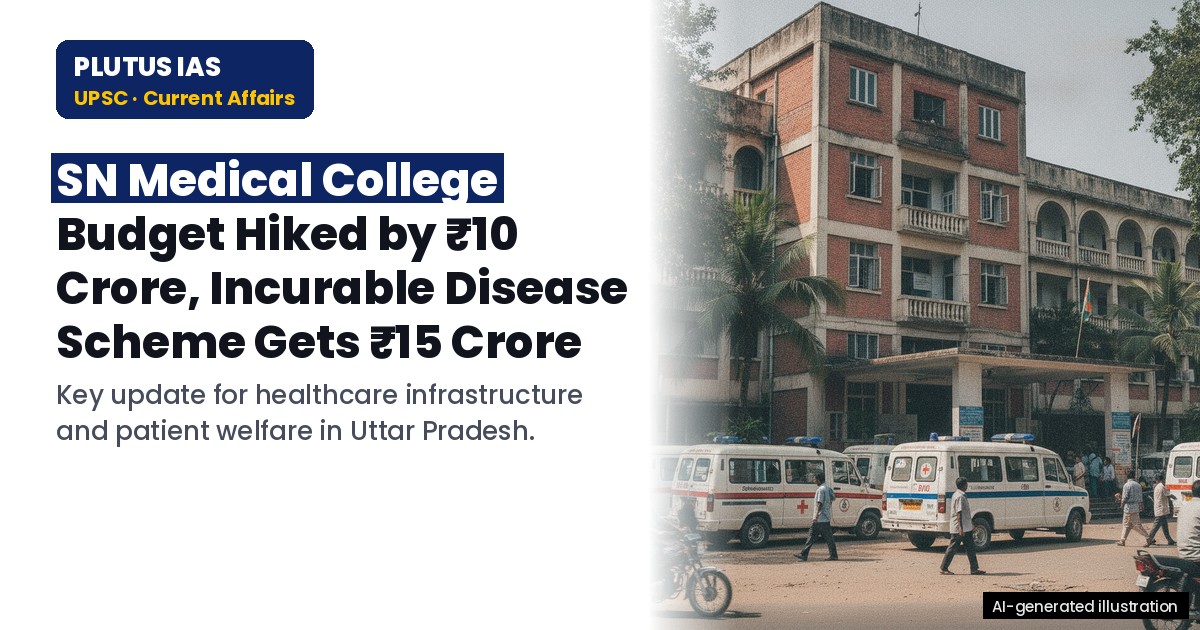
05 Nov UP SN Medical College Budget Hike: Impact on Patient Care
✎ The increased budget for SN Medical College and the 'Asadhya Rog Yojana' in Uttar Pradesh underscores the state government's commitment to enhancing public healthcare infrastructure and ensuring access to critical illness…
Subject Relevance — Where This Topic Fits
- GS Paper II — Governance, Social Justice (Health) | GS Paper III — Indian Economy (Government Budgeting)
- Prelims: SN Medical College, Asadhya Rog Yojana, Critical illness schemes, State government healthcare funding, Medical education budget, Public health infrastructure
- Essay: The role of public health infrastructure in national development, Budgetary allocations and their impact on social welfare
Quick Revision: The increased budget for SN Medical College and the ‘Asadhya Rog Yojana’ in Uttar Pradesh underscores the state government’s commitment to enhancing public healthcare infrastructure and ensuring access to critical illness treatment for vulnerable populations.
Why is this in the news?
The budget for SN Medical College in Uttar Pradesh has been augmented by approximately ₹10 crore. This increase includes a significant enhancement in the allocation for the ‘Asadhya Rog Yojana’ (Critical Illness Scheme) from ₹8 crore to ₹15 crore, alongside additional funds for medicines, chemicals, and oxygen. This budgetary expansion aims to improve patient care and facilitate the treatment of a greater number of individuals, particularly those requiring advanced medical interventions for critical ailments.
Background
- Public healthcare institutions, such as medical colleges, serve as crucial pillars of the healthcare system, providing both medical education and patient care.
- State governments play a pivotal role in funding and managing these institutions, ensuring access to medical services for their populations.
- Critical illness schemes are designed to provide financial assistance for the treatment of severe diseases like cancer, kidney ailments, heart conditions, and liver diseases, often targeting economically vulnerable sections of society.
- The ‘Antyodaya’ category of ration cardholders typically represents the poorest households, often receiving priority access to such welfare schemes.
- Budgetary allocations for medical colleges cover various expenditures, including infrastructure development, procurement of medical supplies (medicines, chemicals, oxygen), maintenance of equipment, and operational costs.
- The increasing patient load and the establishment of new departments within medical colleges necessitate periodic reviews and adjustments of their financial provisions.
Understanding Healthcare Funding and Critical Illness Schemes
- Healthcare funding in India is a shared responsibility between the central and state governments, with states primarily managing public health infrastructure and services within their jurisdiction.
- Medical colleges, besides their educational mandate, function as tertiary care hospitals, offering specialized treatments and advanced diagnostic facilities.
- Critical illness schemes are government-sponsored initiatives aimed at mitigating the financial burden of expensive treatments for life-threatening diseases on patients and their families.
- These schemes often involve direct financial aid, reimbursement of medical expenses, or cashless treatment facilities at empanelled hospitals.
- Eligibility criteria for such schemes typically include income limits, specific disease conditions, and residency requirements.
- The objective of increasing budgetary allocations for medical colleges is to enhance their capacity to provide quality healthcare, accommodate a larger patient volume, and upgrade medical facilities.
- Improved funding for essential supplies like medicines and oxygen directly impacts the quality and availability of treatment, especially in emergency and critical care settings.
- The ‘Asadhya Rog Yojana’ exemplifies a state-level initiative focused on providing free treatment to needy patients, particularly those holding Antyodaya ration cards, for a defined set of critical illnesses.
Key Features
| Feature | Significance |
|---|---|
| Increased Budget Allocation for SN Medical College | Enhances the operational capacity and service delivery of a key public healthcare institution in Uttar Pradesh. |
| Enhanced ‘Asadhya Rog Yojana’ (Incurable Disease Scheme) Budget | Directly benefits patients suffering from critical illnesses such as cancer, kidney ailments, heart conditions, and liver diseases, particularly those from economically vulnerable backgrounds. |
| Increased Funds for Medicines, Chemicals, and Oxygen | Ensures the availability of essential medical supplies, crucial for effective patient care and laboratory diagnostics. |
| Support for Antyodaya Category Ration Cardholders | Provides free treatment to the most indigent sections of society, aligning with inclusive healthcare objectives. |
| Response to Increased Patient Load and Department Expansion | Reflects a proactive governmental approach to address growing healthcare demands and infrastructural development within medical colleges. |
Why it Matters
Social Impact
- Facilitates improved access to advanced medical treatment for a larger segment of the population, especially those requiring specialized care for incurable diseases.
- Reduces the financial burden on economically disadvantaged families by providing free treatment under the ‘Asadhya Rog Yojana’, thereby promoting health equity.
- Enhances the overall quality of public healthcare services by ensuring adequate provision of essential medicines, chemicals, and oxygen.
Governance and Policy
- Demonstrates the government’s commitment to strengthening public health infrastructure and responding to evolving healthcare needs.
- Reinforces the role of state-level schemes in complementing national health initiatives to achieve universal health coverage.
- Highlights the importance of dynamic budget allocation in public institutions to match increasing service demands and infrastructural growth.
Healthcare System Strengthening
- Supports the operational efficiency of medical colleges, which are pivotal for both patient care and medical education/research.
- Enables the expansion of diagnostic and treatment facilities, contributing to a more robust healthcare delivery system.
- Addresses critical supply chain requirements for medical consumables, preventing shortages that could compromise patient outcomes.
Challenges
1. Sustainable Funding Mechanisms
- Ensuring consistent and adequate funding for healthcare institutions beyond ad-hoc increases, especially given rising healthcare costs and technological advancements.
- Developing predictable funding models that can sustain expanded services and infrastructure over the long term without relying solely on annual budget revisions.
UPSC Link: Health Sector Financing
2. Equitable Access Across Regions
- Addressing disparities in healthcare access and quality between urban and rural areas, ensuring that similar enhancements are extended to other medical facilities.
- Preventing over-centralization of specialized care, which can strain major medical colleges while leaving peripheral areas underserved.
UPSC Link: Healthcare Delivery Challenges
3. Efficient Resource Utilization
- Optimizing the procurement and inventory management of medicines, chemicals, and oxygen to minimize wastage and ensure timely availability.
- Implementing robust audit mechanisms to ensure that increased budgetary allocations translate effectively into improved patient care and facility upgrades.
UPSC Link: Public Expenditure Management
4. Human Resource Development
- Ensuring that increased patient loads and departmental expansions are matched by a proportionate increase in qualified medical and paramedical personnel.
- Addressing potential shortages of specialized doctors and support staff, which can limit the effective utilization of enhanced budgets and facilities.
UPSC Link: Human Resources in Health
Challenges — UPSC Perspective
| Issue | Concern |
|---|---|
| Rising Healthcare Costs | The continuous escalation in the cost of advanced medical treatments, pharmaceuticals, and equipment necessitates ever-increasing budgetary allocations, posing a fiscal challenge. |
| Infrastructure and Technology Gap | Despite budget increases, many public medical colleges may still face gaps in modern infrastructure and advanced medical technology compared to private counterparts. |
| Quality of Care and Patient Experience | Ensuring that increased funding translates into tangible improvements in the quality of patient care, reduced waiting times, and an overall positive patient experience. |
| Bureaucratic Delays in Fund Utilization | Potential for administrative inefficiencies and bureaucratic hurdles to delay the timely and effective utilization of allocated funds for procurement and upgrades. |
| Attracting and Retaining Talent | Challenges in attracting and retaining highly skilled medical professionals in public sector institutions, despite improved facilities and budgets. |
Government Initiatives — Must-Memorise for Prelims
- Asadhya Rog Yojana
Way Forward
- Implement a comprehensive long-term financial strategy for public medical colleges, moving beyond annual budget revisions to ensure sustainable growth and operational stability.
- Strengthen procurement processes through transparent e-tendering and bulk purchasing to achieve cost efficiencies in acquiring medicines, chemicals, and equipment.
- Invest in modernizing healthcare infrastructure and integrating advanced medical technologies across all public medical colleges to enhance diagnostic and treatment capabilities.
- Develop robust monitoring and evaluation frameworks to track the utilization of allocated funds and assess their direct impact on patient outcomes and service quality.
- Prioritize human resource development by increasing recruitment of specialized medical professionals and providing continuous training to existing staff.
- Expand the scope and reach of schemes like ‘Asadhya Rog Yojana’ to cover a wider range of critical illnesses and ensure equitable access for all eligible beneficiaries.
- Foster greater autonomy for medical college administrations in financial management, coupled with accountability mechanisms, to facilitate quicker decision-making and resource deployment.
UPSC Value Addition
Keywords for Mains Answer-Writing
Healthcare financing · Public health infrastructure · State-funded healthcare schemes · Tertiary care accessibility · Medical education institutions · Budgetary allocation for health · Chronic disease management · Vulnerable sections healthcare
Constitutional & Policy Linkages
- Article 21: Right to Life and Personal Liberty (includes right to health)
- Article 47: Duty of the State to raise the level of nutrition and the standard of living and to improve public health
Concept Flow
Increased patient load and departmental expansion in SN Medical College. → Government assesses increased healthcare demands and infrastructural needs. → Budget allocation for SN Medical College is enhanced, including ‘Asadhya Rog Yojana’. → Funds released for medicines, chemicals, oxygen, and free treatment for indigent patients. → Improved availability of medical supplies and expanded treatment capacity. → Enhanced access to quality healthcare for patients, especially those with critical illnesses. → Overall strengthening of public health services and medical education infrastructure.
Prelims Practice Questions
Q1. Consider the following statements regarding healthcare financing in India:
1. Public health expenditure in India, as a percentage of GDP, is among the lowest globally.
2. State governments play a significant role in funding healthcare services, particularly at the primary and secondary levels.
3. Centrally Sponsored Schemes are the sole mechanism for central government financial assistance to states for health initiatives.
How many of the above statements are correct?
- Only one
- Only two
- Only three
- None
Answer: Only two — Statement 1 is correct: India’s public health expenditure as a percentage of GDP is indeed relatively low compared to many other nations. Statement 2 is correct: State governments bear a substantial portion of healthcare expenditure, especially for public health facilities and services within their jurisdiction. Statement 3 is incorrect: Besides Centrally Sponsored Schemes, there are also Central Sector Schemes and direct funding mechanisms through various ministries and departments.
Q2. Which of the following diseases are typically covered under state-sponsored ‘Aasaadhya Rog Yojana’ (Chronic Disease Scheme) or similar initiatives aimed at providing financial assistance for critical illnesses?
1. Cancer
2. Kidney diseases
3. Heart ailments
4. Liver diseases
Select the correct answer using the code given below:
- 1 and 2 only
- 2, 3 and 4 only
- 1, 3 and 4 only
- 1, 2, 3 and 4
Answer: 1, 2, 3 and 4 — The news article explicitly mentions Cancer, Kidney, Heart, and Liver diseases as those typically covered under the ‘Aasaadhya Rog Yojana’. These are common categories of chronic, high-cost illnesses for which such schemes provide financial relief.
Mains Practice Question
✍ Examine the role of state governments in strengthening public health infrastructure and ensuring equitable access to tertiary healthcare services. Discuss the challenges encountered in achieving these objectives, with reference to budgetary allocations and scheme implementation. (15 Marks)
Approach: Introduction: Briefly define public health infrastructure and tertiary healthcare. Role of State Governments: Discuss constitutional mandate (State List), primary responsibility for healthcare delivery, funding mechanisms (state budgets), implementation of state-specific health schemes (e.g., Aasaadhya Rog Yojana), management of state medical colleges and hospitals, and human resource development. Challenges: Financial constraints (low public health expenditure, competing demands), infrastructure gaps (rural-urban disparity, equipment shortages), human resource shortages (doctors, specialists, paramedics), quality of care issues, implementation bottlenecks in schemes, lack of robust data for planning, and coordination issues with central schemes. Budgetary Allocations: Discuss the inadequacy of current allocations, the need for increased investment, and efficient utilisation. Scheme Implementation: Focus on effectiveness, reach, transparency, and targeting of beneficiaries (e.g., Antyodaya cardholders). Conclusion: Summarise the critical role of states and suggest measures for improvement, such as increased budgetary commitment, better inter-departmental coordination, and robust monitoring mechanisms.
Source: amarujala.com
Generated by AanyaAi for educational purpose.
Related guides on our sites
- Anthropology VS PSIR
- Best PSIR optional coaching
- Best PSIR optional coaching online
- Best PSIR optional teacher

- UP SN Medical College Budget Hike: Impact on Patient Care - November 5, 2026
- छत्तीसगढ़: अहिवारा सीट रिक्त, उपचुनाव की प्रक्रिया शुरू - November 5, 2026
- Cauvery Water Dispute: TN Seeks SC Intervention - November 5, 2026

No Comments