


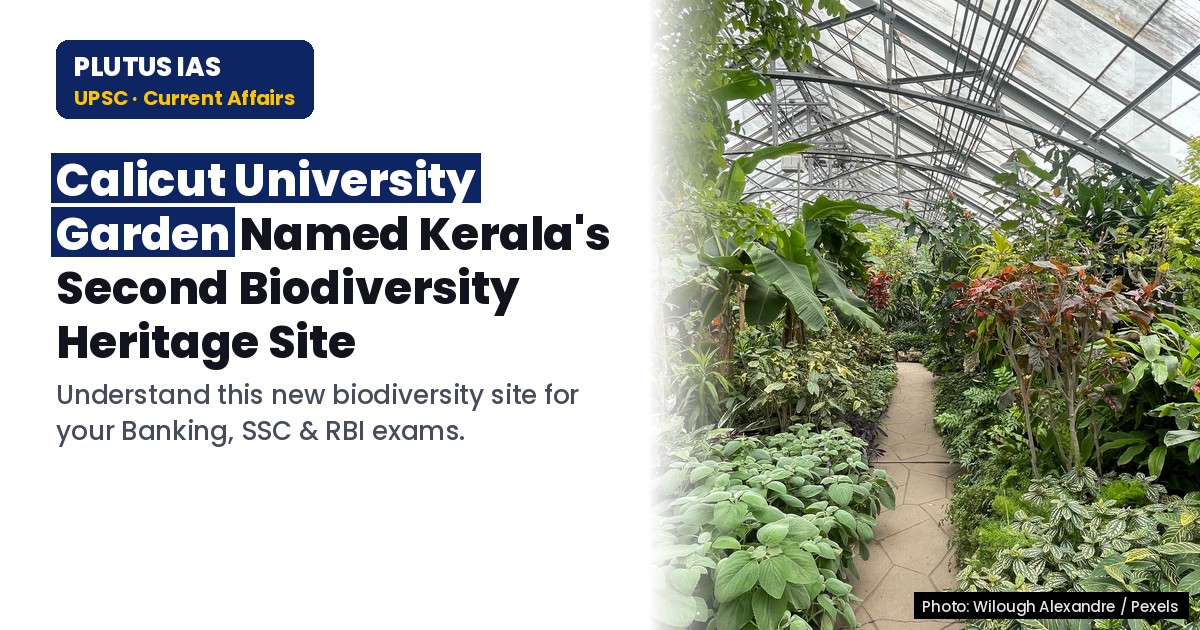
07 Nov Calicut University Garden: Kerala’s Second Biodiversity Heritage Site
✎ Biodiversity Heritage Sites are ecologically unique areas notified by State Governments under the Biological Diversity Act, 2002, for the conservation of rich and fragile biodiversity, often involving local community…
Subject Relevance — Where This Topic Fits
- GS Paper III — Environment and Ecology; Conservation, Environmental Pollution and Degradation, Environmental Impact Assessment
- Prelims: Biodiversity Heritage Site, Biological Diversity Act, 2002, National Biodiversity Board, State Biodiversity Board, Botanical gardens, In-situ conservation, Ex-situ conservation, Western Ghats
- Essay: Biodiversity conservation and sustainable development, The role of local communities and institutions in environmental protection
Quick Revision: Biodiversity Heritage Sites are ecologically unique areas notified by State Governments under the Biological Diversity Act, 2002, for the conservation of rich and fragile biodiversity, often involving local community participation.
Why is this in the news?
The Botanical Garden under the Department of Botany at the University of Calicut has been officially designated as Keralam’s second Biodiversity Heritage Site (BHS) through a gazette notification issued by the State government. This recognition highlights the garden’s significant collection of rare plant species, including those from the Western Ghats, Andaman and Nicobar Islands, and northeastern States, underscoring its importance for biodiversity conservation and research.
Background
- The Biological Diversity Act, 2002, enacted to give effect to the Convention on Biological Diversity (CBD), provides the legal framework for the conservation of biological diversity, sustainable use of its components, and fair and equitable sharing of benefits arising from the use of biological resources.
- Section 37 of the Biological Diversity Act, 2002, empowers State Governments to notify areas of biodiversity importance as Biodiversity Heritage Sites (BHS) in consultation with local bodies.
- The criteria for declaring a BHS include areas with unique, fragile ecosystems, species richness, presence of rare and endemic species, sacred groves, or areas with significant cultural or aesthetic value.
- The first Biodiversity Heritage Site in Kerala is the Ashramam Mangrove area near Ashtamudi Lake creek in Kollam, designated prior to the Calicut University Botanical Garden.
- Botanical gardens play a crucial role in ex-situ conservation, research, and public education regarding plant diversity and environmental protection.
- The Interdisciplinary Centre for Bioprospecting on the Calicut University campus, funded under the Pradhan Mantri Uchchatar Shiksha Abhiyan (PM-USHA) scheme, will collaborate with the garden on plant conservation projects.
What are Biodiversity Heritage Sites (BHS)?
- Biodiversity Heritage Sites are ecologically unique and fragile ecosystems, terrestrial, coastal and inland waters, or marine areas, having rich biodiversity comprising of any one or more of the following components: species richness, high endemism, presence of rare and threatened species, evolutionary significance, wild ancestors of domesticated species, or significant cultural or aesthetic values.
- These sites are declared by State Governments in consultation with local bodies, under Section 37 of the Biological Diversity Act, 2002.
- The primary objective of designating BHS is to conserve and protect biodiversity in these specific areas, often involving local communities in their management.
- The declaration of a BHS aims to promote sustainable management practices and raise public awareness about the importance of biodiversity.
- The National Biodiversity Authority (NBA) and State Biodiversity Boards (SBBs) are instrumental in the identification, notification, and management of these sites.
- The Calicut University Botanical Garden exemplifies a BHS due to its extensive collection of rare plants, including those from biodiversity hotspots like the Western Ghats, and its role in research and education.
Key Features
| Feature | Significance |
|---|---|
| Biodiversity Heritage Site (BHS) Status | Designation under the Biological Diversity Act, 2002, to conserve unique and threatened ecosystems. |
| Calicut University Botanical Garden | Kerala’s second BHS, recognized for its rich collection of rare plant species and ecological importance. |
| Ashramam Mangrove Area, Kollam | Kerala’s first BHS, highlighting the state’s commitment to biodiversity conservation. |
| Diverse Plant Collection | Houses bryophytes, ferns, cacti, aquatic plants, wild ginger, wild bananas, and medicinal herbs, including species from Western Ghats, Andaman & Nicobar Islands, and North-Eastern States. |
| Groundwater Recharge | Large water reservoirs within the garden contribute to replenishing groundwater in adjacent localities. |
| Accessibility Features | Includes tactile and olfactory plant displays with Braille labels and audio guides for visually impaired visitors. |
Why it Matters
Ecological Significance
- Preservation of rare, endemic, and threatened plant species, contributing to in-situ and ex-situ conservation efforts.
- Maintenance of ecological balance through groundwater recharge and habitat provision for various flora.
- Role as a living laboratory for botanical research and education, fostering scientific understanding of plant diversity.
Socio-Cultural Significance
- Promotion of environmental awareness and education among students and the general public.
- Provision of accessible nature experiences for individuals with disabilities through specialized displays.
- Contribution to local heritage by preserving unique natural assets and fostering community engagement in conservation.
Economic Significance
- Potential for bioprospecting and discovery of new medicinal or economically valuable plant compounds.
- Support for local livelihoods through eco-tourism and related activities, if developed responsibly.
- Enhancement of regional scientific infrastructure, attracting research funding and collaborative projects.
Challenges
1. Habitat Fragmentation and Loss
- Increasing pressure from urbanisation and infrastructure development leading to isolation of natural areas.
- Reduction in genetic exchange among plant populations, diminishing their adaptive capacity.
UPSC Link: Environment & Ecology: Conservation, environmental pollution & degradation
2. Invasive Species Threat
- Introduction of non-native species that outcompete indigenous flora, altering ecosystem dynamics.
- Challenges in monitoring and managing invasive plants within a diverse botanical collection.
UPSC Link: Environment & Ecology: Conservation, environmental pollution & degradation
3. Climate Change Impacts
- Alterations in rainfall patterns, temperature regimes, and extreme weather events affecting plant growth and survival.
- Increased vulnerability of sensitive plant species to changing environmental conditions.
UPSC Link: Environment & Ecology: Climate Change
4. Funding and Resource Mobilisation
- Securing consistent financial resources for maintenance, research, and expansion of conservation initiatives.
- Ensuring adequate human resources with specialized expertise for botanical garden management.
UPSC Link: Governance: Government policies & interventions for development in various sectors
5. Public Awareness and Participation
- Limited public understanding of biodiversity conservation importance, hindering community support.
- Challenges in engaging local communities effectively in conservation and protection efforts.
UPSC Link: Environment & Ecology: Environmental impact assessment
Challenges — UPSC Perspective
| Issue | Concern |
|---|---|
| Anthropogenic Pressures | Encroachment and habitat degradation from surrounding developmental activities. |
| Limited Research Capacity | Need for enhanced facilities and skilled personnel for advanced bioprospecting and conservation research. |
| Species Vulnerability | Threats to rare and endemic species from climate change and environmental disturbances. |
| Sustainable Management | Balancing conservation goals with educational, recreational, and research demands. |
| Community Engagement | Ensuring active participation of local communities in biodiversity protection and awareness programs. |
Government Initiatives — Must-Memorise for Prelims
- Pradhan Mantri Uchchatar Shiksha Abhiyan (PM-USHA)
Way Forward
- Strengthen inter-institutional collaboration between universities, state biodiversity boards, and national agencies for integrated conservation strategies.
- Develop and implement robust management plans for Biodiversity Heritage Sites, focusing on long-term ecological sustainability.
- Enhance public awareness campaigns to educate local communities and visitors about the ecological significance of BHS and their role in conservation.
- Invest in advanced research infrastructure and capacity building for bioprospecting and genetic resource conservation.
- Explore sustainable funding mechanisms, including corporate social responsibility (CSR) initiatives and international grants, for BHS maintenance and expansion.
- Integrate traditional ecological knowledge with modern scientific approaches for holistic biodiversity management.
- Promote eco-tourism and responsible visitor management to generate revenue while minimizing ecological impact.
UPSC Value Addition
Keywords for Mains Answer-Writing
Biodiversity Heritage Sites · Biological Diversity Act 2002 · National Biodiversity Authority · State Biodiversity Boards · In-situ conservation · Ex-situ conservation · Western Ghats biodiversity · Plant conservation strategies · Sustainable development goals · Ecological restoration · Pradhan Mantri Uchchatar Shiksha Abhiyan · Botanical gardens
Constitutional & Policy Linkages
- Article 48A: Protection and improvement of environment and safeguarding of forests and wild life.
- Article 51A (g): To protect and improve the natural environment including forests, lakes, rivers and wild life, and to have compassion for living creatures.
Concept Flow
Identification of ecologically unique areas by State Biodiversity Boards. → Recommendation for Biodiversity Heritage Site (BHS) status to the State Government. → Official gazette notification by the State Government under Biological Diversity Act, 2002. → Designation confers legal protection and promotes conservation efforts. → Facilitates research, education, and sustainable management of biodiversity. → Contributes to national and global biodiversity conservation targets.
Prelims Practice Questions
Q1. Consider the following statements regarding Biodiversity Heritage Sites (BHS) in India:
1. A Biodiversity Heritage Site is an area designated by the Central Government under the Biological Diversity Act, 2002.
2. The declaration of a BHS aims to conserve unique and fragile ecosystems, species richness, and cultural significance.
3. The Calicut University Botanical Garden is the first Biodiversity Heritage Site in Kerala.
How many of the above statements are correct?
- Only one
- Only two
- Only three
- None
Answer: Only two — Statement 1 is incorrect: Biodiversity Heritage Sites are designated by State Governments in consultation with local bodies, under Section 37 of the Biological Diversity Act, 2002. Statement 2 is correct: BHS are areas of biodiversity importance, often with cultural, ethical, or aesthetic values. Statement 3 is incorrect: The Calicut University Botanical Garden is Kerala’s second BHS; the first is the Ashramam Mangrove area.
Q2. Which of the following bodies is responsible for advising the Central Government on matters relating to the conservation of biodiversity, sustainable use of its components, and equitable sharing of benefits arising out of the use of biological resources?
- State Biodiversity Board (SBB)
- Biodiversity Management Committee (BMC)
- National Biodiversity Authority (NBA)
- Ministry of Environment, Forest and Climate Change (MoEFCC)
Answer: National Biodiversity Authority (NBA) — The National Biodiversity Authority (NBA) is a statutory autonomous body established in 2003 under the Biological Diversity Act, 2002, to implement the provisions of the Act. It advises the Central Government on biodiversity-related matters.
Mains Practice Question
✍ Elucidate the significance of designating Biodiversity Heritage Sites (BHS) under the Biological Diversity Act, 2002. Discuss how such designations contribute to both in-situ and ex-situ conservation efforts, citing relevant examples. (15 Marks)
Approach: Introduction: Define Biodiversity Heritage Sites (BHS) and their legal basis (Biological Diversity Act, 2002, Section 37). Mention the purpose of BHS (unique, fragile ecosystems, species richness, cultural significance).
Significance of BHS: Detail the importance, including:
1. Protection of threatened species and ecosystems.
2. Recognition of traditional ecological knowledge and cultural practices.
3. Promotion of local community involvement in conservation.
4. Facilitation of scientific research and education.
5. Contribution to national and global biodiversity targets (e.g., Aichi Targets, Post-2020 Global Biodiversity Framework).
Contribution to Conservation Efforts:
1. In-situ Conservation: Explain how BHS designation supports conservation within natural habitats. Examples: protection of endemic species in their native range, maintenance of ecological processes, role of local communities in managing BHS (e.g., sacred groves, traditional agricultural landscapes). Refer to Ashramam Mangrove area as an example of in-situ conservation.
2. Ex-situ Conservation: Discuss how BHS can complement ex-situ efforts. Examples: botanical gardens (like Calicut University Botanical Garden) acting as living gene banks, research centres for propagation, reintroduction programmes, and public awareness. Mention the role of botanical gardens in collecting and preserving rare plants from diverse regions (e.g., Western Ghats, Andaman and Nicobar Islands, North-Eastern States).
Conclusion: Summarise the dual role of BHS in holistic biodiversity conservation, integrating both natural habitat protection and managed conservation efforts, while emphasising community participation and scientific research.
Source: The Hindu
Generated by AanyaAi for educational purpose.
Related guides on our sites
- How to prepare for GS paper 1 for UPSC CSE mains exam
- Best UPSC coaching for IFOS exam
- Best geography optional coaching
- Best geography optional coaching

- Calicut University Garden: Kerala’s Second Biodiversity Heritage Site - November 7, 2026
- हैदराबाद अवैध ऊसाइट रैकेट: तेलंगाना महिला आयोग की निष्क्रियता पर प्रश्न - November 7, 2026
- Amit Shah Reviews Gujarat’s Law & Order, Internal Security - November 7, 2026

No Comments