


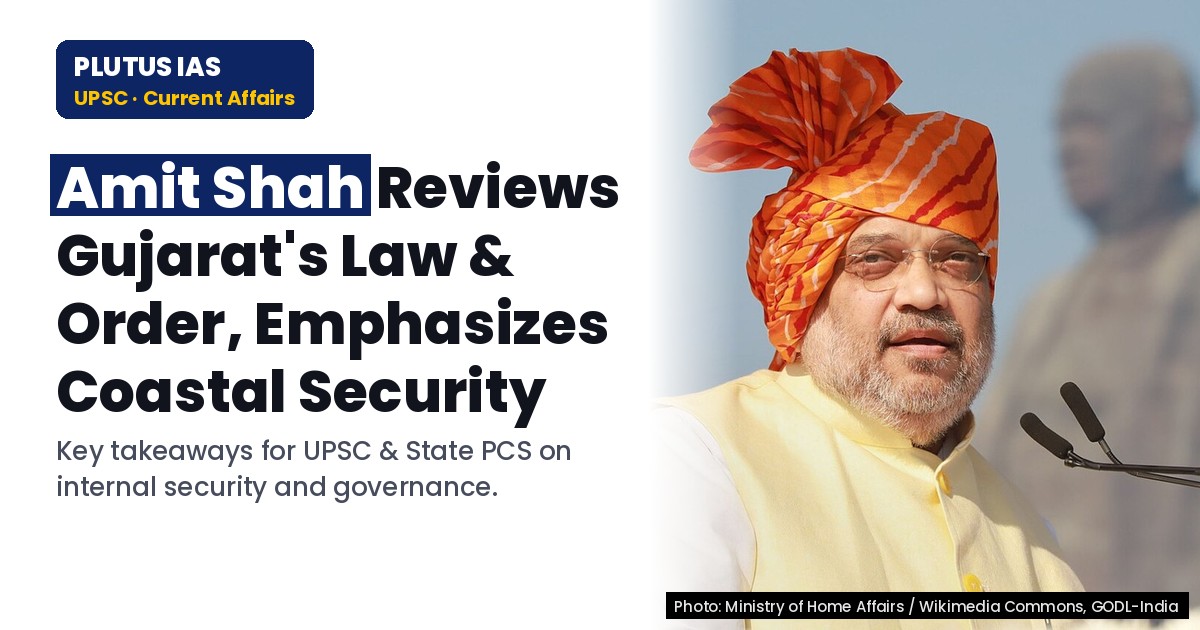
07 Nov Amit Shah Reviews Gujarat’s Law & Order, Internal Security
✎ The comprehensive review of Gujarat's law and order and internal security highlights the multi-faceted approach required for national security, encompassing border management, criminal justice reform, cybercrime, narcotics…
Subject Relevance — Where This Topic Fits
- GS Paper II — Governance, Constitution, Polity, Social Justice and International Relations | GS Paper III — Internal Security, Disaster Management
- Prelims: Internal Security, Coastal Security, Border Management, Cybercrime, Narcotics Trafficking, Disaster Management, Criminal Justice System, Anti-Terrorism Agencies, Illegal Migrants, Enemy Property
- Essay: The imperative of robust internal security for national development and stability., Challenges and strategies in managing India’s diverse security landscape.
Quick Revision: The comprehensive review of Gujarat’s law and order and internal security highlights the multi-faceted approach required for national security, encompassing border management, criminal justice reform, cybercrime, narcotics control, and inter-agency coordination.
Why is this in the news?
The Union Minister of Home Affairs and Cooperation recently conducted a high-level meeting in Ahmedabad to review the law and order situation and internal security in Gujarat. The review encompassed critical aspects such as border and coastal security, implementation of new criminal laws, counter-narcotics efforts, cybercrime mitigation, anti-terrorism measures, management of illegal foreign nationals, and disaster preparedness. The meeting underscored the importance of enhanced coordination among central and state agencies to ensure a secure and developed environment.
Background
- Gujarat possesses a significant coastline of approximately 2,340 kilometers and shares an international border with Pakistan, necessitating robust border and coastal security mechanisms.
- The state’s strategic location makes it vulnerable to various internal security challenges, including narcotics trafficking, infiltration, and cyber threats.
- The Union Government has introduced new criminal laws aimed at modernizing the justice system, and their effective implementation is a key focus for states.
- The proliferation of cybercrime necessitates strengthening digital infrastructure and response mechanisms like S4C and helpline 1930.
- Addressing the issue of illegal foreign nationals is crucial for national security and involves identification, due process, and deportation.
- Disaster management, including urban flood management and fire safety, remains a critical area for state preparedness, particularly in densely populated urban centers.
Key Aspects of Internal Security and Governance Discussed
- **Border and Coastal Security:** Emphasizes strengthening surveillance along Gujarat’s extensive coastline and international border, requiring synergistic efforts from the Border Security Force (BSF), State Police, Coast Guard, and other central agencies.
- **Implementation of New Criminal Laws:** Focuses on the efficient adoption and execution of recently enacted criminal legislation, with Gujarat’s performance in timely charge-sheeting (92% in 60 days, 86% in 90 days) highlighted as commendable.
- **Counter-Narcotics Strategy:** Advocates for a comprehensive approach targeting entire drug networks and kingpins, moving beyond small-scale peddlers, and prioritizing financial investigations to seize illegally acquired assets.
- **Cybercrime Mitigation:** Directs enhancement of capacity for cybercrime response platforms like S4C and the 1930 helpline, crucial for effective detection and prevention of digital offenses.
- **Anti-Terrorism Measures:** Calls for strengthening anti-terrorism agencies to counter evolving threats and maintain a vigilant security posture.
- **Management of Illegal Foreign Nationals:** Stresses accelerated identification and deportation of illegal foreign nationals in accordance with established legal procedures, acknowledging successful special operations in this regard.
- **Disaster Management and Urban Planning:** Includes directives for expediting disaster management initiatives, improving fire safety, implementing urban flood management projects (e.g., Ahmedabad), and accelerating the survey and disposal of enemy properties.
- **Inter-Agency Coordination:** Underscores the critical importance of seamless collaboration and regular review of targets among all central and state agencies to achieve a ‘Secure, Developed, and Drug-Free Gujarat’ as a component of a ‘Secure India’.
Key Features
| Feature | Significance |
|---|---|
| Review of Law and Order and Internal Security | Comprehensive assessment of the state’s security apparatus and operational effectiveness. |
| Emphasis on Border and Coastal Security | Critical for safeguarding national sovereignty, preventing infiltration, and combating maritime threats along Gujarat’s extensive coastline and international border. |
| Implementation of New Criminal Laws | Reflects the state’s proactive approach in adopting and operationalising updated legal frameworks for criminal justice. |
| Action against Drug Networks | Aims to dismantle organised crime syndicates involved in narcotics trafficking, thereby addressing a significant internal security threat and public health concern. |
| Cybercrime Control and Capacity Building | Strengthening mechanisms to counter evolving digital threats and protect citizens from online fraud and other cyber offenses. |
| Identification and Deportation of Illegal Foreign Nationals | Ensures adherence to immigration laws and addresses potential security risks associated with undocumented individuals. |
Why it Matters
Internal Security
- The review underscores the paramount importance of robust law enforcement and intelligence gathering for maintaining peace and order within the state.
- Strengthening border and coastal security directly contributes to national security by preventing cross-border crimes, smuggling, and infiltration.
- Targeting drug networks and cybercrime addresses critical contemporary threats that have wide-ranging societal and economic impacts.
Governance and Administration
- The emphasis on inter-agency coordination (BSF, State Police, Coast Guard, Central Agencies) highlights the multi-faceted approach required for effective security management.
- The focus on timely charge-sheeting and forensic case resolution indicates efforts to enhance the efficiency and effectiveness of the criminal justice system.
- Reviewing disaster management and urban flood projects reflects a holistic governance approach that includes preparedness for natural calamities.
Rule of Law
- The successful implementation of new criminal laws demonstrates a commitment to modernising the legal framework and ensuring swift justice.
- Prioritising financial investigations in drug cases and seizing illegal assets reinforces the principle that crime should not yield profit.
- The systematic identification and deportation of illegal foreign nationals uphold the rule of law regarding immigration and national sovereignty.
Challenges
1. Coastal and Border Vulnerabilities
- Gujarat’s extensive coastline and international border with Pakistan present inherent challenges for comprehensive surveillance and interdiction.
- The dynamic nature of maritime and land borders necessitates continuous adaptation of security strategies and technological upgrades.
UPSC Link: Security challenges and their management in border areas
2. Drug Trafficking Networks
- The sophisticated and often transnational nature of drug networks makes their complete dismantling a complex task, requiring extensive intelligence and inter-state/international cooperation.
- Financial investigations into illegal assets require specialised expertise and coordination among various enforcement agencies.
UPSC Link: Organised crime and terrorism
3. Cybercrime Proliferation
- The rapid evolution of technology and increasing digital literacy contribute to the growing sophistication and volume of cybercrimes, posing challenges for law enforcement.
- Enhancing the capacity of cybercrime units and helplines requires continuous investment in technology, training, and human resources.
UPSC Link: Challenges to internal security through communication networks
4. Judicial and Forensic Backlog
- A large number of pending forensic cases can impede timely justice delivery and affect the conviction rates.
- Ensuring rapid charge-sheeting while maintaining investigative thoroughness is a constant challenge for police forces.
UPSC Link: Criminal Justice System reforms
5. Management of Illegal Foreign Nationals
- Identifying and verifying the nationality of illegal foreign nationals is often complex, requiring robust intelligence and administrative processes.
- The process of legal deportation can be time-consuming and involve diplomatic complexities.
UPSC Link: Security challenges and their management
Challenges — UPSC Perspective
| Issue | Concern |
|---|---|
| Coastal and Border Security | Vulnerability to infiltration, smuggling, and maritime threats due to long coastline and international border. |
| Drug Trafficking | Existence of extensive drug networks, requiring action beyond small peddlers to target kingpins and seize illegal assets. |
| Cybercrimes | Increasing sophistication and volume of cyber threats, necessitating enhanced capacity of response mechanisms like S4C and 1930 helpline. |
| Pending Forensic Cases | Large backlog of over 25,000 cases impacting timely justice delivery and investigative efficiency. |
| Illegal Foreign Nationals | Challenges in identification, verification, and expeditious deportation, posing potential security and demographic concerns. |
| Inter-Agency Coordination | Ensuring seamless cooperation among diverse state and central agencies for integrated security management. |
Way Forward
- Implement advanced surveillance technologies, including drone monitoring and satellite imagery, for comprehensive border and coastal security.
- Strengthen intelligence gathering and sharing mechanisms among central and state agencies to effectively dismantle drug trafficking networks.
- Invest in continuous training and technological upgrades for law enforcement personnel to combat evolving cybercrime methodologies.
- Establish dedicated fast-track forensic laboratories and recruit specialised personnel to clear the backlog of pending cases efficiently.
- Develop a robust national database for tracking and identifying illegal foreign nationals, coupled with streamlined deportation protocols.
- Foster a culture of proactive community policing and public awareness campaigns to enhance citizen participation in crime prevention.
- Conduct regular joint exercises and drills among BSF, State Police, Coast Guard, and central agencies to improve operational coordination and response times.
- Prioritise financial investigations in all organised crime cases to target the economic backbone of criminal enterprises.
UPSC Value Addition
Keywords for Mains Answer-Writing
Internal Security · Coastal Security · Border Management · Drug Trafficking · Cybercrime · Criminal Justice System · Law and Order · Inter-Agency Coordination · Disaster Management · Illegal Immigration
Constitutional & Policy Linkages
- {‘article’: ‘Article 246’, ‘note’: ‘Distribution of legislative powers’}
- {‘article’: ‘Seventh Schedule (List II – State List)’, ‘note’: ‘Public order, Police, Prisons’}
- {‘article’: ‘Seventh Schedule (List III – Concurrent List)’, ‘note’: ‘Criminal law, Criminal procedure’}
Concept Flow
High-level review of internal security → Identification of key security challenges (e.g., border, drugs, cybercrime) → Issuance of directives for strengthening security measures → Enhanced inter-agency coordination and capacity building → Improved implementation of criminal laws and enforcement actions → Progress towards a safer and more secure state environment
Prelims Practice Questions
Q1. Consider the following statements regarding India’s coastal security framework:
1. The Indian Coast Guard (ICG) is the primary agency responsible for coastal security in India.
2. State Marine Police forces operate under the administrative control of the Union Ministry of Home Affairs.
3. The Coastal Security Scheme (CSS) aims to strengthen the infrastructure and capacity of coastal states/UTs for coastal policing.
How many of the above statements are correct?
- Only one
- Only two
- Only three
- None
Answer: Only two — Statement 1 is correct: The Indian Coast Guard is indeed the principal agency for coastal security. Statement 2 is incorrect: State Marine Police forces operate under the respective State Governments, though they receive central assistance. Statement 3 is correct: The Coastal Security Scheme is a key initiative to enhance coastal policing capabilities.
Q2. Which of the following bodies is responsible for coordinating efforts to combat drug trafficking at the national level in India?
- Central Bureau of Investigation (CBI)
- National Investigation Agency (NIA)
- Narcotics Control Bureau (NCB)
- Directorate of Revenue Intelligence (DRI)
Answer: Narcotics Control Bureau (NCB) — The Narcotics Control Bureau (NCB) is the nodal agency for drug law enforcement in India, responsible for combating illicit trafficking and abuse of psychotropic substances.
Mains Practice Question
✍ Examine the multi-pronged approach adopted by the Indian government to enhance internal security, with particular reference to coastal and border management. Discuss the challenges in ensuring effective inter-agency coordination in this domain. (15 Marks)
Approach: MODEL-ANSWER SKELETON:
1. **Introduction**: Briefly define internal security and its comprehensive nature.
2. **Multi-pronged Approach**: Detail key aspects:
* **Coastal Security**: Mention the three-tier system (Indian Navy, Indian Coast Guard, State Marine Police), Coastal Security Scheme, Sagar Prahari Bal, specific challenges like maritime terrorism (e.g., 26/11 Mumbai attacks).
* **Border Management**: Discuss land border guarding forces (BSF, SSB, ITBP, Assam Rifles), Border Area Development Programme (BADP), technological surveillance (e.g., Comprehensive Integrated Border Management System – CIBMS).
* **Counter-Terrorism**: Role of NIA, intelligence agencies, legal frameworks (e.g., UAPA).
* **Cyber Security**: Initiatives like CERT-In, National Cyber Security Policy, Cyber Swachhta Kendra, S4C and 1930 helpline.
* **Drug Trafficking**: Role of NCB, financial investigations, international cooperation.
* **Illegal Immigration**: Identification and deportation mechanisms.
* **Criminal Justice Reforms**: Implementation of new criminal laws, forensic science integration.
3. **Challenges in Inter-Agency Coordination**: Elaborate on difficulties:
* **Jurisdictional Overlaps**: Between central and state agencies, and among different central agencies (e.g., BSF, State Police, Coast Guard).
* **Information Sharing Gaps**: Lack of real-time, seamless intelligence exchange.
* **Resource Disparities**: Uneven distribution of training, equipment, and technology.
* **Command and Control Issues**: Absence of a unified command structure in certain operational areas.
* **Capacity Building**: Need for continuous training and technological upgrades across all agencies.
* **Political Will and Bureaucratic Inertia**.
4. **Way Forward/Conclusion**: Emphasize the need for integrated command structures, enhanced technological integration, regular joint exercises, robust intelligence sharing mechanisms, and continuous capacity building for a ‘Whole of Government’ approach to internal security.
Source: PIB (Press Information Bureau)
Gujarat PCS (GPSC) — State PCS Practice
Prelims: Union Home and Cooperation Minister Shri Amit Shah recently reviewed the law and order and internal security situation in Gujarat. In which city of Gujarat was this high-level meeting held?
- Gandhinagar
- Ahmedabad
- Vadodara
- Surat
Answer: Ahmedabad — The meeting to review Gujarat’s law and order and internal security was held in Ahmedabad.
Mains: Discuss the significance of regular high-level reviews of law and order and internal security for a state like Gujarat, considering its strategic location and economic importance. (Answer in approximately 50 words)
Generated by AanyaAi for educational purpose.
Related guides on our sites
- Best Law optional coaching for upsc
- Best law optional teacher for upsc
- How to prepare for GS paper 1 for UPSC CSE mains exam
- Best UPSC coaching for IFOS exam

- Amit Shah Reviews Gujarat’s Law & Order, Internal Security - November 7, 2026
- ब्रिक्स सतत जीवन शैली सप्ताह: पर्यावरण संरक्षण और मिशन LiFE - November 7, 2026
- Supreme Court Grants Bail in Chhattisgarh Coal Levy Case - November 7, 2026

No Comments