


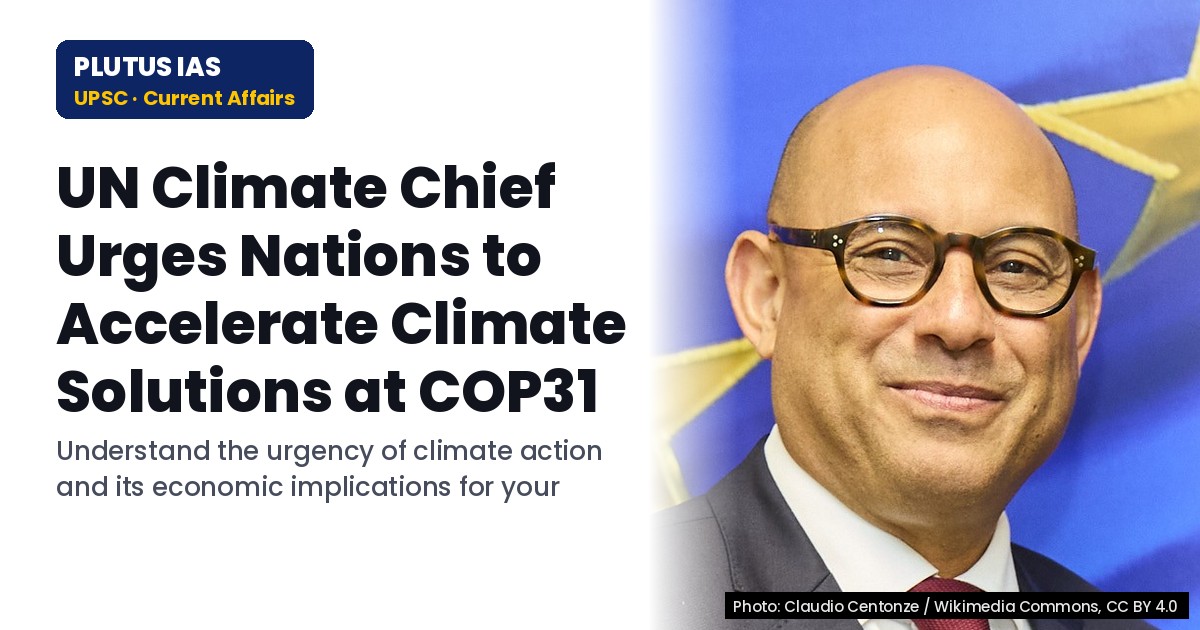
09 Nov COP31: UN Climate Chief Urges Accelerated Climate Solutions
✎ COP31 is poised to be a critical juncture for accelerating practical climate solutions, emphasising the urgent need for collective action, financial commitment, and a just transition to clean energy amidst escalating climate…
Subject Relevance — Where This Topic Fits
- GS Paper I — Geography (Climatology, Environmental Geography) | GS Paper II — International Relations (International Environmental Agreements, Global Governance) | GS Paper III — Environment (Climate Change, Conservation, Environmental Pollution & Degradation, Environmental Impact Assessment) | GS Paper III — Economy (Renewable Energy, Sustainable Development, Economic Impact of Climate Change)
- Prelims: COP (Conference of the Parties), UN Climate Change, Climate Change Executive Secretary, El Niño, Glacial Lake Outburst Floods (GLOFs), Fossil Fuels, Renewable Energy, Climate Resilience, Global Warming, Antalya (Turkiye)
- Essay: The economic and social dimensions of climate change: Towards a just and sustainable transition., International cooperation in addressing global challenges: Climate change as a case study.
Quick Revision: COP31 is poised to be a critical juncture for accelerating practical climate solutions, emphasising the urgent need for collective action, financial commitment, and a just transition to clean energy amidst escalating climate impacts.
Why is this in the news?
The UN Climate Change Executive Secretary, Simon Stiell, has urged countries to significantly accelerate practical solutions for climate change. This call comes amidst intensifying extreme weather events, rising global temperatures, and the escalating economic and social costs associated with climate impacts, including the threat of a super El Niño and glacial lake outburst floods in the Himalayan region. The statement underscores the critical need for collective action and financial commitment to bridge the gap between climate pledges and tangible outcomes.
Background
- The Conference of the Parties (COP) is the supreme decision-making body of the United Nations Framework Convention on Climate Change (UNFCCC). All States that are Parties to the Convention are represented at the COP, where they review the implementation of the Convention and any other legal instruments that the COP adopts.
- The UNFCCC, established in 1992, is an international environmental treaty addressing climate change, negotiated at the Earth Summit in Rio de Janeiro. Its objective is to stabilise greenhouse gas concentrations in the atmosphere at a level that would prevent dangerous anthropogenic interference with the climate system.
- Previous COPs have resulted in landmark agreements such as the Kyoto Protocol (COP3, 1997) and the Paris Agreement (COP21, 2015), which aim to reduce greenhouse gas emissions and limit global warming.
- The Intergovernmental Panel on Climate Change (IPCC) consistently provides scientific assessments on climate change, highlighting the urgency of reducing emissions and adapting to its impacts.
- Extreme weather events, such as heatwaves, droughts, floods, and storms, have become more frequent and intense globally, causing significant economic damage and loss of life, directly attributable in many cases to anthropogenic climate change.
- The phenomenon of El Niño, a periodic warming of ocean surface temperatures in the central and eastern tropical Pacific Ocean, significantly influences global weather patterns and can exacerbate climate impacts, including increased temperatures and altered precipitation regimes.
Understanding Climate Change and Global Response Mechanisms
- Climate change refers to long-term shifts in temperatures and weather patterns, primarily driven by human activities, especially the burning of fossil fuels, which releases heat-trapping greenhouse gases into the atmosphere.
- The primary greenhouse gases include carbon dioxide (CO2), methane (CH4), nitrous oxide (N2O), and fluorinated gases, which trap heat and contribute to the ‘greenhouse effect’.
- Global warming is the long-term heating of Earth’s climate system observed since the pre-industrial period (between 1850 and 1900) due to human activities, primarily fossil fuel burning, which increases heat-trapping greenhouse gas levels in Earth’s atmosphere.
- Climate resilience refers to the capacity of social, economic, and ecological systems to cope with a hazardous event or trend or disturbance, responding or reorganising in ways that maintain their essential function, identity, and structure, while also maintaining the capacity for adaptation, learning, and transformation.
- The transition to clean energy involves shifting from fossil fuels to renewable energy sources such as solar, wind, hydro, geothermal, and biomass, which produce significantly fewer greenhouse gas emissions.
- Glacial Lake Outburst Floods (GLOFs) are sudden releases of large volumes of water from glacial lakes, often triggered by events such as ice avalanches, landslides, or seismic activity, posing significant hazards to downstream communities and infrastructure, particularly in mountainous regions like the Himalayas.
- The economic consequences of climate change include increased costs for disaster relief and recovery, impacts on agriculture and food security, damage to infrastructure, and disruptions to supply chains, alongside the volatility in global fossil fuel markets.
- Addressing climate change requires both mitigation (reducing greenhouse gas emissions) and adaptation (adjusting to actual or expected future climate), with a strong emphasis on international cooperation, financial mechanisms, and technology transfer.
Key Features
| Feature | Significance |
|---|---|
| Acceleration of Practical Solutions | Emphasises the need for concrete, actionable strategies to combat climate change, moving beyond mere commitments to tangible outcomes. |
| Fairness in Energy Transition | Highlights the imperative of equitable distribution of benefits and burdens in the global shift to clean energy and climate resilience, particularly for vulnerable nations. |
| Economic Benefits of Renewable Energy | Underscores the financial advantages of transitioning to renewables, citing substantial savings and reduced exposure to fossil fuel price volatility. |
| Addressing Financial Constraints of COP | Acknowledges the budgetary limitations faced by the Conference of the Parties, necessitating serious discussions on resource allocation for growing responsibilities. |
| Implementation COP Focus | Calls for COP31 to be an ‘Implementation COP’, stressing the importance of closing the gap between climate promises and their real-world impact on communities. |
Why it Matters
Environmental Significance
- The increasing frequency and intensity of extreme weather events, such as heatwaves, glacial lake outburst floods, and the threat of a super El Nino, underscore the escalating impacts of global warming.
- Accelerated climate solutions are crucial to mitigate these devastating effects, protect ecosystems, and safeguard biodiversity, which are integral to planetary health.
Economic Significance
- Dependence on fossil fuels leads to price volatility, causing global economic shocks, increased household expenses, and inflationary pressures, as evidenced by recent events.
- Transitioning to renewable energy offers significant economic benefits, including substantial cost savings and enhanced energy security, reducing vulnerability to geopolitical energy market fluctuations.
- Climate resilience investments protect economies from the financial losses associated with climate-induced disasters, fostering long-term economic stability and growth.
Social Significance
- Vulnerable communities disproportionately bear the brunt of climate change impacts, exacerbating existing inequalities and threatening social solidarity and collective progress.
- A fair and equitable transition to clean energy and climate resilience is essential to address profound injustices and ensure that climate action benefits all segments of society, particularly those most at risk.
- Mitigating climate change impacts prevents displacement, food insecurity, and health crises, thereby enhancing human well-being and reducing social instability.
Governance and Policy Significance
- The call for COP31 to be an ‘Implementation COP’ highlights the critical need for effective governance mechanisms and policy frameworks to translate international climate commitments into national actions.
- Addressing the financial constraints of climate conferences and ensuring adequate resource allocation are vital for sustaining international cooperation and facilitating robust climate negotiations.
- The emphasis on dialogues, trust, and resources underscores the importance of multilateralism and collaborative governance in tackling a global challenge like climate change.
Challenges
1. Bridging the Implementation Gap
- A significant disparity exists between climate commitments made at international summits and their actual implementation on the ground.
- Translating ambitious targets into concrete national policies and actions remains a persistent hurdle, often due to political will, capacity constraints, or conflicting priorities.
UPSC Link: Environmental Pollution & Degradation
2. Financial Constraints and Resource Mobilisation
- The growing responsibilities of climate conferences and the vast scale of climate action require substantial financial resources.
- Securing adequate and predictable funding for mitigation, adaptation, and loss and damage, especially for developing nations, continues to be a major point of contention and a bottleneck for progress.
UPSC Link: Conservation, Environmental Pollution & Degradation
3. Ensuring Equitable Transition
- The transition to clean energy must be just and inclusive, addressing the concerns of fossil fuel-dependent economies and ensuring that vulnerable populations are not left behind.
- Achieving fairness in burden-sharing and benefit distribution across nations, particularly between developed and developing countries, poses complex negotiation challenges.
UPSC Link: Sustainable Development; Social Justice
4. Addressing Fossil Fuel Dependence
- Despite the economic and environmental costs, many economies remain heavily reliant on fossil fuels, making a rapid transition difficult due to entrenched interests and infrastructure.
- Overcoming political and economic resistance to phasing out fossil fuels requires robust policy incentives, technological innovation, and international cooperation.
UPSC Link: Energy; Environmental Pollution & Degradation
5. Impacts of Extreme Weather Events
- The increasing frequency and intensity of extreme weather events, such as heatwaves, floods, and El Nino phenomena, present immediate and severe challenges to communities and infrastructure.
- Developing effective adaptation strategies and building resilience against these diverse and escalating impacts requires significant investment and integrated planning.
UPSC Link: Disaster Management; Environmental Pollution & Degradation
Challenges — UPSC Perspective
| Issue | Concern |
|---|---|
| Global Heating Costs | Escalating economic and social costs due to climate change impacts, including damage from extreme weather events. |
| Vulnerable Communities | Disproportionate impact of climate change on the most susceptible populations, leading to profound injustice and hindering collective progress. |
| Fossil Fuel Cost Volatility | Economic shocks, increased household expenses, and inflation triggered by unstable fossil fuel prices. |
| Budgetary Constraints of COP | Limited financial resources for the UN climate conference despite growing responsibilities, potentially impeding effective negotiations and implementation. |
| Gap Between Promises and Impact | The persistent disconnect between climate commitments made at summits and their tangible effects on people’s lives and the environment. |
Way Forward
- Strengthen National Determined Contributions (NDCs) with more ambitious and concrete mitigation and adaptation targets, ensuring alignment with the 1.5°C goal.
- Enhance financial mechanisms for climate action, including scaling up climate finance for developing countries, improving access, and exploring innovative funding sources.
- Accelerate the global transition to renewable energy through supportive policies, investment incentives, and technological transfer, while ensuring a just transition for affected workforces and communities.
- Prioritise adaptation and resilience-building measures, particularly in vulnerable regions, by integrating climate risk assessments into national development planning and infrastructure projects.
- Foster international cooperation and multilateralism by strengthening trust among nations and ensuring equitable burden-sharing in climate action.
- Improve transparency and accountability frameworks for climate commitments, enabling robust monitoring, reporting, and verification of progress towards agreed goals.
- Invest in climate science and early warning systems to better understand and predict climate impacts, facilitating proactive disaster preparedness and response.
UPSC Value Addition
Keywords for Mains Answer-Writing
COP31 · Climate Change · Global Warming · Climate Solutions · Renewable Energy · Climate Resilience · Fossil Fuel Dependence · Extreme Weather Events · Climate Finance · Sustainable Development Goals (SDGs) · Paris Agreement · Nationally Determined Contributions (NDCs)
Concept Flow
Anthropogenic greenhouse gas emissions → Global heating and climate change → Increased frequency of extreme weather events → Economic shocks and social injustice → Urgency for accelerated climate solutions → International cooperation at COP31 → Implementation of practical, equitable solutions
Prelims Practice Questions
Q1. Consider the following statements regarding the Conference of the Parties (COP) to the UNFCCC:
1. COP meetings are held annually to assess progress in dealing with climate change.
2. The Paris Agreement was adopted at COP21 in 2015.
3. The primary objective of COP31 is to accelerate practical solutions for climate change mitigation and adaptation.
How many of the above statements are correct?
- Only one
- Only two
- Only three
- None
Answer: Only three — Statement 1 is correct: COP meetings are indeed held annually. Statement 2 is correct: The Paris Agreement was adopted at COP21 in 2015. Statement 3 is correct: As per the news, COP31 aims to accelerate practical solutions for climate change.
Q2. Which of the following phenomena is associated with the warming of the Pacific Ocean and can intensify extreme weather events globally?
- La Niña
- El Niño
- Indian Ocean Dipole
- Arctic Oscillation
Answer: El Niño — El Niño is a climate pattern that describes the unusual warming of surface waters in the eastern tropical Pacific Ocean. El Niño is the warm phase of the larger El Niño-Southern Oscillation (ENSO) phenomenon. It can significantly influence weather patterns and intensify extreme weather events worldwide.
Mains Practice Question
✍ The UN Climate Change Executive Secretary has called for COP31 to accelerate practical solutions, highlighting the escalating impacts of global warming and the economic consequences of fossil fuel dependence. In this context, critically examine the challenges in achieving global climate resilience and the role of renewable energy in fostering a just transition. (15 Marks)
Approach: MODEL-ANSWER SKELETON:
1. **Introduction:** Briefly introduce the context of COP31 and the urgency of climate action as highlighted by the UN Climate Change Executive Secretary.
2. **Challenges in Achieving Global Climate Resilience:**
* **Financial Constraints:** Inadequate climate finance, particularly for developing nations, and the growing gap between needs and available resources.
* **Technological Gaps:** Unequal access to climate-resilient technologies and infrastructure, especially in vulnerable regions.
* **Governance and Policy Gaps:** Lack of robust implementation mechanisms for international agreements, varying national commitments (NDCs), and political will.
* **Socio-economic Disparities:** Vulnerable communities disproportionately affected by climate impacts, exacerbating existing inequalities.
* **Loss and Damage:** Difficulties in establishing and operationalizing mechanisms for addressing irreversible impacts.
* **Inter-generational Equity:** Balancing current development needs with future climate security.
3. **Role of Renewable Energy in Fostering a Just Transition:**
* **Mitigation of Emissions:** Direct reduction of greenhouse gas emissions by replacing fossil fuels.
* **Economic Benefits:** Creation of green jobs, energy security, reduced volatility from fossil fuel prices, and economic savings (as mentioned in the news).
* **Energy Access and Equity:** Potential to provide decentralized energy solutions to remote and underserved communities.
* **Technological Innovation:** Drives research and development in sustainable technologies.
* **Addressing ‘Profound Injustice’:** Ensuring that the transition benefits all, especially those reliant on fossil fuel industries, through reskilling and social safety nets.
* **Policy Support:** Need for supportive policies, subsidies, and international cooperation to scale up renewable energy deployment.
4. **Conclusion:** Summarize the imperative for collective action, emphasizing that a just transition to clean energy and enhanced climate resilience is crucial for global stability and sustainable development, requiring concerted efforts from all stakeholders.
Source: orissapost.com
Generated by AanyaAi for educational purpose.
Related guides on our sites
- Best PSIR optional coaching for upsc
- Best PSIR optional teacher for upsc
- Best teacher of PSIR optional for upsc
- Best PSIR optional coaching in delhi for UPSC

- COP31: UN Climate Chief Urges Accelerated Climate Solutions - November 9, 2026
- जी-7 बैठक: वैश्विक संकट और अमेरिकी विदेश नीति पर चर्चा - November 9, 2026
- RBI Clarifies No New Checkbook Rules Post-2026 - November 9, 2026

No Comments