


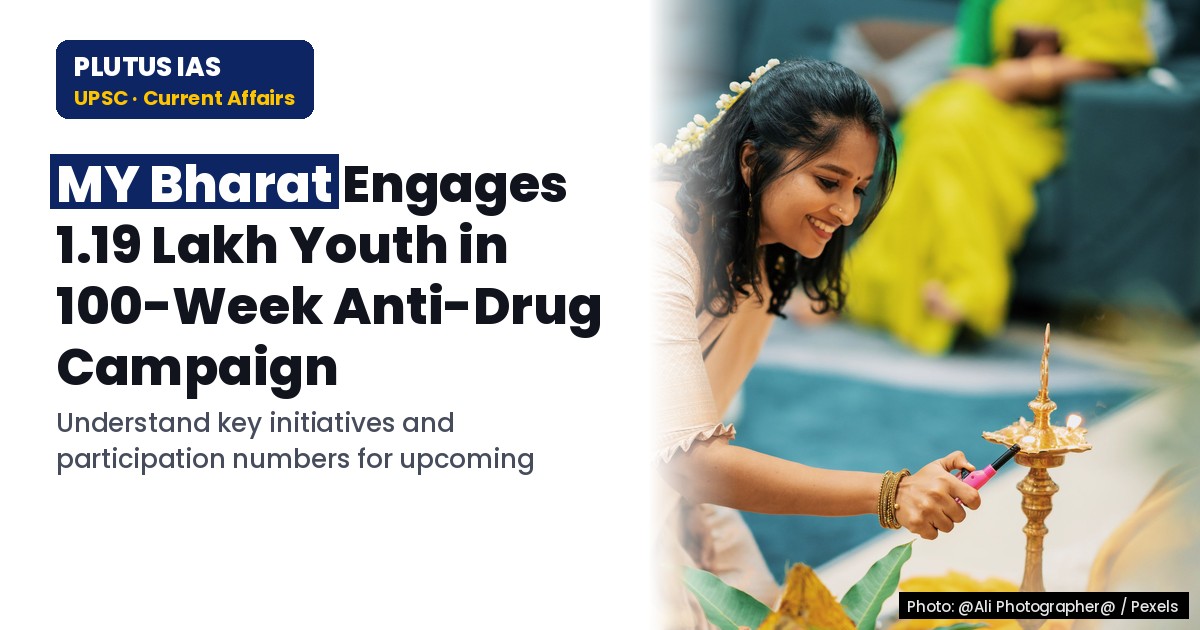
10 Nov MY Bharat’s 100-Week Anti-Drug Campaign: Deepotsav & Youth Parliament
✎ The 'Nasha Mukt Yuva for Viksit Bharat' campaign, spearheaded by My Bharat, is a 100-week initiative leveraging youth engagement and community participation to foster a drug-free India through awareness drives and structured…
Subject Relevance — Where This Topic Fits
- GS Paper I — Social Issues; Role of women and women’s organization, population and associated issues, poverty and developmental issues, urbanization, their problems and their remedies. | GS Paper II — Government policies and interventions for development in various sectors and issues arising out of their design and implementation; Welfare schemes for vulnerable sections of the population by the Centre and States and the performance of these schemes; mechanisms, laws, institutions and Bodies constituted for the protection and betterment of these vulnerable sections. | GS Paper III — Challenges to internal security through communication networks, role of media and social networking sites in internal security challenges, basics of cyber security; money-laundering and its prevention.
- Prelims: Nasha Mukt Bharat Abhiyaan, My Bharat (MY Bharat) portal, Ministry of Youth Affairs and Sports, Drug de-addiction initiatives, Youth Parliament, Social awareness campaigns
- Essay: The imperative of a drug-free society for national development., Youth as catalysts for social change and nation-building., Community participation in addressing public health challenges.
Quick Revision: The ‘Nasha Mukt Yuva for Viksit Bharat’ campaign, spearheaded by My Bharat, is a 100-week initiative leveraging youth engagement and community participation to foster a drug-free India through awareness drives and structured dialogues.
Why is this in the news?
The ‘Nasha Mukt Yuva for Viksit Bharat’ 100-week resolution campaign, spearheaded by My Bharat under the Ministry of Youth Affairs and Sports, recently conducted its eighth week of activities. These included a nationwide ‘Nasha Mukt Yuva Deepotsav – Ek Diya Sankalp Ka’ and ‘Nasha Mukt Yuva Par Charcha’ through Neighborhood Youth Parliaments on November 6 and 7, 2026. These initiatives integrated the festive spirit of Diwali with drug de-addiction awareness and grassroots dialogue, witnessing participation from over 1.19 lakh youths and citizens across 30 states and union territories.
Background
- Drug abuse poses a significant socio-economic and public health challenge in India, impacting individuals, families, and communities.
- The ‘Nasha Mukt Bharat Abhiyaan’ (NMBA) was launched by the Ministry of Social Justice and Empowerment in 2020 across 272 identified vulnerable districts to combat drug abuse.
- Youth engagement is recognised as a critical component in the success of de-addiction efforts, leveraging their potential as agents of positive social change.
- Community-led initiatives and awareness campaigns are crucial for fostering a collective resolve against substance abuse and promoting a drug-free lifestyle.
- The integration of cultural events, such as Deepotsav, with social awareness campaigns enhances public participation and reinforces the message through traditional mediums.
- The establishment of platforms like Neighborhood Youth Parliaments facilitates structured discussions and empowers youth to deliberate on societal issues and contribute to solutions.
About the ‘Nasha Mukt Yuva for Viksit Bharat’ Campaign and associated initiatives
- The ‘Nasha Mukt Yuva for Viksit Bharat’ is a 100-week resolution campaign launched under the aegis of My Bharat (MY Bharat) portal, an autonomous body under the Ministry of Youth Affairs and Sports.
- Its primary objective is to create a drug-free India by fostering continuous youth participation and community-based efforts.
- The campaign employs a multi-pronged strategy, including awareness generation, community mobilisation, and structured dialogue sessions.
- ‘Nasha Mukt Yuva Deepotsav – Ek Diya Sankalp Ka’ is an initiative that integrates festive celebrations with drug de-addiction awareness, involving activities like rangoli making, lamp lighting, and awareness programs.
- The Neighborhood Youth Parliament initiative facilitates ‘Nasha Mukt Yuva Par Charcha’ at the block level, engaging youth in discussions on drug abuse challenges and their role in building a drug-free society.
- Each Neighborhood Youth Parliament aims to connect at least 80 youths through structured sessions covering understanding substance abuse, measures for a drug-free youth, and stories of change.
- Collaborating organisations, including Brahma Kumaris, EPSI, and Heartfulness, actively participate in these events, enhancing their outreach and impact.
- Activities such as slogan writing, street plays, interactive sessions, and pledges against drug abuse are integral components of these awareness and engagement programs.
- The campaign aligns with the broader national vision of ‘Viksit Bharat’ by empowering youth and addressing critical social issues that impede national progress.
Key Features
| Feature | Significance |
|---|---|
| Nasha Mukt Yuva for Viksit Bharat’ 100-Week Sankalp Abhiyan | A comprehensive, nationwide campaign by MyGov India under the Ministry of Youth Affairs and Sports, aiming to foster a drug-free India through sustained youth and community engagement. |
| Nasha Mukt Yuva Deepotsav – Ek Diya Sankalp Ka | An initiative integrating the festive occasion of Diwali with drug awareness, involving activities such as lamp lighting, rangoli creation, and distribution of sweets, fostering community participation. |
| Neighborhood Youth Parliament (Nasha Mukt Yuva Par Charcha) | Block-level discussions focusing on drug abuse challenges, the role of youth in building a drug-free society, and structured sessions to inform and engage young individuals. |
| Pan-India Participation | Engagement of over 1.19 lakh youth and citizens across 30 states/union territories, demonstrating widespread community involvement and commitment to the campaign’s objectives. |
| Collaborative Approach | Involvement of partner organizations such as Brahma Kumaris, EPSI, and Heartfulness, enhancing the reach and impact of awareness and intervention activities. |
Why it Matters
Social Cohesion and Public Health
- The campaign promotes social cohesion by involving diverse community segments in a collective effort against drug abuse, thereby strengthening community resilience.
- It addresses a critical public health issue by raising awareness about the detrimental effects of substance abuse, contributing to the overall well-being of the populace, particularly the youth.
Youth Empowerment and Development
- By engaging youth in discussions and activities, the initiative empowers them to become agents of change, fostering leadership skills and a sense of civic responsibility.
- It aligns with the vision of ‘Viksit Bharat’ by nurturing a healthy and productive youth demographic, which is crucial for national development and demographic dividend realization.
Governance and Policy Implementation
- The campaign exemplifies a decentralized approach to policy implementation, utilizing block-level ‘Neighborhood Youth Parliaments’ to ensure grassroots engagement and feedback.
- It demonstrates inter-ministerial coordination and collaboration with civil society organizations, highlighting a multi-stakeholder model for addressing complex social challenges.
Challenges
1. Pervasiveness of Drug Abuse
- The widespread availability and accessibility of various illicit substances pose a significant challenge to eradication efforts.
- The evolving nature of drug trafficking routes and methods necessitates continuous adaptation of enforcement strategies.
UPSC Link: Social issues, internal security
2. Stigma and Social Acceptance
- Social stigma associated with drug addiction often deters individuals from seeking help, hindering rehabilitation efforts.
- In certain regions, traditional or cultural practices may inadvertently contribute to the acceptance or normalization of substance use.
UPSC Link: Social justice, public health
3. Rehabilitation and Reintegration
- Inadequate infrastructure and resources for de-addiction and rehabilitation centers limit the effectiveness of recovery programs.
- Challenges in the social and economic reintegration of former drug users often lead to relapse and perpetuation of the cycle.
UPSC Link: Social welfare, human resources
4. Youth Vulnerability
- Peer pressure, lack of awareness, and socio-economic stressors make youth particularly vulnerable to initiating drug use.
- The influence of digital platforms and social media in promoting or glamorizing substance abuse presents new challenges for prevention.
UPSC Link: Youth development, social psychology
Challenges — UPSC Perspective
| Issue | Concern |
|---|---|
| Limited Reach and Depth | Ensuring the campaign’s message penetrates deeply into remote and marginalized communities, beyond initial participation numbers, remains a challenge. |
| Sustained Engagement | Maintaining high levels of youth and community engagement throughout the 100-week duration and beyond requires innovative and continuous motivational strategies. |
| Impact Measurement | Accurately assessing the long-term impact of awareness campaigns on actual drug consumption rates and behavioral changes is complex and requires robust monitoring frameworks. |
| Resource Allocation | Adequate allocation of financial and human resources across all participating states and blocks is crucial for the uniform implementation and effectiveness of the campaign. |
| Addressing Root Causes | While awareness is key, addressing underlying socio-economic factors, mental health issues, and lack of opportunities that contribute to drug abuse requires broader policy interventions. |
Government Initiatives — Must-Memorise for Prelims
- Nasha Mukt Bharat Abhiyaan
- MyGov India
Way Forward
- Strengthen community-led initiatives by providing sustained training and resources to local volunteers and youth groups, ensuring their continued active participation.
- Integrate drug prevention education into school and university curricula, utilizing interactive and age-appropriate modules to build resilience among young individuals.
- Enhance the capacity of de-addiction and rehabilitation centers, focusing on holistic recovery models that include psychological counseling, vocational training, and social reintegration support.
- Leverage digital platforms and social media strategically for targeted awareness campaigns, countering misinformation and promoting positive narratives around a drug-free lifestyle.
- Foster inter-agency coordination among law enforcement, health departments, and social welfare ministries to create a comprehensive ecosystem for prevention, treatment, and enforcement.
- Conduct regular impact assessments and evaluations of campaigns and programs, utilizing data-driven insights to refine strategies and ensure optimal resource utilization.
- Promote research into the socio-economic determinants of drug abuse and the effectiveness of various intervention models, informing evidence-based policy formulation.
UPSC Value Addition
Keywords for Mains Answer-Writing
Nasha Mukt Bharat Abhiyaan · youth engagement · community participation · drug abuse prevention · social awareness campaigns · My Bharat (MY Bharat) platform · Viksit Bharat · public health initiatives
Constitutional & Policy Linkages
- Article 47: Duty of the State to raise the level of nutrition and the standard of living and to improve public health.
Concept Flow
Government launches nationwide anti-drug campaign. → Community engagement through festive events and youth parliaments. → Increased awareness about drug abuse and its consequences. → Youth empowered as agents of change for a drug-free society. → Contribution to the vision of ‘Nasha Mukt Yuva for Viksit Bharat’.
Prelims Practice Questions
Q1. Consider the following statements regarding the ‘Nasha Mukt Yuva for Viksit Bharat’ 100-week resolution campaign:
1. The campaign is organized under the aegis of the Ministry of Youth Affairs and Sports.
2. It primarily focuses on urban youth populations, excluding rural areas.
3. ‘Deepotsav – Ek Diya Sankalp Ka’ is an initiative under this campaign aimed at raising awareness through festive celebrations.
How many of the above statements are correct?
- Only one
- Only two
- Only three
- None
Answer: Only two — Statement 1 is correct as the campaign is organized by My Bharat under the Ministry of Youth Affairs and Sports. Statement 2 is incorrect as the campaign aims for nationwide participation, including diverse geographical areas. Statement 3 is correct as ‘Deepotsav – Ek Diya Sankalp Ka’ is explicitly mentioned as an awareness initiative.
Q2. Which of the following initiatives is NOT directly associated with the ‘Nasha Mukt Yuva for Viksit Bharat’ campaign as per the provided information?
- Neighborhood Youth Parliament discussions on drug abuse.
- Deepotsav – Ek Diya Sankalp Ka.
- Distribution of free rehabilitation kits to drug addicts.
- Awareness activities like rangoli making and street plays.
Answer: Distribution of free rehabilitation kits to drug addicts. — The provided information explicitly mentions Neighborhood Youth Parliament discussions, Deepotsav, and awareness activities like rangoli making and street plays as components of the campaign. The distribution of free rehabilitation kits is not mentioned.
Mains Practice Question
✍ Examine the significance of youth engagement and community participation in addressing the challenge of drug abuse in India. Discuss how initiatives like the ‘Nasha Mukt Yuva for Viksit Bharat’ campaign leverage these aspects for effective social change. (15 Marks)
Approach: MODEL-ANSWER SKELETON:
1. Introduction: Briefly define drug abuse as a socio-economic and public health challenge in India.
2. Significance of Youth Engagement:
a. Demographic dividend and vulnerability: Highlight youth as both a vulnerable group and a powerful agent of change.
b. Peer influence: Discuss the role of positive peer pressure and youth leadership.
c. Future custodians: Emphasize their role in building a ‘Viksit Bharat’ free from substance abuse.
d. Innovation and energy: Mention their capacity to drive creative awareness campaigns.
3. Significance of Community Participation:
a. Grassroots reach: Explain how community involvement ensures last-mile delivery and localized solutions.
b. Collective responsibility: Discuss the importance of family, local leaders, and civil society organizations.
c. Sustained efforts: Highlight how community ownership ensures long-term impact beyond campaign periods.
d. De-stigmatization: Role in fostering an environment of support and reducing stigma associated with drug abuse.
4. Leveraging by ‘Nasha Mukt Yuva for Viksit Bharat’ campaign:
a. My Bharat platform: Explain its role in mobilizing and connecting youth volunteers.
b. ‘Deepotsav – Ek Diya Sankalp Ka’: Illustrate how cultural events are used for mass awareness and community bonding.
c. Neighborhood Youth Parliament: Detail its structure for localized discussions, problem-solving, and youth leadership development at the block level.
d. Collaborative approach: Mention partnerships with organizations like Brahma Kumaris, EPSI, and Heartfulness.
5. Conclusion: Summarize the synergistic effect of youth and community involvement in achieving a ‘Nasha Mukt Bharat’ and contributing to national development.
Source: PIB (Press Information Bureau)
Generated by AanyaAi for educational purpose.
Related guides on our sites
- Anthropology VS PSIR
- Best PSIR optional coaching
- Best PSIR optional coaching online
- Best sociology optional coaching

- DRI Foils Elephant Tusk Trafficking in Assam: UPSC & State PCS - November 10, 2026
- आयुष मंत्रालय की विशेष अभियान 6.0 में महत्वपूर्ण प्रगति - November 10, 2026
- SC on Cyber Criminals: No Bail, Jails Only for Them - November 10, 2026

No Comments