


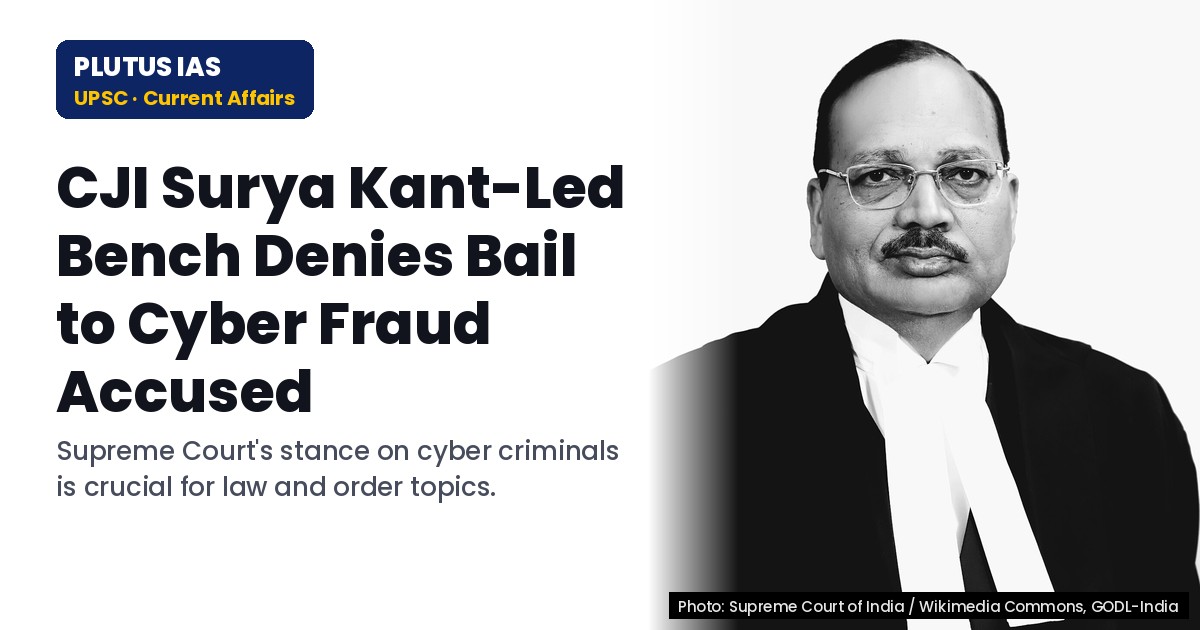
10 Nov SC on Cyber Criminals: No Bail, Jails Only for Them
✎ The Supreme Court has adopted a stringent stance against cyber criminals, emphasizing their incarceration and advocating for robust enforcement mechanisms like Zero FIRs and Standard Operating Procedures to combat digital fraud.
Subject Relevance — Where This Topic Fits
- GS Paper II — Governance, Constitution, Polity, Social Justice | GS Paper III — Internal Security, Cyber Security, Economy
- Prelims: Cybercrime, Digital Arrests, Zero FIR, I4C, National Cyber Crime Reporting Portal, Bail Jurisprudence, Telecommunications Rules, Supreme Court powers
- Essay: The Evolving Landscape of Cybercrime and its Impact on Society, Balancing Individual Liberty with National Security in the Digital Age
Quick Revision: The Supreme Court has adopted a stringent stance against cyber criminals, emphasizing their incarceration and advocating for robust enforcement mechanisms like Zero FIRs and Standard Operating Procedures to combat digital fraud.
Why is this in the news?
The Supreme Court recently adopted a stringent stance against cyber criminals, asserting that they have no place in society and that incarceration is the appropriate recourse. This observation was made while rejecting a bail application in a cyber fraud case, underscoring the judiciary’s firm approach to combating digital illicit activities. The Court also highlighted ongoing efforts to curb cyber fraud, including the implementation of Standard Operating Procedures (SOPs) and the functionality of zero FIR mechanisms.
Background
- The proliferation of digital technologies has led to a significant increase in cybercrime incidents, necessitating robust legal and enforcement responses.
- Cyber fraud, including ‘digital arrests’ (impersonation by criminals to extort money), has emerged as a major concern, impacting numerous citizens and posing a challenge to law enforcement.
- The Indian Cyber Crime Coordination Centre (I4C) under the Ministry of Home Affairs plays a pivotal role in coordinating national efforts against cybercrime, including the management of the National Cyber Crime Reporting Portal.
- The concept of a ‘Zero FIR’ allows for the registration of an FIR irrespective of the geographical jurisdiction, facilitating prompt action against crimes, particularly those with cross-jurisdictional implications like cybercrime.
- Judicial pronouncements, such as those by the Supreme Court, often guide the interpretation and application of laws, influencing policy and enforcement strategies in critical areas like criminal justice and cyber security.
- Legislative measures, including specific rules under telecommunications acts, are being formulated to enhance user identification and regulate radio equipment, aiming to strengthen the framework for combating cybercrime.
Key Aspects of Cybercrime and Related Legal Frameworks
- Cybercrime encompasses any criminal activity that involves a computer, computer network, or networked device, including fraud, data theft, and online harassment.
- The National Cyber Crime Reporting Portal (www.cybercrime.gov.in) is an initiative by the Government of India to provide a centralized platform for citizens to report cybercrime complaints online.
- A ‘Zero FIR’ is an FIR registered by a police station irrespective of the place of occurrence of the crime. It is subsequently transferred to the police station having appropriate jurisdiction for investigation.
- The Indian Cyber Crime Coordination Centre (I4C) is a framework established by the Ministry of Home Affairs to deal with all types of cybercrimes in a coordinated and effective manner.
- Standard Operating Procedures (SOPs) are detailed, written instructions to achieve uniformity of the performance of a specific function, crucial for effective and consistent law enforcement action against cyber fraud.
- Bail jurisprudence in India is governed by the Bharatiya Nagarik Suraksha Sanhita, 2023, and judicial precedents, balancing the liberty of an individual with the interests of justice and societal security.
- The Telecommunications (Radio Equipment Possession Authorisation) Rules, 2025, and Telecommunications (User Identification) Rules, 2025, aim to regulate the use of communication devices and identify users to prevent misuse for criminal activities.
Key Features
| Feature | Significance |
|---|---|
| Judicial Stance on Cybercrime | The Supreme Court’s unequivocal statement reflects a stringent judicial approach towards cyber offenders, emphasising punitive measures over rehabilitation for this specific category of crime. |
| Rejection of Bail for Cyber Fraud Accused | The denial of bail underscores the judiciary’s commitment to immediate incarceration for individuals implicated in cyber fraud, signalling a zero-tolerance policy. |
| Mandate for Standard Operating Procedures (SOPs) | The directive for SOPs and mechanisms to curb cyber fraud, particularly ‘digital arrests’, indicates a proactive judicial intervention to enhance law enforcement efficacy and victim protection. |
| Facilitation of Time-Bound Refunds | The Court’s emphasis on time-bound refunds for victims highlights a focus on restorative justice and mitigating financial losses incurred due to cyber fraud. |
| Direction for Zero FIRs | The instruction to initiate criminal action through zero FIRs against cyber fraudsters aims to streamline the reporting process and ensure immediate legal recourse irrespective of jurisdictional boundaries. |
| Reference to I4C Status Report | The Court’s consideration of data from the Indian Cyber Crime Coordination Centre (I4C) demonstrates reliance on empirical evidence for policy formulation and assessment of anti-cybercrime initiatives. |
Why it Matters
Governance and Law Enforcement
- The Supreme Court’s pronouncements reinforce the imperative for robust governance frameworks to combat cybercrime, compelling law enforcement agencies to adopt stringent measures and adhere to judicial directives.
- The emphasis on zero FIRs and time-bound refunds enhances the accountability of law enforcement and improves citizen access to justice in cybercrime cases.
- The judicial scrutiny of existing mechanisms, such as the e-Zero FIR and State Cyber Crime Coordination Centres, highlights areas requiring administrative strengthening and uniform implementation across states.
Judicial Precedent and Interpretation
- The Court’s firm stance on cyber criminals sets a significant judicial precedent, indicating a departure from traditional rehabilitative approaches for certain categories of offenders, thereby influencing future legal interpretations and sentencing guidelines.
- The oral observations, while not binding law, reflect the judiciary’s strong policy inclination, which can guide legislative and executive actions in addressing the evolving landscape of cyber threats.
- The distinction drawn between the rehabilitative potential of ‘murderers’ versus ‘cyber fraudsters’ signals a nuanced judicial understanding of different criminal typologies and their societal impact.
Societal Impact and Public Safety
- The Court’s assertion that ‘cyber criminals have no space in society’ aims to instill public confidence in the justice system and deter potential offenders by underscoring the severe consequences of such activities.
- The focus on curbing ‘digital arrests’ and facilitating refunds directly addresses prevalent forms of cyber fraud that exploit public trust and cause significant financial and psychological distress to victims.
- Enhanced enforcement against cybercrime contributes to overall public safety by mitigating the risks associated with online financial transactions and digital interactions.
Technological and Regulatory Frameworks
- The reference to the Telecommunications (Radio Equipment Possession Authorisation) Rules, 2025, and the Telecommunications (User Identification) Rules, 2025, underscores the critical role of updated regulatory frameworks in combating technology-driven crimes.
- The Court’s engagement with the I4C status report highlights the necessity of data-driven policy-making and continuous evaluation of cybercrime trends to inform legislative and enforcement strategies.
- The observed disparities in the functionality of e-Zero FIR mechanisms and State Cyber Crime Coordination Centres across states indicate a need for uniform technological adoption and capacity building.
Challenges
1. Evolving Nature of Cybercrime
- Cyber criminals constantly innovate their methods, making it challenging for law enforcement and legal frameworks to keep pace with new threats and attack vectors.
- The transnational nature of cybercrime often involves perpetrators and servers located in different jurisdictions, complicating investigation, prosecution, and extradition processes.
UPSC Link: Security: Cyber security; challenges to internal security through communication networks
2. Jurisdictional Complexities
- The digital realm transcends geographical boundaries, creating jurisdictional ambiguities for law enforcement agencies when crimes originate in one state/country and impact victims in another.
- Lack of uniform implementation of cybercrime coordination centres and e-Zero FIR mechanisms across states creates operational inefficiencies and gaps in reporting and investigation.
UPSC Link: Security: Cyber security; challenges to internal security through communication networks
3. Capacity Building and Resource Allocation
- Law enforcement agencies often lack adequate training, technological infrastructure, and skilled personnel to effectively investigate complex cyber fraud cases.
- Insufficient allocation of financial and human resources hinders the establishment and optimal functioning of dedicated cybercrime units and forensic laboratories.
UPSC Link: Security: Cyber security; challenges to internal security through communication networks
4. Victim Protection and Redressal
- Despite judicial directives, ensuring timely refunds and comprehensive support for victims of cyber fraud remains a significant challenge due to the complexity of tracing illicit funds and the volume of complaints.
- Many victims are unaware of reporting mechanisms like zero FIRs or hesitate to report due to fear, stigma, or lack of trust in the redressal process.
UPSC Link: Security: Cyber security; challenges to internal security through communication networks
5. Regulatory Gaps and Implementation
- While new rules are being notified, the effective implementation and enforcement of telecommunications and user identification regulations are crucial to prevent misuse and identify perpetrators.
- The disparity in the notification and functionality of State Cyber Crime Coordination Centres indicates a need for stronger central guidance and state-level commitment.
UPSC Link: Security: Cyber security; challenges to internal security through communication networks
Challenges — UPSC Perspective
| Issue | Concern |
|---|---|
| Rapid Technological Advancement | Cyber criminals exploit new technologies faster than regulatory and enforcement bodies can adapt, leading to a perpetual cat-and-mouse game. |
| Cross-Border Operations | Tracing and apprehending cyber criminals operating from foreign jurisdictions is difficult due to international legal complexities and varying cooperation levels. |
| Digital Illiteracy and Awareness | A significant portion of the population lacks adequate awareness about cyber threats and safe online practices, making them vulnerable to fraud. |
| Evidence Collection and Forensics | Digital evidence is often volatile, encrypted, or geographically dispersed, posing challenges for collection, preservation, and presentation in court. |
| Resource Disparity | Smaller states or districts may lack the specialized personnel, training, and infrastructure necessary to effectively combat sophisticated cybercrime. |
Government Initiatives — Must-Memorise for Prelims
- Indian Cyber Crime Coordination Centre (I4C)
- National Cyber Crime Reporting Portal
Way Forward
- Strengthen the Indian Cyber Crime Coordination Centre (I4C) by enhancing its technical capabilities, human resources, and inter-agency coordination mechanisms to provide real-time intelligence and support to state law enforcement agencies.
- Ensure uniform and expeditious implementation of e-Zero FIR mechanisms and fully functional State Cyber Crime Coordination Centres across all states and Union Territories, supported by adequate infrastructure and trained personnel.
- Invest significantly in capacity building for law enforcement, judiciary, and public prosecutors through specialized training programs on cyber forensics, digital evidence management, and cybercrime laws.
- Expedite the finalisation and notification of pending regulatory frameworks, such as the Telecommunications (User Identification) Rules, 2025, and ensure their stringent enforcement to enhance user accountability and traceability.
- Launch comprehensive public awareness campaigns to educate citizens about various forms of cyber fraud, safe online practices, and the available reporting and redressal mechanisms, including the National Cyber Crime Reporting Portal.
- Foster international cooperation through bilateral and multilateral agreements to address the transnational nature of cybercrime, facilitating faster information exchange, extradition, and joint investigations.
- Develop robust mechanisms for time-bound refunds and victim support, including legal aid and psychological counselling, to mitigate the financial and emotional impact of cyber fraud on victims.
- Encourage research and development in cyber security technologies and artificial intelligence-driven solutions to proactively detect, prevent, and respond to evolving cyber threats.
UPSC Value Addition
Keywords for Mains Answer-Writing
Cybercrime · Digital fraud · Judicial pronouncements · Bail jurisprudence · Rehabilitation versus incarceration · Law enforcement agencies · Cybersecurity infrastructure · Zero FIR · National Cyber Crime Reporting Portal · Indian Cyber Crime Coordination Centre (I4C) · Telecommunications Rules · Standard Operating Procedures (SOPs)
Constitutional & Policy Linkages
- {‘Article’: ‘Article 130’, ‘Note’: “Supreme Court’s sitting place”}
Prelims Practice Questions
Q1. Consider the following statements regarding cybercrime and related initiatives in India:
1. The Supreme Court has recently emphasised a stringent approach towards cyber criminals, suggesting limited scope for rehabilitation.
2. The Indian Cyber Crime Coordination Centre (I4C) operates under the Ministry of Electronics and Information Technology.
3. The e-Zero FIR mechanism is currently functional in all States and Union Territories of India.
How many of the above statements are correct?
- Only one
- Only two
- Only three
- None
Answer: Only one — Statement 1 is correct: The Supreme Court, in a recent pronouncement, explicitly stated that cyber criminals have no space in society and jails are meant for them, indicating a stringent stance against rehabilitation for such offenders. Statement 2 is incorrect: The Indian Cyber Crime Coordination Centre (I4C) operates under the Ministry of Home Affairs, not the Ministry of Electronics and Information Technology. Statement 3 is incorrect: The news report indicates that the e-Zero FIR mechanism is functional in only 19 States, not all States and Union Territories.
Q2. Which of the following bodies is responsible for coordinating efforts against cybercrime at the national level in India?
- National Technical Research Organisation (NTRO)
- Computer Emergency Response Team – India (CERT-In)
- Indian Cyber Crime Coordination Centre (I4C)
- National Critical Information Infrastructure Protection Centre (NCIIPC)
Answer: Indian Cyber Crime Coordination Centre (I4C) — The Indian Cyber Crime Coordination Centre (I4C) is a dedicated body established by the Ministry of Home Affairs to provide a framework and ecosystem for law enforcement agencies to deal with cybercrime in a coordinated and effective manner.
Mains Practice Question
✍ Critically examine the Supreme Court’s stringent stance on cyber criminals, particularly its view on rehabilitation, in the context of evolving cybercrime challenges in India. Discuss the implications for criminal jurisprudence and the role of state agencies in combating digital fraud. (15 Marks)
Approach: MODEL-ANSWER SKELETON:
1. Introduction: Briefly introduce the Supreme Court’s recent pronouncement on cyber criminals and its emphasis on incarceration over rehabilitation.
2. Context of Evolving Cybercrime Challenges: Discuss the increasing sophistication and scale of cyber fraud, including ‘digital arrests’ and financial scams. Refer to data from I4C (e.g., reduction in digital arrest complaints from 2024 to 2026) to illustrate the challenge.
3. Supreme Court’s Stance and its Rationale: Explain the Court’s ‘ruthless’ approach, contrasting cyber fraudsters with other offenders like murderers regarding rehabilitation potential. Discuss the underlying concerns about societal impact and economic damage caused by cybercrime.
4. Implications for Criminal Jurisprudence:
a. Bail Jurisprudence: Analyse how this stance might influence bail decisions for cybercrime accused.
b. Sentencing Philosophy: Discuss the shift towards punitive measures and away from reformative justice in this specific domain.
c. Constitutional Principles: Briefly touch upon the balance between individual liberty and societal security, and the concept of ‘due process’.
5. Role of State Agencies in Combating Digital Fraud:
a. Law Enforcement: Discuss the Supreme Court’s directives for zero FIRs and SOPs for curbing digital fraud and facilitating refunds.
b. Coordination Mechanisms: Mention the I4C and the status of State Cyber Crime Coordination Centres.
c. Legislative and Regulatory Frameworks: Refer to the Telecommunications (Radio Equipment Possession Authorisation) Rules, 2025, and Telecommunications (User Identification) Rules, 2025.
d. Challenges: Briefly acknowledge challenges in implementation, inter-state coordination, and technological advancements by criminals.
6. Critical Examination: Evaluate whether a purely punitive approach is sustainable or if a balanced strategy incorporating prevention, technological solutions, and international cooperation is also essential. Consider the potential for unintended consequences of an absolute stance.
7. Conclusion: Summarise the need for a multi-pronged approach involving judicial firmness, robust law enforcement, technological safeguards, and continuous policy evolution to effectively tackle cybercrime.
Source: The Hindu
Generated by AanyaAi for educational purpose.
Related guides on our sites
- Best PSIR optional coaching for upsc
- Best Law optional coaching for upsc
- Best PSIR optional teacher for upsc
- Best teacher of PSIR optional for upsc

- SC on Cyber Criminals: No Bail, Jails Only for Them - November 10, 2026
- तेलंगाना: ग्राम पंचायतों के लिए पृथक राजस्व बैंक खाते - November 10, 2026
- Coal Gasification Scheme: UPSC Polity & Governance Update - November 10, 2026

No Comments