


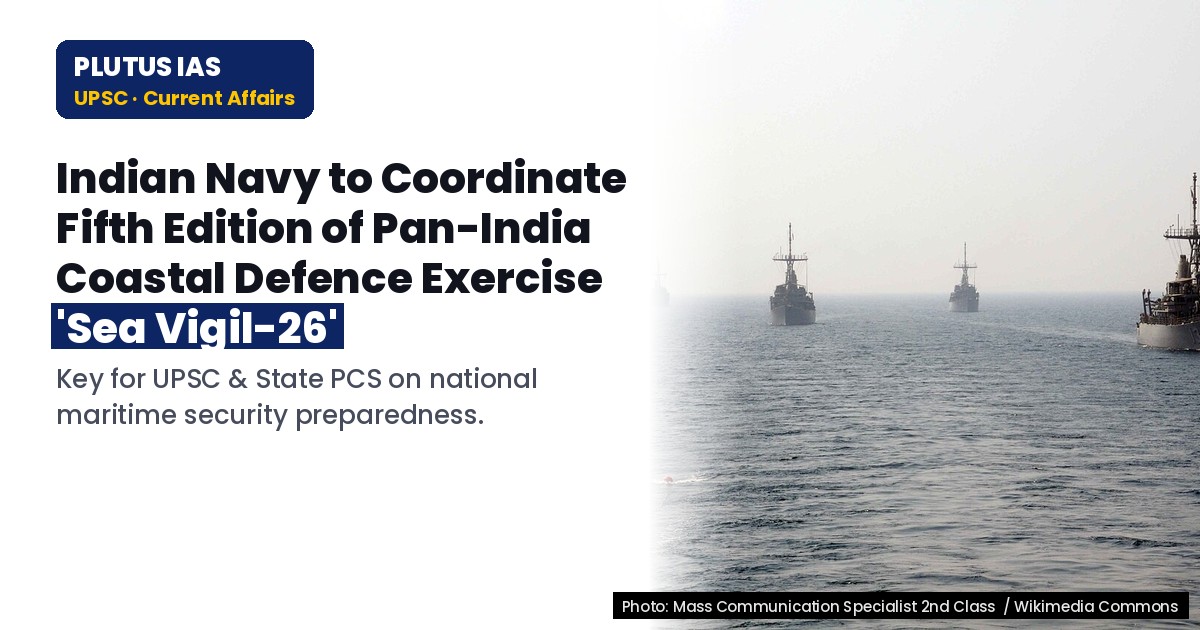
11 Nov Sea Vigil-26: Indian Navy’s Coastal Defence Exercise
✎ 'Sea Vigil' is India's largest biennial coastal defence exercise, led by the Indian Navy, designed to validate the nation's comprehensive coastal security architecture and enhance multi-agency coordination across its entire…
Subject Relevance — Where This Topic Fits
- GS Paper III — Security Challenges and their Management in Border Areas | GS Paper III — Various Security Forces and Agencies and their Mandate
- Prelims: Coastal Defence Exercise ‘Sea Vigil’, Indian Navy, Coastal Security Scheme, Maritime Domain Awareness, Multi-agency coordination, Exclusive Economic Zone
- Essay: India’s Maritime Security Imperatives, Coastal Security as a Pillar of National Defence
Quick Revision: ‘Sea Vigil’ is India’s largest biennial coastal defence exercise, led by the Indian Navy, designed to validate the nation’s comprehensive coastal security architecture and enhance multi-agency coordination across its entire coastline and EEZ.
Why is this in the news?
The Indian Navy is poised to orchestrate the fifth iteration of the pan-India coastal defence exercise, ‘Sea Vigil-26’. This biennial exercise is a critical component of India’s comprehensive coastal security architecture, designed to validate and refine the efficacy of the nation’s multi-layered maritime defence mechanisms. Its execution underscores the continuous commitment to bolstering coastal security in response to evolving threats and challenges within India’s extensive maritime zones.
Background
- Following the 26/11 Mumbai terrorist attacks in 2008, significant deficiencies in India’s coastal security framework were identified, leading to a comprehensive overhaul and strengthening of the system.
- The ‘Sea Vigil’ exercise was conceptualised as a large-scale coastal defence drill to assess the preparedness of all stakeholders involved in coastal security, ranging from central agencies to state maritime police.
- The exercise encompasses India’s entire coastline and Exclusive Economic Zone (EEZ), involving numerous maritime and coastal security agencies.
- It serves as a realistic simulation of various maritime threats, including infiltration, sabotage, and asymmetric warfare, testing the response mechanisms and inter-agency coordination.
- The exercise is conducted biennially, providing a regular assessment cycle for the nation’s coastal defence capabilities and facilitating continuous improvement.
- The Indian Navy is mandated as the lead agency for coastal security in India, responsible for overall coordination and operational control during such exercises and real-world contingencies.
What is Exercise ‘Sea Vigil’?
- ‘Sea Vigil’ is a comprehensive pan-India coastal defence exercise conducted biennially, involving all maritime stakeholders.
- It is the largest coastal defence exercise in India, covering the entire 7,516 km coastline and the Exclusive Economic Zone (EEZ).
- The exercise aims to validate the effectiveness of the coastal security apparatus established post-26/11, including surveillance, interdiction, and response mechanisms.
- Participants include the Indian Navy, Coast Guard, Marine Police, Customs, Port Authorities, and other central and state agencies involved in maritime security.
- It simulates various maritime contingencies, such as terrorist infiltration, illegal migration, arms and narcotics trafficking, and attacks on offshore installations.
- The exercise focuses on enhancing Maritime Domain Awareness (MDA) and improving seamless coordination and information sharing among diverse agencies.
- It assesses the readiness of the coastal security framework to respond to asymmetric threats emanating from the sea.
- ‘Sea Vigil’ is a precursor to the larger Theatre Level Operational Readiness Exercise (TROPEX) conducted by the Indian Navy, providing a realistic scenario for naval operations in a multi-threat environment.
Key Features
| Feature | Significance |
|---|---|
| Exercise ‘Sea Vigil-26’ | A pan-India coastal defence exercise designed to validate and refine the nation’s coastal security apparatus. |
| Fifth Edition | Indicates a sustained and evolving commitment to enhancing maritime domain awareness and response capabilities. |
| Indian Navy’s Coordination | Highlights the Indian Navy’s pivotal role as the lead agency for maritime security, integrating various stakeholders. |
| Multi-agency Participation | Involves all coastal states and Union Territories, along with various central and state agencies, fostering inter-agency synergy. |
| Comprehensive Scope | Encompasses coastal areas, offshore assets, and island territories, addressing a wide spectrum of maritime security threats. |
Why it Matters
National Security
- Enhances the preparedness and response mechanisms against maritime threats, including terrorism, infiltration, and illegal activities.
- Strengthens the overall coastal defence architecture by testing operational readiness and coordination among diverse agencies.
Strategic Importance
- Reinforces India’s position as a responsible maritime power, capable of safeguarding its extensive coastline and maritime interests.
- Contributes to regional stability by demonstrating robust security capabilities in the Indian Ocean Region.
Inter-Agency Coordination
- Fosters seamless collaboration and communication between the Indian Navy, Coast Guard, state marine police, customs, and other security agencies.
- Identifies and addresses gaps in coordination and intelligence sharing, leading to more effective joint operations.
Economic Security
- Protects vital offshore installations, ports, and sea lanes of communication, which are crucial for India’s economic prosperity and energy security.
- Safeguards maritime trade and fishing communities from potential threats, ensuring uninterrupted economic activities.
Challenges
1. Coordination Complexity
- Integrating numerous agencies with varying mandates, jurisdictions, and operational procedures across a vast coastline.
- Ensuring effective communication and real-time information sharing among diverse stakeholders during crisis situations.
UPSC Link: Internal Security: Coastal Security
2. Resource Disparity
- Addressing differences in equipment, training, and technological capabilities among various state and central agencies.
- Optimizing resource allocation and ensuring equitable distribution of assets for comprehensive coastal surveillance.
UPSC Link: Internal Security: Border Management
3. Dynamic Threat Landscape
- Adapting to evolving maritime threats, including sophisticated terrorist tactics, illegal migration, and illicit trafficking.
- Countering non-state actors operating in the maritime domain, which often exploit gaps in surveillance and enforcement.
UPSC Link: Internal Security: Security Challenges
4. Technological Integration
- Implementing advanced surveillance technologies and ensuring interoperability across different platforms and agencies.
- Leveraging artificial intelligence and big data analytics for enhanced maritime domain awareness and predictive analysis.
UPSC Link: Science & Technology: Defence Technology
Challenges — UPSC Perspective
| Issue | Concern |
|---|---|
| Jurisdictional Overlap | Ambiguity in roles and responsibilities among different agencies can lead to delayed responses or gaps in coverage. |
| Information Silos | Lack of seamless information flow between agencies hinders comprehensive threat assessment and coordinated action. |
| Infrastructure Gaps | Inadequate coastal surveillance infrastructure, such as radars and sensors, in remote or sensitive areas. |
| Capacity Building | Need for continuous training and skill development for personnel across all agencies to handle modern maritime threats. |
| Community Engagement | Ensuring active participation and trust-building with coastal communities, who are vital for intelligence gathering. |
Way Forward
- Establish a unified command and control structure for coastal security, streamlining decision-making and operational responses.
- Invest in advanced surveillance technologies, including integrated coastal surveillance systems and unmanned aerial/underwater vehicles.
- Conduct regular joint training exercises and workshops to enhance interoperability and foster a culture of collaboration among agencies.
- Strengthen intelligence gathering and sharing mechanisms, leveraging technology and human intelligence networks, particularly with coastal communities.
- Develop a robust legal framework that clearly defines the roles and responsibilities of all stakeholders in coastal security.
- Promote international cooperation with littoral states to address transnational maritime threats and share best practices.
- Focus on capacity building for marine police and other state-level agencies, providing them with modern equipment and specialized training.
UPSC Value Addition
Keywords for Mains Answer-Writing
Coastal security architecture · Maritime domain awareness · Indian Navy · Coastal defence exercise · Multi-agency coordination · National maritime security · Exclusive Economic Zone · Security challenges · Standard Operating Procedures · Information sharing mechanism
Concept Flow
Maritime threats persist along India’s coastline. → Need for robust coastal defence mechanisms identified. → Pan-India coastal defence exercises like ‘Sea Vigil’ are conducted. → Indian Navy coordinates multi-agency participation. → Operational readiness and inter-agency synergy are enhanced. → Overall coastal security architecture is strengthened.
Prelims Practice Questions
Q1. Consider the following statements regarding ‘Sea Vigil’ exercises:
1. ‘Sea Vigil’ is a biennial pan-India coastal defence exercise.
2. It involves all 13 coastal states and Union Territories of India.
3. The exercise is coordinated by the Indian Coast Guard.
How many of the above statements are correct?
- Only one
- Only two
- All three
- None
Answer: Only two — Statement 1 is correct: ‘Sea Vigil’ is indeed a biennial pan-India coastal defence exercise. Statement 2 is correct: It encompasses all 13 coastal states and Union Territories. Statement 3 is incorrect: The exercise is coordinated by the Indian Navy, not the Indian Coast Guard.
Q2. Which of the following bodies is primarily responsible for the overall maritime security of India, including coastal and offshore areas?
- Indian Coast Guard
- Indian Navy
- Marine Police
- Directorate General of Shipping
Answer: Indian Navy — The Indian Navy is designated as the primary agency responsible for the overall maritime security, including coastal and offshore security. The Indian Coast Guard is responsible for coastal security in territorial waters and Exclusive Economic Zone (EEZ), while Marine Police operate in coastal areas up to 12 nautical miles.
Mains Practice Question
✍ Discuss the significance of pan-India coastal defence exercises like ‘Sea Vigil’ in enhancing India’s maritime security. Critically examine the challenges in achieving comprehensive coastal security and suggest measures to overcome them. (15 Marks)
Approach: MODEL-ANSWER SKELETON:
1. Introduction: Briefly define ‘Sea Vigil’ and its purpose as a pan-India coastal defence exercise.
2. Significance of ‘Sea Vigil’ and similar exercises:
a. Enhancement of Maritime Domain Awareness (MDA).
b. Validation of Standard Operating Procedures (SOPs) for coastal security.
c. Promotion of inter-agency coordination (Indian Navy, Coast Guard, Marine Police, Customs, Fisheries, etc.).
d. Testing of the efficacy of the coastal security architecture post-26/11.
e. Deterrence against maritime threats (terrorism, smuggling, illegal fishing).
f. Capacity building and training for various stakeholders.
3. Challenges in achieving comprehensive coastal security:
a. Vast coastline and numerous landing points.
b. Porosity of maritime borders.
c. Limited resources and infrastructure for surveillance and interdiction.
d. Gaps in real-time information sharing among diverse agencies.
e. Jurisdictional overlaps and lack of seamless coordination.
f. Involvement of local fishing communities and their integration into the security framework.
g. Technological limitations in surveillance and response.
4. Measures to overcome challenges:
a. Strengthening the ‘hub and spoke’ model of coastal security (Naval Operations Centres as hubs).
b. Enhancing technological surveillance (radars, Automatic Identification System (AIS), drones).
c. Regular joint exercises and training for all agencies.
d. Improving intelligence gathering and real-time information fusion centers.
e. Community participation through schemes like ‘Sagar Prahari’ and ‘Coastal Security Scheme’.
f. Streamlining legal and institutional frameworks for clear mandates.
g. Investment in modern patrol vessels and equipment for coastal forces.
5. Conclusion: Reiterate the importance of continuous vigilance, multi-agency synergy, and technological integration for robust coastal defence.
Source: PIB (Press Information Bureau)
Generated by AanyaAi for educational purpose.
Related guides on our sites
- How to prepare for GS paper 1 for UPSC CSE mains exam
- Best UPSC coaching for IFOS exam
- Best mentorship programme for upsc
- UPSC+BA degree

- Sea Vigil-26: Indian Navy’s Coastal Defence Exercise - November 11, 2026
- नागरिकता के पुख्ता सबूत नहीं पैन-वोटर आईडी: गौहाटी हाईकोर्ट - November 11, 2026
- Yuge Yugeen Bharat Museum: Cabinet Approves Project - November 11, 2026

No Comments