


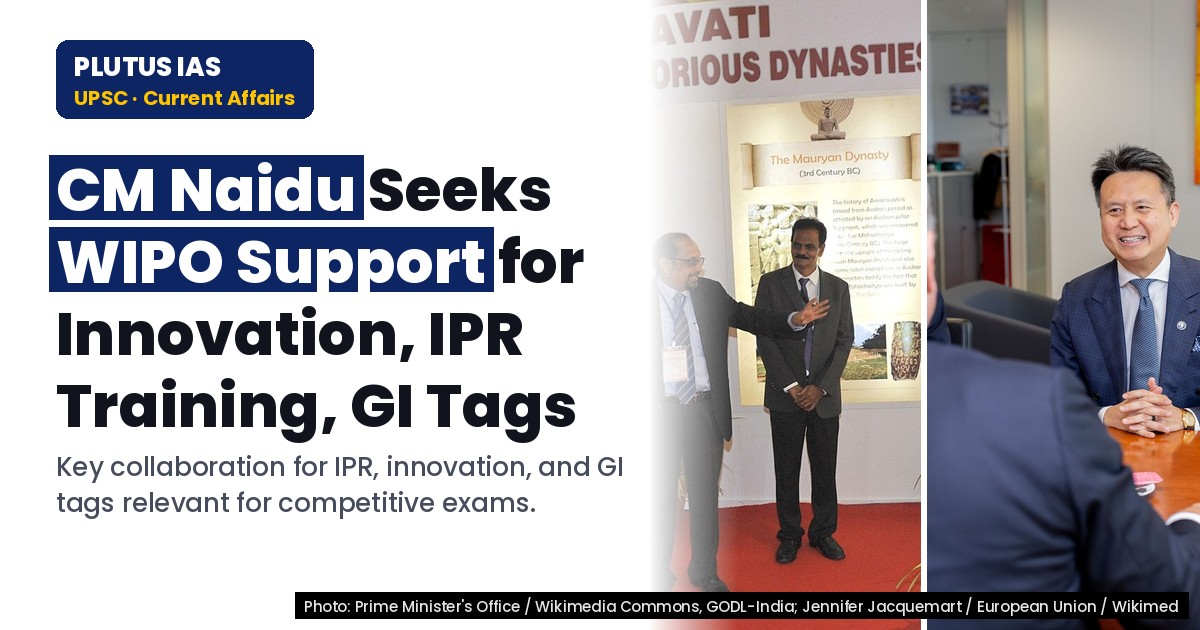
12 Nov Andhra Pradesh Seeks WIPO Support for Innovation & IPR
✎ WIPO is a UN specialized agency dedicated to promoting the protection of intellectual property worldwide and fostering innovation and creativity through international cooperation and services.
Subject Relevance — Where This Topic Fits
- GS Paper II — International Relations | GS Paper III — Economy | GS Paper III — Science and Technology
- Prelims: World Intellectual Property Organization (WIPO), Geographical Indication (GI) Tag, Intellectual Property Rights (IPR), Innovation Ecosystem, MSMEs, Quantum Computing, Artificial Intelligence
- Essay: The Role of Innovation and Technology in India’s Economic Growth, Leveraging International Partnerships for Sustainable Development
Quick Revision: WIPO is a UN specialized agency dedicated to promoting the protection of intellectual property worldwide and fostering innovation and creativity through international cooperation and services.
Why is this in the news?
Andhra Pradesh Chief Minister N. Chandrababu Naidu recently engaged with the Director-General of the World Intellectual Property Organization (WIPO) during the pre-CII Partnership Summit events. The discussions primarily focused on exploring institutional collaboration to bolster the state’s innovation, research, and Intellectual Property Rights (IPR) framework, including proposals for joint training programmes and support for securing Geographical Indication (GI) tags for local products.
Background
- The World Intellectual Property Organization (WIPO) is one of the 15 specialized agencies of the United Nations, established in 1967 to promote the protection of intellectual property throughout the world and to encourage creative activity.
- Intellectual Property Rights (IPR) are legal rights that protect creations of the mind. These include patents, copyrights, trademarks, industrial designs, and geographical indications, providing creators with exclusive rights over their inventions or artistic works.
- Geographical Indication (GI) tags are a form of IPR that identifies goods originating from a specific geographical location, possessing qualities or a reputation due to that origin. They play a crucial role in protecting traditional products and promoting regional economies.
- Innovation ecosystems comprise a network of organizations, individuals, and resources that interact to foster the creation, development, and commercialization of new ideas, products, and services. These often include academic institutions, research centres, startups, incubators, and government support.
- Micro, Small and Medium Enterprises (MSMEs) are vital for economic growth and employment generation in India. Strengthening their capacity in IPR and innovation is crucial for their competitiveness and global integration.
- The Government of India has been actively promoting innovation and IPR through various policies and initiatives, recognizing their significance for economic development, technological advancement, and global competitiveness.
What is the World Intellectual Property Organization (WIPO)?
- WIPO is the global forum for intellectual property (IP) services, policy, information, and cooperation. It is a self-funding agency of the United Nations, with 193 member states.
- Its mission is to lead the development of a balanced and effective international IP system that enables innovation and creativity for the benefit of all.
- WIPO’s activities include administering international treaties on IP, providing global services for protecting IP across borders, and offering capacity-building programmes to developing countries.
- Key international treaties administered by WIPO include the Patent Cooperation Treaty (PCT), the Madrid System for trademarks, and the Hague System for industrial designs.
- WIPO facilitates the registration and protection of various forms of intellectual property, such as patents, trademarks, industrial designs, and geographical indications, at an international level.
- The organization also serves as a reference source for IP information, offering databases, statistics, and legal resources to governments, businesses, and the public.
- WIPO plays a significant role in promoting IP education and awareness, fostering a culture of innovation and respect for intellectual property rights globally.
Key Features
| Feature | Significance |
|---|---|
| WIPO–Andhra Pradesh Academy Proposal | Aims to establish a dedicated institution for joint training programmes on Intellectual Property Rights (IPR), covering patents, trademarks, industrial designs, and technology protection, targeting students, researchers, startups, and MSMEs. |
| Geographical Indication (GI) Tag Support | Seeks WIPO’s assistance in securing GI tags for Andhra Pradesh’s traditional handloom and handicraft sectors, enhancing global recognition and market access for local heritage products. |
| Quality Standards and Global Branding | Focuses on elevating quality standards and strengthening global branding for existing GI products from Andhra Pradesh, ensuring competitiveness in international markets. |
| Partnership for Women-led Enterprises | Invites WIPO to collaborate on expanding women-led business enterprises, leveraging initiatives like the ‘Swayam’ brand to foster women entrepreneurs. |
| Integration of Technology into Governance | Emphasises aligning state policies with WIPO initiatives to integrate advanced technologies like quantum computing and AI into governance, fostering a technology-driven ecosystem. |
| Amaravati–Visakhapatnam Corridor Development | Aims to develop this corridor into a top-100 global science and technology cluster by 2029, attracting investments and promoting innovation in emerging domains. |
Why it Matters
Economic Development
- Facilitates the growth of an innovation-driven economy by strengthening the IPR ecosystem, which is crucial for attracting investments and fostering entrepreneurship.
- Promotes value addition and market access for traditional products through GI tags and enhanced branding, boosting local economies and preserving cultural heritage.
- Supports the development of Micro, Small and Medium Enterprises (MSMEs) and startups by providing essential IPR knowledge and protection mechanisms, thereby increasing their competitiveness.
Technological Advancement
- Accelerates the adoption and development of cutting-edge technologies like quantum computing and artificial intelligence by creating a conducive policy and institutional environment.
- Positions Andhra Pradesh as a significant hub for science and technology, contributing to India’s overall technological prowess and global standing.
- Enhances research and development capabilities by training students and researchers in IPR, ensuring that innovations are protected and commercialised effectively.
Social Empowerment
- Empowers women entrepreneurs by expanding women-led business enterprises, contributing to gender equality and inclusive economic growth.
- Creates employment opportunities through the growth of MSMEs, startups, and traditional sectors, leading to improved livelihoods and reduced regional disparities.
International Collaboration
- Strengthens India’s engagement with international organisations like WIPO, facilitating knowledge exchange and best practices in IPR management.
- Enhances the global visibility and branding of Indian products and innovations, fostering international trade and partnerships.
Challenges
1. IPR Awareness and Enforcement
- Limited awareness among MSMEs, startups, and grassroots innovators regarding the importance and processes of IPR protection.
- Challenges in effective enforcement of IPR laws, leading to issues of infringement and counterfeiting, which deter innovation and investment.
UPSC Link: Economy, Science & Technology
2. Skill Development and Capacity Building
- Need for specialised training programmes and skilled personnel in IPR management, particularly in emerging technological domains.
- Ensuring that training initiatives reach a diverse audience, including rural artisans and women entrepreneurs, to foster inclusive innovation.
UPSC Link: Human Resource Development, Economy
3. Funding and Infrastructure
- Securing adequate financial resources and developing robust infrastructure to support IPR academies, research facilities, and innovation hubs.
- Attracting private sector investment and fostering public-private partnerships for sustainable development of the innovation ecosystem.
UPSC Link: Economy, Infrastructure
4. Market Access and Global Competitiveness
- Overcoming barriers to international market access for GI-tagged products and other local innovations.
- Ensuring that Indian products meet global quality standards and branding requirements to compete effectively in international markets.
UPSC Link: Economy, International Trade
Challenges — UPSC Perspective
| Issue | Concern |
|---|---|
| Low IPR Literacy | Many potential innovators, especially in MSMEs and rural areas, lack understanding of IPR benefits and registration processes. |
| Enforcement Gaps | Ineffective legal and administrative mechanisms for IPR enforcement can undermine the value of protected intellectual property. |
| Resource Allocation | Adequate funding and skilled human resources are crucial for establishing and sustaining high-quality IPR training and support infrastructure. |
| Global Standards Adherence | Meeting international quality benchmarks and branding requirements is essential for the global market acceptance of local products. |
| Digital Divide | Ensuring equitable access to IPR resources and digital platforms for all stakeholders, including those in remote areas, remains a challenge. |
Government Initiatives — Must-Memorise for Prelims
- Ratan Tata Innovation Hub
- Swayam brand
- Amaravati Quantum Valley
Way Forward
- Establish a robust IPR awareness campaign targeting diverse stakeholders, including educational institutions, MSMEs, and self-help groups, to foster a culture of innovation and protection.
- Develop specialised IPR training modules for emerging technologies such as quantum computing and artificial intelligence, ensuring that the workforce is equipped to handle future challenges.
- Streamline the process for obtaining Geographical Indication (GI) tags and provide comprehensive support to local artisans and producers for quality enhancement and global branding.
- Promote public-private partnerships and international collaborations to leverage expertise and resources for building a world-class innovation ecosystem.
- Integrate IPR education into academic curricula at various levels to inculcate an understanding of intellectual property from an early stage.
- Strengthen IPR enforcement mechanisms through capacity building of law enforcement agencies and judicial reforms to deter infringement and protect innovators’ rights.
- Develop a dedicated fund or incentive structure to support women-led enterprises in IPR registration and commercialisation, fostering inclusive economic growth.
UPSC Value Addition
Keywords for Mains Answer-Writing
Intellectual Property Rights (IPR) · World Intellectual Property Organization (WIPO) · Innovation Ecosystem · Geographical Indication (GI) tags · Technology Protection · Startup Ecosystem · Micro, Small and Medium Enterprises (MSMEs) · Women Entrepreneurship · Economic Development Strategy · Global Science and Technology Cluster · Sustainable Development · International Collaboration
Concept Flow
Strengthening IPR Ecosystem → Boosting Innovation and Research → Attracting Investment and Entrepreneurship → Economic Growth and Job Creation → Global Competitiveness and Recognition
Prelims Practice Questions
Q1. Consider the following statements regarding Intellectual Property Rights (IPRs) in India:
1. Patents protect inventions, granting exclusive rights for a limited period.
2. Trademarks are used to distinguish the goods or services of one enterprise from those of other enterprises.
3. Geographical Indications (GIs) identify goods originating from a specific geographical territory, possessing qualities or a reputation due to that origin.
How many of the above statements are correct?
- Only one
- Only two
- All three
- None
Answer: All three — Statement 1 is correct: Patents are granted for inventions, providing exclusive rights for a specified period, typically 20 years, to prevent others from making, using, or selling the invention without permission. Statement 2 is correct: Trademarks are distinctive signs or indicators used by an individual, business organization, or other legal entity to identify that the products or services to consumers originate from a unique source. Statement 3 is correct: GIs are used on products that have a specific geographical origin and possess qualities or a reputation that are due to that origin, such as Darjeeling Tea or Mysore Silk.
Q2. Which of the following international treaties, administered by the World Intellectual Property Organization (WIPO), primarily deals with the protection of industrial designs?
- Paris Convention for the Protection of Industrial Property
- Berne Convention for the Protection of Literary and Artistic Works
- Madrid Agreement Concerning the International Registration of Marks
- Patent Cooperation Treaty (PCT)
Answer: Paris Convention for the Protection of Industrial Property — The Paris Convention for the Protection of Industrial Property covers patents, trademarks, industrial designs, utility models, service marks, trade names, geographical indications, and the repression of unfair competition. The Berne Convention deals with copyright, the Madrid Agreement with trademarks, and the PCT with patents.
Mains Practice Question
✍ Examine the significance of Intellectual Property Rights (IPRs) in fostering an innovation ecosystem and promoting economic development. Discuss the role of international organizations like WIPO in strengthening national IPR regimes and facilitating global collaboration. (15 Marks)
Approach: Introduction: Define IPRs and their fundamental purpose.
Part 1: Significance of IPRs in innovation and economic development.
– Incentivizing innovation: Patents for inventions, copyrights for creative works.
– Facilitating technology transfer and commercialization.
– Promoting entrepreneurship and startup growth.
– Enhancing competitiveness and market differentiation (e.g., trademarks, GIs).
– Attracting foreign direct investment (FDI) and fostering R&D.
– Contributing to cultural and traditional knowledge preservation (e.g., GIs for heritage products).
Part 2: Role of WIPO and international collaboration.
– Standard-setting and harmonization of IPR laws globally (e.g., various WIPO-administered treaties like Paris Convention, Berne Convention, PCT).
– Providing technical assistance and capacity building to member states, especially developing countries.
– Facilitating dispute resolution in IPR matters.
– Promoting global cooperation for IPR protection and enforcement.
– Supporting initiatives for IPR awareness and education (e.g., proposed WIPO–Andhra Pradesh Academy).
– Examples of WIPO’s work: Global Innovation Index, WIPO GREEN, WIPO PROOF.
Conclusion: Summarize the critical role of IPRs and WIPO in a knowledge-based economy, emphasizing the need for robust national frameworks and international partnerships for sustainable development.
Source: The Hindu
Generated by AanyaAi for educational purpose.
Related guides on our sites
- Anthropology VS PSIR
- Best PSIR optional coaching
- Best PSIR optional coaching online
- Best PSIR optional teacher

- Indian Army Delegation Boosts India-Indonesia Defence Ties - November 12, 2026
- जनजातीय गौरव पखवाड़ा 2026: उद्देश्य, पहलें और महत्व - November 12, 2026
- Rupee Rally Stalls: RBI Intervention & Oil Demand - November 12, 2026

No Comments