


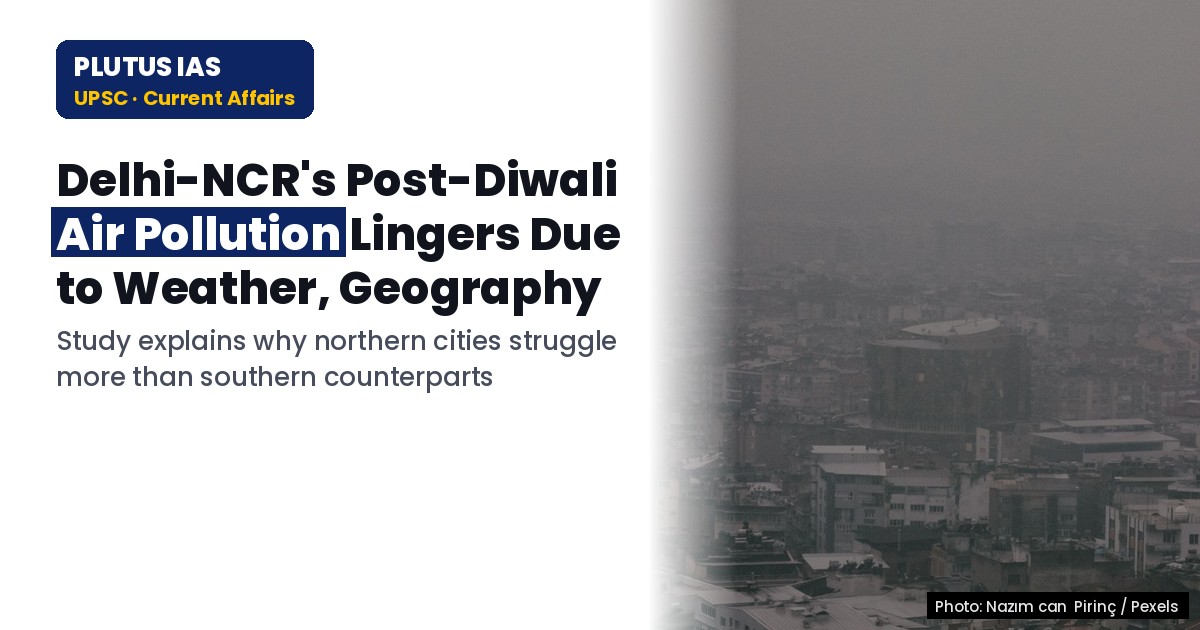
12 Nov Delhi-NCR vs. Chennai-Hyderabad: Post-Diwali Air Quality
✎ The differential post-Diwali air quality recovery between North and South Indian cities is attributable to a combination of meteorological conditions, geographical factors, and varying pollutant dispersion mechanisms.
Subject Relevance — Where This Topic Fits
- GS Paper I — Geography (Urbanisation, Climatology) | GS Paper III — Environment (Environmental Pollution & Degradation, Conservation)
- Prelims: Air Quality Index (AQI), Central Pollution Control Board (CPCB), Particulate Matter (PM2.5, PM10), Air pollution sources, Meteorological factors in air quality, Geographical factors in air quality, National Clean Air Programme (NCAP)
- Essay: Urbanisation, Environmental Sustainability, and Public Health in India, The Challenge of Air Pollution: A Multifaceted Problem Requiring Integrated Solutions
Quick Revision: The differential post-Diwali air quality recovery between North and South Indian cities is attributable to a combination of meteorological conditions, geographical factors, and varying pollutant dispersion mechanisms.
Why is this in the news?
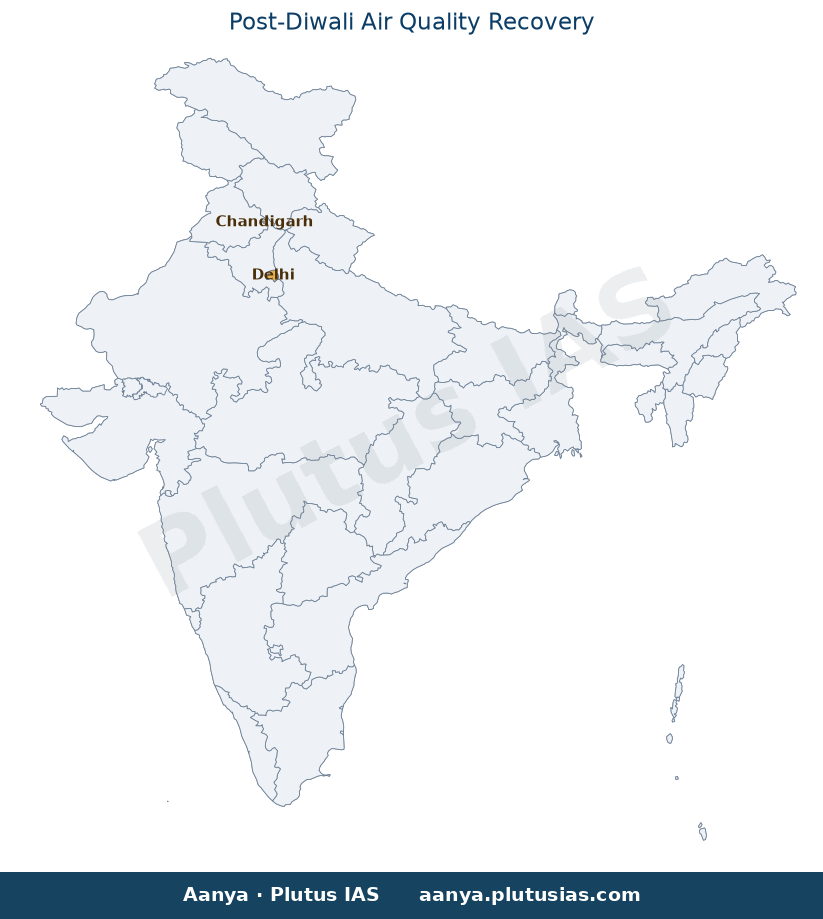
A recent study, analysing Air Quality Index (AQI) data from 2024 to 2026 across nine Indian cities, has highlighted a significant disparity in post-Diwali air pollution recovery between North and South Indian urban centres. While cities like Chennai and Hyderabad demonstrated rapid improvement in air quality within a week following the festival, Delhi-NCR, along with other northern cities such as Gurugram, Lucknow, and Patna, experienced prolonged periods of elevated pollution levels. This differential recovery underscores the complex interplay of meteorological conditions, geographical factors, and anthropogenic emissions in determining urban air quality.
Background
- Air pollution is a critical environmental and public health issue in India, with several cities consistently ranking among the most polluted globally.
- Diwali, the festival of lights, often contributes to a spike in air pollution due to the widespread burning of firecrackers, releasing particulate matter and noxious gases.
- The Air Quality Index (AQI) is a tool for effective communication of air quality status to the public, indicating how clean or polluted the air is and its associated health effects.
- Meteorological factors, such as wind speed and direction, temperature inversions, and atmospheric boundary layer height, significantly influence the dispersion and accumulation of pollutants.
- Geographical features, including proximity to industrial areas, vehicular density, and surrounding topography, also play a crucial role in determining a city’s susceptibility to air pollution.
- The Central Pollution Control Board (CPCB) is the apex body in India responsible for monitoring air quality and implementing measures for pollution control.
Understanding Air Quality Index (AQI) and Factors Influencing Urban Air Pollution
- The Air Quality Index (AQI) is a numerical scale used to report daily air quality, categorising it into six levels: Good, Satisfactory, Moderately Polluted, Poor, Very Poor, and Severe.
- AQI considers eight major pollutants: Particulate Matter (PM2.5 and PM10), Ozone (O3), Carbon Monoxide (CO), Sulfur Dioxide (SO2), Nitrogen Dioxide (NO2), Ammonia (NH3), and Lead (Pb).
- PM2.5 and PM10 are fine particulate matter that can penetrate deep into the respiratory system, posing significant health risks, and are often primary contributors to high AQI readings.
- Anthropogenic sources of air pollution include vehicular emissions, industrial activities, construction dust, biomass burning (including stubble burning in agricultural regions), and domestic fuel combustion.
- Meteorological conditions in North India during winter, such as low wind speeds, lower temperatures, and atmospheric inversions, trap pollutants close to the ground, exacerbating pollution levels.
- Coastal cities like Chennai often benefit from sea breezes and better atmospheric dispersion due to their geographical location, which helps in clearing pollutants more rapidly.
- The National Clean Air Programme (NCAP) aims to reduce particulate matter concentration by 20-30% by 2024 (with 2017 as the base year) in 131 non-attainment cities across India.
- Long-term exposure to high levels of air pollution is linked to various health issues, including respiratory diseases, cardiovascular problems, and increased mortality rates.
Key Features
| Feature | Significance |
|---|---|
| Geographical Location | Delhi-NCR is landlocked, hindering pollutant dispersion, unlike coastal cities like Chennai which benefit from sea breezes. |
| Meteorological Conditions | Post-Diwali, North Indian cities experience calm winds and lower temperatures, leading to atmospheric inversion and pollutant trapping. Southern cities generally have more favourable wind patterns. |
| Pre-existing Pollution Levels | Delhi-NCR often has elevated baseline pollution levels even before Diwali, exacerbating the post-festival impact. |
| Pollutant Dispersion Rate | Cities like Chennai and Hyderabad demonstrate a faster recovery in air quality due to better atmospheric ventilation. |
| Sources of Pollution | Beyond firecrackers, regional factors like stubble burning, vehicular emissions, and industrial activities contribute significantly to persistent pollution in North India. |
Why it Matters
Environmental Significance
- Highlights the complex interplay of anthropogenic activities, meteorological conditions, and geographical factors in determining air quality dynamics.
- Underscores the regional disparities in pollution resilience and the need for tailored environmental management strategies.
- Emphasises the long-term health implications of sustained exposure to high levels of air pollution for urban populations.
Public Health Significance
- Persistent air pollution exacerbates respiratory and cardiovascular diseases, leading to increased morbidity and mortality.
- Impacts vulnerable populations, including children and the elderly, disproportionately.
- Places a significant burden on public healthcare infrastructure and resources.
Governance and Policy Significance
- Reveals the limitations of short-term interventions and the necessity for comprehensive, multi-sectoral approaches to air pollution control.
- Informs urban planning and development strategies to incorporate environmental considerations, such as promoting green infrastructure and efficient public transport.
- Stresses the importance of robust monitoring systems and data-driven policy formulation, as exemplified by the CPCB’s AQI bulletins.
Challenges
1. Persistent Air Pollution
- Delhi-NCR experiences prolonged periods of poor air quality, particularly post-Diwali, due to a combination of emissions, adverse meteorological conditions, and geographical constraints.
- The baseline pollution levels are often already elevated before festival-related emissions, leading to a cumulative and severe impact.
UPSC Link: Environmental Pollution & Degradation
2. Geographical and Meteorological Constraints
- The landlocked nature of Delhi-NCR, coupled with winter atmospheric inversion and calm winds, traps pollutants, preventing their dispersion.
- This contrasts with coastal cities that benefit from better ventilation and wind patterns, aiding in faster pollutant clearance.
UPSC Link: Geographical Phenomena; Climate Change
3. Multi-source Emissions Management
- Addressing air pollution requires tackling diverse sources, including vehicular emissions, industrial discharges, construction dust, stubble burning, and domestic combustion, which necessitates coordinated efforts across multiple sectors and states.
- The contribution of firecrackers, while significant during festivals, is compounded by these perennial sources.
UPSC Link: Environmental Impact Assessment; Pollution Control
4. Public Health Burden
- Sustained exposure to high levels of air pollution leads to severe public health consequences, including respiratory illnesses, cardiovascular diseases, and reduced life expectancy.
- This places a considerable strain on healthcare systems and diminishes overall societal productivity.
UPSC Link: Health; Human Development
Challenges — UPSC Perspective
| Issue | Concern |
|---|---|
| Prolonged Pollution Episodes | Unlike Southern cities, Delhi-NCR experiences extended periods of high AQI post-Diwali, indicating systemic issues beyond festival-specific emissions. |
| Geographical Disadvantage | The landlocked basin geography of Delhi-NCR, combined with winter meteorology, impedes natural dispersion of pollutants, exacerbating air quality degradation. |
| Baseline Pollution Levels | High pre-Diwali AQI in Delhi suggests a chronic pollution problem, where festival emissions merely push an already critical situation into severe categories. |
| Regional Disparities in Recovery | The stark difference in air quality recovery rates between North and South Indian cities highlights the need for region-specific pollution control strategies. |
| Multi-sectoral Emission Sources | Effective pollution control requires addressing a multitude of sources including vehicular, industrial, construction, and agricultural burning, demanding inter-agency and inter-state coordination. |
Way Forward
- Implement stringent emission standards for vehicles and industries, coupled with robust enforcement mechanisms.
- Promote and incentivise the adoption of cleaner energy sources and technologies across all sectors, including residential and commercial.
- Enhance public transportation infrastructure and encourage modal shifts away from private vehicles to reduce vehicular emissions.
- Develop and implement comprehensive regional air quality management plans that account for specific geographical and meteorological conditions.
- Invest in advanced air quality monitoring networks and data analytics to provide real-time, actionable insights for policy interventions.
- Foster inter-state cooperation to address transboundary pollution sources, such as agricultural stubble burning.
- Launch sustained public awareness campaigns to educate citizens on pollution sources, health impacts, and individual actions for mitigation.
- Integrate green infrastructure and urban planning principles that enhance natural ventilation and reduce heat island effects in cities.
UPSC Value Addition
Keywords for Mains Answer-Writing
Air Pollution · Air Quality Index (AQI) · Urban Air Quality Management · Geographical Factors in Pollution · Meteorological Factors in Pollution · Pollution Sources · Environmental Governance · Sustainable Urban Development
Constitutional & Policy Linkages
- Article 21: Right to a healthy environment
- Article 48A: Protection and improvement of environment
- Article 51A(g): Duty to protect and improve natural environment
Concept Flow
Anthropogenic emissions (e.g., firecrackers, vehicles, industry) → Pollutant accumulation in atmosphere → Adverse meteorological conditions (e.g., calm winds, inversion) → Geographical constraints (e.g., landlocked basin) → Reduced pollutant dispersion and trapping → Elevated Air Quality Index (AQI) → Adverse public health impacts
Prelims Practice Questions
Q1. Consider the following statements regarding air pollution in Indian cities:
1. The Air Quality Index (AQI) is a tool for effective communication of air quality status to the public.
2. Geographical features like landlocked conditions and wind patterns significantly influence the persistence of air pollutants.
3. Post-Diwali air quality recovery rates are uniform across all major Indian cities due to similar meteorological conditions.
How many of the above statements are correct?
- Only one
- Only two
- Only three
- None
Answer: Only two — Statement 1 is correct: AQI is designed to provide a simple, understandable measure of air quality. Statement 2 is correct: Geographical and meteorological factors are crucial in pollutant dispersion and accumulation. Statement 3 is incorrect: The news article explicitly states that recovery rates vary significantly between cities like Delhi-NCR and Chennai/Hyderabad, primarily due to differing geographical and meteorological conditions.
Q2. Assertion (A): Delhi-NCR experiences prolonged periods of high air pollution after events like Diwali, unlike coastal cities such as Chennai and Hyderabad.
Reason (R): The geographical location and prevailing meteorological conditions, including wind patterns and temperature inversions, play a significant role in the dispersion or accumulation of pollutants.
Which one of the following is correct in respect of the above statements?
- Both A and R are true and R is the correct explanation of A.
- Both A and R are true but R is not the correct explanation of A.
- A is true but R is false.
- A is false but R is true.
Answer: Both A and R are true and R is the correct explanation of A. — Assertion (A) is true as observed in the study mentioned in the news. Reason (R) is also true, as geographical and meteorological factors are indeed primary determinants of pollutant dispersion and persistence. Furthermore, R correctly explains why Delhi-NCR’s pollution persists longer than in coastal cities, which benefit from sea breezes and better ventilation.
Mains Practice Question
✍ Examine the multifaceted factors contributing to persistent air pollution in urban agglomerations like Delhi-NCR, contrasting them with the relatively quicker recovery observed in coastal cities. Suggest comprehensive strategies for effective air quality management in Indian cities. (15 Marks)
Approach: MODEL-ANSWER SKELETON: The answer should first delineate the specific factors leading to prolonged pollution in Delhi-NCR, such as geographical entrapment (landlocked basin), meteorological conditions (winter inversions, low wind speeds), diverse pollution sources (vehicular emissions, industrial, stubble burning, construction dust, domestic biomass burning), and high population density. Contrast this with coastal cities like Chennai and Hyderabad, highlighting the role of sea breezes, better ventilation, and different meteorological regimes in pollutant dispersion. The second part should propose comprehensive strategies, including: source-specific interventions (e.g., stricter emission norms, promotion of public transport, industrial emission controls, waste management, crop residue management); technological solutions (e.g., air purifiers, smog towers with critical evaluation); urban planning measures (e.g., green infrastructure, zoning regulations); policy and governance reforms (e.g., inter-state cooperation, real-time monitoring, enforcement of environmental laws, public awareness campaigns); and international best practices.
Source: aajtak.in
Telangana PCS (TGPSC (TSPSC)) — State PCS Practice
Prelims: Which of the following factors is NOT primarily responsible for the relatively cleaner air quality observed in Hyderabad and Chennai compared to Delhi-NCR after festivals like Diwali, as per recent observations?
- Geographical proximity to coastal areas facilitating wind dispersal of pollutants.
- Lower population density and vehicular emissions compared to Delhi-NCR.
- Effective implementation of stringent pollution control measures and green initiatives by state governments.
- Absence of agricultural stubble burning in surrounding regions.
Answer: Lower population density and vehicular emissions compared to Delhi-NCR. — While population density and vehicular emissions are factors, the primary reasons highlighted for cleaner air in Hyderabad/Chennai are coastal winds and absence of stubble burning, not necessarily lower population density or consistently lower vehicular emissions compared to Delhi-NCR’s scale.
Mains: Analyze the geographical and meteorological factors that contribute to better air quality in Hyderabad and Chennai, particularly after events like Diwali, in contrast to the persistent pollution in Delhi-NCR. Discuss potential lessons for urban environmental governance in Telangana, drawing comparisons with the Delhi-NCR situation.
Generated by AanyaAi for educational purpose.
Related guides on our sites
- Best PSIR optional coaching in delhi for UPSC
- How to prepare for GS paper 1 for UPSC CSE mains exam
- Best UPSC coaching for IFOS exam
- Best geography optional coaching

- आंध्र प्रदेश: वैश्विक निवेश हब और व्यापार सुगमता पर जोर - November 12, 2026
- Indian Army Delegation Boosts India-Indonesia Defence Ties - November 12, 2026
- जनजातीय गौरव पखवाड़ा 2026: उद्देश्य, पहलें और महत्व - November 12, 2026

No Comments