


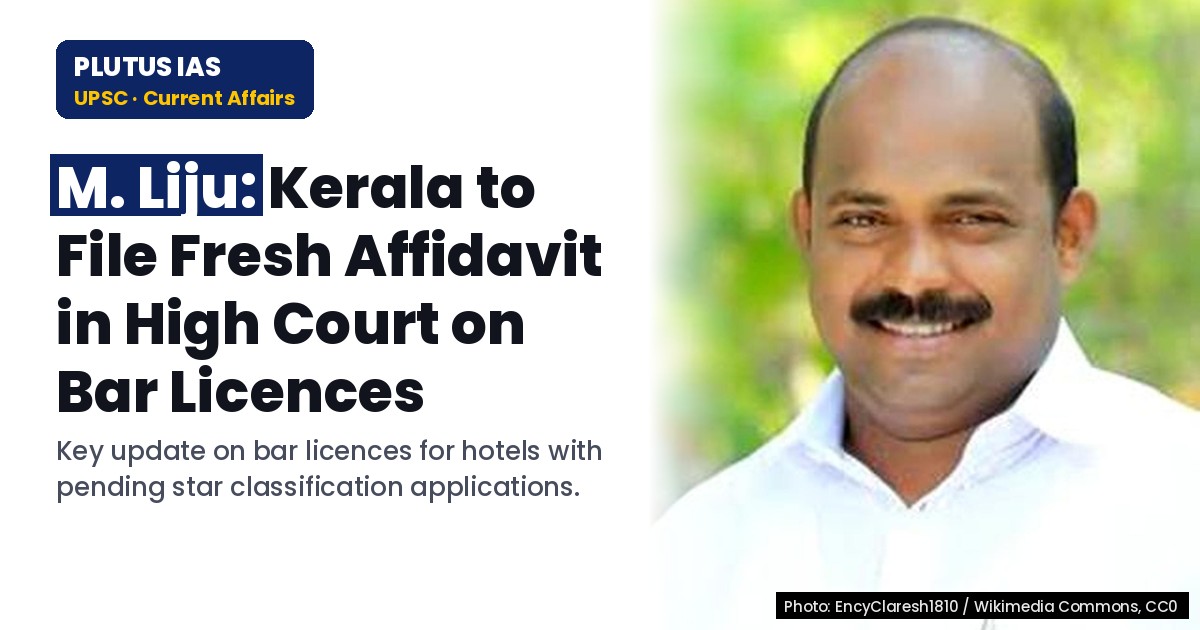
13 Nov Kerala Bar Licences: State to File New High Court Affidavit
✎ State excise policies, which regulate the grant of bar licences, often mandate hotel star classification as a prerequisite, linking state-level regulations with national tourism standards and subjecting such policy decisions to…
Subject Relevance — Where This Topic Fits
- GS Paper II — Governance; Constitution; Judiciary | GS Paper III — Indian Economy (Tourism Sector)
- Prelims: Excise Policy, Bar Licences, Hotel Star Classification, Judicial Review, State List, Union List
- Essay: Transparency and Accountability in Governance: The Role of Institutions, Balancing Economic Development with Social Welfare: The Case of Excise Policy
Quick Revision: State excise policies, which regulate the grant of bar licences, often mandate hotel star classification as a prerequisite, linking state-level regulations with national tourism standards and subjecting such policy decisions to judicial scrutiny.
Why is this in the news?
The Kerala State government is preparing to submit a new additional affidavit to the Kerala High Court concerning the issuance of bar licences to hotels. This development follows the receipt of updated information from the Union Tourism Ministry regarding the status of star classification applications for these hotels, which is a prerequisite for obtaining such licences under existing policy. The case involves a challenge to a previous government’s decision to consider licence applications from hotels with pending star classification requests.
Background
- Bar licences are typically granted to hotels holding three-to-five-star classifications, as per established policy guidelines.
- A previous state government had adopted a policy to consider applications for bar licences from hotels whose star classification applications were still under review by the Union Tourism Ministry.
- This policy decision was subsequently challenged in the Kerala High Court, leading to ongoing legal proceedings.
- Upon assuming office, the current state government identified a lack of comprehensive data regarding star classification applications, specifically the number of rejections by the Union Tourism Ministry.
- The State Excise and Taxes departments formally requested this crucial information from the Union Tourism Ministry to ensure informed decision-making and legal compliance.
- The Union Tourism Ministry has since provided details on rejected and pending applications, and has also filed its own affidavit in the High Court.
- The state government, after consulting with legal and departmental experts, aims to proceed transparently and uphold existing rules, laws, and policy in its revised affidavit.
- The Union Tourism Ministry has reportedly informed the state government that star classification applications for 32 hotels in Kerala have been rejected.
- The subject matter of ‘alcoholic liquors for human consumption’ falls under Entry 51 of the State List (List II) of the Seventh Schedule to the Constitution of India, granting states legislative and executive power over excise duties and regulation of liquor.
- The Union Tourism Ministry is responsible for the star classification of hotels, which is a national standardisation process.
- Judicial review by High Courts, under Articles 226 and 227 of the Constitution, allows for the examination of the constitutionality and legality of executive actions and legislative enactments.
What is Hotel Star Classification and its Relevance to Bar Licences?
- Hotel Star Classification is a system employed by the Ministry of Tourism, Government of India, to categorise hotels based on their facilities, services, and quality standards.
- The classification ranges from one-star to five-star (and beyond, e.g., Heritage, Five-Star Deluxe), providing a benchmark for quality and service for both domestic and international tourists.
- This classification is crucial for hotels as it influences their market positioning, pricing, and eligibility for various government incentives and permissions.
- For many state excise policies, including Kerala’s, a minimum star classification (e.g., three-star) is a mandatory prerequisite for obtaining a bar licence.
- The rationale behind linking bar licences to star classification often includes ensuring that establishments serving alcohol meet certain standards of hygiene, safety, and overall guest experience.
- The classification process involves an application by the hotel, followed by an inspection by a committee constituted by the Ministry of Tourism.
- The committee assesses various parameters such as room size, amenities, dining facilities, recreational options, safety measures, and staff training.
- A valid star classification certificate is typically required to be renewed periodically, ensuring continued adherence to prescribed standards.
- The process aims to promote quality tourism infrastructure and provide reliable information to consumers.
Key Features
| Feature | Significance |
|---|---|
| Bar Licence Granting Policy | Regulates the issuance of permits for alcohol sales by hotels, directly impacting the hospitality sector and state excise revenue. |
| Star Classification of Hotels | A system by the Union Tourism Ministry to categorise hotels based on quality, services, and facilities, often a prerequisite for various operational licenses, including bar licences. |
| Judicial Scrutiny (Kerala High Court) | Highlights the role of the judiciary in reviewing executive decisions and ensuring adherence to established laws, policies, and principles of transparency. |
| Inter-Ministerial Coordination | Demonstrates the necessity of information exchange and collaboration between state excise/taxes departments and the Union Tourism Ministry for effective policy implementation. |
| Transparency in Governance | The government’s stated intent to proceed transparently underscores the importance of public trust and accountability in administrative processes. |
Why it Matters
Governance and Administration
- Illustrates the complexities of policy implementation, particularly when inter-departmental and inter-governmental coordination is required.
- Underscores the principle of judicial review, where administrative decisions are subject to legal challenge and scrutiny by higher courts.
- Emphasises the importance of maintaining transparency and adherence to established legal frameworks in governmental actions.
Economic Implications
- Directly impacts the hospitality sector, as bar licences are crucial for the operational viability and revenue generation of hotels.
- Affects state excise revenue, which is a significant component of state government finances.
- Influences investment decisions in the tourism and hospitality industry, as regulatory clarity and stability are vital for business confidence.
Legal and Constitutional
- Highlights the interplay between state-level excise policies and Union government classifications (e.g., star ratings by the Ministry of Tourism).
- Reinforces the role of High Courts in interpreting laws and policies, ensuring that executive actions are consistent with constitutional provisions and statutory mandates.
Challenges
1. Regulatory Ambiguity
- Lack of clear, consistent guidelines regarding the grant of bar licences to hotels with pending star classification applications can lead to legal disputes.
- Varying interpretations of policy by successive governments can create uncertainty for businesses and regulatory bodies.
UPSC Link: Governance; Government policies and interventions
2. Inter-Agency Coordination
- Difficulties in obtaining timely and accurate information from different government ministries (e.g., State Excise vs. Union Tourism Ministry) can impede decision-making.
- Discrepancies in data or communication gaps can result in policy implementation challenges and legal complications.
UPSC Link: Governance; Role of civil services
3. Judicial Overreach Concerns
- While judicial review is essential, frequent court interventions in policy matters can sometimes be perceived as impinging on executive domain, though courts primarily ensure legality and constitutionality.
- Prolonged litigation can delay policy implementation and create an uncertain business environment.
UPSC Link: Indian Constitution; Structure, organization and functioning of the Executive and the Judiciary
4. Maintaining Policy Consistency
- Changes in government often lead to shifts in policy, which, if not managed transparently and legally, can result in challenges and a perception of arbitrary decision-making.
- Balancing the need for policy evolution with the imperative of stability and predictability for stakeholders.
UPSC Link: Governance; Government policies and interventions
Challenges — UPSC Perspective
| Issue | Concern |
|---|---|
| Pending Star Classification Applications | Hotels awaiting classification face uncertainty regarding their eligibility for bar licences, impacting business operations. |
| Information Asymmetry | Lack of complete and timely data from the Union Tourism Ministry complicated the State government’s initial affidavit. |
| Legal Challenge in High Court | The previous government’s decision was challenged, necessitating judicial intervention and review of executive policy. |
| Policy Reversal/Review | The new government’s re-evaluation of the policy adopted by its predecessor highlights potential for discontinuity and legal scrutiny. |
| Transparency and Due Process | Ensuring that all decisions, especially those with economic implications, are made transparently and in accordance with established laws. |
Way Forward
- Establish clear, unambiguous guidelines for granting bar licences, especially for hotels with pending star classification applications, to minimise legal disputes.
- Strengthen inter-departmental and inter-ministerial communication channels to ensure timely and accurate information exchange, particularly between state and central authorities.
- Develop a robust mechanism for policy review and amendment that incorporates stakeholder consultations and ensures legal soundness.
- Prioritise transparency in all administrative decisions related to licensing and regulatory approvals to foster public trust and reduce litigation.
- Consider establishing an independent regulatory body or a dedicated ombudsman for the hospitality sector to address grievances and ensure fair practices.
- Implement a digital platform for tracking star classification applications and bar licence requests to enhance efficiency and transparency.
- Conduct regular policy impact assessments to evaluate the economic and social effects of excise and tourism regulations.
UPSC Value Addition
Keywords for Mains Answer-Writing
State Excise Policy · Union Tourism Ministry · Bar Licences · Star Classification of Hotels · Judicial Review · Administrative Transparency · Inter-Ministerial Coordination · Constitutional Governance · Rule of Law · State-Centre Relations · Policy Formulation · Accountability in Governance
Constitutional & Policy Linkages
- Article 226: High Court’s power to issue writs
- Article 246: Distribution of legislative powers
- Seventh Schedule: State List (Entry 51 – duties of excise)
Concept Flow
State policy allows bar licences for star-classified hotels. → Previous government considered applications with pending star classification. → Decision challenged in Kerala High Court. → New government seeks details from Union Tourism Ministry. → Union Ministry provides information on rejected/pending applications. → State government prepares fresh affidavit for High Court. → Judicial review ensures legality and transparency of executive action.
Prelims Practice Questions
Q1. Consider the following statements regarding the regulation of bar licences in India:
1. Bar licences are primarily granted by the Union Tourism Ministry based on hotel star classifications.
2. State governments have the authority to formulate their own excise policies, including criteria for granting bar licences.
3. Judicial review can be invoked to challenge state government decisions regarding excise policy and licence issuance.
How many of the above statements are correct?
- Only one
- Only two
- Only three
- None
Answer: Only two — Statement 1 is incorrect; bar licences are granted by state excise departments, though hotel star classification by the Union Tourism Ministry can be a criterion. Statement 2 is correct; states have significant autonomy in excise matters. Statement 3 is correct; any administrative decision, including those related to excise policy, can be subjected to judicial review if it violates legal principles or constitutional provisions.
Q2. Which of the following bodies is primarily responsible for the star classification of hotels in India?
- Ministry of Home Affairs
- Ministry of Finance
- Ministry of Tourism
- Ministry of Commerce and Industry
Answer: Ministry of Tourism — The Ministry of Tourism, Government of India, is responsible for the classification and approval of hotels, including the star classification system, which is often a prerequisite for various operational licences, such as bar licences.
Mains Practice Question
✍ Examine the interplay between state excise policy, central tourism guidelines, and judicial oversight in the context of granting commercial licences. Discuss the implications of inter-departmental communication and transparency for effective governance. (15 Marks)
Approach: MODEL-ANSWER SKELETON:
1. **Introduction:** Define State Excise Policy (Article 246, List II, Entry 51, 8, 66) and the role of the Union Tourism Ministry in hotel classification. Briefly mention the context of bar licence issuance.
2. **Interplay of State Excise Policy and Central Tourism Guidelines:**
* **State Autonomy:** Explain the constitutional basis for states to legislate on ‘intoxicating liquors’ and ‘duties of excise’ (State List entries).
* **Central Influence:** Detail how Union Tourism Ministry’s star classification (a central guideline) often serves as a prerequisite or criterion for state-issued bar licences, creating a linkage.
* **Policy Divergence:** Discuss potential for differing state policies and how they might interpret or incorporate central guidelines.
3. **Role of Judicial Oversight:**
* **Grounds for Review:** Explain how High Courts and the Supreme Court exercise judicial review over administrative actions (Article 226, 32).
* **Principles:** Mention principles like ‘rule of law’, ‘arbitrariness’, ‘natural justice’, and ‘procedural fairness’ as grounds for judicial intervention in licensing decisions.
* **Impact:** Illustrate how judicial intervention can compel governments to ensure transparency, consistency, and adherence to established norms.
4. **Implications of Inter-Departmental Communication and Transparency:**
* **Efficiency:** How clear communication between state excise/taxes departments and the Union Tourism Ministry prevents delays and inconsistencies.
* **Accountability:** How transparency in policy formulation and implementation, including the status of applications (pending/rejected), enhances public trust and reduces scope for malpractices.
* **Policy Coherence:** The need for harmonised information flow to ensure that state policies are based on accurate and complete data from central agencies.
* **Good Governance:** Link these aspects to broader principles of good governance, administrative ethics, and citizen-centric administration.
5. **Conclusion:** Summarise the need for a balanced approach that respects state autonomy, integrates central guidelines judiciously, operates under robust judicial scrutiny, and prioritises transparent and efficient inter-departmental coordination for effective public service delivery.
Source: The Hindu
Kerala PCS (Kerala PSC (KAS)) — State PCS Practice
Prelims: With reference to the recent statement by the Kerala Excise Minister regarding filing a fresh affidavit in the Kerala High Court on bar licences, which of the following statements is/are correct?
1. The State government intends to review existing policies related to the issuance of bar licences.
2. The affidavit will primarily address concerns raised by the judiciary regarding the current licensing framework.
3. This move is a direct response to a Supreme Court directive on liquor policy.
Select the correct option using the codes given below:
- A. 1 only
- B. 2 only
- C. 1 and 2 only
- D. 1, 2 and 3
Answer: C. 1 and 2 only — The topic mentions the State filing a fresh affidavit in the Kerala High Court on bar licences, implying a review of existing policies and addressing judicial concerns. It does not mention a Supreme Court directive.
Mains: Discuss the potential implications of the Kerala government’s decision to file a fresh affidavit in the High Court regarding bar licences, considering its impact on the state’s excise policy and revenue generation.
Generated by AanyaAi for educational purpose.
Related guides on our sites
- Anthropology VS PSIR
- Best PSIR optional coaching
- Best PSIR optional coaching online
- Best PSIR optional teacher

- NAMASTE Scheme: Enhancing Sanitation Workers’ Livelihoods & Safety - November 14, 2026
- एमएसएमई का विशेष अभियान 6.0: स्वच्छता और लंबित मामलों का निपटारा - November 14, 2026
- Sea Vigil-26: Coastal Defence Drills Off Visakhapatnam - November 14, 2026

No Comments