


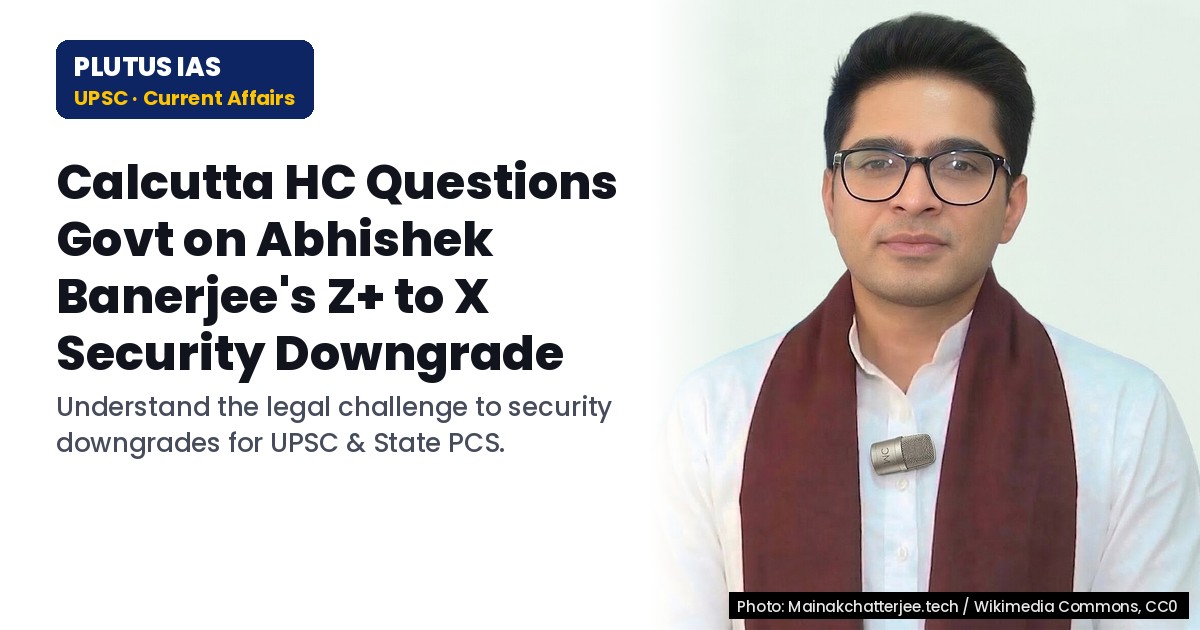
13 Nov अभिषेक बनर्जी सुरक्षा कटौती: कलकत्ता HC ने सरकार से पूछा
✎ Security classifications in India are determined by threat assessments and are subject to periodic review, with judicial scrutiny available to ensure non-arbitrary and objective decision-making.
Subject Relevance — Where This Topic Fits
- GS Paper II — Governance, Constitution, Polity, Social Justice and International Relations | GS Paper III — Internal Security, Disaster Management
- Prelims: Security classification, Z+ security, X security, Security Review Committee, Judicial review, Fundamental rights, State security protocols, High Court jurisdiction
- Essay: The balance between individual rights and state discretion in security matters, Judicial oversight in administrative decision-making
Quick Revision: Security classifications in India are determined by threat assessments and are subject to periodic review, with judicial scrutiny available to ensure non-arbitrary and objective decision-making.
Why is this in the news?
The Calcutta High Court has reserved its judgment on a petition challenging the reduction of a Member of Parliament’s security from Z+ to X category. The court questioned the state government regarding the absence of an interim review of the security assessment, despite alleged complaints of attacks and requests for enhanced protection, and sought clarification on the protocols governing the frequency and triggers for such reviews.
Background
- The petitioner’s security was downgraded from Z+ to X category following a change in the state government.
- The decision to reduce security was made on May 12, shortly after the formation of the new government on May 9.
- The petitioner contended that Z+ security had been provided since 2013 based on threat assessments.
- Allegations were made that the security downgrade was politically motivated and occurred without a formal meeting or discussion by the authorised security review committee.
- The petitioner claimed multiple attacks occurred after the security reduction, with complaints lodged but no subsequent action or security enhancement.
- The state government argued that security provision is not a fundamental right and that no specific threat assessment necessitated Z+ security for the individual.
Understanding Security Classifications in India
- Security classifications in India are categorised into various levels, including X, Y, Y+, Z, and Z+, indicating the degree of protection provided to individuals facing perceived threats.
- These classifications are determined by threat assessment agencies, typically involving intelligence inputs from central and state agencies.
- Z+ category represents the highest level of security cover, involving a substantial number of personnel from elite forces like the National Security Guard (NSG) or Central Reserve Police Force (CRPF), along with armed police.
- X category security is the lowest level, usually involving two armed police personnel for protection.
- The review of security classifications is generally conducted periodically, often every six months, by a Security Review Committee or similar authorised body.
- The decision to upgrade or downgrade security is intended to be based on an objective assessment of threat perception, rather than political considerations.
- Individuals can petition courts if they believe their security downgrade is arbitrary, politically motivated, or not based on a genuine threat assessment, invoking judicial review of administrative actions.
- The state’s responsibility includes ensuring the safety and security of its citizens, particularly those facing specific threats, while also managing public resources efficiently.
Key Features
| Feature | Significance |
|---|---|
| Security Categorisation | India’s security categorisation system assesses threat levels to individuals and assigns corresponding protection tiers (X, Y, Y+, Z, Z+). |
| Threat Perception | Security assessments are based on intelligence inputs regarding potential threats from terrorists, extremist groups, or other adversaries. |
| Review Mechanism | Security categorisations are subject to periodic review, typically every six months, by authorised committees to ensure relevance and adequacy. |
| Interim Review Provision | The system generally allows for interim reviews if there are significant changes in threat perception or specific incidents warranting immediate reassessment. |
| Judicial Scrutiny | Decisions related to security withdrawal or downgrading can be challenged in courts, which examine the procedural fairness and substantive basis of such decisions. |
Why it Matters
Governance and Administration
- Highlights the judicial oversight of executive decisions, particularly concerning the security of public figures.
- Emphasises the importance of established protocols and transparent procedures in government functioning, even in sensitive areas like security assessments.
- Underscores the principle of accountability, where government actions are subject to scrutiny for adherence to rules and rational basis.
Rule of Law
- Reinforces the judiciary’s role in upholding the rule of law by ensuring that administrative actions are not arbitrary or politically motivated.
- Illustrates that security provision, while a state function, must operate within legal frameworks and established guidelines, not as an absolute discretionary power.
Public Safety and Security
- Underlines the state’s responsibility to provide adequate security based on objective threat assessments, irrespective of political affiliations.
- Raises questions about the efficacy and impartiality of security review mechanisms when allegations of political motivation arise.
Challenges
1. Procedural Fairness in Security Reviews
- The core challenge lies in ensuring that security assessments and subsequent decisions on categorisation are conducted impartially and strictly adhere to established procedures.
- Allegations of political motivation in downgrading security undermine public trust in the objectivity of state security apparatuses.
UPSC Link: Governance: Transparency & Accountability
2. Balancing Security Needs with State Resources
- While providing adequate security is crucial, the state also faces the challenge of optimally allocating resources, especially for high-tier security categories.
- The decision to downgrade security often involves a cost-benefit analysis, which must be transparently justified by threat assessments.
UPSC Link: Internal Security: Resource Management
3. Judicial Intervention in Executive Functions
- The High Court’s intervention highlights the delicate balance between judicial review and executive autonomy in matters of national security and public order.
- Courts must ensure that executive decisions are not arbitrary, while also respecting the expertise of security agencies.
UPSC Link: Indian Constitution: Separation of Powers
4. Maintaining Public Trust in Institutions
- When security decisions become embroiled in political controversy, it can erode public confidence in the impartiality and professionalism of security agencies and the government.
- Ensuring that security decisions are perceived as fair and based on genuine threat assessments is vital for maintaining institutional credibility.
UPSC Link: Ethics: Public Service Values
Challenges — UPSC Perspective
| Issue | Concern |
|---|---|
| Downgrading of Z+ to X category security | Allegations of political motivation and lack of adherence to established review protocols. |
| Absence of interim security review | Despite complaints of alleged attacks, the security committee did not convene an interim meeting to reassess the threat. |
| Removal of police picket | Allegations that police presence at the individual’s residence and office was removed, potentially increasing vulnerability. |
| Justification for security reduction | State government’s argument that security is not a fundamental right and no specific threat assessment warranted Z+ security, questioned by the court regarding interim review. |
Way Forward
- Strict adherence to established protocols for security assessment and review, ensuring all procedural steps are followed meticulously.
- Implementation of a transparent and objective threat assessment mechanism, free from political influence, to determine security categorisation.
- Regular and timely conduct of security reviews, with provisions for expedited interim reviews in response to credible new threats or incidents.
- Documentation of all decisions related to security categorisation, including the rationale and evidence considered, to ensure accountability.
- Establishment of an independent oversight body or mechanism to review security decisions, particularly when allegations of bias or political motivation arise.
- Training for security personnel and review committee members on best practices in threat assessment and security provision, emphasising impartiality.
- Clear communication of the criteria and process for security categorisation to enhance public understanding and trust.
UPSC Value Addition
Keywords for Mains Answer-Writing
Z+ security · threat assessment · security review committee · judicial review · executive discretion · fundamental rights · police protection · governance accountability · political neutrality · public expenditure
Constitutional & Policy Linkages
- {‘article’: ‘Article 14’, ‘note’: ‘Equality before law’}
- {‘article’: ‘Article 21’, ‘note’: ‘Right to life and personal liberty’}
- {‘article’: ‘Article 226’, ‘note’: “High Courts’ writ jurisdiction”}
Concept Flow
Threat perception assessment by security agencies → Categorisation of security level (e.g., Z+, X) → Periodic review of security categorisation → Allegations of politically motivated security downgrade → Judicial challenge and High Court intervention → Court’s scrutiny of procedural fairness and rationale
Prelims Practice Questions
Q1. Consider the following statements regarding security classifications in India:
1. Z+ security is the highest level of protection provided to individuals facing significant threats.
2. The Special Protection Group (SPG) is primarily responsible for providing Z+ security.
3. Security assessments and reviews are typically conducted by a committee comprising intelligence and police officials.
How many of the above statements are correct?
- Only one
- Only two
- All three
- None
Answer: All three — Statement 1 is correct: Z+ security is indeed the highest level of protection, indicating a severe threat perception. Statement 2 is incorrect: The SPG primarily protects the Prime Minister and their immediate family. Other high-level security, including Z+, is provided by various central armed police forces (e.g., CRPF, CISF) and state police. Statement 3 is correct: Security assessments are dynamic and involve a multi-agency committee to evaluate threat levels.
Q2. Which of the following is NOT a fundamental right guaranteed under the Constitution of India?
- Right to Equality
- Right to Freedom of Speech and Expression
- Right to Security Protection
- Right to Constitutional Remedies
Answer: Right to Security Protection — The Right to Security Protection is not explicitly listed as a fundamental right in the Indian Constitution. While the state has a duty to protect its citizens, and personal security is implicitly linked to the Right to Life (Article 21), a specific ‘Right to Security Protection’ as a fundamental right does not exist. The other options are fundamental rights enshrined in Part III of the Constitution.
Mains Practice Question
✍ Critically examine the legal and administrative framework governing the provision and review of security cover for individuals in India. Discuss the challenges associated with ensuring transparency and political neutrality in such decisions. (15 Marks)
Approach: MODEL-ANSWER SKELETON:
1. **Introduction:** Briefly define security cover (e.g., Z+, Z, Y, X categories) and its purpose (threat mitigation).
2. **Legal and Administrative Framework:**
* No specific central law; largely governed by executive orders, intelligence inputs, and established protocols.
* Role of the Ministry of Home Affairs (MHA) at the Centre and State Home Departments.
* Involvement of intelligence agencies (IB, RAW) and police forces in threat assessment.
* Concept of a ‘Security Review Committee’ for periodic assessments.
* Judicial intervention: High Courts and Supreme Court have occasionally reviewed executive decisions on security, emphasizing non-arbitrariness and due process.
3. **Challenges to Transparency and Political Neutrality:**
* **Lack of codified law:** Absence of a specific statute can lead to discretionary decision-making.
* **Secrecy of threat assessment:** Intelligence inputs are inherently confidential, making public scrutiny difficult.
* **Potential for political influence:** Allegations of security being granted, withdrawn, or downgraded based on political considerations rather than objective threat assessment.
* **Subjectivity in assessment:** Determining ‘threat perception’ can be subjective, leading to inconsistencies.
* **Resource allocation:** High costs associated with enhanced security cover, raising questions of public expenditure justification.
* **Judicial scrutiny limitations:** Courts generally defer to expert opinion in security matters but intervene in cases of manifest arbitrariness.
4. **Conclusion:** Emphasize the need for robust, objective, and transparent mechanisms for threat assessment and security review, balancing national security imperatives with principles of fairness and accountability, potentially through a standing, independent expert body or clearer guidelines.
Source: indiatv.in
Generated by AanyaAi for educational purpose.
Related guides on our sites
- How to prepare for GS paper 1 for UPSC CSE mains exam
- Best UPSC coaching for IFOS exam
- Best mentorship programme for upsc
- UPSC+BA degree

- अभिषेक बनर्जी सुरक्षा कटौती: कलकत्ता HC ने सरकार से पूछा - November 13, 2026
- Ladli Behna Yojana: MP’s Women Empowerment Initiative - November 13, 2026
- ज्ञान प्रणालियों पर समिति की रिपोर्ट: प्रतिक्रिया और सुझाव आमंत्रित - November 13, 2026

No Comments