


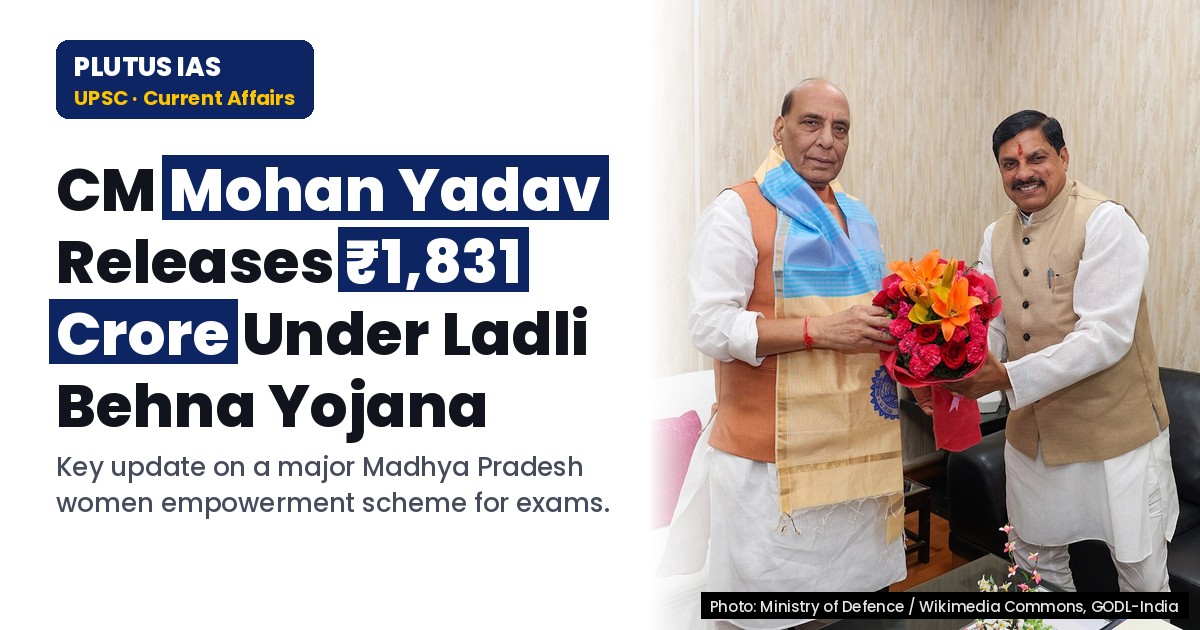
13 Nov Ladli Behna Yojana: MP’s Women Empowerment Initiative
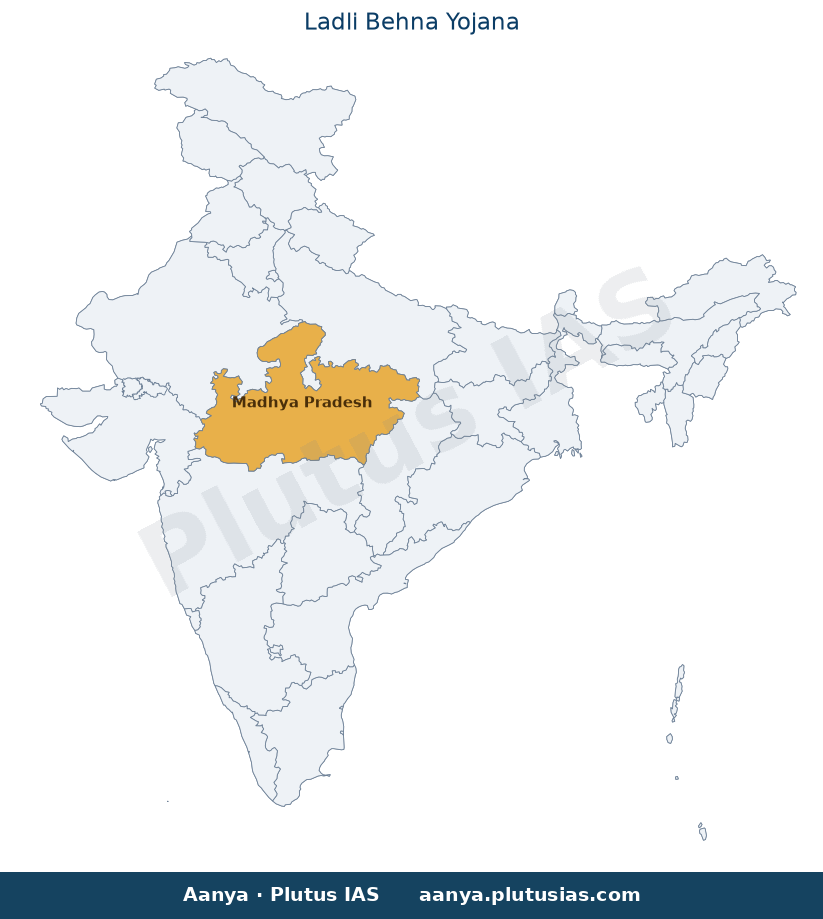
✎ The Ladli Behna Yojana is a Madhya Pradesh state government scheme providing direct monthly financial assistance to eligible women through DBT, aiming for their economic empowerment and improved living standards.
Subject Relevance — Where This Topic Fits
- GS Paper II — Government Policies and Interventions for Development in various sectors and Issues arising out of their Design and Implementation | GS Paper II — Welfare Schemes for Vulnerable Sections of the Population by the Centre and States and the Performance of these Schemes; Mechanisms, Laws, Institutions and Bodies constituted for the Protection and Betterment of these Vulnerable Sections | GS Paper III — Inclusive Growth and Issues Arising from it
- Prelims: Ladli Behna Yojana, Direct Benefit Transfer (DBT), Women’s Empowerment Schemes, State-sponsored welfare programs, Financial Inclusion, Self-Help Groups (SHGs)
- Essay: The Role of State-Sponsored Welfare Schemes in Achieving Inclusive Growth and Social Justice, Empowering Women through Financial Autonomy: Challenges and Opportunities
Quick Revision: The Ladli Behna Yojana is a Madhya Pradesh state government scheme providing direct monthly financial assistance to eligible women through DBT, aiming for their economic empowerment and improved living standards.
Why is this in the news?
The 42nd installment of the Ladli Behna Yojana, a flagship welfare scheme of the Madhya Pradesh government, was recently disbursed. An amount of ₹1,500 was transferred to the bank accounts of over 1.24 crore eligible women beneficiaries. Concurrently, financial assistance in the form of loans amounting to ₹200 crore was also provided to Self-Help Groups (SHGs) during the same event, underscoring a broader focus on women’s economic upliftment.
Background
- The concept of Direct Benefit Transfer (DBT) was initiated by the Government of India with the primary aim of reforming government delivery systems by re-engineering the existing process in welfare schemes for simpler and faster flow of funds and ensuring accurate targeting of beneficiaries.
- DBT seeks to reduce leakages and delays in the delivery of welfare benefits by directly transferring funds to the bank accounts of beneficiaries, thereby promoting financial inclusion and transparency.
- Women’s empowerment, particularly through economic independence, is a critical component of sustainable development and is often addressed through various government schemes at both central and state levels.
- State governments frequently implement specific welfare schemes tailored to the unique socio-economic contexts and needs of their respective populations, often focusing on vulnerable groups such as women, children, and the elderly.
- The provision of financial assistance to Self-Help Groups (SHGs) is a common strategy to foster collective economic activity, entrepreneurship, and financial literacy among women, contributing to their overall empowerment and community development.
What is the Ladli Behna Yojana?
- The Ladli Behna Yojana is a state-sponsored welfare scheme launched by the Government of Madhya Pradesh.
- Its primary objective is to provide financial assistance to eligible women residents of the state, aiming to enhance their economic independence and improve their living standards.
- Under the scheme, a fixed monetary amount is periodically transferred directly into the bank accounts of the identified female beneficiaries through the Direct Benefit Transfer (DBT) mechanism.
- Initially, the scheme provided ₹1,000 per month, which was subsequently increased to ₹1,250 and then to ₹1,500 per month, reflecting an incremental approach to beneficiary support.
- Eligibility criteria typically include age limits, residency requirements, and income thresholds, with beneficiaries needing to complete e-KYC and link their Aadhaar to their bank accounts for seamless fund transfer.
- The scheme targets a wide demographic of women, excluding those who are income taxpayers or government employees, to ensure that benefits reach the most deserving sections of society.
- The scheme also periodically reviews beneficiary eligibility, with provisions for removal from the list if conditions such as age limits (e.g., exceeding 60 years) are no longer met or if e-KYC compliance is not maintained.
Key Features
| Feature | Significance |
|---|---|
| Direct Benefit Transfer (DBT) | Ensures efficient and transparent delivery of financial assistance directly to beneficiaries’ bank accounts, minimizing leakages and administrative overheads. |
| Financial Inclusion | Promotes the integration of women into the formal financial system by requiring bank accounts for direct transfers, fostering financial literacy and independence. |
| Women’s Empowerment | Provides women with discretionary income, enhancing their decision-making power within households and contributing to their socio-economic upliftment. |
| Regular Installments | The consistent disbursement of financial aid provides a predictable income stream, enabling beneficiaries to plan their expenditures and manage household finances more effectively. |
| Digital Accessibility | The provision for checking status online via a dedicated portal (cmladlibahna.mp.gov.in) enhances transparency and accessibility for beneficiaries, promoting digital literacy. |
Why it Matters
Socio-Economic Significance
- Enhances the financial autonomy of women, enabling them to make independent decisions regarding household expenditures and personal needs.
- Contributes to poverty alleviation by providing a regular income supplement to economically vulnerable households, thereby improving living standards.
- Promotes gender equality by recognizing women’s contributions to the household economy and providing them with direct financial resources.
Governance Significance
- Demonstrates the efficacy of Direct Benefit Transfer (DBT) mechanisms in delivering social welfare benefits efficiently and transparently.
- Strengthens the state’s capacity for targeted welfare delivery, ensuring that financial assistance reaches the intended beneficiaries.
- Fosters public trust in government schemes through consistent and timely disbursement of funds, along with accessible status tracking mechanisms.
Developmental Significance
- Stimulates local economies by increasing the purchasing power of a significant segment of the population, potentially boosting demand for goods and services.
- Encourages financial literacy and inclusion among women, as they are required to operate bank accounts for receiving benefits.
- Supports the broader agenda of inclusive growth by addressing economic disparities and empowering marginalized sections of society.
Challenges
1. Ensuring Universal Eligibility and Coverage
- The exclusion of eligible beneficiaries due to stringent or complex eligibility criteria, or lack of awareness.
- Challenges in identifying and enrolling all eligible women, particularly those in remote or underserved areas.
UPSC Link: Social Justice: Mechanisms, Laws, Institutions and Bodies constituted for the Protection and Betterment of Vulnerable Sections
2. Digital Divide and Accessibility
- Beneficiaries in rural or digitally underserved areas may face difficulties accessing online portals for status checks or e-KYC processes.
- Lack of digital literacy among some women beneficiaries can hinder their ability to fully utilize the scheme’s digital features.
UPSC Link: Governance: e-governance- applications, models, successes, limitations, and potential; citizens charters, transparency & accountability and institutional and other measures.
3. Financial Sustainability of the Scheme
- The long-term fiscal burden on the state exchequer due to continuous and increasing financial outlays for the scheme.
- Balancing welfare expenditure with other developmental priorities and maintaining fiscal prudence.
UPSC Link: Indian Economy and issues relating to Planning, Mobilization of Resources, Growth, Development and Employment.
4. Preventing Misuse and Ensuring Accountability
- Challenges in ensuring that the financial assistance is utilized for the intended purpose of women’s empowerment and household welfare.
- Monitoring mechanisms to prevent fraudulent claims or diversion of funds, ensuring that only genuine beneficiaries receive support.
UPSC Link: Governance: Transparency & Accountability and Institutional and other measures.
Challenges — UPSC Perspective
| Issue | Concern |
|---|---|
| Exclusion Errors | Eligible women may be left out due to technical glitches, incomplete documentation, or lack of information about the scheme’s requirements (e.g., e-KYC). |
| Digital Literacy Gap | Many beneficiaries, especially in rural areas, may lack the digital skills required to check their payment status online, leading to dependency on intermediaries. |
| Bank Account Accessibility | Issues such as dormant accounts, incorrect account details, or difficulties in accessing banking services can impede timely receipt of funds. |
| Inflationary Impact | While providing direct income, large-scale cash transfers could, in some economic contexts, contribute to localized inflationary pressures. |
| Dependency Syndrome | Concerns that continuous direct cash transfers might inadvertently reduce incentives for seeking employment or engaging in self-help initiatives among some beneficiaries. |
Government Initiatives — Must-Memorise for Prelims
- Ladli Behna Yojana
Way Forward
- Strengthen outreach and awareness campaigns to ensure comprehensive coverage of all eligible women, particularly in remote and marginalized communities.
- Enhance digital literacy initiatives and provide accessible support centers to assist beneficiaries with e-KYC, status checks, and other online processes.
- Regularly review and update eligibility criteria to minimize exclusion errors and ensure the scheme remains inclusive and responsive to changing socio-economic conditions.
- Implement robust monitoring and evaluation frameworks to assess the scheme’s impact on women’s empowerment, financial inclusion, and household welfare.
- Explore avenues for linking financial assistance with skill development and livelihood generation programs to foster long-term economic independence.
- Ensure the fiscal sustainability of the scheme through prudent financial planning and by exploring diversified funding mechanisms.
- Establish efficient grievance redressal mechanisms to promptly address issues related to payment delays, eligibility disputes, and technical challenges.
UPSC Value Addition
Keywords for Mains Answer-Writing
Direct Benefit Transfer (DBT) · Women’s empowerment · Financial inclusion · Social welfare schemes · State-sponsored initiatives · Poverty alleviation · Gender equality · Fiscal federalism
Constitutional & Policy Linkages
- {‘article’: ‘Article 38’, ‘note’: ‘State to secure social order’}
- {‘article’: ‘Article 39’, ‘note’: ‘Certain principles of policy by the State’}
- {‘article’: ‘Article 46’, ‘note’: ‘Promotion of educational and economic interests’}
Concept Flow
Government identifies vulnerable women for support. → Eligible women apply and complete e-KYC. → Funds are allocated by the state government. → Chief Minister initiates Direct Benefit Transfer. → Financial assistance is credited to beneficiaries’ bank accounts. → Beneficiaries utilize funds for household needs/empowerment. → Scheme’s impact is monitored for continuous improvement.
Prelims Practice Questions
Q1. Consider the following statements regarding Direct Benefit Transfer (DBT) in India:
1. DBT aims to reduce leakages and delays in the delivery of social welfare benefits.
2. The JAM Trinity (Jan Dhan-Aadhaar-Mobile) has been instrumental in the expansion of DBT.
3. All state-sponsored welfare schemes are mandatorily integrated with the DBT platform.
How many of the above statements are correct?
- Only one
- Only two
- Only three
- None
Answer: Only two — Statement 1 is correct: DBT’s primary objective is to ensure efficient and transparent delivery of benefits, minimizing intermediaries and corruption. Statement 2 is correct: The JAM Trinity has significantly facilitated the expansion of DBT by providing bank accounts, unique identification, and mobile connectivity. Statement 3 is incorrect: While many state schemes are integrated, it is not mandatory for all state-sponsored welfare schemes to be on the central DBT platform; states have autonomy in their implementation.
Q2. Which of the following is a key objective of welfare schemes focused on direct financial assistance to women?
- To promote male participation in household decision-making.
- To enhance women’s economic independence and decision-making power.
- To exclusively fund large-scale infrastructure projects.
- To replace all existing public distribution systems.
Answer: To enhance women’s economic independence and decision-making power. — Welfare schemes providing direct financial assistance to women, such as the Ladli Behna Yojana, primarily aim to empower women economically, improve their financial autonomy, and enhance their role in household and community decision-making. This contributes to broader goals of gender equality and poverty alleviation.
Mains Practice Question
✍ Examine the role of Direct Benefit Transfer (DBT) in enhancing the effectiveness and transparency of social welfare schemes in India. Discuss the challenges associated with its implementation, particularly in state-specific initiatives. (15 Marks)
Approach: MODEL-ANSWER SKELETON: Introduction: Define DBT and its core principle. Role in Effectiveness and Transparency: Discuss reduction of leakages (e.g., ghost beneficiaries), timely delivery, financial inclusion (JAM Trinity), empowerment of beneficiaries (choice and control), and improved accountability. Challenges in Implementation: Address issues such as digital literacy and access (rural/remote areas), banking infrastructure gaps, Aadhaar seeding errors, exclusion errors (e.g., non-eligibility due to technical glitches), data privacy concerns, political interference, and sustainability of funding for state-specific schemes. Conclusion: Summarize the dual nature of DBT’s impact and suggest measures for overcoming challenges to maximize its potential.
Source: navbharattimes.indiatimes.com
Generated by AanyaAi for educational purpose.
Related guides on our sites
- Best PSIR optional coaching for upsc
- Best sociology optional coaching for upsc
- Which is best sociology optional coaching for upsc
- Best PSIR optional teacher for upsc

- Ladli Behna Yojana: MP’s Women Empowerment Initiative - November 13, 2026
- ज्ञान प्रणालियों पर समिति की रिपोर्ट: प्रतिक्रिया और सुझाव आमंत्रित - November 13, 2026
- DIPAM’s Special Campaign 6: Institutionalizing Cleanliness & Reducing Arrears - November 13, 2026

No Comments