


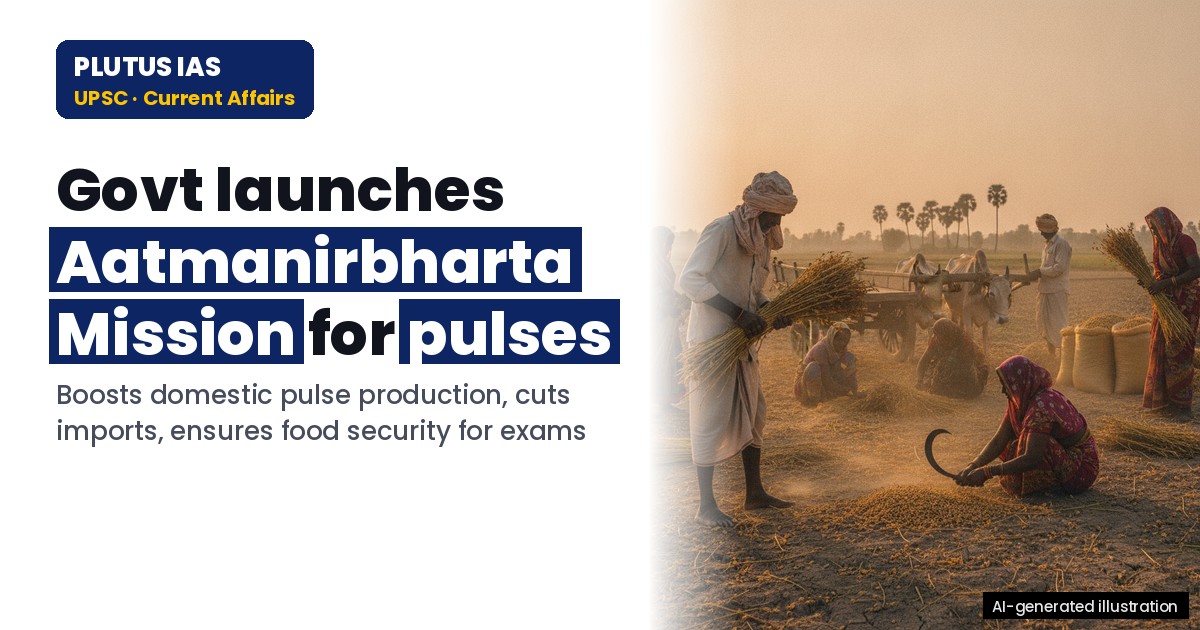
11 Oct Aatmanirbharta Mission in Pulses: UPSC & State PCS Current Affairs
✎ Pulses in India are cultivated across ~23-25 million hectares, with productivity enhancement through high-yielding varieties and MSP-backed procurement being the cornerstone of achieving self-sufficiency by 2027.
Subject Relevance — Where This Topic Fits
- GS Paper III — Agriculture, Food Security, and Issues Related to Direct and Indirect Farm Subsidies | GS Paper III — Government Budgeting and Resource Mobilisation for Agricultural Development
- Prelims: Minimum Support Price (MSP) for pulses, National Food Security Mission (NFSM), Pulses Revolution, Rainfed agriculture dependency, Price volatility in pulses
- Essay: The Imperative of Agricultural Self-Reliance in India: Balancing Production and Sustainability, Policy Interventions for Food Security: Lessons from India’s Pulses Sector
Quick Revision: Pulses in India are cultivated across ~23-25 million hectares, with productivity enhancement through high-yielding varieties and MSP-backed procurement being the cornerstone of achieving self-sufficiency by 2027.
Why is this in the news?
The Government of India has intensified efforts to achieve self-sufficiency in pulses, a critical protein source for the population, through a combination of policy reforms, technological interventions, and targeted subsidies. Recent initiatives aim to address persistent challenges such as low productivity, fragmented landholdings, and price fluctuations, which have historically necessitated large-scale imports. This renewed focus aligns with the broader Aatmanirbharta (self-reliance) agenda, particularly in the context of food security and nutritional resilience.
Background
- Pulses constitute a vital component of India’s dietary habits, providing approximately 32 grams of protein per 100 grams, and are a key source of dietary fibre and micronutrients such as iron and folic acid.
- Despite being the world’s largest producer of pulses, India’s average yield (781 kg/ha in 2022-23) remains significantly lower than the global average (1,085 kg/ha), primarily due to rainfed cultivation and limited access to improved seeds and technologies.
- India’s pulses imports have fluctuated between 3-6 million tonnes annually over the past decade, with major imports sourced from Canada, Australia, and Myanmar, posing challenges to domestic price stability and farmer incomes.
- The National Food Security Mission (NFSM) was launched in 2007 to enhance the production of pulses, oilseeds, and rice, with a dedicated sub-mission for pulses (NFSM-Pulses) focusing on area expansion, productivity enhancement, and post-harvest management.
- Climate change-induced erratic rainfall patterns, soil degradation, and the dominance of small and marginal farmers (holding ~86% of operational landholdings) further exacerbate the sector’s vulnerabilities.
- The government’s Aatmanirbharta push in agriculture is encapsulated in initiatives such as the PM-KISAN scheme, Soil Health Cards, and the promotion of crop diversification, with pulses identified as a priority crop for achieving nutritional and economic resilience.
What is India’s Mission for Aatmanirbharta in Pulses?
- The mission is a multi-pronged strategy aimed at reducing India’s dependence on pulse imports by 2027 through a combination of policy, technological, and market interventions, aligning with the broader goal of Aatmanirbharta in agriculture.
- Key policy instruments include the enhancement of Minimum Support Prices (MSP) for pulses, with the government guaranteeing procurement at MSP levels to incentivize cultivation, particularly for tur (pigeon pea), urad (black gram), and moong (green gram).
- The mission leverages technological interventions such as high-yielding, drought-resistant pulse varieties, micro-irrigation techniques (e.g., drip and sprinkler systems), and precision farming tools to improve productivity in rainfed and marginal lands.
- A critical component is the promotion of cluster-based farming under the Sub-Mission on Pulses (NFSM-Pulses), where farmers in identified districts are provided with integrated support, including quality seeds, soil health cards, and extension services.
- The government is also focusing on post-harvest management, including the establishment of pulse processing units, storage infrastructure, and market linkages to reduce wastage and ensure remunerative prices for farmers.
- Public-private partnerships (PPPs) are being encouraged to scale up seed production, particularly for breeder and foundation seeds, and to develop value-added products such as pulse-based protein isolates and fortified foods.
- The mission integrates climate-resilient agriculture practices, such as conservation agriculture and crop-livestock integration, to mitigate the impact of climate variability on pulse production.
- Monitoring and evaluation mechanisms, including real-time data analytics and farmer feedback systems, are being institutionalised to track progress and address bottlenecks in implementation.
Key Features
| Feature | Significance |
|---|---|
| Mission for Aatmanirbharta in Pulses | A government-led strategic initiative to reduce import dependence in pulses by enhancing domestic production, processing, and storage capabilities through targeted interventions. |
| Focus on High-Yield Varieties | Promotion of improved seed varieties, agronomic practices, and technology adoption to boost pulse productivity per unit area. |
| Price Stabilisation Measures | Implementation of Minimum Support Price (MSP) and procurement mechanisms to safeguard farmer incomes and ensure market stability. |
| Post-Harvest Infrastructure | Development of storage facilities, processing units, and supply chain logistics to minimise wastage and improve market access for pulses. |
| Subsidies and Incentives | Provision of financial support, credit access, and insurance schemes to incentivise pulse cultivation and reduce risk for farmers. |
Why it Matters
Economic Security
- Reduces foreign exchange outgo on pulse imports, currently estimated at over ₹20,000 crore annually, thereby improving the current account balance.
- Enhances self-reliance in protein-rich food sources, contributing to nutritional security and reducing vulnerability to global supply chain disruptions.
- Supports rural livelihoods by stabilising farm incomes through assured procurement and market linkages for pulse growers.
Agricultural Productivity
- Addressing the stagnation in pulse yields, which have lagged behind cereals due to factors like limited R&D investment and suboptimal agronomic practices.
- Integration of climate-resilient pulse varieties to mitigate risks posed by erratic monsoons and soil degradation.
- Leveraging precision agriculture and digital tools for real-time monitoring of crop health and input optimisation.
Policy Coherence
- Aligns with the National Mission on Sustainable Agriculture (NMSA) and the National Food Security Mission (NFSM) to create synergy in agricultural development.
- Complements the Pradhan Mantri Kisan Samman Nidhi (PM-KISAN) by ensuring remunerative prices for pulse crops, thereby augmenting farmer welfare.
- Supports the goal of doubling farmer incomes by 2024-25 through targeted interventions in high-potential pulse-growing regions.
Strategic Autonomy
- Reduces reliance on imports from countries like Canada, Australia, and Myanmar, which account for over 60% of India’s pulse imports.
- Strengthens India’s position in global pulse trade negotiations by reducing import dependency and enhancing export potential for surplus varieties.
- Mitigates geopolitical risks associated with supply chain vulnerabilities in critical food commodities.
Challenges
1. Climatic Vulnerability
- Pulses are highly sensitive to temperature fluctuations, erratic rainfall, and drought conditions, leading to yield instability.
- Increased frequency of extreme weather events under climate change exacerbates production risks for pulse crops.
UPSC Link: GS3: Climate Change and Agriculture
2. Small and Fragmented Land Holdings
- Over 85% of Indian farmers operate on holdings smaller than 2 hectares, limiting economies of scale in pulse cultivation.
- Fragmented land parcels hinder the adoption of mechanised farming and precision agriculture technologies.
UPSC Link: GS3: Land Reforms and Agriculture
3. Market Distortions and Price Volatility
- Fluctuations in pulse prices due to speculative trading, hoarding, and inadequate market information systems.
- Price crashes post-harvest discourage farmers from diversifying into pulse cultivation, perpetuating cereal dominance.
UPSC Link: GS3: Agricultural Marketing and Price Policy
4. Limited Post-Harvest Infrastructure
- Inadequate storage facilities lead to post-harvest losses of up to 20% in pulses, particularly in rainfed regions.
- Lack of processing units and value-addition infrastructure reduces marketability and farmer profitability.
UPSC Link: GS3: Food Processing and Supply Chain
5. Input Constraints and Soil Degradation
- Declining soil fertility and micronutrient deficiencies, particularly in pulse-growing regions like Maharashtra and Madhya Pradesh.
- High cost and limited availability of quality seeds and fertilisers tailored for pulse crops.
UPSC Link: GS3: Soil Health and Fertility Management
6. Policy Implementation Gaps
- Inadequate convergence between central and state-level schemes, leading to suboptimal utilisation of funds.
- Delays in disbursement of subsidies and MSP payments, affecting farmer confidence and investment decisions.
UPSC Link: GS3: Governance and Policy Implementation
Challenges — UPSC Perspective
| Issue | Concern |
|---|---|
| Climatic Vulnerability | Yield instability due to erratic rainfall and temperature extremes |
| Fragmented Land Holdings | Limited adoption of mechanisation and precision agriculture |
| Price Volatility | Market distortions discourage pulse cultivation |
| Post-Harvest Losses | Inadequate storage and processing infrastructure |
| Soil Degradation | Declining fertility and micronutrient deficiencies |
| Policy Implementation | Gaps in scheme convergence and delayed disbursements |
Government Initiatives — Must-Memorise for Prelims
- National Mission on Sustainable Agriculture (NMSA)
- National Food Security Mission (NFSM) – Pulses Sub-Mission
- Pradhan Mantri Annadata Aay SanraksHan Abhiyan (PM-AASHA)
- Sub-Mission on Agricultural Mechanisation (SMAM)
- Mission for Integrated Development of Horticulture (MIDH) – Pulses Component
Way Forward
- Strengthen climate-resilient pulse varieties through accelerated breeding programmes and seed distribution networks.
- Expand post-harvest infrastructure, including warehousing, cold storage, and primary processing units in pulse-growing districts.
- Enhance market linkages by promoting Farmer Producer Organisations (FPOs) and electronic trading platforms for pulses.
- Rationalise input subsidies to ensure equitable access to quality seeds, fertilisers, and irrigation for pulse farmers.
- Implement dynamic pricing policies to stabilise pulse prices and prevent post-harvest distress sales.
- Promote intercropping and crop diversification models to integrate pulses with cereals and oilseeds for sustainable farming systems.
- Leverage digital tools for real-time crop monitoring, advisory services, and insurance claim settlements.
- Enhance convergence between central and state schemes to eliminate duplication and improve programme efficiency.
UPSC Value Addition
Keywords for Mains Answer-Writing
Aatmanirbharta in Pulses · National Mission on Pulses · Pulse production · Self-sufficiency in pulses · Minimum Support Price (MSP) · Pulse imports · Food security · Agricultural productivity · Sub-Mission on Pulses · Nutritional security · Crop diversification · Policy interventions in agriculture · Agri-export policy · Pulse Mission Value Chain · Kharif and Rabi pulses · Pulse production clusters · Seed replacement rate · Post-harvest infrastructure · Price stabilization mechanisms
Concept Flow
Decline in Domestic Pulse Production → Increased Import Dependence → Foreign Exchange Outflow → Vulnerability to Global Supply Chain Disruptions → Policy Response: Mission for Aatmanirbharta in Pulses → Targeted Interventions (Seeds, MSP, Infrastructure) → Enhanced Production and Productivity → Market Integration: Improved Post-Harvest Infrastructure → Reduced Wastage → Stable Supply → Price Stabilisation → Farmer Welfare: Assured MSP and Procurement → Higher Incomes → Investment in Technology → Sustainable Pulse Cultivation → Strategic Outcome: Reduced Import Dependence → Enhanced Food Security → Self-Reliance in Protein Sources
Prelims Practice Questions
Q1. Consider the following statements regarding the National Mission on Pulses (NMP) in India:
1. The NMP was launched as a sub-scheme under the National Food Security Mission (NFSM).
2. It aims to enhance the production of pulses through area expansion and productivity improvement.
3. The Mission provides financial assistance for the establishment of pulse seed hubs.
4. The NMP exclusively focuses on Kharif season pulses and excludes Rabi season pulses.
How many of the above statements are correct?
- Only one
- Only two
- Only three
- All four
Answer: Only three — Statements 1, 2, and 3 are correct. The NMP is a sub-scheme under NFSM, aims to enhance pulse production, and provides financial assistance for seed hubs. Statement 4 is incorrect as the NMP covers both Kharif and Rabi season pulses.
Q2. Assertion (A): The Minimum Support Price (MSP) for pulses in India is determined by the Commission for Agricultural Costs and Prices (CACP).
Reason (R): The CACP recommends MSPs based on the cost of cultivation, demand-supply trends, and market prices.
In the context of the above two statements, which one of the following is correct?
- Both A and R are true and R is the correct explanation of A.
- Both A and R are true but R is NOT the correct explanation of A.
- A is true but R is false.
- A is false but R is true.
Answer: Both A and R are true and R is the correct explanation of A. — Both A and R are true, and R correctly explains A. The CACP, under the Ministry of Agriculture, recommends MSPs for agricultural commodities, including pulses, based on specified criteria.
Q3. Match the following pairs related to pulse production in India:
Column I (Pulse Crops) Column II (Major Producing States)
A. Chickpea (Chana) 1. Maharashtra
B. Tur (Arhar) 2. Madhya Pradesh
C. Urad (Black Gram) 3. Andhra Pradesh
D. Moong (Green Gram) 4. Rajasthan
Select the correct match using the codes below:
- A-4, B-1, C-2, D-3
- A-2, B-1, C-4, D-3
- A-1, B-2, C-3, D-4
- A-3, B-4, C-1, D-2
Answer: A-2, B-1, C-4, D-3 — Correct matches: Chickpea (Chana) – Madhya Pradesh, Tur (Arhar) – Maharashtra, Urad (Black Gram) – Rajasthan, Moong (Green Gram) – Andhra Pradesh. These pairings reflect the major pulse-producing states in India.
Mains Practice Question
✍ The Government of India’s thrust towards achieving ‘Aatmanirbharta in Pulses’ represents a critical policy intervention in the agricultural sector. Critically examine the rationale, key policy instruments, and challenges in this mission. Also assess the extent to which it has contributed to reducing India’s dependence on pulse imports. (15 Marks)
Approach: MODEL-ANSWER SKELETON:
1. **Rationale for Aatmanirbharta in Pulses**:
– India’s high dependence on pulse imports (e.g., 2022-23 imports ~3.8 million tonnes) and vulnerability to global price volatility.
– Nutritional security: Pulses are a primary source of protein for vegetarian populations; per capita consumption (~10-11 kg/year) falls short of recommended levels.
– Farmers’ income: Price fluctuations and low productivity (~700-900 kg/ha) necessitate productivity enhancement.
– Food security: Pulses are a key component of the Public Distribution System (PDS) and Mid-Day Meal Scheme.
2. **Key Policy Instruments**:
– **National Mission on Pulses (NMP)**: Sub-scheme under National Food Security Mission (NFSM), launched in 2014-15, with objectives of area expansion, productivity improvement, and post-harvest management.
– **Minimum Support Price (MSP)**: Announced for 10 pulses (e.g., Tur, Urad, Moong, Gram) to provide remunerative prices; procurement under Price Support Scheme (PSS).
– **Seed Replacement Rate (SRR)**: Targets of 25-30% for pulses to improve seed quality; establishment of pulse seed hubs.
– **Pulse Mission Value Chain**: Focus on post-harvest infrastructure, storage, and market linkages to reduce wastage and improve farmer returns.
– **Crop Diversification**: Promotion of pulses in rice-wheat cropping systems (e.g., inclusion in crop insurance schemes like PMFBY).
3. **Challenges**:
– **Low Productivity**: Constraints such as erratic monsoons, lack of irrigation, and poor soil health.
– **Market Distortions**: MSP procurement is limited to surplus states; market prices often fall below MSP, discouraging cultivation.
– **Input Constraints**: Inadequate availability of quality seeds, fertilizers, and extension services.
– **Post-Harvest Losses**: Lack of storage and processing infrastructure leads to ~15-20% losses.
– **Policy Coherence**: Overlapping schemes (e.g., NFSM, PM-KISAN) and lack of convergence in implementation.
4. **Impact on Import Dependence**:
– **Trend Analysis**: Pulse imports declined from ~6.6 million tonnes in 2016-17 to ~3.8 million tonnes in 2022-23, indicating partial success.
– **Production Growth**: Pulses production increased from ~16.4 million tonnes in 2014-15 to ~27.5 million tonnes in 2022-23.
– **Limitations**: Import dependence persists for specific pulses (e.g., Tur, Masoor) due to regional production gaps and market dynamics.
5. **Way Forward**:
– Strengthening research and development (e.g., ICAR’s pulse research institutes).
– Expanding irrigation coverage (e.g., micro-irrigation under PMKSY).
– Enhancing market linkages through e-NAM and agri-logistics.
– Promoting pulse-based value addition and export promotion under Agri-Export Policy 2018.
Source: PIB (Press Information Bureau)
Generated by AanyaAi for educational purpose.
Related guides on our sites
- Current affairs for upsc 2026
- Best PSIR optional coaching for upsc
- Best PSIR optional teacher for upsc
- Best teacher of PSIR optional for upsc

- NAMASTE Scheme: Enhancing Sanitation Workers’ Livelihoods & Safety - November 14, 2026
- एमएसएमई का विशेष अभियान 6.0: स्वच्छता और लंबित मामलों का निपटारा - November 14, 2026
- Sea Vigil-26: Coastal Defence Drills Off Visakhapatnam - November 14, 2026

No Comments