


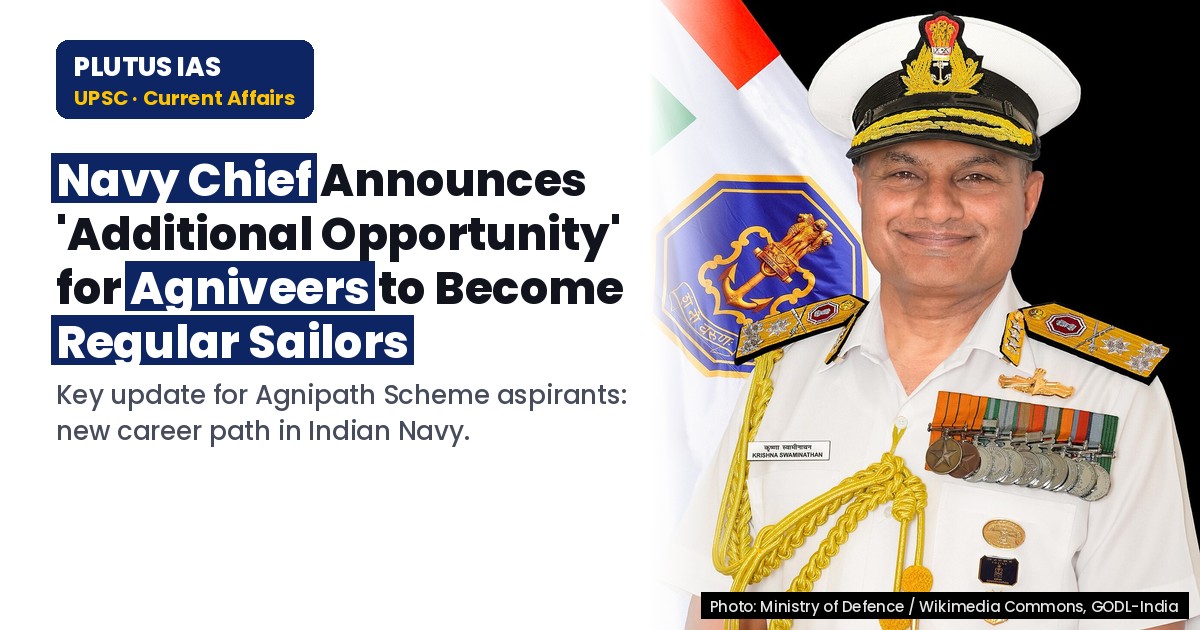
13 Nov Agnipath Scheme: Agniveers Can Now Become Regular Sailors
✎ The Agnipath scheme, a transformative defence recruitment policy, has been recently amended to offer Agniveers an extended two-year tenure and an enhanced opportunity for permanent absorption into regular service.
Subject Relevance — Where This Topic Fits
- GS Paper II — Government Policies and Interventions | GS Paper III — Security Challenges and their Management
- Prelims: Agnipath Scheme, Agniveers, Indian Navy, Indian Coast Guard, INS Chilka, Chief of Defence Staff
- Essay: Youth Employment and National Security, Defence Reforms and Human Resource Management
Quick Revision: The Agnipath scheme, a transformative defence recruitment policy, has been recently amended to offer Agniveers an extended two-year tenure and an enhanced opportunity for permanent absorption into regular service.
Why is this in the news?
The Chief of Naval Staff recently addressed the passing out parade of the ninth batch of Agniveers at INS Chilka, highlighting a significant amendment to the Agnipath scheme. This amendment provides an ‘additional opportunity’ for Agniveers to transition into regular service within the Indian Navy, extending their initial four-year tenure by two years and offering subsequent permanent recruitment based on specific eligibility criteria and performance.
Background
- The Agnipath scheme was launched in June 2022 as a transformative reform for the recruitment of personnel below officer rank in the Indian Armed Forces.
- It introduced a four-year tenure for ‘Agniveers’, with a provision for retaining 25% of them in regular service based on organisational requirements and performance.
- The scheme aimed to create a more youthful and technologically adept armed force, while also reducing the defence pension bill.
- The recent amendment, announced on November 4, extends the initial four-year tenure by two years for exiting Agniveers, followed by a pathway to permanent recruitment.
- This change was announced shortly before the first batch of Agniveers was due to complete their initial four-year service period.
- The passing out parade at INS Chilka marked the successful completion of ab initio training for 3,358 trainees, including 142 women Agniveers, representing the largest single batch ever at the establishment.
The Agnipath Scheme and its Recent Amendments
- The Agnipath scheme is a recruitment policy for soldiers, airmen, and sailors in the Indian Armed Forces, designed to induct young personnel for a fixed term.
- Recruits under this scheme are known as ‘Agniveers’ and serve for a period of four years, encompassing training and active service.
- Upon completion of the four-year term, up to 25% of the Agniveers are to be absorbed into the regular cadre of the armed forces, subject to merit, willingness, and medical fitness.
- The recent amendment provides a two-year extension to Agniveers completing their four-year tenure, offering them an additional pathway to regular service.
- This extension and subsequent permanent recruitment are contingent upon meeting specific eligibility criteria and demonstrating satisfactory performance and conduct.
- The scheme aims to enhance the youth profile of the armed forces, improve their operational effectiveness, and provide a skilled workforce to the civilian sector upon their exit.
- Financial benefits for Agniveers include a customised monthly package, a ‘Seva Nidhi’ package upon exit, and various insurance benefits.
- The scheme applies to all three services: the Indian Army, Indian Navy, and Indian Air Force, with training establishments like INS Chilka playing a crucial role in their initial induction and training.
Key Features
| Feature | Significance |
|---|---|
| Revamped Agnipath Scheme | Introduces an ‘additional opportunity’ for Agniveers to transition into regular service, extending beyond the initial 25% retention provision. |
| Two-year Extension for Agniveers | Agniveers completing their four-year tenure are now eligible for a two-year extension, subject to specific eligibility criteria, before potential permanent recruitment. |
| Largest Single Batch at INS Chilka | The passing out of 3,358 trainees, including 142 women Agniveers, signifies an increased intake and integration of women into naval roles. |
| Competitive Selection Process | Only approximately 1.5% of applicants are selected, underscoring the rigorous standards and merit-based entry into the armed forces under the Agnipath scheme. |
Why it Matters
Human Resource Management in Defence
- The modification addresses concerns regarding the short service tenure of Agniveers by providing a pathway for longer careers, potentially enhancing motivation and skill retention.
- It aims to strike a balance between maintaining a youthful profile of the armed forces and retaining experienced personnel, contributing to operational effectiveness.
- The scheme’s evolution reflects an adaptive approach to defence personnel policies, responding to feedback and operational requirements.
Social and Gender Inclusion
- The inclusion of 142 women Agniveers in a single batch highlights the increasing role of women in the armed forces, promoting gender equality and diverse representation.
- Their presence serves as an inspiration, potentially encouraging more young women from various backgrounds to consider careers in the defence sector.
National Security and Preparedness
- By offering extended service opportunities, the scheme contributes to building a more experienced and proficient cadre of military personnel, crucial for national defence.
- The large intake of trainees ensures a continuous supply of trained personnel, maintaining the operational readiness and strength of the Indian Navy and Coast Guard.
Challenges
1. Integration and Training Efficacy
- Ensuring seamless integration of Agniveers into the existing service structure, particularly those transitioning to regular service, requires robust human resource planning.
- Maintaining high standards of training and skill development throughout the extended tenure to meet the evolving demands of modern warfare is critical.
UPSC Link: Internal Security; Defence Policy
2. Motivation and Morale Management
- Sustaining high levels of motivation among Agniveers, especially those who may not be selected for permanent service, requires clear communication and support mechanisms.
- Addressing potential disparities in career progression and benefits between regular recruits and Agniveers requires careful policy formulation.
UPSC Link: Governance; Public Administration
3. Resource Allocation and Infrastructure
- The increased number of trainees and extended service periods necessitate adequate allocation of resources for training infrastructure, accommodation, and welfare facilities.
- Managing the logistical and financial implications of a larger and more diverse workforce within the defence establishment is a significant undertaking.
UPSC Link: Government Budgeting; Defence Expenditure
Challenges — UPSC Perspective
| Issue | Concern |
|---|---|
| Retention Rates and Skill Loss | The initial 75% exit rate raised concerns about potential loss of trained personnel and institutional knowledge, impacting long-term defence capabilities. |
| Career Progression Uncertainty | The short-term nature of the initial scheme created uncertainty regarding career prospects and post-service rehabilitation for a significant portion of Agniveers. |
| Integration of Women Agniveers | Ensuring equitable opportunities, appropriate infrastructure, and a supportive environment for women in traditionally male-dominated roles requires continuous effort. |
| Maintaining Force Cohesion | Potential differences in service conditions and career paths between Agniveers and existing regular personnel could impact unit cohesion and morale if not managed effectively. |
Government Initiatives — Must-Memorise for Prelims
- Agnipath Scheme
Way Forward
- Implement a transparent and merit-based selection process for permanent recruitment, ensuring fairness and equal opportunity for all eligible Agniveers.
- Develop comprehensive rehabilitation and re-skilling programmes for Agniveers who do not transition to regular service, facilitating their integration into civilian life.
- Continuously review and refine the Agnipath scheme based on operational feedback, personnel performance, and evolving defence requirements.
- Invest in advanced training infrastructure and methodologies to ensure Agniveers receive cutting-edge skills relevant to modern warfare.
- Foster a supportive and inclusive environment within the armed forces, particularly for women Agniveers, to maximize their potential and contribution.
- Strengthen communication channels to address concerns and provide clarity regarding career progression, benefits, and post-service opportunities for Agniveers.
- Conduct regular assessments of the scheme’s impact on force structure, morale, and operational effectiveness to inform future policy adjustments.
UPSC Value Addition
Keywords for Mains Answer-Writing
Agnipath Scheme · Agniveers · Indian Armed Forces Recruitment · Military Modernisation · Youth Employment · National Security · Defence Policy · Human Resource Management in Defence · Skill Development · Indian Navy
Concept Flow
Initial Agnipath Scheme introduced for short-term recruitment. → Concerns arise regarding retention and career progression. → Government announces modifications to the scheme. → Agniveers now offered two-year extension and opportunity for regular service. → This aims to enhance retention, motivation, and long-term defence capabilities.
Prelims Practice Questions
Q1. Consider the following statements regarding the Agnipath Scheme:
1. The scheme was initiated in June 2022 for the recruitment of soldiers into the Indian Armed Forces.
2. Initially, it provided for the retention of 50% of Agniveers in regular services after a four-year tenure.
3. The recent amendments to the scheme allow for a two-year extension and subsequent permanent recruitment for eligible Agniveers.
How many of the above statements are correct?
- Only one
- Only two
- All three
- None
Answer: Only two — Statement 1 is correct: The Agnipath scheme was indeed initiated in June 2022. Statement 2 is incorrect: Initially, the scheme provided for the retention of only 25% of Agniveers, not 50%. Statement 3 is correct: Recent amendments announced on November 4, 2026, provide for a two-year extension and subsequent permanent recruitment, subject to eligibility criteria.
Q2. Which of the following is the primary objective of the Agnipath Scheme?
- To reduce the overall defence budget significantly.
- To provide short-term employment opportunities for youth in the private sector.
- To introduce a youthful profile in the armed forces and enhance their combat readiness.
- To establish a compulsory military service for all Indian citizens.
Answer: To introduce a youthful profile in the armed forces and enhance their combat readiness. — The primary objective of the Agnipath Scheme is to infuse youthfulness into the armed forces, enhance their combat readiness, and create a more agile and technologically adept fighting force, while also providing an opportunity for national service.
Mains Practice Question
✍ Examine the rationale behind the Agnipath Scheme and its potential implications for the human resource management and operational effectiveness of the Indian Armed Forces. Critically analyse the recent amendments to the scheme. (15 Marks)
Approach: MODEL-ANSWER SKELETON:
1. **Introduction**: Briefly define the Agnipath Scheme and its launch year (June 2022).
2. **Rationale behind Agnipath Scheme**: Discuss the stated objectives:
* Youthful profile for the armed forces.
* Enhanced combat readiness and technological adaptability.
* Reduced average age of personnel.
* Fiscal prudence (though this should be mentioned neutrally).
* Skill development and national service opportunity for youth.
3. **Potential Implications for Human Resource Management**:
* **Positive**: Streamlined recruitment, potential for a more motivated and fit workforce, infusion of new skills.
* **Challenges**: Concerns regarding short tenure impacting morale, training investment, post-service rehabilitation, and institutional knowledge retention.
4. **Potential Implications for Operational Effectiveness**:
* **Positive**: Agility, adaptability, and a younger fighting force.
* **Challenges**: Experience gap, cohesion within units, impact on regimental system, and continuous training requirements.
5. **Critical Analysis of Recent Amendments (November 2026)**:
* **Details**: Two-year extension for Agniveers, provision for permanent recruitment beyond 25% for eligible personnel.
* **Rationale for Amendments**: Address concerns regarding career progression, post-service prospects, and retention of trained personnel.
* **Impact of Amendments**: Discuss how these changes might mitigate some initial concerns, improve career prospects for Agniveers, potentially enhance retention, and address the experience gap. Also, consider if they dilute the original ‘short-term’ nature of the scheme.
6. **Conclusion**: Summarise the evolving nature of the scheme, balancing the need for a modern, youthful military with the imperative of a stable, experienced, and motivated workforce. Emphasise the ongoing adaptation to ensure optimal outcomes for national security and personnel welfare.
Source: orissapost.com
Generated by AanyaAi for educational purpose.
Related guides on our sites
- How to prepare for GS paper 1 for UPSC CSE mains exam
- Best UPSC coaching for IFOS exam
- Best mentorship programme for upsc
- UPSC+BA degree

- NAMASTE Scheme: Enhancing Sanitation Workers’ Livelihoods & Safety - November 14, 2026
- एमएसएमई का विशेष अभियान 6.0: स्वच्छता और लंबित मामलों का निपटारा - November 14, 2026
- Sea Vigil-26: Coastal Defence Drills Off Visakhapatnam - November 14, 2026

No Comments