


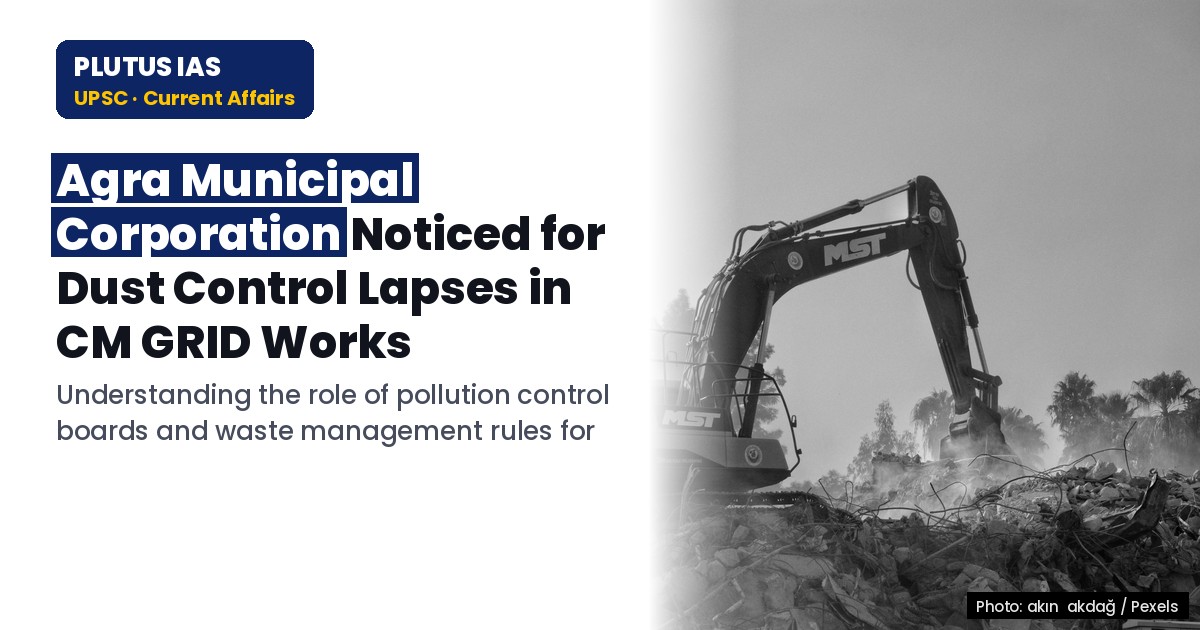
06 Nov Agra Pollution: Municipal Corp. Noticed for Dust Control Lapses
✎ The notice to Agra Municipal Corporation underscores the critical role of local bodies in adhering to environmental regulations like GRAP and C&D Waste Management Rules to mitigate urban air pollution, with non-compliance…
Subject Relevance — Where This Topic Fits
- GS Paper III — Environment, Ecology, and Disaster Management | GS Paper II — Governance and Public Policy
- Prelims: Air Pollution, Dust Pollution, Construction and Demolition Waste Management Rules, Graded Response Action Plan (GRAP), Pollution Control Board, Environmental Compensation, National Green Tribunal (NGT), Environmental Protection Act, 1986
- Essay: Balancing Development and Environmental Protection in Urban India, The Role of Local Governance in Addressing Environmental Challenges
Quick Revision: The notice to Agra Municipal Corporation underscores the critical role of local bodies in adhering to environmental regulations like GRAP and C&D Waste Management Rules to mitigate urban air pollution, with non-compliance attracting environmental compensation and legal action.
Why is this in the news?
The Uttar Pradesh Pollution Control Board (UPPCB) has issued a notice to the Agra Municipal Corporation, citing deficiencies in dust control and construction and demolition (C&D) waste management during ongoing infrastructure projects under the Chief Minister Green Road Infrastructure Development Scheme (CM GRID). The notice highlights violations of the Graded Response Action Plan (GRAP) and C&D Waste Management Rules, demanding a response within seven days and threatening environmental compensation and legal action if corrective measures are not implemented.
Background
- Air pollution, particularly from particulate matter, poses a significant public health challenge in numerous Indian cities, including Agra.
- Construction and demolition activities are identified as major contributors to ambient air pollution, primarily through the generation of dust and improper waste disposal.
- The Graded Response Action Plan (GRAP) is a set of emergency measures implemented to combat air pollution in the National Capital Region (NCR) and surrounding areas, including Agra, based on the severity of air quality.
- The Construction and Demolition Waste Management Rules, 2016, mandate scientific management of C&D waste, including segregation, collection, processing, and disposal, to minimize environmental impact.
- State Pollution Control Boards (SPCBs) are statutory bodies responsible for implementing environmental laws and regulations, including monitoring pollution levels and enforcing compliance.
- Non-compliance with environmental norms can lead to penalties, including environmental compensation, which is a fine levied to compensate for environmental damage, and legal action under relevant environmental protection acts.
Understanding Key Regulatory Frameworks for Air Quality Management
- The Graded Response Action Plan (GRAP) is an emergency action plan to tackle air pollution, implemented by the Environment Pollution (Prevention and Control) Authority (EPCA) and now by the Commission for Air Quality Management (CAQM) in NCR and adjoining areas.
- GRAP categorizes air quality into ‘Moderate to Poor,’ ‘Very Poor,’ ‘Severe,’ and ‘Severe Plus’ levels, prescribing specific actions for each stage, such as banning construction activities, restricting vehicle movement, and closing polluting industries.
- The Construction and Demolition Waste Management Rules, 2016, apply to every waste generator, including local authorities, and mandate the responsible management of C&D waste, emphasizing reuse, recycling, and safe disposal.
- Key provisions of the C&D Waste Management Rules include obtaining permission for construction, ensuring proper storage of C&D waste, preventing dust generation, and transporting waste in covered vehicles.
- The Environment (Protection) Act, 1986, serves as an umbrella legislation for environmental protection in India, empowering the central government to take measures for improving environmental quality and preventing, controlling, and abating environmental pollution.
- State Pollution Control Boards (SPCBs) are established under the Water (Prevention and Control of Pollution) Act, 1974, and the Air (Prevention and Control of Pollution) Act, 1981, with responsibilities including monitoring pollution, issuing consents, and enforcing environmental standards.
- Environmental Compensation is a penalty imposed on polluters to account for the damage caused to the environment, often determined by the National Green Tribunal (NGT) or Pollution Control Boards based on the ‘Polluter Pays Principle’.
- The ‘Polluter Pays Principle’ dictates that the party responsible for causing pollution should bear the costs of managing it to prevent damage to human health or the environment, as well as the costs of remediation.
Key Features
| Feature | Significance |
|---|---|
| Notice Issuance | Regional Pollution Control Board issued a notice to Agra Municipal Corporation. |
| Violation Cited | Non-compliance with dust control measures and construction and demolition (C&D) waste management rules. |
| Specific Deficiencies | Inadequate water sprinkling at construction sites, open dumping of construction material and debris on roads, and insufficient restoration of roads post-construction. |
| Regulatory Framework | Violations pertain to the Graded Response Action Plan (GRAP) and C&D Waste Management Rules. |
| Consequence of Non-Compliance | Threat of environmental compensation charges and legal action if corrective measures are not implemented within seven days. |
Why it Matters
Environmental Significance
- Addresses the escalating issue of air pollution, particularly particulate matter, which poses severe health risks to the populace.
- Highlights the imperative of stringent adherence to environmental regulations for sustainable urban development.
- Emphasises the role of local bodies in mitigating environmental degradation caused by infrastructure projects.
Governance and Administrative Significance
- Demonstrates the accountability mechanism where regulatory bodies enforce environmental norms on implementing agencies.
- Underscores the importance of inter-agency coordination and responsibility in executing public works while safeguarding environmental quality.
- Sets a precedent for holding municipal corporations liable for environmental non-compliance, promoting better governance practices.
Public Health Significance
- Directly impacts the respiratory health and overall well-being of citizens exposed to elevated levels of airborne dust and pollutants.
- Reinforces the necessity of proactive measures to ensure a healthy living environment, especially in densely populated urban areas.
- Contributes to the broader objective of achieving cleaner air, which is a fundamental aspect of public health.
Challenges
1. Enforcement of Environmental Regulations
- Ensuring consistent and effective implementation of environmental laws and guidelines across all urban development projects.
- Overcoming capacity constraints within regulatory bodies for comprehensive monitoring and enforcement activities.
UPSC Link: Environmental Pollution & Degradation
2. Sustainable Urban Infrastructure Development
- Balancing rapid urbanisation and infrastructure expansion with environmental protection and public health considerations.
- Integrating environmental impact assessments and mitigation strategies into project planning and execution phases.
UPSC Link: Urbanisation, their problems & remedies
3. Waste Management and Disposal
- Developing robust systems for the collection, segregation, processing, and safe disposal of construction and demolition waste.
- Preventing illegal dumping and ensuring proper recycling and reuse of C&D waste materials.
UPSC Link: Solid Waste Management
4. Inter-Agency Coordination
- Fostering seamless collaboration and accountability among various government departments and agencies involved in urban projects.
- Resolving jurisdictional overlaps and ensuring shared responsibility for environmental compliance.
UPSC Link: Government Policies & Interventions
Challenges — UPSC Perspective
| Issue | Concern |
|---|---|
| Dust Emission from Construction | Significant contributor to ambient air pollution, leading to respiratory ailments and reduced air quality. |
| Improper C&D Waste Management | Open dumping of debris obstructs public spaces, creates health hazards, and exacerbates dust pollution. |
| Inadequate Road Restoration | Post-construction neglect of roads causes inconvenience to commuters, traffic disruptions, and further dust generation. |
| Non-compliance with GRAP | Failure to implement mandated pollution control measures, undermining efforts to improve air quality in critical periods. |
| Accountability of Local Bodies | Lack of stringent oversight and enforcement mechanisms allowing municipal corporations to overlook environmental responsibilities. |
Government Initiatives — Must-Memorise for Prelims
- Chief Minister Green Road Infrastructure Development Scheme (CM GRID)
- Graded Response Action Plan (GRAP)
Way Forward
- Implement comprehensive dust suppression techniques, including regular water sprinkling and use of wind barriers, at all construction sites.
- Ensure strict adherence to Construction and Demolition Waste Management Rules, 2016, with proper segregation, collection, and disposal mechanisms.
- Mandate the use of covered vehicles for transporting construction materials and debris to prevent spillage and dust generation.
- Integrate environmental compliance as a key performance indicator for all urban infrastructure projects and implementing agencies.
- Strengthen the monitoring and enforcement capabilities of pollution control boards through technological advancements and increased human resources.
- Impose deterrent environmental compensation charges and initiate legal proceedings against persistent violators to ensure accountability.
- Develop and implement a robust mechanism for post-construction site restoration, including timely repair of roads and removal of residual debris.
UPSC Value Addition
Keywords for Mains Answer-Writing
Air Pollution Control · Construction and Demolition Waste Management Rules · Graded Response Action Plan (GRAP) · Environmental Compensation · Urban Governance · Sustainable Infrastructure Development · Polluter Pays Principle · Environmental Protection Act 1986 · National Green Tribunal · Public Health Impacts of Pollution
Constitutional & Policy Linkages
- Article 21: Right to Life (includes right to a healthy environment)
- Article 48A: Protection and improvement of environment (Directive Principle)
Concept Flow
Urban infrastructure development projects initiated by municipal corporations. → Inadequate dust control and C&D waste management practices at construction sites. → Increased particulate matter and air pollution in the urban environment. → Regional Pollution Control Board identifies violations of environmental norms (GRAP, C&D Waste Rules). → Notice issued to the Municipal Corporation, demanding corrective action and threatening penalties. → Potential imposition of environmental compensation and legal action if non-compliance persists.
Prelims Practice Questions
Q1. Consider the following statements regarding the Graded Response Action Plan (GRAP):
1. GRAP is a set of emergency measures implemented to combat air pollution in the National Capital Region (NCR) and other identified polluted areas.
2. It is implemented by the Central Pollution Control Board (CPCB) after a notification from the Ministry of Environment, Forest and Climate Change.
3. Measures under GRAP are dynamic and depend on the severity of air pollution, categorized into ‘Poor’, ‘Very Poor’, ‘Severe’, and ‘Severe Plus’ levels.
How many of the above statements are correct?
- Only one
- Only two
- All three
- None
Answer: All three — Statement 1 is correct: GRAP is indeed an emergency response mechanism for air pollution, primarily in the NCR and other critical zones. Statement 2 is incorrect: GRAP is implemented by the Commission for Air Quality Management (CAQM) in NCR and adjoining areas, not directly by CPCB after a MoEF&CC notification. CPCB assists in monitoring. Statement 3 is correct: GRAP measures are indeed graded based on pollution levels, with specific actions for each category.
Q2. Which of the following is NOT a primary source of dust pollution from construction and demolition activities?
- Excavation and earthmoving operations
- Transportation of construction materials
- Demolition of existing structures
- Use of energy-efficient lighting at construction sites
Answer: Use of energy-efficient lighting at construction sites — Excavation, transportation of materials, and demolition directly generate particulate matter (dust). The use of energy-efficient lighting at construction sites is an environmental sustainability measure related to energy consumption, not a direct source of dust pollution.
Mains Practice Question
✍ The recent notice issued by the Pollution Control Board to the Municipal Corporation of Agra highlights critical lapses in construction dust control and waste management. Discuss the regulatory framework governing construction and demolition waste in India. To what extent have these regulations been effective in mitigating urban air pollution? (15 Marks)
Approach: MODEL-ANSWER SKELETON:
1. Introduction: Briefly introduce the context of urban air pollution and the role of construction and demolition (C&D) activities.
2. Regulatory Framework for C&D Waste:
a. Construction and Demolition Waste Management Rules, 2016: Key provisions including segregation, collection, processing, and disposal responsibilities of generators, local authorities, and state pollution control boards.
b. Environmental Protection Act, 1986: Overarching legislation empowering the Central Government to take measures for environmental protection.
c. Graded Response Action Plan (GRAP): Specific measures related to C&D activities during different pollution levels (e.g., ban on C&D activities, dust suppression).
d. Role of Central Pollution Control Board (CPCB) and State Pollution Control Boards (SPCBs): Monitoring, enforcement, and issuance of guidelines.
e. National Green Tribunal (NGT) Act, 2010: Role of NGT in adjudicating environmental disputes and imposing penalties for non-compliance.
3. Effectiveness of Regulations in Mitigating Urban Air Pollution:
a. Successes: Increased awareness, establishment of C&D waste processing facilities in some cities, legal recourse through NGT, integration into urban planning in certain areas.
b. Challenges/Limitations:
i. Implementation Gaps: Lack of strict enforcement by local bodies, inadequate infrastructure for waste processing.
ii. Monitoring Deficiencies: Insufficient surveillance of construction sites, particularly smaller ones.
iii. Behavioral Aspects: Lack of compliance by individual contractors and developers regarding dust suppression and waste segregation.
iv. Financial Constraints: Limited funds for C&D waste management infrastructure and technology.
v. Inter-agency Coordination: Issues in coordination between municipal corporations, pollution control boards, and urban development authorities.
c. Data/Reports: Reference to air quality index (AQI) data, CPCB reports, or NGT observations on C&D waste violations.
4. Conclusion: Summarize the need for robust enforcement, technological adoption, public participation, and inter-agency synergy to enhance the effectiveness of C&D waste management regulations in addressing urban air pollution.
Source: amarujala.com
Generated by AanyaAi for educational purpose.
Related guides on our sites
- Current affairs for upsc 2026
- How to prepare for GS paper 1 for UPSC CSE mains exam
- Best UPSC coaching for IFOS exam
- Best geography optional coaching

- सुप्रीम कोर्ट: सेवानिवृत्त सरकारी कर्मचारियों के पेंशन पर महत्वपूर्ण निर्देश - November 6, 2026
- Special Campaign 6: E-Waste Management & Administrative Reform - November 6, 2026
- INDIA AND MYANMAR COMMENCE INAUGURAL TRI-SERVICES JOINT HADR EXERCISE ‘RAHAT MITRA’ - November 6, 2026

No Comments