


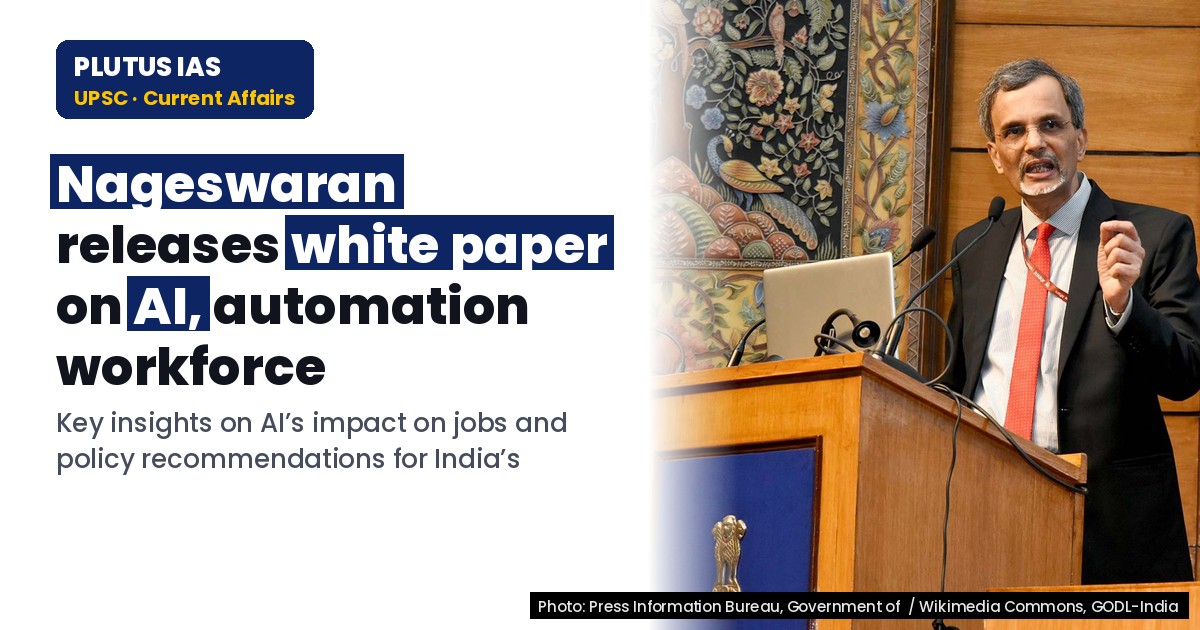
11 Oct AI and Automation in India’s Workforce: CEA Nageswaran’s White Paper Insights
✎ AI exposure in India’s workforce has risen modestly since 2012, with fewer than 8% of employed individuals in AI-complementary roles in 2025, underscoring the urgent need for skill development and policy interventions to mitigate…
Subject Relevance — Where This Topic Fits
- GS Paper III — Science and Technology: Developments and their Applications and Effects in Everyday Life | GS Paper III — Indian Economy and Issues Relating to Planning, Mobilisation of Resources, Growth, Development and Employment | GS Paper III — Inclusive Growth and Issues Arising from it
- Prelims: Artificial Intelligence (AI), Automation, Labour Market Exposure, Complementarity vs Substitution, Routine vs Non-Routine Tasks, Employment Elasticity, Skill Premium, Digital Divide, NITI Aayog’s National Strategy for Artificial Intelligence, Nasscom, Great Lakes Institute of Management, IMT Ghaziabad
- Essay: The Intersection of Technology and Human Capital: Challenges and Opportunities for India, Policy Frameworks in the Age of AI: Balancing Innovation and Inclusion
Quick Revision: AI exposure in India’s workforce has risen modestly since 2012, with fewer than 8% of employed individuals in AI-complementary roles in 2025, underscoring the urgent need for skill development and policy interventions to mitigate substitution risks.
Why is this in the news?
The release of the white paper titled *AI, Automation and India’s Workforce: Who Gains, Who’s Exposed, and How Policy Can Shape the Future* by Chief Economic Advisor V. Anantha Nageswaran on 11 October 2026 underscores the evolving dynamics of India’s labour market in the context of artificial intelligence (AI) and automation. The report quantifies the exposure of Indian employment to AI, assesses the quality of this exposure, and highlights regional disparities, thereby providing empirical evidence for policy formulation aimed at mitigating substitution risks while enhancing complementary opportunities.
Background
- The global discourse on AI and automation has intensified since the 2010s, with significant implications for labour markets, particularly in emerging economies like India, where the workforce is characterised by a large informal sector and varying degrees of digital literacy.
- India’s employment landscape is segmented, with formal and informal sectors exhibiting distinct vulnerabilities and opportunities in the face of technological disruption. Routine tasks, which are more susceptible to automation, constitute a substantial portion of India’s workforce, especially in manufacturing and services.
- The Government of India has prioritised AI adoption through initiatives such as NITI Aayog’s *National Strategy for Artificial Intelligence* (2018) and the *Responsible AI for Youth* programme, reflecting a broader commitment to integrating AI into economic growth strategies.
- The white paper’s findings align with global trends, where AI exposure is higher among younger workers, indicating the need for lifelong learning and upskilling to remain relevant in an AI-augmented labour market.
- Regional disparities in AI exposure reflect broader developmental challenges, with southern states leading in quantity but lagging in quality of AI exposure, while northern states with higher informal employment face greater substitution risks.
- The paper’s emphasis on policy shaping the future of work is consistent with constitutional provisions such as Article 41 (Right to Work) and Article 43 (Living Wage), which mandate state intervention in employment generation and skill development.
Understanding AI Exposure, Complementarity, and Substitution in the Labour Market
- **AI Exposure**: Refers to the extent to which jobs are susceptible to AI-driven automation or augmentation. The white paper defines exposure as the share of employment in occupations where AI tools can either replace or complement human tasks.
- AI Complementarity: Occupations where AI tools enhance productivity rather than replace human labour. Examples include data analysis, medical diagnostics, and customer service automation. The paper notes that fewer than 8% of employed Indians were in AI-complementary roles in 2025, highlighting a critical skill gap.
- AI Substitution: Occupations where AI tools can perform tasks traditionally done by humans, leading to potential job displacement. Routine tasks in manufacturing, clerical work, and certain service roles are highly susceptible to substitution.
- Quality of Exposure: The white paper distinguishes between high-quality exposure (complementary roles) and low-quality exposure (substitution-prone roles). Southern states, despite higher exposure rates, lag in the quality of AI-complementary jobs, indicating a need for targeted skill development.
- Regional Disparities: Southern states (e.g., Tamil Nadu, Karnataka, Kerala) exhibit higher AI exposure (average 30.9%) due to stronger IT and services sectors, while northern states (e.g., Uttar Pradesh, Bihar) have lower exposure (16.8–20%) but face greater substitution risks due to informal employment structures.
- Age Dynamics: Younger workers (25–34 years) are 10 percentage points more likely to be in AI-exposed occupations than older workers (55–64 years), reflecting generational differences in digital literacy and adaptability.
- Policy Imperatives: The paper underscores the need for policies that enhance AI complementarity, such as upskilling programmes, digital infrastructure development, and incentives for industries to adopt AI in a labour-augmenting rather than labour-replacing manner.
Key Features
| Feature | Significance |
|---|---|
| Rise in AI-exposed employment (2012–2025) | Modest but measurable increase in workforce exposure to AI, indicating gradual technological integration in labour markets. |
| AI complementarity vs. substitution | Higher share of workers in AI-complementary roles (46.3 million) compared to substitution-prone roles, though substitution pressure still dominates. |
| Regional disparity in AI exposure | Southern states lead in quantity of AI-exposed jobs (30.9% average), while northern and eastern states lag (16.8–20%), reflecting uneven digital infrastructure and skill distribution. |
| Age-wise distribution of AI exposure | Younger workers (25–34 years) show 29% exposure, 10 percentage points higher than older cohorts (55–64 years), highlighting generational digital divide. |
| Quality of AI exposure | Improvement in the nature of AI exposure over time, though fewer than 8% of employed persons were in AI-complementary occupations by 2025. |
Why it Matters
Economic Implications
- Gradual but persistent automation of routine tasks may reduce low-productivity employment, necessitating reskilling initiatives to mitigate labour displacement.
Labour Market Dynamics
- AI exposure is concentrated among younger workers, suggesting that early-career upskilling in digital literacy and technical competencies is critical for future employability.
Regional Development
- Disparities in AI exposure across states underscore the need for targeted interventions in education, digital infrastructure, and industrial policy to ensure inclusive growth.
Policy Design
- The paper’s emphasis on complementarity over substitution highlights the importance of policies that foster human-AI collaboration rather than outright replacement of labour.
Global Comparisons
- India’s 46.3 million workers in AI-complementary roles are comparable to the United States (52.5 million) but exceed Russia (20.9 million), indicating India’s growing but still modest integration with AI-driven economies.
Challenges
1. Labour Displacement Risk
- Workers in routine-based occupations face heightened substitution pressure, particularly in sectors like manufacturing and administrative services.
UPSC Link: GS3: Employment and Inclusive Growth
2. Skill Mismatch and Digital Divide
- Generational and regional disparities in AI exposure risk exacerbating inequalities in income and employment opportunities.
UPSC Link: GS3: Skill Development and Human Resource
3. Policy Implementation Gaps
- Existing reskilling programmes may lack scalability or alignment with evolving AI-driven labour market demands.
UPSC Link: GS2: Governance and Public Policy
4. Infrastructure and Accessibility
- Uneven digital infrastructure across states hinders equitable AI adoption, particularly in rural and economically backward regions.
UPSC Link: GS3: Infrastructure and Industrial Policy
5. Ethical and Regulatory Concerns
- Rapid AI integration raises questions about data privacy, algorithmic bias, and the need for robust governance frameworks.
UPSC Link: GS4: Ethics and Integrity in Governance
Challenges — UPSC Perspective
| Issue | Concern |
|---|---|
| Substitution Pressure | Risk of job losses in routine-based occupations due to automation. |
| Skill Gaps | Inadequate digital literacy and technical skills among workers, particularly older cohorts. |
| Regional Imbalances | Concentration of AI exposure in southern states, leaving northern and eastern states at a disadvantage. |
| Policy Lag | Potential mismatch between rapid technological change and the pace of policy adaptation. |
| Ethical Risks | Need for safeguards against algorithmic bias, data privacy violations, and unequal access to AI tools. |
Way Forward
- Strengthen vocational training programmes to align with AI-driven skill demands, focusing on younger and mid-career workers.
- Expand digital infrastructure in rural and economically disadvantaged states to bridge regional disparities in AI exposure.
- Introduce incentives for industries to adopt AI in a manner that complements rather than replaces human labour.
- Develop national standards for digital literacy and AI competency to ensure equitable skill development.
- Enhance data governance frameworks to address privacy, security, and ethical concerns in AI deployment.
- Promote public-private partnerships to scale reskilling initiatives and foster innovation in AI applications.
- Monitor labour market trends through periodic assessments to anticipate and mitigate displacement risks.
- Encourage research and development in AI to ensure domestic innovation aligns with global technological advancements.
UPSC Value Addition
Keywords for Mains Answer-Writing
Artificial Intelligence and Automation · Labour Market Transformation · Complementarity vs Substitution in AI · AI Exposure Index · Demographic Dividend and AI · Regional Disparities in AI Adoption · Policy Interventions for AI Workforce · Skill Complementarity in the Fourth Industrial Revolution · Economic Survey and AI White Papers · Future of Work in India
Concept Flow
Technological advancement in AI and automation → Gradual integration into labour markets → Rise in AI-exposed employment → Emergence of complementarity and substitution pressures → Regional and generational disparities in exposure → Policy response required to mitigate risks and leverage opportunities → Long-term impact on economic growth and social equity.
Prelims Practice Questions
Q1. Consider the following statements regarding the impact of Artificial Intelligence (AI) on employment in India as per the white paper released by the Chief Economic Advisor:
1. The share of Indian employment exposed to AI has risen modestly since 2012.
2. The quality of AI exposure has improved over the years.
3. The ratio of substitution pressure to complementary work has increased between 2012 and 2025.
4. The southern States lead both in the quantity and quality of AI exposure.
How many of the above statements are correct?
- Only one
- Only two
- Only three
- All four
Answer: Only three — Statements 1 and 2 are correct as per the white paper. Statement 3 is incorrect because the ratio of substitution pressure to complementary work has *fallen*, though substitution pressure still outweighs complementary work. Statement 4 is incorrect as southern States lead in quantity but *not* in quality of AI exposure.
Q2. Assertion (A): The white paper highlights that fewer than 8% of employed people in India were in occupations with a realistic chance of AI complementarity in 2025.
Reason (R): The paper attributes this to the limited availability of high-skilled labour in India compared to countries like the United States and Russia.
- Both A and R are true, and R is the correct explanation of A
- Both A and R are true, but R is *not* the correct explanation of A
- A is true, but R is false
- A is false, but R is true
Answer: A is true, but R is false — Assertion (A) is true as the white paper states fewer than 8% of employed people were in AI-complementary occupations in 2025. Reason (R) is true but does not correctly explain (A), as the paper does not attribute the statistic to labour skill shortages but to broader occupational trends.
Q3. Match the following pairs regarding AI exposure in India’s workforce as per the white paper:
Column I (Region/Group) | Column II (AI Exposure Share)
—————————————|——————————
A. Southern States (Average) | 1. 30.9%
B. Uttar Pradesh, Bihar, Rajasthan | 2. 16.8% to 20%
C. Workers aged 25-34 | 3. 29%
D. Workers aged 55-64 | 4. 19%
- {‘A’: 1, ‘B’: 2, ‘C’: 3, ‘D’: 4}
- {‘A’: 2, ‘B’: 1, ‘C’: 4, ‘D’: 3}
- {‘A’: 1, ‘B’: 2, ‘C’: 4, ‘D’: 3}
- {‘A’: 3, ‘B’: 1, ‘C’: 2, ‘D’: 4}
Answer: {‘A’: 1, ‘B’: 2, ‘C’: 3, ‘D’: 4} — The correct pairing is: A-1 (Southern States average 30.9%), B-2 (Uttar Pradesh, Bihar, Rajasthan range from 16.8% to 20%), C-3 (Workers aged 25-34: 29%), D-4 (Workers aged 55-64: 19%).
Mains Practice Question
✍ The white paper on AI, Automation and India’s Workforce highlights a paradox: while the share of employment exposed to AI has risen modestly since 2012 and the quality of exposure has improved, substitution pressure still outweighs complementary work by half. Critically analyse the implications of this trend for India’s demographic dividend and regional disparities in AI adoption. (15 Marks)
Approach: MODEL-ANSWER SKELETON:
1. **Context and Data**: Define AI exposure and complementarity vs substitution (cite white paper data: 4.8 percentage point rise in routine work exposed to automation, 29% AI exposure in 25-34 age group, southern States’ 30.9% share vs 16.8%-20% in BIMARU states).
2. **Demographic Dividend Angle**:
– Link AI exposure concentration in 25-34 age group to India’s demographic dividend (NITI Aayog’s ‘Demographic Dividend’ reports).
– Discuss risks: if substitution pressure outpaces complementarity, youth may face structural unemployment despite demographic advantage.
– Cite ILO reports on youth unemployment trends in India (if recent data available).
3. **Regional Disparities**:
– Explain southern States’ leadership in AI exposure quantity (high urbanisation, IT hubs like Bengaluru, Hyderabad, Chennai) vs quality lag (need for upskilling in Tier-2/3 cities).
– Analyse BIMARU states’ lower exposure (agricultural dominance, lower digital infrastructure, skill gaps).
– Reference NITI Aayog’s Aspirational Districts Programme and Digital India initiatives as policy responses.
4. **Policy Interventions**:
– **Skill Development**: Link to Skill India Mission, NSDC’s AI/automation skilling modules, and the white paper’s recommendation on targeted upskilling.
– **Industrial Policy**: Discuss Production-Linked Incentive (PLI) schemes for AI/automation sectors (e.g., semiconductors, electronics manufacturing).
– **Labour Market Reforms**: Examine the need for flexible labour codes to accommodate AI-driven job transitions (e.g., Code on Social Security, 2020).
5. **Balanced View**:
– Acknowledge potential benefits: AI-driven productivity gains in agriculture (e.g., precision farming), healthcare (diagnostics), and services.
– Highlight challenges: digital divide, data privacy (Personal Data Protection Bill, 2019), and ethical AI governance.
6. **Conclusion**: Reiterate the paradox and propose a multi-pronged approach: targeted skilling, regional policy convergence, and adaptive labour regulations to harness AI’s complementarity while mitigating substitution risks.
Source: The Hindu
Generated by AanyaAi for educational purpose.
Related guides on our sites
- How to prepare for GS paper 1 for UPSC CSE mains exam
- Best UPSC coaching for IFOS exam
- Best mentorship programme for upsc
- UPSC+BA degree

- AI and Automation in India’s Workforce: CEA Nageswaran’s White Paper Insights - October 11, 2026
- पीएम मोदी ने चेन्नई में ₹13,000 करोड़ की विकास परियोजनाओं का किया शुभारंभ - October 11, 2026
- IITM Pune Hosts Early Career Workshop & ESTIC Preview for UPSC - October 11, 2026

No Comments