


02 Aug AI Avatar ‘Sarathi’ Revolutionizes Consular Services for Indian Diaspora
✎ AI avatars like 'Sarathi' and chatbots such as 'Bharati' are being deployed by Indian missions to enhance consular services, improve accessibility, and bridge linguistic gaps for the diaspora, aligning with the government’s…
 Virtual avatarsChatbotsConsular servicesDiaspora outreach
Subject Relevance — Where This Topic Fits
- GS Paper II — International Relations: Role of Indian Missions and Consulates | GS Paper III — Science and Technology: Applications of AI in Governance and Public Service Delivery
- Prelims: AI avatar ‘Sarathi’, Consulate General of India, Munich, Bhashini AI platform, Pravasi Bharatiya Sahayata Kendra (PBSK), OCI services, police clearance certificate, Heads of Mission Conference 2026
- Essay: The transformative potential of artificial intelligence in redefining citizen-centric governance and public service delivery, Digital diplomacy: Bridging gaps between nations and diaspora communities through technology
Quick Revision: AI avatars like ‘Sarathi’ and chatbots such as ‘Bharati’ are being deployed by Indian missions to enhance consular services, improve accessibility, and bridge linguistic gaps for the diaspora, aligning with the government’s vision of technology-driven, citizen-centric governance.
Why is this in the news?
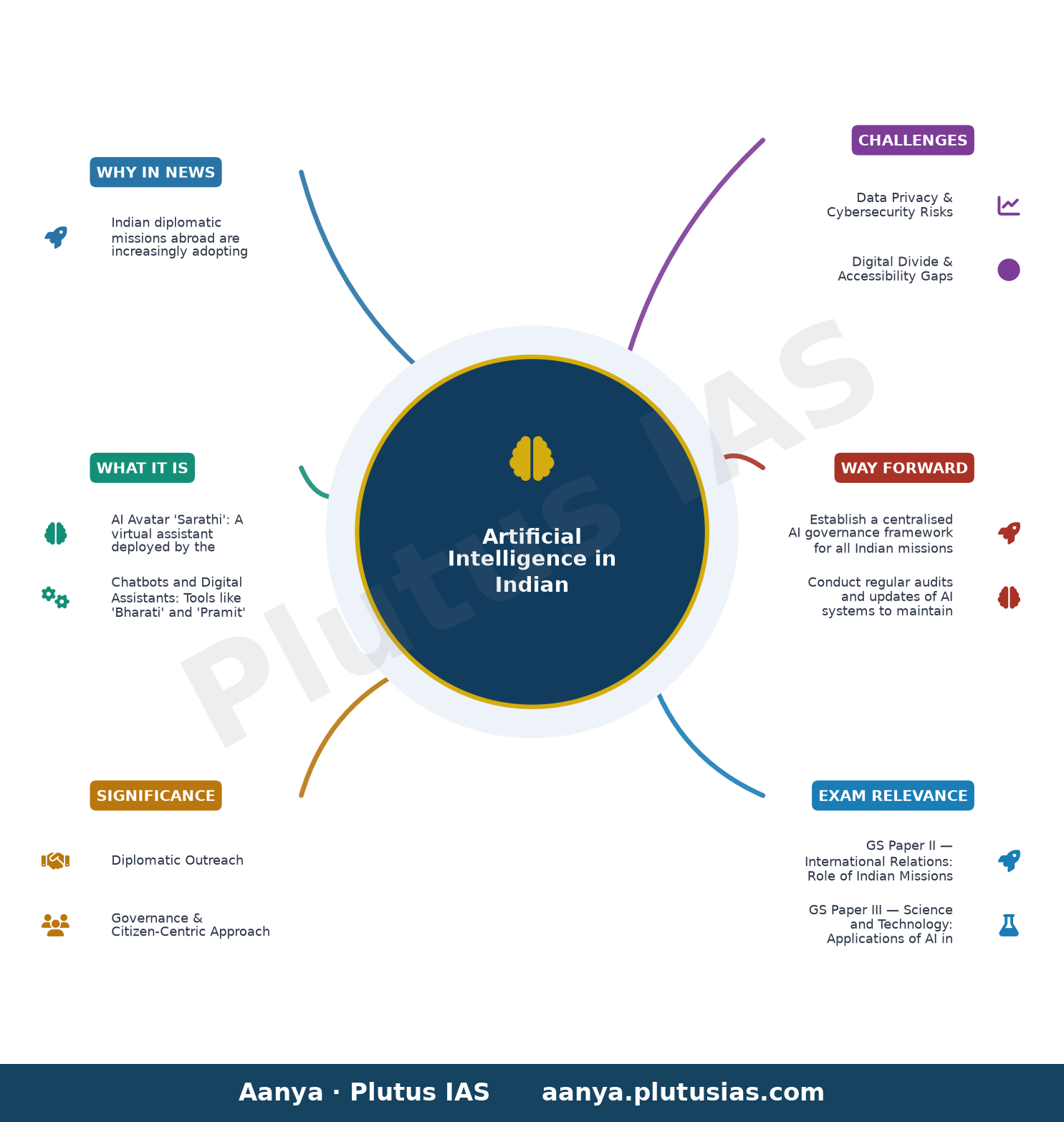
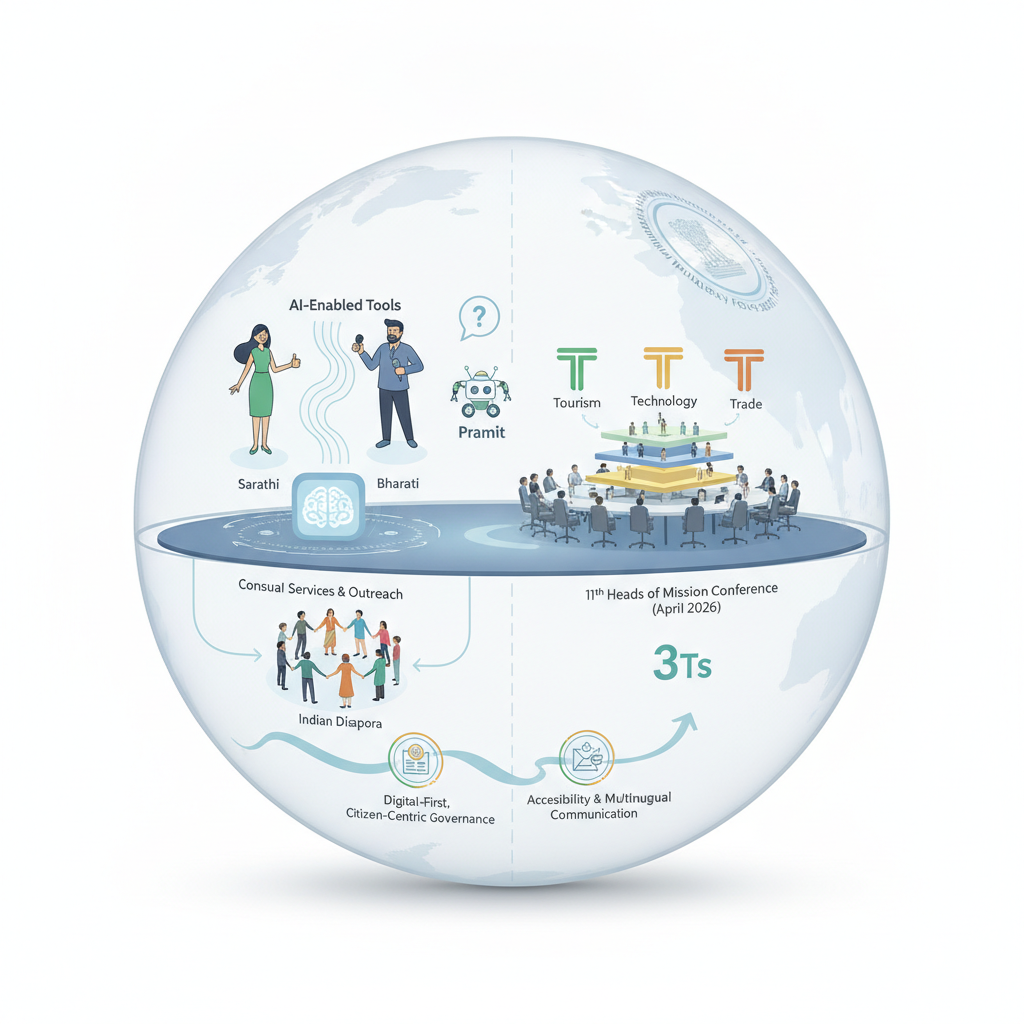
Indian diplomatic missions abroad are increasingly adopting AI-enabled tools, including virtual avatars like ‘Sarathi’ and chatbots such as ‘Bharati’ and ‘Pramit’, to enhance consular services and outreach to the diaspora. This initiative, highlighted by the Consulate General of India in Munich, aligns with the broader theme of ‘Reforming Indian Diplomacy for 2047’ discussed at the 11th Heads of Mission Conference, where technology, tourism, and trade were identified as key pillars. The move reflects a shift toward digital-first, citizen-centric governance and addresses longstanding challenges in accessibility and multilingual communication for diaspora communities.
Background
- The 11th Heads of Mission Conference (April 2026) emphasized the 3Ts—tourism, technology, and trade—as critical to India’s diplomatic strategy for 2047, urging missions to adopt modern digital tools for outreach.
- Traditional consular services, such as passport issuance, visa processing, and OCI registration, have historically relied on text-based advisories, which often lack accessibility for diverse linguistic and demographic groups.
- The Government of India’s Bhashini AI platform was launched to bridge multilingual communication gaps, enabling seamless translation across dozens of Indian and international languages.
- AI-driven chatbots like ‘Bharati’ and ‘Pramit’ have been deployed to handle routine queries, reducing the burden on consular staff and improving response times.
- The initiative in Munich, featuring the AI avatar ‘Sarathi’, represents a pilot effort to humanize digital interactions while maintaining accuracy and efficiency in consular services.
AI-Enabled Tools in Indian Missions: Mechanisms, Objectives, and Implications
- AI Avatar ‘Sarathi’: A virtual assistant deployed by the Consulate General of India in Munich to address diaspora queries on passports, visas, OCI services, police clearance certificates, birth registration, and consular matters through concise audio-visual content.
- Chatbots and Digital Assistants: Tools like ‘Bharati’ and ‘Pramit’ provide automated responses to frequently asked questions, streamlining service delivery and reducing operational bottlenecks in consulates.
- Bhashini AI Platform: A government-backed initiative enabling real-time translation of text, documents, and voice across multiple languages, addressing linguistic barriers in diaspora communication with Indian missions.
- Citizen-Centric Governance: The adoption of AI aligns with the broader government agenda of leveraging technology to enhance accessibility, transparency, and efficiency in public service delivery for the diaspora.
- Multilingual Outreach: AI tools facilitate engagement with diaspora communities in their preferred languages, ensuring inclusivity and reducing the reliance on manual translation services.
- Data-Driven Diplomacy: AI enables missions to analyze query patterns and service gaps, allowing for targeted improvements in consular services and policy formulation.
- Future-Proofing Diplomacy: The initiative positions Indian missions at the forefront of digital diplomacy, preparing for a future where AI and automation play a central role in international relations and citizen services.
Key Features
| Feature | Significance |
|---|---|
| AI Avatar ‘Sarathi’ | Provides real-time, interactive, and multilingual assistance to the Indian diaspora on consular services such as visas, OCI, passports, and birth registration, enhancing accessibility and reducing response time. |
| Bhashini AI Platform Integration | Enables seamless translation of text, documents, and voice across multiple Indian and international languages, bridging linguistic barriers for diaspora citizens. |
| Digital Assistants ‘Bharati’ and ‘Pramit’ | AI-powered chatbots deployed by missions like New York and Dubai to handle user queries efficiently, improving service delivery and reducing manual workload. |
| Concise Audio-Visual Content | Replaces traditional text-based advisories with engaging, short-form videos to improve comprehension and outreach, aligning with modern digital communication trends. |
| Pravasi Bharatiya Sahayata Kendra (PBSK) Digital Services | Digital platform in Dubai integrating AI and chatbots to provide consular support and assistance to the diaspora, enhancing service efficiency. |
Why it Matters
Diplomatic Outreach
- Demonstrates India’s adoption of cutting-edge technology to modernise diplomatic missions, aligning with the Prime Minister’s vision of ‘Reforming Indian Diplomacy for 2047’ and the 3Ts (Tourism, Technology, Trade).
- Enhances the credibility and accessibility of Indian missions abroad by providing authentic, real-time information through digital platforms, reducing misinformation and improving trust among the diaspora.
- Facilitates the dissemination of consular services to a diverse global audience, including non-resident Indians (NRIs) and Persons of Indian Origin (PIOs), ensuring equitable access to government services.
Governance & Citizen-Centric Approach
- Reflects the government’s commitment to citizen-centric governance by leveraging technology to simplify bureaucratic processes and improve service delivery for the diaspora.
- Reduces the burden on consular staff by automating routine queries, allowing officials to focus on complex cases and strategic diplomatic functions.
- Promotes transparency and efficiency in consular services, aligning with the principles of good governance and digital public infrastructure.
Economic & Social Impact
- Supports the Indian diaspora in navigating legal and administrative processes, thereby contributing to economic stability and remittance flows to India.
- Encourages tourism and investment by providing clear, accessible information on visa policies, travel advisories, and consular services, indirectly boosting India’s soft power.
- Enhances social inclusion by addressing language barriers through multilingual AI tools, ensuring that non-English-speaking diaspora members can access critical information.
Challenges
1. Data Privacy & Cybersecurity Risks
- AI-driven systems handling sensitive personal data (e.g., passports, visas) are vulnerable to cyber threats, necessitating robust encryption and compliance with global data protection regulations.
- Ensuring the security of AI avatars and chatbots against malicious attacks or misuse requires continuous monitoring and updates to safeguard user information.
UPSC Link: GS3: Cybersecurity
2. Digital Divide & Accessibility Gaps
- Not all diaspora members, particularly older individuals or those in remote regions, may have access to high-speed internet or digital devices, limiting the reach of AI-enabled services.
- Language barriers persist despite multilingual tools, as regional dialects and technical jargon may not be fully covered, requiring continuous refinement of AI models.
UPSC Link: GS2: Digital Divide
3. Accuracy & Reliability of AI Responses
- AI systems may generate incorrect or outdated information if not regularly updated with the latest consular policies, leading to misinformation and potential legal complications.
- Ensuring the accuracy of AI-generated content requires rigorous validation processes and human oversight to prevent errors in critical services like visa processing.
UPSC Link: GS3: AI Governance
4. Cultural & Contextual Adaptation
- AI avatars and chatbots must be culturally sensitive and contextually appropriate to avoid miscommunication or offence, particularly when addressing diverse diaspora communities.
- Tailoring AI responses to regional legal and administrative frameworks (e.g., OCI rules, police clearance certificates) requires localisation efforts and domain expertise.
UPSC Link: GS2: Cultural Diplomacy
5. Cost & Scalability
- Developing and maintaining AI-driven systems involves significant initial investment and ongoing costs, which may strain the budgets of smaller missions or consulates.
- Scaling AI solutions across all Indian missions globally requires standardised protocols, training for staff, and interoperability with existing digital infrastructure.
UPSC Link: GS3: Public Expenditure
Challenges — UPSC Perspective
| Issue | Concern |
|---|---|
| Data Privacy | Risk of unauthorised access or leakage of sensitive consular data processed by AI systems. |
| Digital Literacy | Limited digital skills among older diaspora members hinder adoption of AI-enabled services. |
| AI Hallucinations | Potential for AI to generate incorrect or misleading information without human oversight. |
| Multilingual Gaps | Incomplete coverage of regional dialects and technical terms in AI translations. |
| Regulatory Compliance | Need to align AI systems with global data protection laws (e.g., GDPR) and Indian regulations. |
| Infrastructure Gaps | Uneven internet connectivity and device availability in certain diaspora regions. |
Way Forward
- Establish a centralised AI governance framework for all Indian missions to ensure standardisation, security, and interoperability of AI tools.
- Conduct regular audits and updates of AI systems to maintain accuracy, particularly for dynamic consular policies like visa rules and OCI regulations.
- Expand digital literacy programmes for the diaspora, especially in regions with low adoption of AI-enabled services, through partnerships with local organisations.
- Invest in multilingual AI models to cover all major Indian languages and regional dialects, ensuring inclusivity for non-English-speaking diaspora members.
- Implement robust cybersecurity protocols, including encryption, access controls, and real-time threat monitoring, to protect sensitive consular data.
- Develop a feedback mechanism for diaspora members to report inaccuracies or usability issues, enabling continuous improvement of AI systems.
- Promote public-private partnerships to reduce costs and accelerate the deployment of AI-driven consular services across missions.
- Integrate AI tools with existing digital platforms like the Ministry of External Affairs’ eMigrate and MEA Grievance Portal to create a unified service ecosystem.
UPSC Value Addition
Keywords for Mains Answer-Writing
Indian diaspora engagement · AI-enabled consular services · Digital diplomacy · Consular reforms · Technology in governance · Citizen-centric governance · Multilingual digital platforms · AI avatars in public service delivery · Heads of Mission Conference 2026 · Pramit and Bharati chatbots · Bhashini AI platform · Pravasi Bharatiya Sahayata Kendra (PBSK)
Constitutional & Policy Linkages
- Article 263: Coordination between Centre and States in matters of foreign affairs (relevant for consular services).
Concept Flow
Prime Minister’s emphasis on technology in diplomacy (3Ts) → → Heads of Mission Conference (April 2026) identifies gaps in tech adoption → → Munich Consulate launches AI avatar ‘Sarathi’ for consular services → → Integration of Bhashini AI and chatbots (‘Bharati’, ‘Pramit’) in missions → → Improved accessibility and efficiency in diaspora services → → Potential for scalability and policy feedback loops to refine AI systems.
Prelims Practice Questions
Q1. Consider the following statements regarding the AI avatar ‘Sarathi’ launched by the Consulate General of India in Munich:
1. Sarathi is an AI-enabled virtual assistant designed to address queries related to passports, visas, and OCI services.
2. The initiative was launched following the 11th Heads of Mission Conference held in April 2026.
3. Sarathi exclusively operates through text-based interactions and does not utilise audio-visual content.
How many of the above statements are correct?
- Only one
- Only two
- All
- None
Answer: Only two — Statement 1 is correct as Sarathi addresses consular matters like passports and visas. Statement 2 is correct as the initiative was launched post the Heads of Mission Conference in April 2026. Statement 3 is incorrect because Sarathi uses concise audio-visual content.
Q2. Assertion (A): The Bhashini AI platform is designed to bridge multilingual communication gaps for diaspora citizens.
Reason (R): Bhashini enables seamless translation of text, documents, and voice across multiple languages.
- Both A and R are true, and R is the correct explanation of A.
- Both A and R are true, but R is not the correct explanation of A.
- A is true, but R is false.
- A is false, but R is true.
Answer: Both A and R are true, and R is the correct explanation of A. — Both Assertion (A) and Reason (R) are true, and R correctly explains A as Bhashini’s primary function is to facilitate multilingual communication.
Q3. Match the following AI-enabled initiatives with their respective Indian missions abroad:
Column I (Initiative) | Column II (Mission)
— | —
1. Sarathi | A. Consulate General of India, Dubai
2. Bharati | B. Consulate General of India, Munich
3. Pramit | C. Consulate General of India, New York
4. Bhashini | D. All Indian missions abroad
- 1-B, 2-C, 3-A, 4-D
- 1-A, 2-B, 3-C, 4-D
- 1-D, 2-A, 3-B, 3-C
- 1-C, 2-D, 3-A, 4-B
Answer: 1-B, 2-C, 3-A, 4-D — Sarathi is associated with the Consulate General of India, Munich (1-B). Bharati was deployed by the Consulate General of India, New York (2-C). Pramit is linked to the Consulate General of India, Dubai (3-A). Bhashini is a government-wide platform used by all missions (4-D).
Mains Practice Question
✍ Critically examine the role of technology in enhancing consular services for the Indian diaspora. How far has the adoption of AI-enabled tools like Sarathi, Bharati, and Pramit transformed the outreach and efficiency of Indian missions abroad? Substantiate your answer with reference to recent initiatives and their impact on citizen-centric governance. (15 Marks)
Approach: MODEL-ANSWER SKELETON:
1. **Context and Rationale**:
– Briefly introduce the need for technology-driven consular services, citing the PM’s emphasis on ‘3Ts’ (tourism, technology, trade) at the 11th Heads of Mission Conference (April 2026).
– Highlight the limitations of traditional text-based advisories and the shift toward AI-enabled solutions.
2. **Key Initiatives and Mechanisms**:
– **AI Avatars (Sarathi)**: Explain its role in delivering concise audio-visual content for services like passports, visas, OCI, and birth registration. Cite the Munich Consulate’s initiative as an example.
– **Chatbots (Bharati and Pramit)**: Describe their deployment in missions like New York and Dubai, focusing on their ability to handle subject-specific queries and multilingual support.
– **Bhashini AI Platform**: Explain its function in bridging language barriers through real-time translation of text, documents, and voice across languages.
3. **Impact on Outreach and Efficiency**:
– **Accessibility**: Discuss how AI tools make information more accessible and engaging for a diverse diaspora population.
– **Scalability**: Highlight the ability to serve large diaspora populations (e.g., 2.5 million in the New York Consulate’s jurisdiction).
– **Efficiency**: Emphasise reduced response times, 24/7 availability, and cost-effectiveness compared to traditional methods.
4. **Challenges and Limitations**:
– **Digital Divide**: Address potential barriers for non-tech-savvy users or those with limited internet access.
– **Data Privacy**: Discuss concerns related to the use of AI in handling sensitive consular data.
– **Accuracy and Bias**: Acknowledge the need for continuous monitoring to ensure AI responses are accurate and unbiased.
5. **Conclusion**:
– Summarise the transformative potential of AI-enabled tools in consular services.
– Argue that while these tools significantly enhance efficiency and outreach, they must be complemented by traditional methods to ensure inclusivity.
**Balanced View**: Present both the advantages (e.g., improved citizen satisfaction, reduced workload for officials) and challenges (e.g., over-reliance on technology, privacy concerns) to demonstrate critical analysis.
Source: The Indian Express
Generated by AanyaAi for educational purpose.


No Comments