


02 Aug AI Avatar ‘Sarathi’ Revolutionizes Consular Services for Indian Diaspora
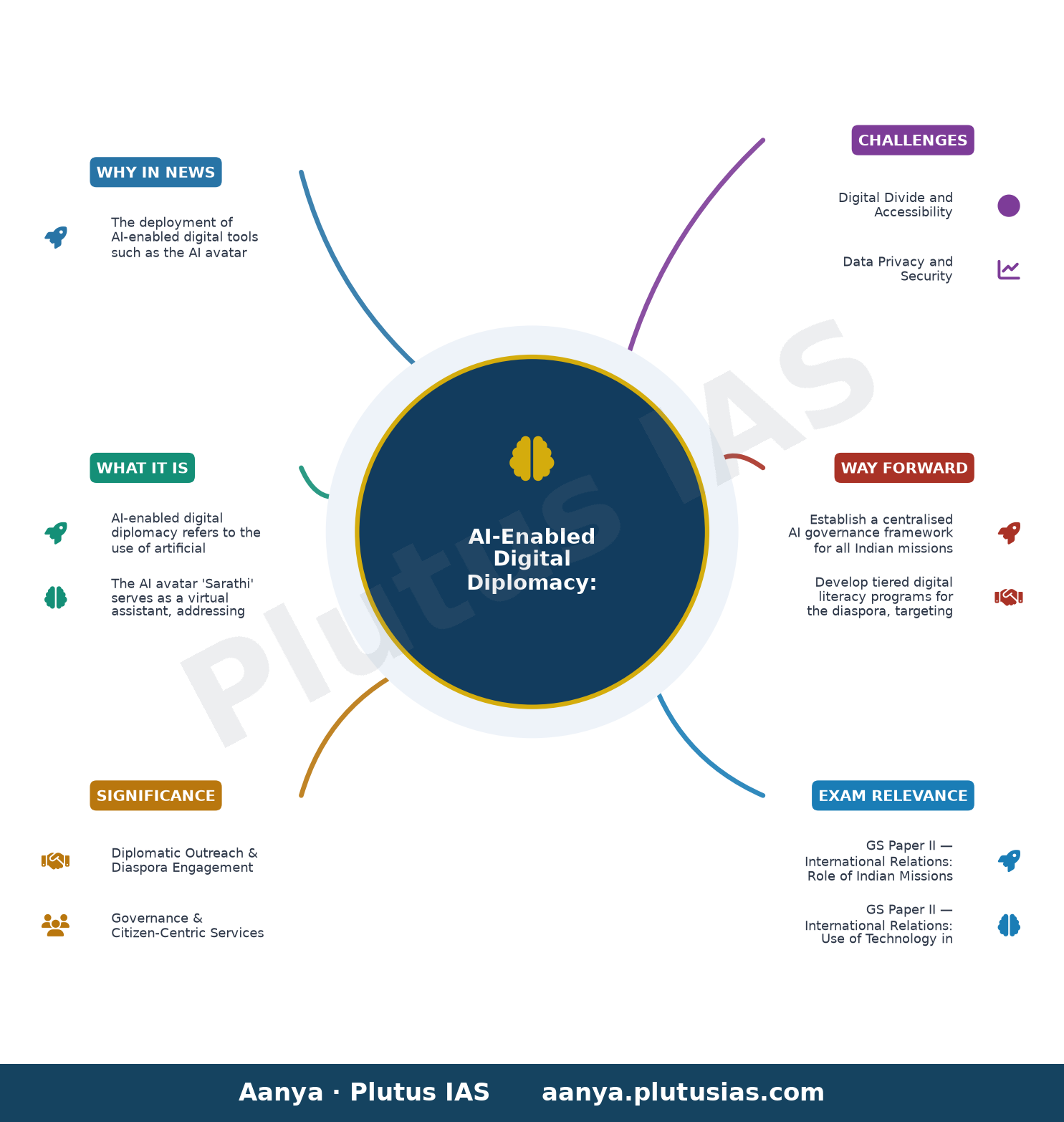
✎ AI-enabled digital diplomacy enhances consular services for the Indian diaspora by leveraging AI avatars, chatbots, and multilingual platforms to improve accessibility, efficiency, and engagement.
 AI avatar SarathiConsular servicesDigital outreach toolsTechnology-driven governanceDiaspora communication
Subject Relevance — Where This Topic Fits
- GS Paper II — International Relations: Role of Indian Missions and Consulates | GS Paper II — International Relations: Use of Technology in Diplomacy | GS Paper III — Science and Technology: AI and Digital Governance
- Prelims: AI avatar, Sarathi, Bhashini AI platform, Pravasi Bharatiya Sahayata Kendra (PBSK), OCI services, Consular services, Chatbots in governance, Heads of Mission Conference, Citizen-centric governance
- Essay: The role of technology in transforming public service delivery, Diplomacy in the digital age: Balancing tradition and innovation
Quick Revision: AI-enabled digital diplomacy enhances consular services for the Indian diaspora by leveraging AI avatars, chatbots, and multilingual platforms to improve accessibility, efficiency, and engagement.
Why is this in the news?
The deployment of AI-enabled digital tools such as the AI avatar ‘Sarathi’ by the Consulate General of India in Munich to assist the Indian diaspora with consular services marks a significant shift in diplomatic outreach. This initiative, aligned with the Prime Minister’s emphasis on technology-driven governance during the 11th Heads of Mission Conference, underscores the integration of artificial intelligence and digital communication tools in enhancing the efficiency and accessibility of consular services for Indians abroad.
Background
- The Indian diaspora, estimated at over 18 million globally, requires timely and accurate consular services, including passport issuance, visa processing, Overseas Citizen of India (OCI) services, and birth registration.
- Traditional text-based advisories and manual processes have often led to delays and accessibility challenges for diaspora members, particularly in regions with linguistic and cultural diversity.
- The 11th Heads of Mission Conference in April 2026, themed ‘Reforming Indian Diplomacy for 2047’, highlighted the need for missions to adopt technology to improve outreach and service delivery.
- Prime Minister Narendra Modi’s emphasis on the 3Ts—tourism, technology, and trade—during the conference underscored the strategic importance of digital transformation in diplomacy.
- The Consulate General of India in Munich launched the AI avatar ‘Sarathi’ as part of a broader initiative to leverage AI and modern digital tools for diaspora engagement.
- The government’s Bhashini AI platform has been integrated by missions to bridge multilingual communication gaps, enabling seamless translation across Indian and international languages.
What is AI-Enabled Digital Diplomacy in the Context of Indian Missions?
- AI-enabled digital diplomacy refers to the use of artificial intelligence, avatars, chatbots, and digital platforms by Indian missions to enhance consular services and outreach to the diaspora.
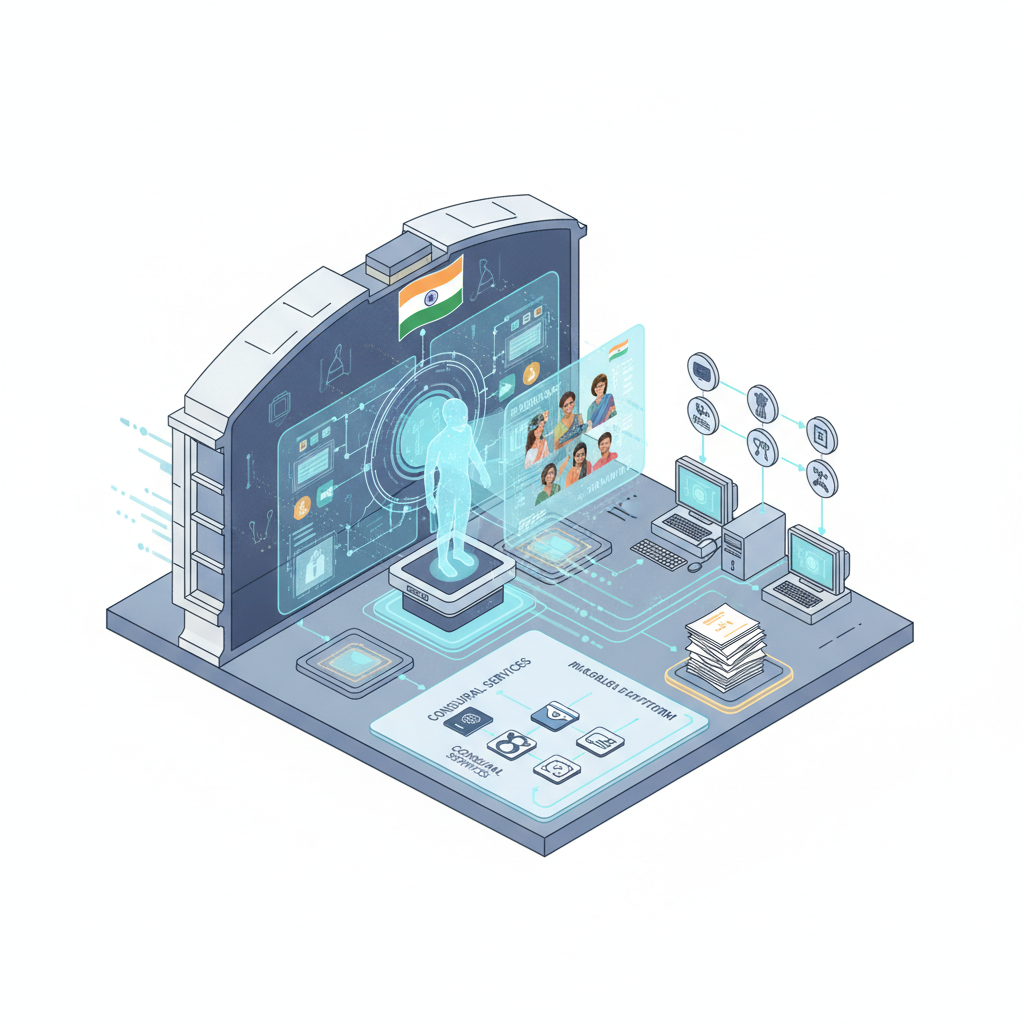
- The AI avatar ‘Sarathi’ serves as a virtual assistant, addressing queries related to passports, visas, OCI services, birth registration, police clearance, and consular matters through concise audio-visual content.
- The initiative aims to make consular information more accessible, engaging, and interactive by replacing traditional text-based advisories with modern digital communication tools.
- The Bhashini AI platform facilitates multilingual communication by enabling seamless translation of text, documents, and voice across multiple languages, ensuring inclusivity for diaspora members.
- Chatbots such as ‘Bharati’ and ‘Pramit’ have been deployed by several Indian missions to provide real-time assistance for diaspora queries.
- The use of AI and digital tools aligns with the government’s citizen-centric governance approach, emphasizing efficiency, transparency, and accessibility in public service delivery.
- This initiative reflects a broader trend of digital transformation in diplomacy, where technology is leveraged to bridge gaps in communication, reduce delays, and enhance service delivery for the diaspora.
Key Features
| Feature | Significance |
|---|---|
| AI Avatar ‘Sarathi’ | Provides a human-like interface for diaspora queries on consular services, enhancing accessibility and reducing response time. |
| Bhashini AI Platform | Enables seamless multilingual communication by translating text, documents, and voice across languages, bridging linguistic gaps. |
| Chatbots ‘Bharati’ and ‘Pramit’ | Automates routine queries (e.g., visa processes, document requirements) to improve efficiency in consular services. |
| Digital Assistants in PBSK (Dubai) | Integrates AI into Pravasi Bharatiya Sahayata Kendra services, offering real-time support for diaspora welfare queries. |
| Concise Audio-Visual Content | Replaces traditional text-based advisories with engaging, interactive videos for better comprehension and retention. |
Why it Matters
Diplomatic Outreach & Diaspora Engagement
- Demonstrates India’s adoption of cutting-edge technology (AI, digital platforms) to modernise diplomatic outreach, aligning with the 3Ts (Tourism, Technology, Trade) vision outlined at the 11th Heads of Mission Conference.
- Enhances the credibility and accessibility of Indian missions by providing authentic, real-time consular information through digital channels.
- Strengthens India’s soft power by demonstrating responsiveness to the needs of the 18-million-strong diaspora, fostering goodwill and trust.
Governance & Citizen-Centric Services
- Reflects the government’s commitment to citizen-centric governance by leveraging AI to simplify bureaucratic processes (e.g., OCI services, birth registration) for non-resident Indians.
- Reduces the burden on human staff by automating repetitive queries, allowing consular officers to focus on complex cases.
- Promotes inclusivity by catering to diverse linguistic and technical literacy levels among the diaspora.
Technological Integration & Digital Public Infrastructure
- Showcases India’s prowess in AI and digital public infrastructure, positioning the country as a leader in leveraging technology for public service delivery.
- Highlights the scalability of platforms like Bhashini, which can be replicated across missions to address multilingual challenges globally.
- Aligns with global trends in e-governance, where AI-driven solutions are increasingly used to enhance service delivery and citizen engagement.
Challenges
1. Digital Divide and Accessibility
- Risk of excluding diaspora members with limited internet access or low digital literacy, particularly in remote or economically disadvantaged regions.
- Dependence on high-speed internet and modern devices may disadvantage older or less tech-savvy users.
UPSC Link: GS2: Welfare Schemes for Vulnerable Sections
2. Data Privacy and Security
- AI-driven systems handling sensitive consular data (e.g., passports, OCI applications) must comply with global data protection regulations (e.g., GDPR) to avoid breaches.
- Potential vulnerabilities in chatbots or AI avatars could expose personal information if not adequately secured.
UPSC Link: GS3: Cyber Security
3. Accuracy and Reliability of AI Responses
- AI systems may provide incorrect or outdated information if not regularly updated with the latest consular policies or legal frameworks.
- Over-reliance on AI could lead to a decline in human oversight, risking misinformation in critical matters like visa rejections or legal disputes.
UPSC Link: GS2: Role of Civil Services in Policy Implementation
4. Cultural and Linguistic Nuances
- AI translations (e.g., via Bhashini) may struggle with regional dialects, idiomatic expressions, or legal terminologies, leading to miscommunication.
- Cultural sensitivities in consular services (e.g., marriage registration, inheritance laws) require nuanced handling, which AI may not fully grasp.
UPSC Link: GS2: Issues Relating to Development and Management of Social Sector/Services
5. Scalability and Maintenance Costs
- High initial investment in AI infrastructure (e.g., avatars, chatbots, translation tools) may strain limited consular budgets, especially for smaller missions.
- Ongoing costs for updates, training, and maintenance could pose long-term financial challenges.
UPSC Link: GS3: Infrastructure and Investment Models
Challenges — UPSC Perspective
| Issue | Concern |
|---|---|
| Digital Divide | Exclusion of users with limited internet access or low digital literacy. |
| Data Privacy | Risk of breaches in handling sensitive consular data. |
| AI Accuracy | Potential for outdated or incorrect responses due to policy changes. |
| Linguistic Nuances | Challenges in translating legal or regional terms accurately. |
| Costs | High initial and maintenance costs for AI infrastructure. |
| Human Oversight | Risk of reduced human intervention leading to errors in critical cases. |
Way Forward
- Establish a centralised AI governance framework for all Indian missions to ensure consistency, security, and compliance with global data standards.
- Develop tiered digital literacy programs for the diaspora, targeting older adults and users in low-connectivity regions.
- Implement real-time AI monitoring systems to flag and correct inaccuracies in responses, with periodic audits by consular experts.
- Expand the Bhashini platform to include region-specific dialects and legal terminologies, ensuring culturally and legally accurate translations.
- Pilot public-private partnerships to share costs of AI infrastructure development and maintenance, leveraging corporate social responsibility (CSR) funds.
- Integrate AI-driven systems with existing consular databases (e.g., Passport Seva, OCI portal) to ensure seamless updates and data synchronisation.
- Conduct user feedback surveys to assess the effectiveness of AI tools and identify areas for improvement in service delivery.
- Train consular staff to oversee AI systems, ensuring a balance between automation and human intervention for complex queries.
UPSC Value Addition
Keywords for Mains Answer-Writing
Artificial Intelligence in governance · Digital diplomacy · Consular services modernization · Diaspora outreach mechanisms · AI-enabled public service delivery · E-governance and consular reforms · Virtual avatars in administration · Citizen-centric digital governance · Multilingual AI platforms for governance · Heads of Mission Conference 2026 · Technology-driven consular services · Prime Minister’s 3Ts vision for diplomacy
Concept Flow
Prime Minister’s emphasis on 3Ts (Tourism, Technology, Trade) at the 11th Heads of Mission Conference → Recognition of technological lag in diaspora outreach → Launch of AI-enabled initiatives (e.g., Sarathi, Bhashini) by Indian missions. → Diaspora’s demand for accessible, real-time consular services → Adoption of AI avatars, chatbots, and multilingual platforms → Enhanced engagement and reduced bureaucratic delays. → Integration of AI with consular databases (e.g., Passport Seva, OCI portal) → Streamlined service delivery → Improved trust and goodwill among the diaspora. → Potential challenges in digital divide, data privacy, and AI accuracy → Need for governance frameworks, training, and oversight → Ensuring equitable and reliable service delivery. → Scalability of AI tools across missions → Standardisation of processes → Positioning India as a leader in digital diplomacy and citizen-centric governance.
Prelims Practice Questions
Q1. Consider the following statements regarding the use of AI in Indian consular services:
1. The AI avatar ‘Sarathi’ was launched by the Consulate General of India in Munich to assist the Indian diaspora with passports, visas, and OCI services.
2. The AI platform ‘Bhashini’ is used exclusively for translating documents into Hindi and English.
3. The Consulate General of India in New York deployed a chatbot named ‘Bharati’ to address diaspora queries.
How many of the above statements are correct?
- Only one
- Only two
- All three
- None
Answer: All three — Statement 1 and 3 are correct as per the article. Statement 2 is incorrect because ‘Bhashini’ supports translation across dozens of Indian and international languages, not exclusively Hindi and English.
Q2. Assertion (A): The Heads of Mission Conference 2026 emphasized the need to leverage technology for diaspora outreach.
Reason (R): The initiative to use AI-enabled videos and chatbots was a direct outcome of the discussions held during the conference.
In the context of the above two statements, which one of the following is correct?
- Both A and R are true, and R is the correct explanation of A.
- Both A and R are true, but R is not the correct explanation of A.
- A is true, but R is false.
- A is false, but R is true.
Answer: Both A and R are true, but R is not the correct explanation of A. — Both statements are true, and Reason (R) correctly explains Assertion (A) as the article states that the initiative emerged from brainstorming sessions at the conference.
Q3. Match the following AI-enabled tools with their respective Indian missions:
Column I (AI Tool) Column II (Mission)
A. Sarathi 1. Consulate General of India, New York
B. Bharati 2. Consulate General of India, Munich
C. Pramit 3. Consulate General of India, Dubai
D. Bhashini 4. Ministry of External Affairs (Central Platform)
Select the correct match:
- A-2, B-1, C-3, D-4
- A-1, B-2, C-3, D-4
- A-3, B-1, C-2, D-4
- A-2, B-3, C-1, D-4
Answer: A-2, B-1, C-3, D-4 — Sarathi is deployed in Munich, Bharati in New York, Pramit in Dubai, and Bhashini is a central government platform for multilingual translation.
Mains Practice Question
✍ The deployment of AI-enabled tools such as virtual avatars and chatbots by Indian missions represents a paradigm shift in consular services and diaspora outreach. Critically examine the potential benefits and challenges of this technological transformation in the context of India’s diplomatic and administrative reforms. (15 Marks)
Approach: MODEL-ANSWER SKELETON:
1. **Context and Initiative**: Briefly describe the AI-enabled initiatives (Sarathi, Bharati, Pramit, Bhashini) and their launch by Indian missions, as highlighted in the article.
2. **Benefits**:
– **Accessibility and Inclusivity**: AI avatars and chatbots make consular information accessible to a diverse diaspora, overcoming language barriers (e.g., Bhashini’s multilingual support).
– **Efficiency and Scalability**: Automated responses reduce human workload and enable 24/7 service delivery for routine queries (passports, visas, OCI).
– **Cost-Effectiveness**: Long-term cost savings for missions by reducing reliance on manual processes.
– **Alignment with Governance**: Fits the citizen-centric governance model and the PM’s 3Ts (Technology, Tourism, Trade) vision for diplomacy.
3. **Challenges and Risks**:
– **Data Privacy and Security**: Handling sensitive consular data via AI systems raises concerns about cyber threats and unauthorized access.
– **Accuracy and Reliability**: AI tools may provide incorrect or outdated information if not regularly updated, leading to misinformation.
– **Digital Divide**: Not all diaspora members may have access to digital platforms or the technical literacy to use them.
– **Human Touch**: Over-reliance on AI may erode the personal touch and empathy in consular services, which is critical for grievance redressal.
4. **Comparative Perspective**: Contrast with traditional text-based advisories and manual service delivery mechanisms.
5. **Way Forward**:
– Strengthen AI training with real-time data updates.
– Ensure robust cybersecurity frameworks.
– Hybrid models combining AI with human oversight for complex cases.
– Pilot programs in high-density diaspora regions before scaling up.
6. **Conclusion**: Summarize the transformative potential of AI in consular services while acknowledging the need for safeguards to mitigate risks.
Source: The Indian Express
Generated by AanyaAi for educational purpose.


No Comments