


11 Aug AI Cameras to Prevent Level Crossing Accidents: Railway Safety Upgrade 2026
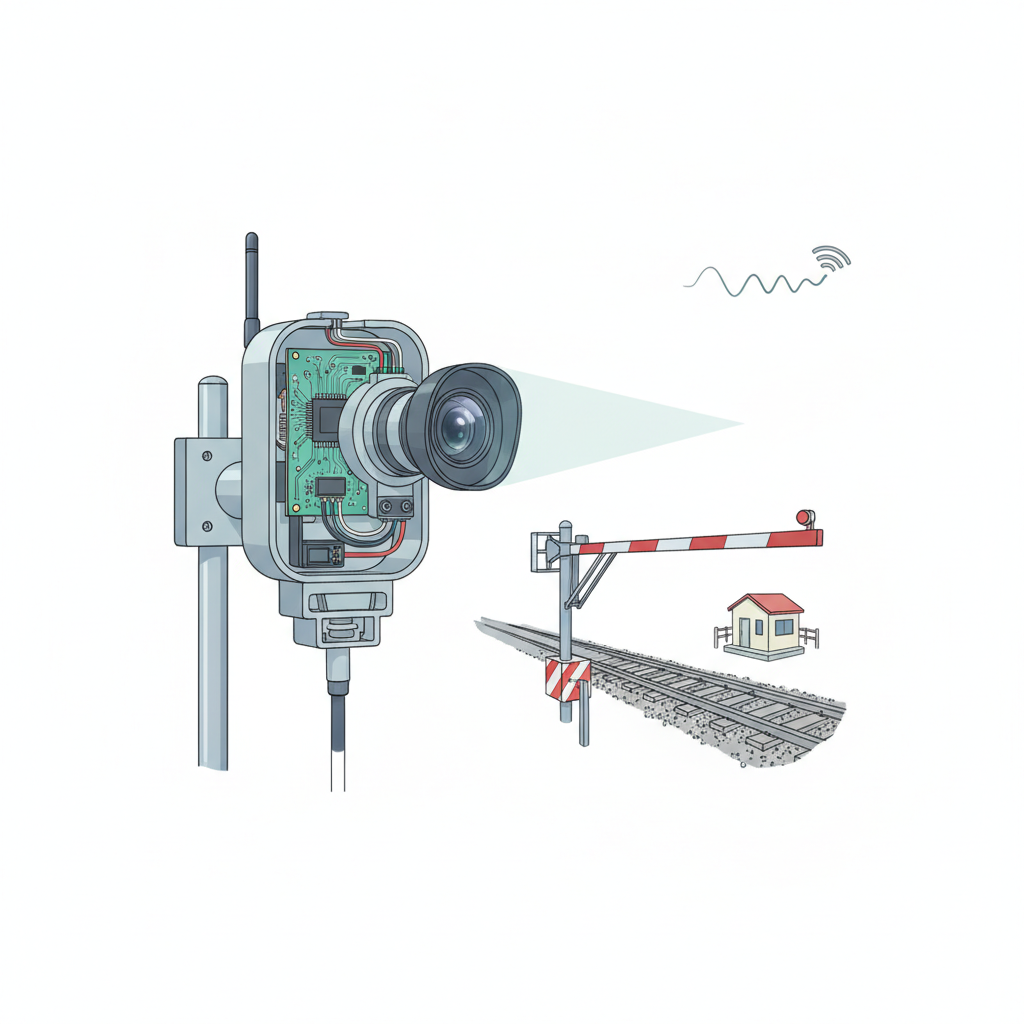
AI-powered cameraLevel crossing gateAlert system✎ AI-powered surveillance at non-interlocked level crossings uses real-time CCTV feeds and automated alerts to verify gate closure, addressing human error risks in manual monitoring systems.
Subject Relevance — Where This Topic Fits
- GS Paper III — Infrastructure: Energy, Ports, Roads, Railways, Airports and Urban Transport
- Prelims: Level crossing, non-interlocked crossing, interlocking system, gateman, Station Master, private number (PN), AI-enabled surveillance, CCTV monitoring, Railway Safety Norms, Railway Accidents (Prevention) Act, 1989, Railway Board directives
- Essay: The intersection of technology and public safety: Lessons from railway accident prevention
Quick Revision: AI-powered surveillance at non-interlocked level crossings uses real-time CCTV feeds and automated alerts to verify gate closure, addressing human error risks in manual monitoring systems.
Why is this in the news?
The Indian Railways is deploying AI-powered surveillance cameras at non-interlocked level crossings to mitigate the risk of accidents caused by gates remaining open. This initiative follows a fatal accident in Tamil Nadu’s Cuddalore district in July 2025, where a train collided with a school van at a manned level crossing, allegedly due to a gate being left open despite the gateman’s confirmation of closure. The AI-enabled system will provide real-time monitoring and automated alerts to railway officials, addressing a critical safety gap in the existing monitoring framework.
Background
- Level crossings in India are classified as interlocked or non-interlocked based on the presence of a mechanical or electrical interlocking system that synchronises gate operation with train movement.
- Non-interlocked level crossings rely on manual operation by gatemen, who are required to close and lock the gate and confirm closure to the Station Master via a private number (PN) exchange.
- The Cuddalore accident (July 2025) highlighted systemic vulnerabilities in manual confirmation processes, where human error or miscommunication led to a gate remaining open despite the gateman’s claim of closure.
- The Railway Board issued directives in 2025 for the installation of CCTV cameras at all non-interlocked level crossings to enhance oversight and accountability.
- The deployment of AI-powered cameras aligns with broader efforts to integrate digital technologies in railway safety, including the use of IoT and machine learning for predictive maintenance and real-time monitoring.
What are AI-powered surveillance systems for non-interlocked level crossings?
- AI-powered cameras are advanced CCTV systems equipped with computer vision algorithms to detect and analyse the status of level crossing gates in real time.
- The system provides live video feeds directly to the Station Master of the nearest railway station and the engineering control room, enabling direct visual verification of gate closure.
- AI algorithms are programmed to generate automated alerts if a gate remains open beyond a predefined threshold or fails to close within the required timeframe, reducing reliance on manual confirmation.
- The cameras are solar-powered, ensuring operational continuity in remote or power-deficient areas, and are designed to withstand harsh environmental conditions.
- Safeguards include accuracy thresholds to minimise false alerts, with human oversight retained for critical decision-making to avoid over-reliance on automation.
- The system complements existing safety protocols, such as the private number (PN) exchange, by providing an additional layer of verification and accountability.
- Implementation is prioritised at non-interlocked crossings due to their higher accident risk, where manual processes are more prone to human error or miscommunication.
- The initiative is part of a broader digital transformation in Indian Railways, aimed at enhancing safety, efficiency, and transparency in operations.
Key Features
| Feature | Significance |
|---|---|
| AI-powered surveillance cameras | Enables real-time monitoring of non-interlocked level crossing gates to verify physical closure, addressing the critical gap in manual confirmation by gatemen. |
| Solar-powered CCTV units | Ensures uninterrupted operation in remote or power-deficient locations, reducing dependency on grid electricity for safety infrastructure. |
| Live video feeds to Station Master and control room | Provides direct visual verification of gate status, enabling informed decision-making before train departure. |
| AI-based alerting system with accuracy thresholds | Automates detection of open gates or delayed closure, reducing human error and enabling timely intervention. |
| Private Number (PN) exchange system retention | Maintains the existing procedural safeguard while supplementing it with technological oversight to enhance reliability. |
Why it Matters
Railway Safety and Operational Efficiency
- Eliminates reliance on manual confirmation of gate closure, reducing the risk of human error in safety-critical operations.
- Enhances situational awareness for Station Masters and control room personnel through real-time visual data.
- Reduces the likelihood of accidents at non-interlocked level crossings, which are inherently more vulnerable due to the absence of automatic interlocking systems.
- Improves response time to safety breaches by enabling immediate alerts and corrective actions.
- Supports the broader objective of achieving zero-accident targets in railway operations.
Technological Integration in Governance
- Demonstrates the application of AI and IoT in critical public infrastructure to enhance safety and accountability.
- Sets a precedent for the use of predictive analytics in preventive safety measures across transport sectors.
- Highlights the importance of integrating technology with existing procedural frameworks to address systemic vulnerabilities.
- Encourages adoption of smart surveillance systems in other high-risk public infrastructure domains.
Institutional and Procedural Reforms
- Strengthens the role of engineering control rooms in monitoring and managing safety-critical infrastructure.
- Provides a model for decentralised yet centrally monitored safety systems in large-scale public utility networks.
- Supports the Railway Board’s directive to modernise safety protocols following high-impact accidents.
- Enhances transparency and accountability in safety-critical operations through automated record-keeping and verification.
Challenges
1. Technological Reliability and False Positives
- AI-based alerting systems may generate false positives, leading to unnecessary interventions or complacency if alerts are ignored.
- Accuracy thresholds must be calibrated to balance sensitivity and specificity, avoiding both over-alerting and under-detection.
- Dependence on technology introduces risks of system failures, cyber threats, or data corruption, necessitating robust cybersecurity measures.
UPSC Link: GS3: Science & Tech
2. Human Resource Adaptation and Training
- Gatemen and Station Masters may require training to interpret AI alerts and integrate them into existing workflows.
- Resistance to technological adoption among staff accustomed to traditional methods could hinder effective implementation.
- Ensuring consistent use of the new system across all non-interlocked level crossings, including remote locations.
UPSC Link: GS2: Governance
3. Infrastructure and Logistical Constraints
- Deployment of cameras and associated infrastructure may face challenges in geographically difficult or resource-constrained areas.
- Maintenance of solar-powered units in harsh weather conditions or remote locations could impact long-term reliability.
- Cost implications of scaling the system across thousands of non-interlocked level crossings nationwide.
UPSC Link: GS3: Infrastructure
4. Data Privacy and Ethical Considerations
- Real-time video feeds raise concerns about data privacy, particularly in areas near residential or sensitive locations.
- Unauthorised access or misuse of surveillance data could lead to legal or ethical violations, necessitating strict data governance frameworks.
- Balancing the need for safety with the rights of individuals in public spaces.
UPSC Link: GS2: Governance
5. Regulatory and Compliance Challenges
- Ensuring that the AI system complies with national and international standards for safety and reliability in railway operations.
- Addressing liability issues in case of system failure or accidents despite the deployment of AI-enabled safety measures.
- Coordinating between multiple stakeholders, including railway authorities, local governments, and technology providers.
UPSC Link: GS2: Governance
Challenges — UPSC Perspective
| Issue | Concern |
|---|---|
| False positives in AI alerts | Risk of alert fatigue or desensitisation among staff, reducing the system’s effectiveness. |
| Training gaps among railway staff | Potential for inconsistent adoption or misuse of the new system due to lack of familiarity. |
| Infrastructure deployment challenges | Delays or incomplete implementation in remote or resource-constrained locations. |
| Data privacy and security risks | Legal and ethical implications of real-time surveillance in public spaces. |
| Regulatory and compliance hurdles | Need for standardised protocols to ensure system reliability and accountability. |
| Maintenance and scalability | Long-term operational costs and technical support requirements for nationwide deployment. |
Way Forward
- Conduct pilot testing of the AI-enabled system in select non-interlocked level crossings to validate accuracy and usability before nationwide rollout.
- Develop comprehensive training modules for gatemen, Station Masters, and control room personnel to ensure seamless integration of the new system.
- Establish a dedicated cybersecurity framework to protect surveillance data and prevent unauthorised access or tampering.
- Formulate standard operating procedures (SOPs) for responding to AI-generated alerts, including escalation protocols and accountability measures.
- Integrate the AI system with existing railway safety databases to enable data-driven decision-making and trend analysis.
- Allocate dedicated budgetary provisions for maintenance, upgrades, and scalability of the surveillance infrastructure.
- Engage with local communities in areas near level crossings to address concerns about data privacy and surveillance ethics.
- Monitor and evaluate the system’s performance through periodic audits and feedback mechanisms to identify areas for improvement.
UPSC Value Addition
Keywords for Mains Answer-Writing
Artificial Intelligence in governance · Railway safety measures · Level crossing safety · Non-interlocked level crossings · AI-powered surveillance · Real-time monitoring systems · Railway accident prevention · Institutional accountability in railways · Technological interventions in public infrastructure · Safety governance and risk mitigation · Automation in railway operations · Constitutional and statutory provisions for public safety
Concept Flow
Accident at non-interlocked level crossing due to human error in gate closure verification → Railway Board directives mandating CCTV installation at all such crossings → Deployment of AI-powered surveillance cameras with real-time monitoring capabilities → AI-based alerting system to detect open gates or delayed closure → Live video feeds transmitted to Station Master and control room for visual verification → Automated alerts enabling timely intervention before train departure → Reduction in accidents and enhancement of railway safety through technological oversight
Prelims Practice Questions
Q1. Consider the following statements regarding level crossings in Indian Railways:
1. Non-interlocked level crossings rely solely on the gateman’s confirmation for closure.
2. Interlocked level crossings are equipped with mechanical or electrical systems that ensure the gate is closed before a train is allowed to pass.
3. The recent AI-powered camera initiative is applicable only to interlocked level crossings.
How many of the above statements are correct?
- Only one
- Only two
- All three
- None
Answer: Only two — Statement 1 is correct as non-interlocked crossings depend on the gateman’s confirmation. Statement 2 is correct as interlocked crossings use systems to ensure gate closure. Statement 3 is incorrect as the AI initiative targets non-interlocked crossings.
Q2. Assertion (A): The introduction of AI-powered cameras at level crossings aims to replace the role of gatemen in ensuring safety.
Reason (R): AI systems can provide real-time monitoring and alerts, reducing human error in gate closure verification.
- Both A and R are true, and R is the correct explanation of A.
- Both A and R are true, but R is not the correct explanation of A.
- A is true, but R is false.
- A is false, but R is true.
Answer: A is false, but R is true. — Assertion (A) is false because AI cameras supplement, rather than replace, the role of gatemen. Reason (R) is true as AI systems enhance monitoring and reduce human error.
Q3. Match the following terms related to railway safety with their correct descriptions:
Column I
1. Non-interlocked level crossing
2. Interlocked level crossing
3. AI-powered surveillance camera
4. Station Master
Column II
A. Uses mechanical or electrical systems to ensure gate closure before train passage
B. Relies on gateman’s confirmation for gate closure
C. Provides real-time video feeds and AI-based alerts for open gates
D. Responsible for authorising train departure and monitoring level crossings
- 1-B, 2-A, 3-C, 4-D
- 1-A, 2-B, 3-C, 4-D
- 1-B, 2-A, 3-D, 4-C
- 1-C, 2-B, 3-A, 4-D
Answer: 1-B, 2-A, 3-C, 4-D — 1-B: Non-interlocked crossings rely on gateman’s confirmation. 2-A: Interlocked crossings use systems to ensure gate closure. 3-C: AI cameras provide real-time monitoring and alerts. 4-D: Station Master authorises train departure and monitors crossings.
Mains Practice Question
✍ The deployment of AI-powered surveillance cameras at non-interlocked level crossings in Indian Railways represents a shift towards technological governance in public safety infrastructure. Critically examine the potential benefits and limitations of such interventions, with reference to the principles of accountability, efficiency, and technological dependency. (15 Marks)
Approach: MODEL-ANSWER SKELETON:
1. **Introduction (2 marks)**
– Define non-interlocked level crossings and the rationale for AI intervention.
– State the objective: reducing human error and enhancing real-time monitoring.
2. **Benefits (5 marks)**
– **Accountability**: AI systems provide verifiable, timestamped records of gate status, reducing reliance on human confirmation.
– **Efficiency**: Real-time alerts enable immediate intervention, potentially preventing accidents like the Cuddalore incident (July 2025).
– **Technological Safeguards**: AI can be calibrated to ignore false positives (e.g., stray animals) while flagging genuine risks.
– **Scalability**: Solar-powered cameras ensure sustainability in remote areas.
3. **Limitations and Risks (5 marks)**
– **Technological Dependency**: Over-reliance on AI may erode the role of gatemen without addressing systemic issues (e.g., training, fatigue).
– **False Positives/Negatives**: AI systems may fail in adverse weather or during power outages, leading to complacency.
– **Privacy Concerns**: Continuous surveillance raises questions about data security and citizen privacy.
– **Cost and Maintenance**: High initial investment and upkeep may strain railway budgets, particularly in low-traffic crossings.
4. **Balanced Conclusion (3 marks)**
– AI is a valuable tool but must be integrated with human oversight and periodic audits.
– Recommend a phased rollout with pilot studies to assess efficacy and address limitations.
– Emphasise the need for a regulatory framework to govern AI deployment in critical infrastructure.
Source: The Hindu
Generated by AanyaAi for educational purpose.


No Comments