


11 Aug AI-Generated Objectionable Images: Cyber Crime in Chhattisgarh
✎ Deepfake-generated non-consensual images of women constitute cybercrimes under Sections 67, 67A, and 67C of the Information Technology Act, 2000, and may also invoke provisions of the IPC and the Digital Personal Data Protection…
Subject Relevance — Where This Topic Fits
- GS Paper II — Governance, Constitution, Polity, Social Justice and International Relations (Cyber Governance, Digital Rights) | GS Paper III — Science and Technology (AI, Cyber Security), Security (Cyber Crimes)
- Prelims: Deepfake Technology, Information Technology Act, 2000 (Section 67C), Cyber Crimes, National Cyber Crime Reporting Portal, Digital Personal Data Protection Act, 2023, Women’s Rights and Cyber Harassment, AI and Ethical Concerns
- Essay: The Ethical Dilemma of Artificial Intelligence: Balancing Innovation and Human Rights, Digital Empowerment vs. Digital Vulnerability: The Two Faces of Technology
Quick Revision: Deepfake-generated non-consensual images of women constitute cybercrimes under Sections 67, 67A, and 67C of the Information Technology Act, 2000, and may also invoke provisions of the IPC and the Digital Personal Data Protection Act, 2023.
Why is this in the news?
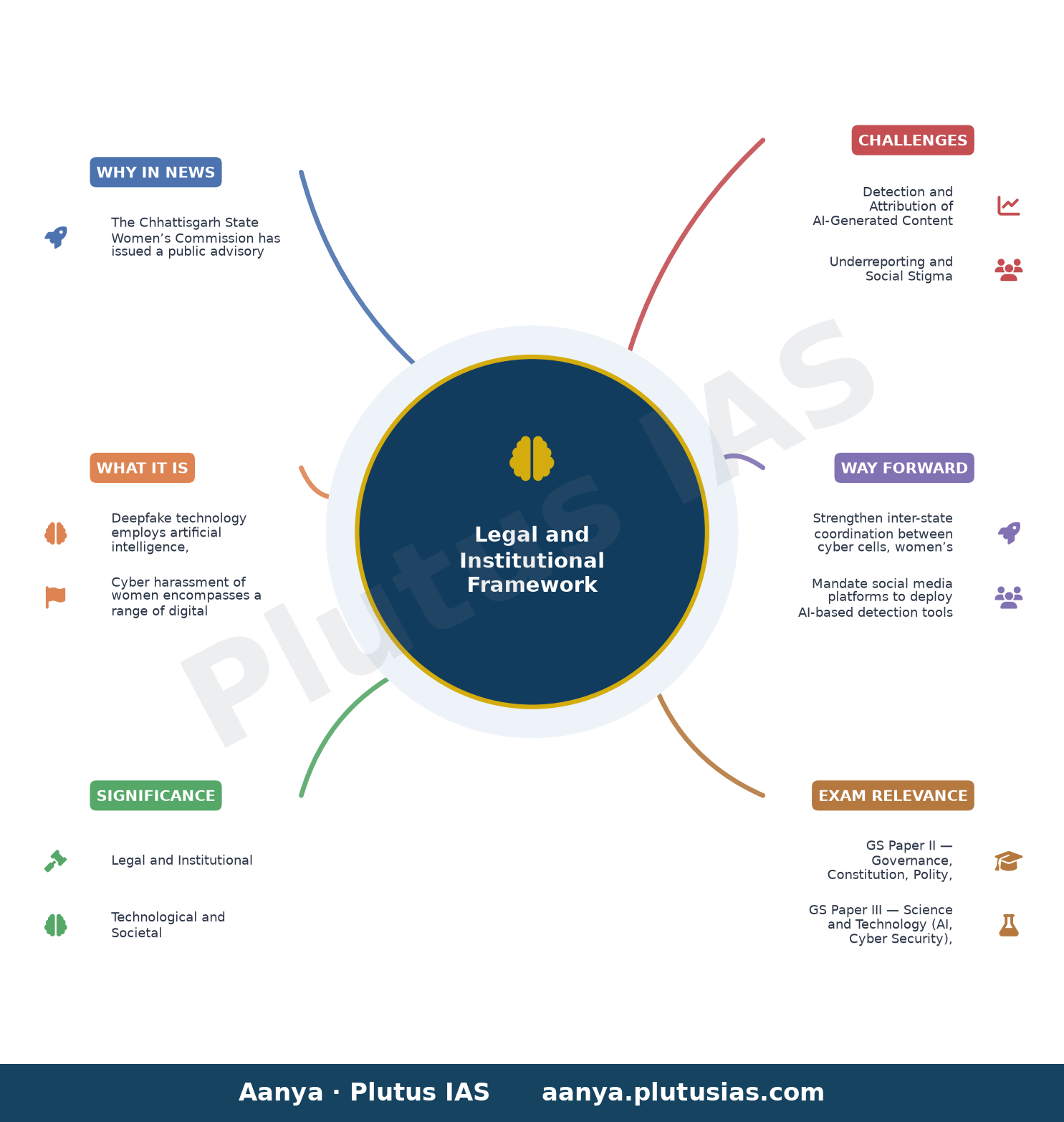
The Chhattisgarh State Women’s Commission has issued a public advisory cautioning against the dissemination of AI-generated objectionable images of women on social media, classifying such acts as cybercrimes under existing legal frameworks. This development underscores the growing intersection of artificial intelligence, digital rights, and gender-based cyber violence in India, necessitating a review of legal safeguards and institutional responses.
Background
- The proliferation of deepfake technology has intensified concerns over the misuse of artificial intelligence to create and disseminate non-consensual, sexually explicit, or defamatory content, particularly targeting women.
- Section 67C of the Information Technology (Amendment) Act, 2008, mandates the preservation and retention of electronic records, including digital content, to aid in cybercrime investigations.
- The National Cyber Crime Reporting Portal (NCRP), launched by the Ministry of Home Affairs, serves as a centralized platform for reporting cyber offenses, including those involving deepfakes.
- The Digital Personal Data Protection Act, 2023, introduces stringent obligations on data fiduciaries and processors to prevent unauthorized processing of personal data, including biometric and facial data used in deepfakes.
- The Supreme Court of India, in *Puttaswamy v. Union of India* (2017), recognized the right to privacy as a fundamental right, which extends to protection against unauthorized use of one’s image or likeness in digital spaces.
- State women’s commissions, as quasi-judicial bodies, play a pivotal role in addressing gender-based cyber violence through public awareness, grievance redressal, and advocacy for policy reforms.
What Constitutes Deepfake Technology and Cyber Harassment of Women?
- Deepfake technology employs artificial intelligence, particularly generative adversarial networks (GANs), to create hyper-realistic synthetic media, including images, videos, and audio, by superimposing or generating content that mimics real individuals.
- Cyber harassment of women encompasses a range of digital offenses, including cyberstalking, online defamation, non-consensual sharing of intimate images (revenge porn), morphing, and deepfake-based impersonation, all of which infringe upon privacy and dignity.
- Section 67 of the Information Technology Act, 2000, criminalizes the publication or transmission of obscene material in electronic form, which may apply to deepfake content if it is deemed obscene or defamatory.
- Section 67A of the same Act addresses the publication or transmission of material containing sexually explicit acts in electronic form, providing a legal recourse for victims of deepfake-based sexual exploitation.
- The Indian Penal Code, 1860, through Sections 354A (sexual harassment), 354C (voyeurism), 499 (defamation), and 500 (punishment for defamation), offers legal remedies for victims of cyber harassment, including those involving deepfakes.
- Institutional mechanisms such as the National Commission for Women (NCW) and state women’s commissions provide grievance redressal, advocacy, and awareness campaigns to combat gender-based cyber violence.
- The ethical implications of deepfake technology extend beyond legal frameworks, necessitating multi-stakeholder collaboration among policymakers, technology developers, civil society, and law enforcement to mitigate risks.
Key Features
| Feature | Significance |
|---|---|
| AI-generated objectionable imagery | Demonstrates the misuse of advanced technologies to create and disseminate deepfake content, escalating cybercrimes against women. |
| Chhattisgarh State Women’s Commission’s advisory | Highlights institutional vigilance and proactive measures to address emerging digital threats to women’s dignity and safety. |
| Legal categorisation as cybercrime | Reinforces the applicability of existing cyber laws (e.g., Section 67C of the IT Act, 2000) to AI-generated content, ensuring accountability. |
| Immediate FIR registration mechanism | Empowers victims to seek legal recourse without delay, aligning with Section 154(1) of the CrPC for prompt investigation. |
| Public awareness campaigns | Underscores the necessity of educating women and communities about digital rights and legal protections against online harassment. |
Why it Matters
Legal and Institutional
- Establishes precedent for treating AI-generated deepfakes as cybercrimes under existing legal frameworks, ensuring consistency in enforcement.
- Strengthens the role of state commissions in addressing technology-driven gender-based violence, complementing national bodies like the National Commission for Women (NCW).
- Validates the jurisdiction of state authorities in regulating digital platforms for content moderation, particularly concerning women’s safety.
Technological and Societal
- Exposes the vulnerabilities in digital ecosystems where AI tools can be weaponised to infringe upon privacy and dignity.
- Highlights the need for ethical AI governance and stricter platform accountability to prevent the proliferation of deepfake content.
- Reinforces the importance of digital literacy among women to recognise and report AI-generated harassment.
Policy and Governance
- Demonstrates the efficacy of institutional mechanisms like Jan Sunwai (public hearings) in addressing grievances related to digital crimes.
- Emphasises the necessity of inter-departmental coordination between law enforcement, cyber cells, and women’s commissions for holistic redressal.
Challenges
1. Detection and Attribution of AI-Generated Content
- Identifying AI-generated deepfakes requires advanced forensic tools, which are often inaccessible to law enforcement agencies.
- Perpetrators exploit jurisdictional gaps, operating across state or national borders to evade accountability.
- Rapid evolution of AI technologies outpaces legislative and technological safeguards, creating enforcement lag.
UPSC Link: GS3: Cyber Security, GS2: Fundamental Rights
2. Underreporting and Social Stigma
- Victims often hesitate to report due to fear of social ostracisation, lack of awareness, or distrust in institutional mechanisms.
- Cultural norms may discourage women from pursuing legal recourse, particularly in cases involving reputational damage.
- Stigma associated with digital harassment discourages bystander intervention or reporting by peers.
UPSC Link: GS1: Social Issues, GS2: Governance
3. Technological and Resource Constraints
- Law enforcement agencies face shortages of trained cybercrime investigators and digital forensic experts.
- Limited access to AI detection tools and platforms’ reluctance to share data hinder effective investigation.
- High costs of litigation deter victims from pursuing cases, particularly in lower-income groups.
UPSC Link: GS3: Science & Technology, GS2: Governance
4. Legal Ambiguities and Enforcement Gaps
- Ambiguity in defining ‘objectionable content’ under existing laws (e.g., IT Act, 2000) leads to inconsistent adjudication.
- Lack of specific provisions for AI-generated content in cyber laws creates loopholes for exploiters.
- Slow judicial processes delay justice, exacerbating trauma for victims.
UPSC Link: GS2: Constitution & Law
5. Platform Accountability and Ethical AI
- Social media platforms often lack robust mechanisms to detect and remove AI-generated deepfakes promptly.
- Voluntary compliance with ethical AI guidelines is insufficient; mandatory regulations are needed.
- Profit-driven algorithms prioritise engagement over safety, inadvertently amplifying harmful content.
UPSC Link: GS3: Technology & Ethics
Challenges — UPSC Perspective
| Issue | Concern |
|---|---|
| Cross-border jurisdiction | Perpetrators exploit jurisdictional gaps to evade legal action. |
| Lack of forensic tools | Limited access to AI detection technologies hampers investigation. |
| Social stigma | Victims hesitate to report due to fear of reputational damage. |
| Platform inaction | Social media platforms delay removal of deepfake content. |
| Legislative lag | Existing laws are inadequate to address AI-generated crimes. |
| Resource constraints | Law enforcement lacks trained personnel and infrastructure. |
Way Forward
- Strengthen inter-state coordination between cyber cells, women’s commissions, and law enforcement for rapid response to AI-generated crimes.
- Mandate social media platforms to deploy AI-based detection tools for real-time monitoring and removal of deepfake content.
- Launch nationwide awareness campaigns to educate women about digital rights, legal recourse, and reporting mechanisms.
- Enhance forensic capabilities of law enforcement through training programs and partnerships with tech institutions.
- Amend the IT Act, 2000, to include specific provisions for AI-generated content, ensuring clearer legal definitions and penalties.
- Establish dedicated cybercrime units in state women’s commissions to handle technology-driven gender-based violence cases.
- Promote ethical AI governance by enforcing mandatory compliance with guidelines for content creation and dissemination.
- Encourage collaboration between civil society organisations and tech companies to develop victim support systems.
UPSC Value Addition
Keywords for Mains Answer-Writing
Cybercrime against women · Artificial Intelligence and ethics · Information Technology Act, 2000 · Section 67C of IT Act · Deepfake technology · Digital privacy rights · Cyber security for women · National Commission for Women · Social media regulation · Legal remedies for online harassment · Right to Privacy under Article 21 · Cyber forensic investigation · Digital empowerment of women · AI-generated misinformation
Constitutional & Policy Linkages
- Article 19(1)(a) – Freedom of speech and expression (balanced against reasonable restrictions under Article 19(2)).
- Article 21 – Right to privacy and dignity (interpreted to include protection from digital harassment).
- Article 15(3) – Empowers the state to make special provisions for women’s welfare.
Concept Flow
Emergence of AI tools → Creation of deepfake content → Dissemination on social media → Violation of privacy and dignity → Categorisation as cybercrime → Institutional response (Women’s Commission advisory) → Legal recourse (FIR registration) → Policy reforms (IT Act amendments). → Technological advancement → Weaponisation of AI → Exploitation of legal gaps → Institutional awareness → Victim empowerment → Enforcement challenges → Need for ethical governance. → Digital platform proliferation → Lack of accountability → Proliferation of deepfakes → Social harm → Institutional intervention → Public awareness → Policy evolution. → AI-generated content → Cross-border dissemination → Jurisdictional ambiguity → Legal ambiguity → Need for coordinated governance → Technological solutions. → Victimisation → Underreporting → Stigma → Institutional distrust → Awareness campaigns → Legal literacy → Empowerment.
Prelims Practice Questions
Q1. Consider the following statements regarding the legal framework to address cybercrimes against women in India:
1. Section 67C of the Information Technology Act, 2000, specifically penalizes the publication of obscene or sexually explicit material in electronic form.
2. The National Commission for Women (NCW) has statutory powers to register First Information Reports (FIRs) directly with the police.
3. The Information Technology (Intermediary Guidelines and Digital Media Ethics Code) Rules, 2021, mandate social media platforms to remove unlawful content within 24 hours of a complaint.
How many of the above statements are correct?
- Only one
- Only two
- All three
- None
Answer: Only two — Statement 1 is correct as Section 67C of the IT Act penalizes publishing or transmitting obscene material in electronic form. Statement 2 is incorrect because the NCW does not have statutory powers to register FIRs directly; it can only recommend or facilitate. Statement 3 is correct as the 2021 Rules require intermediaries to remove unlawful content within 24 hours of a complaint.
Q2. Assertion (A): The creation and dissemination of AI-generated deepfake images of women constitutes a cybercrime under the Information Technology Act, 2000.
Reason (R): The IT Act, 2000, read with the Information Technology (Intermediary Guidelines and Digital Media Ethics Code) Rules, 2021, imposes liability on intermediaries for hosting such content.
Options:
A. Both A and R are true, and R is the correct explanation of A.
B. Both A and R are true, but R is not the correct explanation of A.
C. A is true, but R is false.
D. A is false, but R is true.
Answer: ? — Assertion (A) is true as the IT Act, through its provisions and rules, criminalizes the creation and dissemination of obscene or sexually explicit content, including AI-generated deepfakes. Reason (R) is also true and correctly explains the legal basis for liability on intermediaries.
Q3. Match the following cybercrime-related provisions with their corresponding legal instruments:
Column I
1. Penalty for publishing or transmitting obscene material in electronic form
2. Intermediary due diligence obligations
3. Right to be forgotten
4. Data protection for personal data
Column II
A. Section 67C of the Information Technology Act, 2000
B. Information Technology (Intermediary Guidelines and Digital Media Ethics Code) Rules, 2021
C. Personal Data Protection Act, 2023 (notified sections)
D. Supreme Court judgment in Puttaswamy v. Union of India (2017)
Options:
1. 1-A, 2-B, 3-D, 4-C
2. 1-B, 2-A, 3-C, 4-D
3. 1-C, 2-D, 3-A, 4-B
4. 1-D, 2-C, 3-B, 4-A
- 1
- 2
- 3
- 4
Answer: 1 — 1-A is correct as Section 67C of the IT Act penalizes obscene material. 2-B is correct as the 2021 Rules impose due diligence obligations on intermediaries. 3-D is correct as the right to be forgotten emanates from the Puttaswamy judgment. 4-C is correct as the PDP Act governs data protection.
Mains Practice Question
✍ The proliferation of AI-generated deepfake content targeting women has emerged as a significant cybercrime challenge in contemporary India. Critically examine the adequacy of the existing legal and institutional framework to address this menace. Also, suggest measures to strengthen the cybersecurity ecosystem for women. (15 Marks)
Approach: MODEL-ANSWER SKELETON:
1. Introduction (2 marks): Briefly define AI-generated deepfakes, their misuse against women, and the legal vacuum they exploit.
2. Legal Framework Analysis (5 marks):
– Information Technology Act, 2000: Sections 66C (identity theft), 66E (violation of privacy), 67C (obscene material), and 69A (blocking content).
– Information Technology (Intermediary Guidelines and Digital Media Ethics Code) Rules, 2021: Due diligence obligations and grievance redressal mechanisms.
– Personal Data Protection Act, 2023 (notified sections): Data principal rights and obligations of data fiduciaries.
– Indian Penal Code, 1860: Sections 354C (voyeurism), 354D (stalking), 509 (word/gesture insulting modesty).
– Limitations: Lack of specific provisions on deepfakes, jurisdictional challenges, and low conviction rates.
3. Institutional Framework (3 marks):
– Role of National Commission for Women (NCW): Advisory and facilitative powers, limitations in enforcement.
– Cybercrime cells and forensic labs: Capacity constraints and delays in investigation.
– Social media intermediaries: Compliance with takedown requests and accountability mechanisms.
4. Contemporary Challenges (3 marks):
– Technological sophistication of deepfakes outpacing legal updates.
– Cross-border nature of cybercrimes complicating jurisdiction.
– Underreporting due to stigma, lack of awareness, and fear of retaliation.
5. Suggested Measures (2 marks):
– Amend IT Act to include specific provisions on deepfakes and AI-generated misinformation.
– Strengthen cyber forensic infrastructure with AI-driven detection tools.
– Mandate digital literacy programs for women and girls.
– Enhance inter-ministerial coordination (MeitY, NCW, State Women Commissions).
– Promote ethical AI development through industry self-regulation and government oversight.
Source: amarujala.com
Generated by AanyaAi for educational purpose.


No Comments