



04 Aug AI Skills Now Top Priority for UPSC & State PCS Hiring in GCCs
✎ The evolution of Global Capability Centres in India—from cost centres to AI-driven innovation hubs—has redefined hiring priorities, placing a premium on technical fluency in AI, product engineering, and applied research, while…
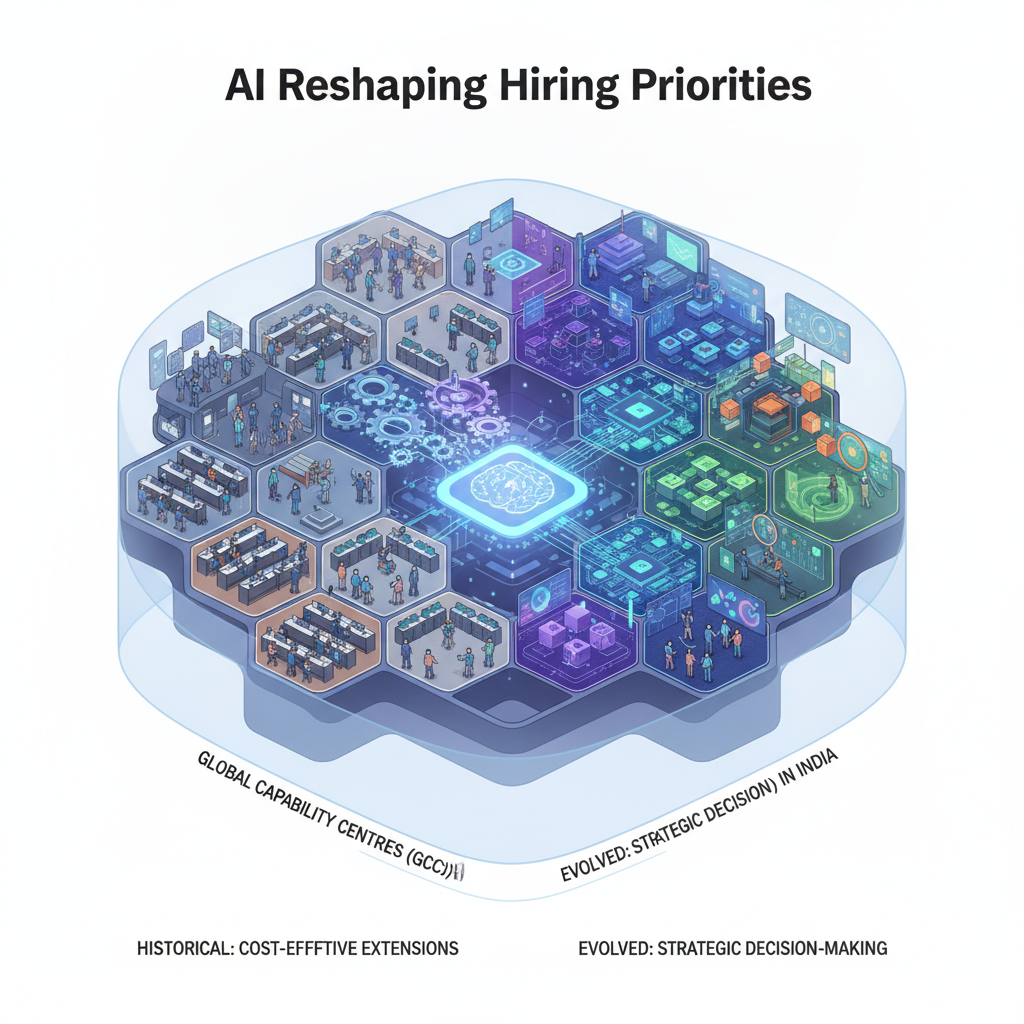 AI integrationProduct engineeringApplied researchStrategic decision-makingInnovation-centric rolesTechnical fluency
Subject Relevance — Where This Topic Fits
- GS Paper III — Indian Economy and issues relating to Planning, Mobilisation of Resources, Growth, Development and Employment | GS Paper III — Effects of Liberalisation on the Economy, Changes in Industrial Policy and their Effects on Industrial Growth | GS Paper III — Science and Technology — Developments and their Applications and Effects in Everyday Life | GS Paper III — Awareness in the fields of IT, Space, Computers, Robotics, Nano-technology, Bio-technology
- Prelims: Global Capability Centres (GCCs), Artificial Intelligence (AI), Machine Learning (ML), Product Engineering, Applied Research, NASSCOM, Zinnov, Operational Efficiency vs Innovation, Talent Pipeline Constraints, Reskilling and Upskilling
- Essay: The transformative role of technology in redefining traditional business models: A case study of Global Capability Centres in India, Human capital as the new frontier of competitive advantage: Lessons from the AI-driven evolution of GCCs
Quick Revision: The evolution of Global Capability Centres in India—from cost centres to AI-driven innovation hubs—has redefined hiring priorities, placing a premium on technical fluency in AI, product engineering, and applied research, while shifting the focus from process-driven roles to outcome-based contributions.
Why is this in the news?
The article highlights a paradigm shift in the operational and strategic role of Global Capability Centres (GCCs) in India, driven by the integration of Artificial Intelligence (AI) and machine learning. This transformation has necessitated a corresponding evolution in hiring priorities, moving from process-driven roles to innovation-centric positions that require technical fluency in AI, product engineering, and applied research. The shift underscores the growing importance of GCCs as centres of strategic decision-making rather than mere cost-saving extensions of parent enterprises.
Background
- Global Capability Centres (GCCs) in India were historically established as cost-effective extensions of multinational corporations to handle routine back-office operations and process-driven tasks.
- Over the past decade, GCCs have evolved into strategic hubs responsible for product engineering, applied research, and business decision-making, aligning with the broader trend of ‘reverse innovation’ where innovation originates from subsidiaries rather than headquarters.
- The integration of AI and machine learning has accelerated this transformation, with GCCs now expected to drive innovation, automate processes, and contribute to core business strategies.
- According to the Zinnov-Nasscom GCC Landscape Report 2026, India’s GCC workforce has grown to 2.36 million professionals, positioning the country as a global leader in AI hiring and talent acquisition.
- The shift from operational efficiency to innovation-driven capabilities has redefined the skill sets required in the workforce, placing a premium on technical expertise, problem-solving, and the ability to leverage AI tools for business solutions.
- The hiring landscape has transitioned from resume-based screening to outcome-driven assessments, including coding tests, case studies, and simulation exercises, to identify candidates capable of delivering tangible results.
What are Global Capability Centres (GCCs) and their evolving role in the AI-driven economy?
- Global Capability Centres (GCCs) are offshore or nearshore centres established by multinational corporations to perform high-value functions such as product engineering, research and development, IT services, and business process management.
- Initially, GCCs were primarily cost centres focused on operational efficiency, handling tasks like customer support, data entry, and routine IT operations for parent enterprises.
- Over time, GCCs have transitioned into innovation hubs, with responsibilities expanding to include product development, applied research, and strategic decision-making that were traditionally confined to headquarters.
- The integration of AI and machine learning has further elevated the role of GCCs, enabling them to automate processes, derive insights from data, and contribute to core business strategies such as product innovation and market expansion.
- India has emerged as a global leader in hosting GCCs, with a workforce of 2.36 million professionals, owing to its large talent pool, cost advantages, and strong ecosystem in IT and engineering.
- The shift towards AI-driven GCCs has necessitated a corresponding evolution in hiring practices, with a focus on recruiting professionals skilled in AI, machine learning, product engineering, and data science.
- GCCs are now expected to demonstrate measurable contributions to innovation, such as launching new products, improving operational efficiencies, or solving complex business problems, rather than merely executing predefined processes.
- The transformation of GCCs aligns with broader trends in global business, where multinational corporations are leveraging distributed innovation models to drive competitiveness and agility.
UPSC Value Addition
Keywords for Mains Answer-Writing
Global Capability Centres (GCCs) · Artificial Intelligence (AI) in hiring · Product engineering and applied research in GCCs · AI-driven recruitment processes · Technical fluency in AI/ML · Zinnov-Nasscom GCC Landscape Report 2026 · Operational efficiency to innovation hubs · AI hiring at scale in India · Automation of manual processes · Technical graduate pipeline and AI skills
Prelims Practice Questions
Q1. Consider the following statements about Global Capability Centres (GCCs) in India:
1. GCCs were historically established as cost centres focused on operational efficiency.
2. Modern GCCs in India are increasingly involved in product engineering and applied research.
3. The Zinnov-Nasscom GCC Landscape Report 2026 estimates India’s GCC workforce at 2.36 million professionals.
4. GCCs primarily hire candidates with traditional process-driven roles rather than AI specialists.
How many of the above statements are correct?
- Only one
- Only two
- Only three
- All
Answer: Only three — Statements 1, 2, and 3 are correct. Statement 4 is incorrect as GCCs now prioritise hiring AI specialists over traditional process-driven roles.
Q2. Assertion (A): The primary hiring criterion for GCCs in India has shifted from operational efficiency to AI and machine learning fluency.
Reason (R): The Zinnov-Nasscom GCC Landscape Report 2026 highlights that 80% of GCCs opened in 2026 list AI and machine learning as their central purpose.
Options:
A) Both A and R are true, and R is the correct explanation of A.
B) Both A and R are true, but R is not the correct explanation of A.
C) A is true, but R is false.
D) A is false, but R is true.
- A
- B
- C
- D
Answer: A — Both A and R are true, and R correctly explains A as the report underscores the centrality of AI in GCC operations, driving hiring priorities.
Q3. Match the following terms related to GCCs with their correct descriptions:
Column I
1. Global Capability Centres (GCCs)
2. AI-driven recruitment
3. Product engineering in GCCs
4. Zinnov-Nasscom GCC Landscape Report
Column II
A. A report estimating India’s GCC workforce at 2.36 million professionals.
B. Centres that have evolved from cost centres to innovation hubs.
C. Hiring processes that utilise coding tests and simulation exercises to filter candidates.
D. The practice of developing products and conducting applied research within GCCs.
Options:
1-B, 2-C, 3-D, 4-A
1-A, 2-C, 3-D, 4-B
1-B, 2-D, 3-C, 4-A
1-D, 2-C, 3-B, 4-A
- 1-B, 2-C, 3-D, 4-A
- 1-A, 2-C, 3-D, 4-B
- 1-B, 2-D, 3-C, 4-A
- 1-D, 2-C, 3-B, 4-A
Answer: 1-B, 2-C, 3-D, 4-A — The correct matches are: 1-B (GCCs as innovation hubs), 2-C (AI-driven recruitment), 3-D (product engineering), and 4-A (Zinnov-Nasscom report).
Mains Practice Question
✍ Critically examine the transformation of Global Capability Centres (GCCs) in India from cost centres to innovation hubs, with a focus on the role of Artificial Intelligence (AI). Also, analyse how this shift has redefined recruitment priorities and the skills required for professionals in these centres. (15 Marks)
Approach: MODEL-ANSWER SKELETON:
1. **Introduction**: Define GCCs and their historical role as cost centres focused on operational efficiency.
2. **Evolution of GCCs**: Explain the shift towards product engineering, applied research, and business decision-making within GCCs, citing the Zinnov-Nasscom GCC Landscape Report 2026.
3. **AI as a Catalyst**: Discuss how AI and machine learning have become central to GCC operations, with 80% of new GCCs in 2026 listing AI as their primary purpose.
4. **Recruitment Priorities**: Analyse the transition from process-driven hiring to a focus on builders, decision-makers, and AI specialists. Highlight the use of coding tests, case studies, and simulation exercises in recruitment.
5. **Skills in Demand**: Explain the new standard of hiring, where candidates must combine core technical grounding with AI/ML fluency, including applied projects and certifications.
6. **Challenges**: Discuss the constraints in the technical graduate pipeline and the narrowing focus on professionals with AI skills.
7. **Conclusion**: Summarise the broader implications for India’s role in global innovation and the future of GCCs.
Source: The Hindu
Generated by AanyaAi for educational purpose.


No Comments