


31 Jul AI Training Threatens Rare Books: UPSC Perspective on Cultural Loss vs Tech Progress
✎ The digitisation of rare books for AI training poses a critical ethical dilemma: while it accelerates technological progress, it risks irreversible cultural loss and legal ambiguities over intellectual property rights.
Subject Relevance — Where This Topic Fits
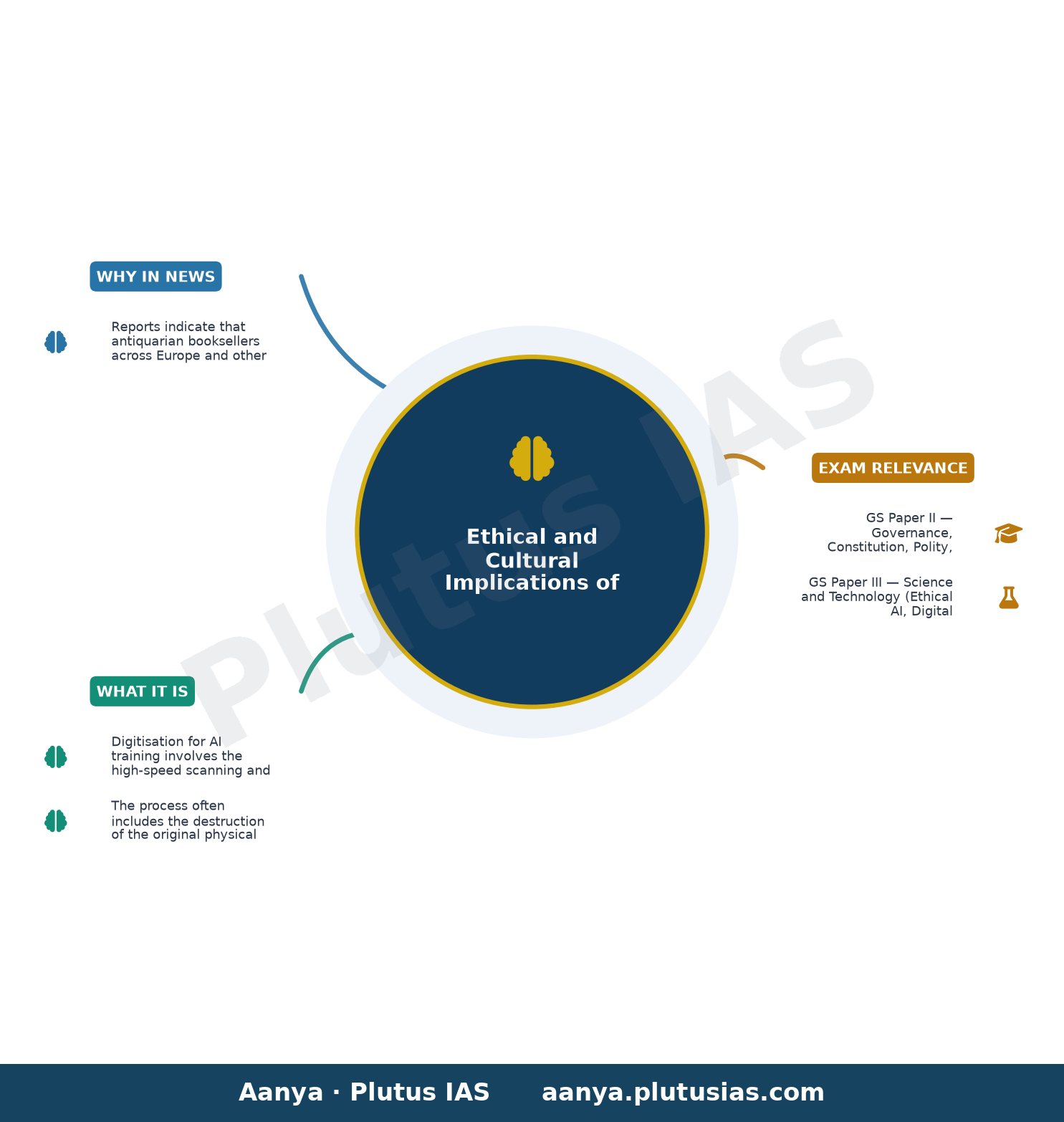
- GS Paper II — Governance, Constitution, Polity, Social Justice and International Relations (Ethical dimensions of AI) | GS Paper III — Science and Technology (Ethical AI, Digital Preservation, and Intellectual Property Rights)
- Prelims: Generative AI, Intellectual Property Rights (IPR), Digital Preservation, Copyright Act, 1957, UNESCO Convention for the Safeguarding of the Intangible Cultural Heritage, Data Ethics, Fair Use Doctrine, Antiquarian Booksellers, Digitisation of Cultural Heritage, AI Training Data, Moral Hazard in Technology
- Essay: Technology as a double-edged sword: Progress versus preservation of human heritage, The ethical vacuum in the age of artificial intelligence: Where do cultural artefacts fit in?
Quick Revision: The digitisation of rare books for AI training poses a critical ethical dilemma: while it accelerates technological progress, it risks irreversible cultural loss and legal ambiguities over intellectual property rights.
Why is this in the news?
Reports indicate that antiquarian booksellers across Europe and other regions are receiving bulk purchase requests from AI companies aiming to dismantle and digitise rare books for training generative AI models. The practice, while legally permissible in certain jurisdictions, raises profound ethical, cultural, and legal questions regarding the commodification of human knowledge, the destruction of physical cultural artefacts, and the long-term implications for intellectual property rights and digital preservation.
Background
- The digitisation of books for AI training is part of a broader trend where generative AI models require vast datasets to improve their performance, often sourced from publicly available texts, including books.
- Rare and antiquarian books, which are physical artefacts of cultural and historical significance, are being targeted due to their unique content and the scarcity of digitised versions.
- The practice contrasts with traditional approaches to cultural preservation, where physical books are conserved as artefacts of tangible heritage, often housed in libraries, museums, or private collections.
- Legal frameworks governing the use of copyrighted material for AI training vary across jurisdictions, with some countries permitting the use of published works under ‘fair use’ or ‘text and data mining’ exemptions, while others impose stricter controls.
- The ethical debate centres on whether the destruction of physical books for AI training constitutes a form of cultural erasure, particularly when the original artefacts are irreplaceable.
- UNESCO and other international bodies have emphasised the importance of preserving intangible cultural heritage, including literary works, as part of humanity’s shared identity.
What is the digitisation of books for AI training?
- Digitisation for AI training involves the high-speed scanning and extraction of text from physical books to create machine-readable datasets, which are then used to train large language models (LLMs) and other generative AI systems.
- The process often includes the destruction of the original physical books after digitisation, rendering them unusable as cultural artefacts and reducing them to mere ‘raw material’ for technological advancement.
- AI companies justify this practice by citing the need for diverse and high-quality training data to improve the accuracy and creativity of AI models, particularly in domains like literature, history, and philosophy.
- The ethical concerns arise from the irreversible loss of physical books, which may be irreplaceable due to their age, rarity, or historical significance, and the potential violation of authors’ moral rights over their works.
- Legal ambiguity persists, as copyright laws in many jurisdictions do not explicitly address the use of published works for AI training, leading to debates over fair use, transformative works, and the commercial exploitation of cultural heritage.
- The practice also raises questions about the ownership of digitised content, particularly when the original works are in the public domain but their digitised versions are controlled by private entities.
- Cultural institutions, including libraries and museums, have traditionally played a key role in preserving books as both intellectual and physical entities, but the rise of AI-driven digitisation threatens to bypass these safeguards.
- The broader implications include the potential homogenisation of cultural knowledge, as AI models trained on digitised texts may prioritise commercially viable or widely available works over niche or marginalised literary traditions.
UPSC Value Addition
Keywords for Mains Answer-Writing
Generative AI and Intellectual Property Rights · Digitisation of Cultural Heritage · Ethics of AI Training Data · Copyright Law and AI · Cultural Preservation vs Technological Advancement · Rare Books and AI Training · AI Governance and Legal Frameworks · Digital Humanities and AI · Intellectual Property Rights in the Digital Age · Balancing Innovation and Cultural Heritage
Prelims Practice Questions
Q1. Consider the following statements regarding the digitisation of books for AI training:
1. The process of digitising books for AI training involves scanning every page at high speed and extracting textual data.
2. Once digitised, the physical books are preserved as cultural artefacts for future generations.
3. The legality of such practices is universally accepted and does not raise moral concerns.
How many of the above statements are correct?
- Only one
- Only two
- All
- None
Answer: Only one — Statement 1 is correct as the article describes the process of scanning books at high speed to extract textual data. Statement 2 is incorrect because the article states that once digitised, the original books are often destroyed and not preserved. Statement 3 is incorrect as the article highlights that legality does not resolve the moral concerns surrounding the destruction of books for AI training.
Q2. Assertion (A): Generative AI models require vast quantities of human-written content to train effectively.
Reason (R): The digitisation of rare books for AI training is a legally and ethically uncontested practice.
In the context of the above statements, which of the following is correct?
- Both A and R are true, and R is the correct explanation of A
- Both A and R are true, but R is not the correct explanation of A
- A is true, but R is false
- A is false, but R is true
Answer: A is true, but R is false — Assertion (A) is true as the article explicitly states that AI companies seek vast quantities of human-written content for training. Reason (R) is false because the article underscores that the practice raises significant moral and ethical concerns, despite being legal in some jurisdictions.
Q3. Match the following terms with their correct descriptions:
Column I
1. Generative AI
2. Digitisation
3. Intellectual Property Rights
4. Cultural Heritage
Column II
A. The process of converting physical books into digital format for preservation or analysis.
B. Legal protections granted to the creators of original works, including books and art.
C. AI systems capable of generating new content, such as text, images, or music, based on training data.
D. The legacy of physical artifacts and intangible attributes of a group or society passed down from generation to generation.
- 1-C, 2-A, 3-B, 4-D; 1-B, 2-A, 3-C, 4-D; 1-A, 2-C, 3-B, 4-D; 1-D, 2-A, 3-C, 4-B
- answer_string_list_indexes_to_match_pairs_correctly
- explain_match_pairs_correctly
- format
- match
Answer: 1-C, 2-A, 3-B, 4-D; 1-B, 2-A, 3-C, 4-D; 1-A, 2-C, 3-B, 4-D; 1-D, 2-A, 3-C, 4-B —
Mains Practice Question
✍ The digitisation of rare books for training generative AI models represents a paradigm shift in the utilisation of cultural heritage. Critically examine the ethical, legal, and cultural implications of this practice, with particular reference to the balance between technological advancement and the preservation of intangible human heritage. (15 Marks)
Approach: MODEL-ANSWER SKELETON:
1. **Ethical Implications (4 Marks)**
– Discuss the moral concerns of destroying physical books, which are repositories of cultural memory, emotions, and historical narratives.
– Reference the ethical principle of ‘cultural stewardship’ and the responsibility to preserve heritage for future generations.
– Highlight the tension between utilitarian approaches (AI advancement) and deontological ethics (duty to preserve cultural artefacts).
2. **Legal Frameworks (4 Marks)**
– Examine the applicability of existing intellectual property laws (e.g., Copyright Act, 1957) to AI training data extraction.
– Discuss the ambiguity in ‘fair use’ or ‘fair dealing’ provisions when applied to generative AI training.
– Reference international frameworks such as the Berne Convention and WIPO’s stance on AI and copyright.
3. **Cultural and Societal Impact (4 Marks)**
– Analyse the loss of ‘tangible cultural heritage’ and the intangible value of books as companions in human experience.
– Discuss the role of books in preserving linguistic diversity and indigenous knowledge systems.
– Evaluate the long-term consequences of reducing books to ‘industrial feedstock’ for AI.
4. **Balancing Innovation and Preservation (3 Marks)**
– Propose ethical guidelines for AI training, such as opt-in consent for digitisation or mandatory preservation of a physical copy.
– Highlight the role of digital humanities in preserving cultural heritage without destroying physical artefacts.
– Conclude with a balanced view: technological progress must not come at the cost of eroding human cultural capital.
Source: Times of India
Generated by AanyaAi for educational purpose.

- यूएनजीए 2026: युद्ध, एआई और सुधार – दुनिया के नेता क्या करेंगे? (UPSC दृष्टिकोण) - September 22, 2026
- 40 दिन बाद भी संसद सत्र अनिर्णीत, महिला आरक्षण विधेयक पर सरकार की तैयारी - September 22, 2026
- Why Parliament Session Still Unprorogued After 40 Days? Women’s Quota Law Buzz Explained - September 22, 2026

No Comments