


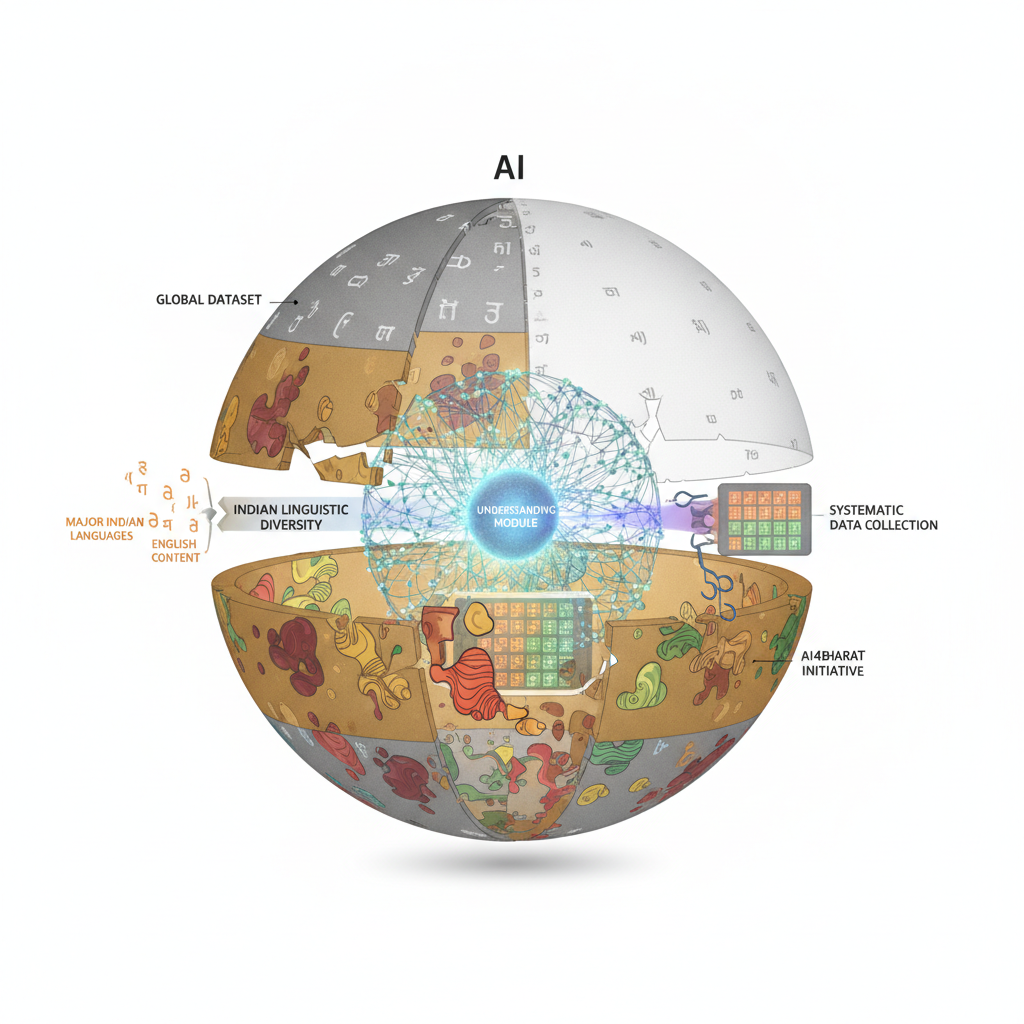
08 Aug AI4Bharat at IIT Madras: Teaching AI to Understand India’s Languages
AI modelsNLP toolsLinguistic dataRegional languages✎ AI systems trained on low-resource Indian languages face systemic data scarcity, necessitating grassroots data collection and interdisciplinary collaboration to ensure inclusive technological development.
Subject Relevance — Where This Topic Fits
- GS Paper II — Governance, Constitution, Polity, Social Justice and International Relations (Digital Governance and Inclusion) | GS Paper III — Science and Technology (Emerging Technologies, AI, Data Governance)
- Prelims: Digital public infrastructure, Natural Language Processing (NLP), Low-resource languages, AI4Bharat initiative, UNESCO Atlas of the World’s Languages in Danger, Bhashini initiative, Neural Machine Translation (NMT), Data sovereignty
- Essay: The role of technology in preserving cultural heritage: Balancing innovation with inclusivity, Linguistic diversity as a cornerstone of national identity and its implications for governance
Quick Revision: AI systems trained on low-resource Indian languages face systemic data scarcity, necessitating grassroots data collection and interdisciplinary collaboration to ensure inclusive technological development.
Why is this in the news?
The article highlights the critical challenge of integrating India’s vast linguistic diversity into artificial intelligence systems, as demonstrated by the AI4Bharat initiative at IIT Madras. It underscores the inadequacy of existing AI models in understanding low-resource Indian languages and dialects, which lack sufficient digital data for training, thereby perpetuating digital divides and limiting technological accessibility for millions of Indians. The piece also signals the urgency of systematic data collection and preservation efforts to bridge this gap.
Background
- The digital divide in India is exacerbated by the predominance of English and a few major Indian languages in online content, leaving most regional languages underrepresented in digital ecosystems.
- AI4Bharat, an open-source research lab at IIT Madras, focuses on developing NLP tools for low-resource Indian languages, including speech recognition, machine translation, and conversational AI.
- The absence of standardized written forms for many spoken dialects and the prevalence of code-mixing (e.g., Hinglish) further complicate AI training for Indian languages.
What is the challenge of teaching AI to understand India’s linguistic diversity?
- AI models, particularly those based on deep learning, require vast amounts of annotated data to train effectively. Most Indian languages lack sufficient digital corpora (text, speech, or video) to serve as training data, classifying them as ‘low-resource languages.’
- The linguistic landscape of India is characterized by micro-level variations, including dialects, accents, and regional slang, which are not captured in standard datasets. For example, Bundeli spoken in Madhya Pradesh differs significantly from Hindi spoken in Uttar Pradesh.
- Many Indian languages are primarily oral traditions, with words and expressions that have no standardized written form, making it difficult to create structured datasets for AI training.
- Code-mixing and code-switching (e.g., switching between Hindi and English in a single sentence) are common in Indian speech, posing additional challenges for AI systems trained on monolingual or bilingual datasets.
- The lack of linguistic diversity in AI training data leads to biased or inaccurate outputs, particularly for speakers of marginalized languages or dialects, thereby exacerbating digital exclusion.
- Efforts like AI4Bharat’s ‘voice hunt’ involve fieldwork across India to collect speech samples, transcribe dialects, and document endangered languages, creating a foundational dataset for AI training.
- Preserving linguistic diversity is not merely a technological challenge but also a cultural and social imperative, as languages encode identity, heritage, and knowledge systems unique to communities.
Key Features
| Feature | Significance |
|---|---|
| Multilingual Data Collection | AI4Bharat’s fieldwork captures spoken dialects and accents from diverse linguistic communities, enabling AI models to learn beyond written corpora. |
| Low-Resource Language Focus | Prioritises languages with minimal digital presence (e.g., Tulu, Bundeli, Santali) to bridge the data divide and democratise AI access. |
| Contextual Understanding | Trains AI to interpret mixed-language queries (e.g., Hindi-English code-switching) and informal speech patterns common in Indian conversations. |
| Preservation of Oral Traditions | Documents unwritten dialects and colloquialisms, safeguarding intangible cultural heritage while enhancing AI adaptability. |
| Real-Time Adaptation | Uses iterative feedback loops from native speakers to refine AI responses for regional and sub-regional linguistic variations. |
Why it Matters
Technological Sovereignty
- Reduces dependence on foreign AI models trained predominantly on English and high-resource languages, fostering indigenous innovation in NLP (Natural Language Processing).
- Enables India to develop AI systems tailored to its linguistic and cultural context, aligning with the vision of ‘Atmanirbhar Bharat’ in the digital domain.
Digital Inclusion
- Expands AI accessibility to non-English speakers, particularly in rural and tribal areas, by bridging the digital divide through language-agnostic interfaces.
- Supports e-governance, education, and healthcare delivery in local languages, enhancing public service reach and citizen engagement.
Economic Impact
- Creates high-skilled employment opportunities in AI research, linguistics, and data annotation, contributing to India’s tech-driven growth.
- Stimulates the development of language-specific AI applications (e.g., translation tools, voice assistants), unlocking new markets and sectors.
Cultural Preservation
- Documents endangered dialects and oral traditions, providing a repository for future linguistic and anthropological research.
- Promotes cultural pride by validating the linguistic diversity of India’s 1.4 billion people in the digital space.
Policy and Governance
- Aligns with the National Education Policy 2020’s emphasis on multilingualism and mother-tongue education through AI-enabled tools.
- Supports the Digital India initiative by ensuring that AI-driven services are inclusive and linguistically representative.
Challenges
1. Data Scarcity for Low-Resource Languages
- Limited digital corpora for languages like Santali, Kodava, or Tulu restricts AI training datasets, leading to poor model performance.
- Oral traditions lack standardised orthography, complicating data annotation and model training.
UPSC Link: GS3: Science & Tech – AI Challenges
2. Dialectal and Accentual Diversity
- Regional variations within a single language (e.g., Hindi vs. Bhojpuri vs. Awadhi) require granular data collection to avoid misinterpretation.
- Code-switching between languages (e.g., Hindi-English) poses challenges for context-aware AI responses.
UPSC Link: GS1: Society – Linguistic Diversity
3. Ethical and Privacy Concerns
- Collecting voice data from marginalised communities raises issues of consent, data ownership, and potential misuse.
- Bias in AI models trained on skewed datasets may perpetuate stereotypes or exclude certain linguistic groups.
UPSC Link: GS4: Ethics – Data Privacy
4. Infrastructure and Resource Constraints
- Fieldwork for data collection requires significant logistical and financial resources, especially for remote or tribal areas.
- Computational power and expertise for training multilingual AI models are concentrated in elite institutions, limiting scalability.
UPSC Link: GS3: Infrastructure – Digital
5. Standardisation vs. Preservation Dilemma
- Balancing the need for standardised language models with the preservation of dialectal variations is a complex technical and cultural challenge.
- Over-standardisation may erode linguistic uniqueness, while under-standardisation may hinder AI usability.
UPSC Link: GS1: Society – Language Policy
Challenges — UPSC Perspective
| Issue | Concern |
|---|---|
| Data Paucity | Insufficient digital text/audio for training AI in low-resource languages. |
| Dialectal Fragmentation | Regional variations within languages complicate model generalisation. |
| Ethical Risks | Potential misuse of voice data from vulnerable communities. |
| Computational Costs | High resource requirements for training multilingual AI models. |
| Cultural Homogenisation | Risk of AI models favouring dominant dialects over minority languages. |
| Policy Gaps | Lack of clear guidelines on data collection, storage, and usage for linguistic AI. |
Way Forward
- Establish a national linguistic data repository under aegis of MeitY or UGC to centralise and standardise data collection efforts.
- Incentivise private-sector collaboration with academic institutions (e.g., IITs, C-DAC) for scalable AI training infrastructure.
- Develop open-source toolkits for local developers to adapt AI models to regional dialects, fostering grassroots innovation.
- Integrate linguistic diversity into school curricula via AI-enabled language labs, aligning with NEP 2020’s multilingual goals.
- Formulate a national policy on ethical AI data collection, ensuring informed consent and data sovereignty for linguistic communities.
- Leverage CSR funds from tech corporations to sponsor fieldwork in tribal and remote areas for comprehensive dialect mapping.
- Promote interdisciplinary research combining linguistics, computer science, and anthropology to address dialectal nuances.
- Create a public-private partnership model for deploying AI voice assistants in government services (e.g., MNREGA, PDS) in local languages.
UPSC Value Addition
Keywords for Mains Answer-Writing
Artificial Intelligence · Natural Language Processing · Low-resource languages · Digital language divide · AI4Bharat initiative · Linguistic diversity in India · Digital public infrastructure · Ethical AI · Machine Learning models · Preservation of indigenous languages · Digital inclusion · Multilingual AI systems · UNESCO Atlas of the World’s Languages in Danger · Data sovereignty · AI governance
Concept Flow
India’s linguistic diversity → Inadequate digital data for AI training → AI4Bharat’s fieldwork for data collection → Training multilingual AI models → Development of region-specific AI applications → Enhanced digital inclusion and cultural preservation
Prelims Practice Questions
Q1. Consider the following statements regarding AI4Bharat’s initiative to teach AI Indian languages:
1. AI4Bharat is a research lab at IIT Madras focused on building AI systems for low-resource Indian languages.
2. The initiative primarily relies on digital content from the internet to train AI models.
3. The project aims to preserve dialects and indigenous languages by collecting voice data across India.
4. AI4Bharat’s work is limited to written forms of Indian languages and does not include spoken data.
How many of the above statements are correct?
- Only one
- Only two
- Only three
- All four
Answer: Only three — Statements 1 and 3 are correct as AI4Bharat is indeed a research lab at IIT Madras working on low-resource languages and collecting voice data. Statement 2 is incorrect because many Indian languages lack sufficient digital content, making reliance on internet data impractical. Statement 4 is incorrect as the project specifically includes spoken data to capture dialects and accents.
Q2. Assertion (A): Most AI systems today are trained predominantly on English-language datasets due to the abundance of digital content in English.
Reason (R): The internet contains a significantly higher volume of English-language data compared to other languages, including many Indian languages.
Options:
A. Both A and R are true, and R is the correct explanation of A.
B. Both A and R are true, but R is NOT the correct explanation of A.
C. A is true, but R is false.
D. A is false, but R is true.
Answer: ? — Both the assertion and reason are true, and the reason correctly explains the assertion. The dominance of English in digital datasets is a well-documented challenge for AI systems, particularly for low-resource languages like many Indian languages.
Q3. Match the following initiatives/technologies with their primary objectives:
Column I
1. AI4Bharat
2. Bhashini Mission
3. UNESCO Atlas of the World’s Languages in Danger
4. Digital India BHASHINI
Column II
A. Preservation and promotion of Indian languages through AI and digital tools
B. Mapping and documenting endangered languages globally
C. Developing AI models for low-resource Indian languages
D. A government initiative to enable easy access to Indian languages via technology
Options:
A. 1-C, 2-D, 3-B, 4-A
B. 1-C, 2-A, 3-B, 4-D
C. 1-B, 2-D, 3-A, 4-C
D. 1-D, 2-A, 3-C, 4-B
Answer: ? — AI4Bharat (1) focuses on developing AI models for low-resource languages (C). Bhashini Mission (2) aims to promote Indian languages through digital tools (A). UNESCO Atlas (3) maps endangered languages globally (B). Digital India BHASHINI (4) is a government initiative to facilitate access to Indian languages via technology (D).
Mains Practice Question
✍ The linguistic diversity of India presents both an opportunity and a challenge for the development of Artificial Intelligence systems. Critically examine the obstacles posed by low-resource languages to the training of AI models in India, and analyse how initiatives like AI4Bharat can address these challenges. Also, assess the implications of such efforts for digital inclusion and the preservation of indigenous languages. (15 Marks)
Approach: MODEL-ANSWER SKELETON:
1. **Introduction (2 marks)**
– Briefly define low-resource languages and their significance in India’s linguistic landscape (e.g., over 19,500 mother tongues, 121 languages spoken by more than 10,000 people, and 19 languages in the 8th Schedule of the Constitution).
– State the core challenge: AI models trained on high-resource languages (e.g., English) struggle with accuracy in low-resource languages due to insufficient digital data.
2. **Obstacles posed by low-resource languages (5 marks)**
– **Data scarcity**: Lack of digitised text, audio, or video content in many Indian languages, particularly oral languages or dialects with no standardised script.
– **Dialectal and accentual diversity**: Regional variations (e.g., Bundeli vs. Braj, Tulu vs. Kodava) and intra-language differences (e.g., Hindi spoken in Bihar vs. Uttar Pradesh) complicate model training.
– **Absence of standardisation**: Many languages lack formal grammar rules, dictionaries, or digital corpora, making it difficult to curate training datasets.
– **Technological barriers**: Limited computational resources and expertise in developing models for niche languages.
– **Ethical and cultural concerns**: Risk of misrepresentation or erasure of indigenous languages if AI systems are not culturally sensitive.
3. **Role of AI4Bharat and similar initiatives (4 marks)**
– **Data collection**: Fieldwork-based voice and text data collection across India to build diverse datasets (e.g., AI4Bharat’s efforts in recording dialects and preserving oral traditions).
– **Collaborative models**: Partnerships with local communities, linguists, and institutions to ensure authenticity and inclusivity in data curation.
– **Technological innovation**: Development of lightweight, efficient AI models (e.g., transformer-based models fine-tuned for low-resource languages) and tools for real-time translation and speech recognition.
– **Policy integration**: Alignment with national missions like the **Digital India BHASHINI** and **Bhashini Mission**, which aim to leverage AI for language preservation and digital inclusion.
4. **Implications for digital inclusion and language preservation (3 marks)**
– **Digital inclusion**: Enabling non-English speakers to access AI-driven services (e.g., healthcare, education, governance) in their native languages, reducing the digital divide.
– **Preservation of indigenous languages**: Documenting and revitalising endangered languages (e.g., languages listed in the UNESCO Atlas of the World’s Languages in Danger) through AI-assisted tools.
– **Economic and social empowerment**: Facilitating participation in the digital economy for speakers of low-resource languages, thereby promoting socio-economic equity.
5. **Challenges and limitations (1 mark)**
– **Sustainability**: Ensuring long-term funding and institutional support for such initiatives.
– **Bias and representation**: Addressing potential biases in AI models that may favour dominant languages or dialects over marginalised ones.
– **Regulatory gaps**: Need for robust data governance frameworks to protect indigenous knowledge and prevent exploitation.
Source: The Hindu
Generated by AanyaAi for educational purpose.

- वस्त्र मंत्रालय ने शुरू किया ‘स्वच्छता ही सेवा 2026’ अभियान: जाने प्रमुख पहल - September 24, 2026
- Swachhata Hi Seva 2026: Textile Ministry’s Nationwide Cleanliness & Green Initiatives - September 24, 2026
- आरबीआई ने क्लेम एक्सिवा फाइनेंस पर लगाया 2.70 लाख रुपये का जुर्माना - September 24, 2026

No Comments