


08 Sep AI’s Role in Flood Prediction & Smart Water Management for UPSC 2026
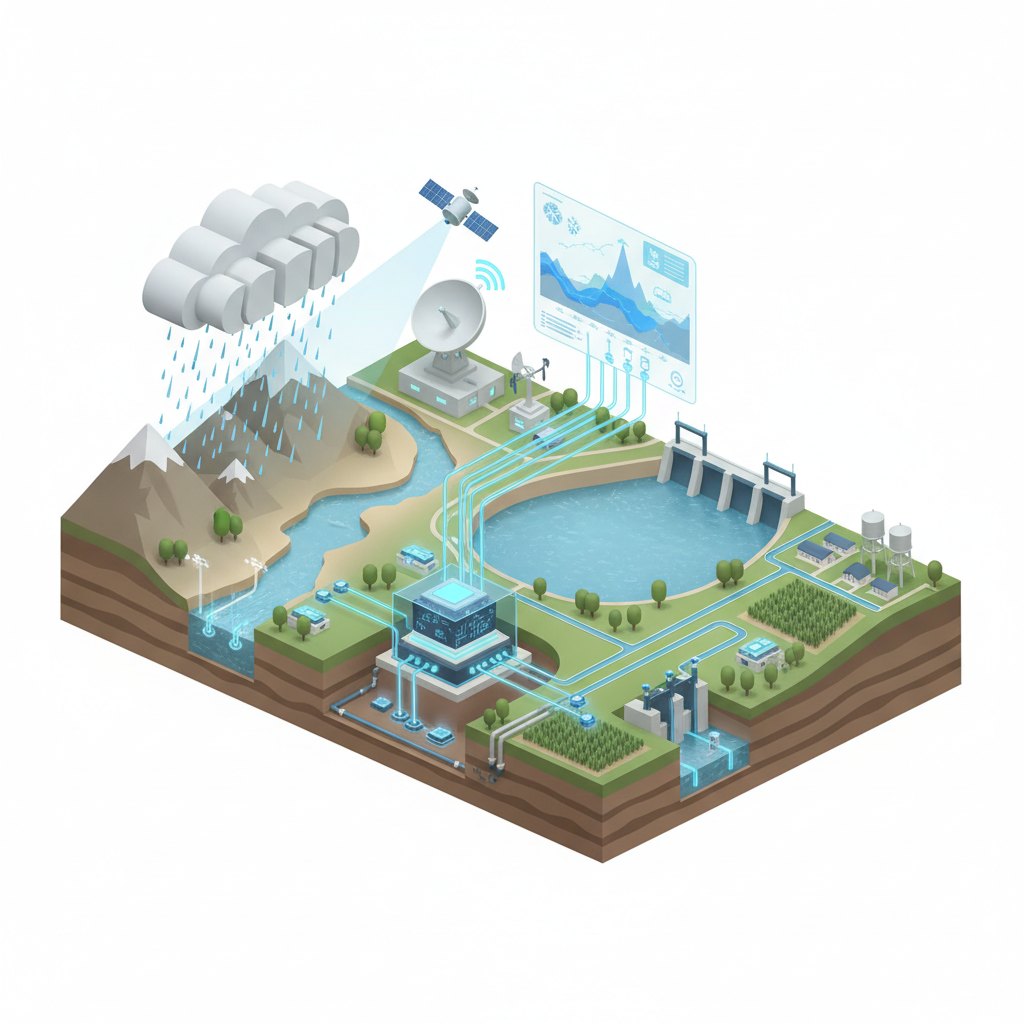
✎ AI-driven hydrological models, when integrated with real-time sensor data and satellite imagery, enable proactive flood prediction, reservoir optimisation, and climate-resilient water governance.
Subject Relevance — Where This Topic Fits
- GS Paper III — Science and Technology — Developments and their Applications and Effects in Everyday Life | GS Paper III — Environment and Disaster Management — Disaster and Hazard Management
- Prelims: Artificial Intelligence (AI), Machine Learning (ML), Earth Observation, Remote Sensing, Flood Prediction Models, Reservoir Management, Real-time Sensor Data, Space Technology Applications, Climate Monitoring, Hydrological Disaster Management
- Essay: The Intersection of Technology and Governance: Leveraging AI for Sustainable Resource Management, Climate Resilience through Innovation: The Role of Space Technology in Disaster Mitigation
Quick Revision: AI-driven hydrological models, when integrated with real-time sensor data and satellite imagery, enable proactive flood prediction, reservoir optimisation, and climate-resilient water governance.
Why is this in the news?
A recent two-day workshop at Madanapalle Institute of Technology and Science (MITS) Deemed to be University highlighted the potential of artificial intelligence (AI) in enhancing flood prediction, water scarcity mitigation, and real-time decision-making for reservoir management, irrigation, and drinking water supply. The workshop, organised in collaboration with national science academies and featuring experts from IISc Bengaluru, ISRO, and NARL, underscored the integration of real-time sensor data, satellite imagery, and weather forecasts with AI-driven analytics as a transformative approach to hydrological disaster management and sustainable water resource governance.
Background
- The increasing frequency and intensity of floods and droughts globally, exacerbated by climate change, have intensified the demand for advanced predictive tools in water resource management.
- India, with its diverse hydrological regimes and high vulnerability to extreme weather events, has been progressively adopting technological solutions to enhance disaster preparedness and water security.
- The National Disaster Management Authority (NDMA) and the Central Water Commission (CWC) have emphasised the need for integrated flood forecasting systems that combine traditional hydro-meteorological data with modern computational techniques.
- The Indian Space Research Organisation (ISRO) has been instrumental in developing satellite-based earth observation systems, including the Resourcesat, Cartosat, and INSAT series, which provide critical data for hydrological modelling and disaster monitoring.
- The National Mission for Clean Ganga (NMCG) and the Jal Shakti Abhiyan have integrated remote sensing and GIS-based tools for river basin management, demonstrating the policy impetus for technology-driven water governance.
- Recent advancements in AI and machine learning have enabled the processing of large-scale, multi-source data streams, including satellite imagery, weather radar, and ground-based sensor networks, to generate actionable insights for disaster management.
What is Artificial Intelligence in the Context of Hydrological Disaster Management?
- Artificial Intelligence (AI) refers to the simulation of human intelligence in machines, enabling them to perform tasks such as learning, reasoning, problem-solving, and decision-making with minimal human intervention.
- In hydrological disaster management, AI encompasses the use of machine learning algorithms, deep learning models, and data analytics to process and interpret vast datasets from satellites, sensors, and weather stations for predictive modelling.
- AI-driven flood prediction models utilise real-time and historical data on rainfall, river discharge, soil moisture, and land use to forecast flood events with higher accuracy and lead time, thereby enabling timely evacuation and resource allocation.
- AI applications in water management extend to reservoir operation optimisation, where algorithms analyse inflow-outflow patterns, demand forecasts, and hydrological constraints to recommend optimal water release schedules, balancing flood control, irrigation, and drinking water supply.
- Earth observation technologies, including remote sensing and satellite imagery, provide critical inputs for AI models by offering high-resolution data on land cover, vegetation indices, and water body dynamics, which are essential for hydrological analysis.
- AI enhances climate monitoring by integrating satellite-based climate data (e.g., temperature, precipitation, evapotranspiration) with ground-based observations to assess long-term trends in water availability and drought risk.
- The integration of AI with Internet of Things (IoT) devices, such as automated weather stations and river gauges, enables continuous data acquisition and real-time decision support, reducing the latency in disaster response.
- AI-powered decision support systems for water governance facilitate scenario analysis, risk assessment, and policy evaluation, aiding policymakers in designing adaptive and resilient water management strategies.
Key Features
| Feature | Significance |
|---|---|
| Real-time sensor data integration | Enables dynamic monitoring of water levels, rainfall, and soil moisture for timely flood alerts and water resource allocation. |
| Satellite imagery analysis via AI | Provides high-resolution spatial data on water bodies, land use, and vegetation to assess flood risks and drought conditions. |
| Weather forecast assimilation | Combines meteorological data with AI models to predict extreme weather events and optimise reservoir operations. |
| AI-driven decision support systems | Facilitates automated and data-informed choices for irrigation scheduling, drinking water distribution, and flood mitigation. |
| Earth observation and climate monitoring | Uses AI to process data from ISRO and NARL satellites for long-term climate trend analysis and water security planning. |
Why it Matters
Economic
- Reduces economic losses from floods and droughts by enabling proactive measures, thereby safeguarding agriculture, infrastructure, and livelihoods.
- Enhances agricultural productivity through precision irrigation and water-use efficiency, contributing to food security.
- Lowers operational costs for water utilities by optimising resource distribution and reducing wastage in supply chains.
Technological
- Accelerates the adoption of Fourth Industrial Revolution tools in governance, particularly in climate-sensitive sectors like water management.
- Promotes interdisciplinary research by integrating AI, space technology, and hydrological sciences for sustainable development.
- Strengthens India’s position in global climate monitoring and disaster resilience through indigenous innovation.
Environmental
- Minimises ecological damage from unplanned water releases or over-extraction by ensuring evidence-based interventions.
- Supports climate adaptation strategies by providing granular data on water availability and extreme weather patterns.
- Contributes to the Sustainable Development Goals (SDGs), particularly SDG 6 (Clean Water and Sanitation) and SDG 13 (Climate Action).
Governance
- Enhances transparency and accountability in water resource management through data-driven policy formulation.
- Facilitates inter-agency coordination among meteorological departments, disaster management authorities, and water resource agencies.
- Empowers local governments with tools for decentralised decision-making in water governance.
Challenges
1. Data Quality and Accessibility
- Dependence on high-quality, real-time data from sensors and satellites; gaps in coverage or calibration can lead to inaccurate predictions.
- Interoperability issues between datasets from multiple agencies (e.g., CWC, IMD, ISRO) hinder seamless integration.
- Privacy concerns arise from the use of satellite imagery and citizen data in AI models, necessitating robust data governance frameworks.
UPSC Link: GS-III: Disaster Management
2. Technological and Infrastructure Constraints
- High computational costs for processing large-scale AI models and satellite data, particularly for state-level agencies.
- Limited access to advanced AI tools and cloud computing infrastructure in rural and remote regions.
- Skill gaps among personnel in government agencies to deploy, maintain, and interpret AI-driven systems.
UPSC Link: GS-III: Science & Technology
3. Policy and Regulatory Gaps
- Lack of a unified national framework for AI adoption in climate-sensitive sectors, leading to fragmented implementation.
- Absence of clear guidelines on data sharing, ownership, and liability in case of AI-driven errors in flood prediction.
- Need for updated standards and protocols for integrating AI outputs into existing disaster management and water resource policies.
UPSC Link: GS-II: Governance
4. Ethical and Social Considerations
- Risk of algorithmic bias in AI models, which may disproportionately affect vulnerable communities in flood-prone or water-scarce regions.
- Public resistance to AI-driven decisions in critical sectors due to lack of awareness or distrust in technology.
- Ethical dilemmas in prioritising water allocation during scarcity, requiring transparent and participatory decision-making.
UPSC Link: GS-IV: Ethics
Challenges — UPSC Perspective
| Issue | Concern |
|---|---|
| Data fragmentation | Lack of standardised formats and protocols for data sharing across agencies. |
| Computational limitations | Inadequate high-performance computing resources for large-scale AI model training. |
| Regulatory ambiguity | Unclear legal provisions on data privacy and liability in AI applications. |
| Capacity building | Shortage of trained professionals in AI and hydrological sciences within government institutions. |
| Public trust | Low awareness and scepticism among stakeholders about AI-driven water management solutions. |
| Resource allocation | Competing demands for limited funds between AI infrastructure and traditional water management systems. |
Way Forward
- Establish a national-level inter-ministerial task force to develop a unified AI policy for climate and water resource management.
- Invest in upgrading sensor networks and satellite data infrastructure to ensure high-resolution, real-time monitoring.
- Launch capacity-building programmes for government officials and local bodies on AI tools and their applications in water governance.
- Develop open-source AI models and platforms for flood prediction and water management, with provisions for customisation by states.
- Formulate clear data governance guidelines, including standards for data sharing, privacy, and accountability.
- Promote public-private partnerships to accelerate the deployment of AI solutions in water utilities and disaster management.
- Integrate AI outputs into existing disaster management plans (e.g., National Disaster Management Plan) and state-level water policies.
- Conduct pilot projects in flood-prone and drought-affected regions to demonstrate the efficacy of AI-driven interventions.
UPSC Value Addition
Keywords for Mains Answer-Writing
Artificial Intelligence · Flood prediction · Water resource management · Smart water governance · Real-time sensor data integration · Satellite imagery in climate monitoring · AI in earth observation · Reservoir management · Irrigation optimization · Climate-resilient infrastructure · Multi-disciplinary collaboration · Science Academies Workshop · Space technology for climate action · Data-driven decision-making · Sustainable water security · Technological governance in natural disasters
Concept Flow
Climate change increases frequency and intensity of extreme weather events (e.g., floods, droughts) → → Traditional water management systems struggle to adapt to dynamic conditions → → AI integrates real-time sensor data, satellite imagery, and weather forecasts → → AI models generate predictive analytics for flood risks and water scarcity → → Decision support systems translate AI outputs into actionable water resource policies → → Implementation of adaptive measures (e.g., reservoir operations, irrigation schedules) → → Outcome: Reduced economic losses, improved water security, and enhanced climate resilience.
Prelims Practice Questions
Q1. Consider the following statements regarding the application of Artificial Intelligence (AI) in water resource management:
1. AI can integrate real-time sensor data, satellite imagery, and weather forecasts to predict floods.
2. AI applications in earth observation are primarily used for agricultural productivity enhancement.
3. The National Atmospheric Research Laboratory (NARL) has developed AI models for flood prediction.
How many of the above statements are correct?
- Only one
- Only two
- All three
- None
Answer: Only two — Statement 1 is correct as AI integrates multi-source data for flood prediction. Statement 2 is incorrect because AI in earth observation is used for climate monitoring and disaster management, not solely for agricultural productivity. Statement 3 is correct as NARL scientists discussed AI applications in climate monitoring, which includes flood prediction.
Q2. Assertion (A): The integration of AI with real-time sensor data and satellite imagery can significantly enhance water resource management.
Reason (R): AI models can process large volumes of data to provide timely and accurate predictions for flood events and water scarcity.
Codes:
(A) Both A and R are true, and R is the correct explanation of A.
(B) Both A and R are true, but R is not the correct explanation of A.
(C) A is true, but R is false.
(D) A is false, but R is true.
- A
- B
- C
- D
Answer: A — Both Assertion (A) and Reason (R) are true. AI models indeed process large datasets to improve predictions for floods and water scarcity, making R the correct explanation for A.
Q3. Match the following AI applications in climate and resource monitoring with their respective organizations:
Column I (Application) | Column II (Organization)
————————|————————–
1. AI in flood prediction | A. Indian Space Research Organisation (ISRO)
2. AI for earth observation | B. National Atmospheric Research Laboratory (NARL)
3. AI-driven climate monitoring | C. Indian Institute of Science (IISc), Bengaluru
Select the correct match:
Options:
A. 1-A, 2-B, 3-C
B. 1-C, 2-A, 3-B
C. 1-B, 2-A, 3-C
D. 1-C, 2-B, 3-A
- A
- B
- C
- D
Answer: B — 1. AI in flood prediction is associated with the Indian Institute of Science (IISc), Bengaluru (Statement by Prof. D. Nagesh Kumar). 2. AI for earth observation is linked to the Indian Space Research Organisation (ISRO) (Statement by ISRO scientist Kandula V. Subrahmanyam). 3. AI-driven climate monitoring is discussed by the National Atmospheric Research Laboratory (NARL) (Statement by Jyothi Narayan Bhate).
Mains Practice Question
✍ Artificial Intelligence (AI) is increasingly being integrated into climate and water resource management systems to enhance resilience against floods and water scarcity. Critically examine the potential of AI in transforming water governance in India. Also, discuss the challenges in its implementation and the institutional frameworks required to harness its full potential. (15 Marks)
Approach: MODEL-ANSWER SKELETON:
1. **Introduction (2 marks)**
– Define AI and its relevance in climate and water resource management.
– Mention the context: AI’s role in flood prediction, reservoir management, and irrigation optimization as highlighted in the workshop at MITS University.
2. **Potential of AI in Water Governance (5 marks)**
– **Flood Prediction and Early Warning Systems**: AI models integrating real-time sensor data, satellite imagery (e.g., from ISRO), and weather forecasts to predict floods with higher accuracy and lead time.
– **Smart Reservoir and Irrigation Management**: AI-driven decision support systems for optimal water release, reducing wastage and improving efficiency.
– **Climate-Resilient Infrastructure**: AI applications in designing climate-resilient water infrastructure and drought mitigation strategies.
– **Data-Driven Policy Making**: Use of AI in analyzing historical data to formulate long-term water security policies.
– **Multi-Disciplinary Collaboration**: Role of institutions like IISc, ISRO, NARL, and science academies in fostering AI applications (Reference: Science Academies Workshop on ‘AI and Space Technologies for Climate and Resource Monitoring’).
3. **Challenges in Implementation (4 marks)**
– **Data Quality and Availability**: Dependence on high-quality, real-time data; issues of data gaps, especially in remote or rural areas.
– **Technological and Infrastructure Constraints**: Limited computational resources, lack of skilled workforce, and high costs of AI deployment.
– **Regulatory and Ethical Concerns**: Data privacy, ownership, and ethical use of AI in governance.
– **Institutional Silos**: Fragmentation among government agencies, research institutions, and private sector limiting seamless integration.
4. **Institutional Frameworks for Harnessing AI (4 marks)**
– **Policy and Governance**: Need for a national AI policy for climate and water management, aligned with the National Water Mission and National Disaster Management Authority (NDMA).
– **Capacity Building**: Training programs for officials, researchers, and stakeholders in AI and data science.
– **Public-Private Partnerships (PPP)**: Collaboration with tech firms, startups, and academic institutions for innovation and deployment.
– **Regulatory Oversight**: Establishing standards for AI model transparency, accountability, and interoperability (Reference: NITI Aayog’s National Strategy for Artificial Intelligence).
5. **Conclusion (2 marks)**
– Summarize the transformative potential of AI in water governance.
– Emphasize the need for a balanced approach combining technological innovation with robust institutional frameworks and ethical considerations.
Source: The Hindu
Generated by AanyaAi for educational purpose.
Related guides on our sites
- Current affairs for upsc 2026
- How to prepare for GS paper 1 for UPSC CSE mains exam
- Best UPSC coaching for IFOS exam
- Best geography optional coaching

- AI’s Role in Flood Prediction & Smart Water Management for UPSC 2026 - September 8, 2026
- आरबीआई ने अमनाथ सहकारी बैंक, बेंगलुरु के लिए निर्देशों की अवधि बढ़ाई: जानिए क्या है पूरा मामला? - September 8, 2026
- RBI Extends Directions for Amanath Co-operative Bank: Key UPSC Polity Insight - September 8, 2026

No Comments