


17 Sep Allahabad HC Upholds Adult’s Right to Choose Faith & Partner in Shamli Case
✎ The Allahabad High Court’s ruling reaffirms that the constitutionally protected autonomy of an adult in matters of religion and marriage cannot be overridden by parental authority or state intervention, except in cases of proven…
Subject Relevance — Where This Topic Fits
- GS Paper II — Fundamental Rights (Articles 25, 26, 29, 30) | GS Paper III — Role of Judiciary in Protecting Individual Liberties
- Prelims: Freedom of Religion (Article 25), Right to Privacy (Puttaswamy judgment), Habeas Corpus, Anti-Conversion Laws, UP Prohibition of Unlawful Conversion of Religion Act 2021
- Essay: Personal Liberty vs. Parental Authority: Balancing Constitutional Rights
Quick Revision: The Allahabad High Court’s ruling reaffirms that the constitutionally protected autonomy of an adult in matters of religion and marriage cannot be overridden by parental authority or state intervention, except in cases of proven coercion or illegality.
Why is this in the news?
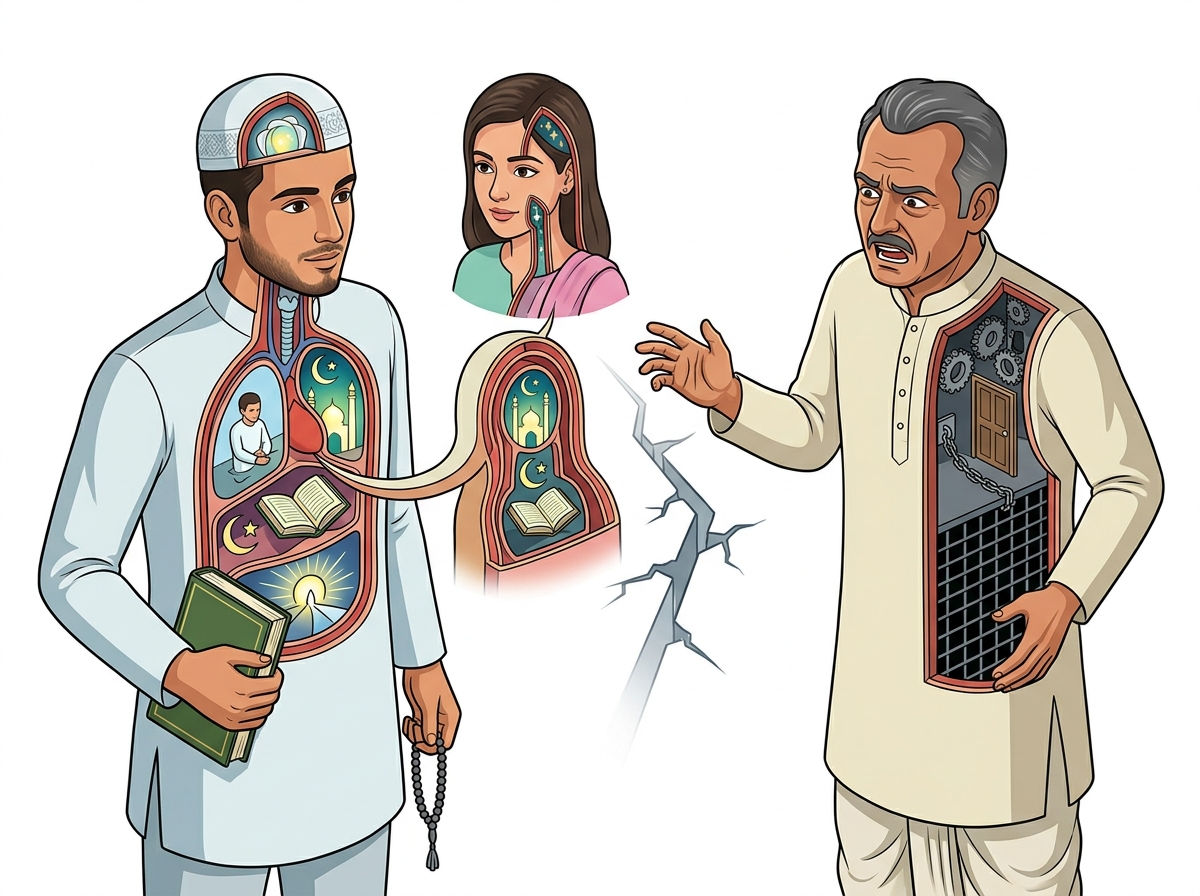
The Allahabad High Court, in a significant judgment, upheld the constitutional autonomy of an adult individual in matters of religious faith and choice of life partner, rejecting a father’s plea to restrain his son from practicing Islam and marrying a Muslim woman. The ruling reinforces judicial precedence on personal liberty, particularly in cases involving interfaith relationships and religious conversions, and underscores the limitations of parental authority over adult children.
Background
- The case emerged from Shamli, Uttar Pradesh, where Ayush Malik, an adult, embraced Islam in 2014 and expressed his intention to marry Chandni Qureshi, a Muslim woman.
- Ayush’s father, Devraj Singh Malik, filed an FIR against Chandni and her relatives under provisions of the UP Prohibition of Unlawful Conversion of Religion Act, alleging forced conversion and coercion.
- Ayush alleged unlawful confinement and threats from his family, prompting a habeas corpus petition filed by his friend, Sultan, seeking his production before the court.
- The case intersects with debates on anti-conversion laws, which critics argue can be misused to target interfaith marriages or personal religious choices, while proponents claim they safeguard against coercion.
- The judgment reaffirms the principle that the state cannot interfere in the private religious or matrimonial choices of consenting adults, except under exceptional circumstances permitted by law.
Constitutional Safeguards for Personal Autonomy in Religious and Matrimonial Matters
- Article 25 of the Constitution guarantees the freedom of conscience and the right to freely profess, practice, and propagate religion, subject to public order, morality, and health.
- Habeas corpus petitions are a constitutional remedy to prevent unlawful detention, as enshrined in Article 32 and Article 226 of the Constitution, ensuring judicial oversight over personal liberty.
- Anti-conversion laws, such as the UP Prohibition of Unlawful Conversion of Religion Act, 2021, aim to prevent forced conversions but have been criticized for potential misuse in cases of consensual interfaith relationships.
- The Allahabad High Court’s ruling underscores that parental concern, while understandable, cannot override the constitutional rights of an adult to choose their faith or partner, absent evidence of coercion or undue influence.
- Judicial precedence establishes that the state’s role is to protect individual rights, not to impose familial or societal preferences on consenting adults.
- The case highlights the tension between individual autonomy and societal norms, particularly in interfaith or inter-caste relationships, where family opposition often leads to legal disputes.
Key Features
| Feature | Significance |
|---|---|
| Constitutional autonomy of adult persons | Upholds Article 21 and 25, ensuring personal liberty and freedom of religion without undue familial or state interference. |
| Habeas corpus jurisdiction of High Courts | Exercises judicial oversight to prevent unlawful detention, even within familial settings, ensuring constitutional safeguards. |
| Anti-conversion legislation (UP Prohibition of Unlawful Conversion of Religion Act, 2021) | Regulates religious conversions to prevent coercion, fraud, or inducement, while balancing individual choice. |
| Judicial scrutiny of conversion claims | Assesses voluntariness of religious conversion and marriage choices, distinguishing between genuine belief and coercion. |
| Parental concern vs. individual autonomy | Highlights the tension between familial welfare and constitutional rights, resolved in favour of the latter for competent adults. |
Why it Matters
Legal and Constitutional
- Reinforces the principle that the State shall not interfere in the personal religious or matrimonial choices of competent adults, as guaranteed under Articles 21 and 25 of the Constitution.
- Demonstrates the judiciary’s role in protecting individual autonomy from familial or societal pressures, even when such pressures stem from well-intentioned concern.
- Clarifies the scope of habeas corpus petitions in cases of alleged unlawful detention within familial contexts, extending judicial protection to personal liberty.
- Sets a precedent for future cases involving religious conversion and inter-faith marriages, balancing statutory regulations with constitutional freedoms.
Social and Ethical
- Underscores the need for societal acceptance of inter-faith relationships and personal religious choices, reducing stigma and familial coercion.
- Highlights the ethical responsibility of families to respect individual autonomy while addressing concerns through dialogue rather than coercion or legal action.
- Encourages a culture of mutual understanding and tolerance, where personal choices are not weaponised through criminalisation or false allegations.
Institutional
- Affirms the role of the judiciary as the final arbiter in disputes involving personal liberty and constitutional rights, even in emotionally charged familial matters.
- Demonstrates the efficacy of habeas corpus petitions in ensuring the protection of fundamental rights, particularly for vulnerable individuals.
- Showcases the interaction between statutory laws (e.g., anti-conversion laws) and constitutional freedoms, requiring judicial interpretation to reconcile conflicts.
Challenges
1. Balancing individual autonomy with familial and societal concerns
- Familial pressure often conflicts with constitutional rights, requiring judicial intervention to delineate boundaries.
- Societal stigma around inter-faith relationships and religious conversions can lead to coercion, necessitating legal safeguards.
- The challenge of distinguishing between genuine religious conviction and coercion remains complex, requiring nuanced judicial assessment.
UPSC Link: GS Paper 2: Fundamental Rights (Articles 21, 25)
2. Enforcement of anti-conversion laws without infringing on constitutional rights
- Anti-conversion laws aim to prevent coercion but risk being misused to suppress personal religious choices.
- The judiciary must ensure that such laws are applied proportionately, avoiding criminalisation of voluntary conversions or marriages.
- Law enforcement agencies face the challenge of investigating complaints without prejudging the voluntariness of the conversion or marriage.
UPSC Link: GS Paper 2: Directive Principles of State Policy (Article 44)
3. Protection of personal liberty in cases of alleged unlawful detention
- Habeas corpus petitions must balance the need for swift justice with the risk of false allegations or familial disputes.
- The judiciary must verify the voluntariness of the individual’s statements and actions to prevent misuse of the legal process.
- Collusion between state agencies and families can undermine judicial oversight, requiring robust procedural safeguards.
UPSC Link: GS Paper 2: Judicial Review and Writs (Article 32, 226)
4. Cultural and religious sensitivities in inter-faith matters
- Inter-faith relationships often face societal resistance, leading to familial and legal conflicts.
- The judiciary must navigate these sensitivities without imposing its own cultural biases, ensuring neutrality.
- Public discourse on such matters must be informed by constitutional values rather than communal narratives.
UPSC Link: GS Paper 1: Secularism and Communalism
5. Judicial capacity to assess voluntariness in conversions and marriages
- Determining whether a conversion or marriage is voluntary requires psychological, social, and legal expertise.
- The judiciary must rely on expert testimony and objective evidence to avoid subjective interpretations.
- Delays in judicial proceedings can exacerbate familial pressures, necessitating expedited hearings.
UPSC Link: GS Paper 2: Judicial Activism and PILs
Challenges — UPSC Perspective
| Issue | Concern |
|---|---|
| Misuse of anti-conversion laws | Risk of suppressing personal religious choices under the guise of preventing coercion. |
| Familial coercion vs. individual autonomy | Families may use legal or social pressure to override constitutional rights. |
| False allegations in habeas corpus petitions | Potential for misuse of legal provisions to settle personal or familial disputes. |
| Societal stigma around inter-faith relationships | Leads to discrimination, coercion, and legal conflicts. |
| Judicial assessment of voluntariness | Complexity in verifying genuine belief or coercion in conversions and marriages. |
| Collusion between state agencies and families | Undermines judicial oversight and personal liberty protections. |
Way Forward
- Strengthen judicial training on constitutional rights, particularly Articles 21 and 25, to ensure consistent application in personal liberty cases.
- Enhance public awareness campaigns on inter-faith relationships and religious conversions, promoting tolerance and mutual respect.
- Establish specialised fast-track courts for cases involving habeas corpus and anti-conversion laws to expedite justice.
- Encourage families to resolve disputes through mediation and dialogue rather than legal coercion, leveraging community leaders and counsellors.
- Develop clear guidelines for law enforcement agencies to investigate anti-conversion complaints without infringing on constitutional rights.
- Promote interdisciplinary research on the psychological and social factors influencing religious conversions and inter-faith marriages.
- Ensure that anti-conversion laws are reviewed periodically to align with constitutional principles and societal needs.
- Foster a culture of constitutional literacy among citizens, particularly regarding personal liberty and freedom of religion.
UPSC Value Addition
Keywords for Mains Answer-Writing
Constitutional autonomy of an adult · Freedom of religion under Article 25 · Right to choose a life partner · UP Prohibition of Unlawful Conversion of Religion Act · Habeas corpus jurisdiction · Judicial review of personal liberty · Right to privacy and personal autonomy · Inter-faith marriages and legal safeguards · Judicial intervention in family disputes · Constitutional morality and individual rights
Constitutional & Policy Linkages
- Article 21: Protection of personal liberty and autonomy.
- Article 25: Freedom of conscience and free profession, practice, and propagation of religion.
- Article 14: Equality before law and equal protection of laws.
- Article 226: Power of High Courts to issue writs for enforcement of fundamental rights.
Concept Flow
Religious conversion and inter-faith marriage → Familial opposition and legal action → Registration of FIR under anti-conversion law → Allegation of unlawful detention → Habeas corpus petition filed → Judicial scrutiny of voluntariness → Court upholds constitutional autonomy → Reinforcement of judicial precedent on personal liberty.
Prelims Practice Questions
Q1. Consider the following statements regarding the constitutional provisions related to freedom of religion and personal liberty in India: 1. Article 25 guarantees the freedom of conscience and the right to freely profess, practise, and propagate religion. 2. The right to choose a life partner is a fundamental right under Article 21 of the Constitution. 3. The State can impose restrictions on the freedom of religion solely on the grounds of public order, morality, or health. How many of the above statements are correct?
- Only one
- Only two
- All three
- None
Answer: All three — Statements 1 and 2 are correct. Article 25(1) guarantees freedom of religion, while the right to choose a life partner is recognised as part of the right to life and personal liberty under Article 21. Statement 3 is incorrect; restrictions under Article 25(1) must also satisfy the doctrine of reasonable restrictions under Article 25(2).
Q2. Assertion (A): The Allahabad High Court’s order in the Ayush Malik case reaffirms the principle that an adult’s choice of religion and life partner is constitutionally protected. Reason (R): The Constitution of India, through Articles 25 and 21, guarantees autonomy to individuals in matters of personal belief and matrimonial choices, subject only to reasonable restrictions.
- Both A and R are true, and R is the correct explanation of A
- Both A and R are true, but R is not the correct explanation of A
- A is true, but R is false
- A is false, but R is true
Answer: Both A and R are true, and R is the correct explanation of A — Both the assertion and reason are correct. The Allahabad High Court’s order aligns with the constitutional provisions under Articles 25 and 21, which protect an adult’s autonomy in matters of religion and personal choices. The reason correctly explains the assertion.
Q3. Match the following constitutional provisions with their corresponding rights: Column I (Provision) Column II (Right) 1. Article 25(1) A. Right to life and personal liberty 2. Article 21 B. Freedom of conscience and religion 3. Article 19(1)(a) C. Freedom of speech and expression 4. Article 26 D. Freedom to manage religious affairs
- 1-B, 2-A, 3-C, 4-D; 1-D, 2-A, 3-C, 4-B; 1-B, 2-C, 3-A, 4-D; 1-A, 2-B, 3-D, 4-C
- answer_list_indexes_to_correct_pairing_indexes_0
- explain_list_indexes_to_correct_pairing_indexes_0
- format_match
Answer: 1-B, 2-A, 3-C, 4-D; 1-D, 2-A, 3-C, 4-B; 1-B, 2-C, 3-A, 4-D; 1-A, 2-B, 3-D, 4-C —
Q4. Which of the following best describes the legal principle established by the Allahabad High Court in the Ayush Malik case?
- The court upheld the father’s right to restrain his adult son’s religious conversion and marriage choice on grounds of familial welfare.
- The court ruled that an adult’s right to choose religion and life partner is constitutionally protected and cannot be overridden by familial concerns.
- The court directed the State to enforce anti-conversion laws strictly to prevent religious conversions without parental consent.
- The court held that habeas corpus petitions are not maintainable in cases involving inter-faith marriages.
Answer: The court ruled that an adult’s right to choose religion and life partner is constitutionally protected and cannot be overridden by familial concerns. — The Allahabad High Court ruled that an adult’s right to choose religion and life partner is constitutionally protected under Articles 25 and 21, and such autonomy cannot be overridden by familial concerns. The court emphasised the principle of constitutional morality over familial objections.
Mains Practice Question
✍ The Allahabad High Court’s judgment in the Ayush Malik case reaffirms the principle that an adult’s right to choose religion and life partner is constitutionally protected. Critically examine the legal and constitutional foundations of this principle, with reference to relevant constitutional provisions, judicial precedents, and contemporary societal challenges. (15 Marks)
Approach: MODEL-ANSWER SKELETON:
1. **Constitutional Foundations**:
– Article 25(1): Freedom of conscience and right to practise, profess, and propagate religion.
– Article 21: Right to life and personal liberty, including autonomy in personal choices.
– Article 19(1)(a): Freedom of speech and expression, which may extend to religious expression.
– Article 26: Freedom to manage religious affairs.
2. **Judicial Precedents**:
– *Shayara Bano v. Union of India* (2017): Reiterated the right to privacy and autonomy in personal matters.
– *Lily Thomas v. Union of India* (2000): Struck down Section 8(4) of the Representation of the People Act, 1951, affirming the primacy of fundamental rights.
– *Hadiya case (Shamima Farooqui v. State of Kerala)* (2017): Held that an adult’s choice of religion and marriage partner is constitutionally protected.
– *K.S. Puttaswamy v. Union of India* (2017): Established the right to privacy as a fundamental right, encompassing personal autonomy.
3. **Doctrine of Reasonable Restrictions**:
– Article 25(2): Restrictions on religious freedom can be imposed on grounds of public order, morality, or health.
– *Ramesh Yeshwant Prabhoo v. P.K. Kunte* (1996): Clarified the scope of reasonable restrictions under Article 25.
4. **Contemporary Challenges**:
– **Anti-Conversion Laws**: State-specific laws (e.g., Uttar Pradesh Prohibition of Unlawful Conversion of Religion Act, 2021) and their potential to infringe upon personal autonomy.
– **Inter-Faith Marriages**: Societal and familial resistance, often framed as ‘love jihad’ narratives, and their legal implications.
– **Judicial Role**: The balance between protecting individual rights and addressing societal concerns through judicial intervention.
5. **Constitutional Morality vs. Familial Concerns**:
– The court’s emphasis on constitutional morality over familial objections aligns with the principle that fundamental rights are not subject to majoritarian or familial approval.
– The judgment underscores the State’s role in protecting individual rights against coercion or undue influence, while ensuring that restrictions are reasonable and proportionate.
6. **Conclusion**:
– The Allahabad High Court’s order reinforces the supremacy of constitutional rights over societal or familial pressures.
– It highlights the need for a nuanced interpretation of anti-conversion laws to prevent their misuse while safeguarding individual autonomy.
Source: The Indian Express
Uttar Pradesh PCS (UPPSC) — State PCS Practice
Prelims: Regarding the Allahabad High Court’s ruling on the ‘Brainwashed into Islam’ case, which of the following statements is correct?
- The High Court dismissed the father’s plea, stating that no evidence was found to substantiate the claim of religious conversion through coercion.
- The High Court ordered a CBI investigation into the alleged religious conversion of the minor.
- The High Court upheld the father’s claim and directed the state government to frame strict anti-conversion laws.
- The High Court ruled in favor of the minor’s religious conversion, citing freedom of religion under Article 25 of the Constitution.
Answer: The High Court dismissed the father’s plea, stating that no evidence was found to substantiate the claim of religious conversion through coercion. — The Allahabad High Court dismissed the father’s plea due to lack of evidence supporting the claim of forced religious conversion in Uttar Pradesh.
Mains: Critically analyze the role of the Allahabad High Court’s judgment in the ‘Brainwashed into Islam’ case in strengthening or weakening the implementation of anti-conversion laws in Uttar Pradesh. Discuss the socio-legal implications for the state’s administration and minority communities.
Generated by AanyaAi for educational purpose.
Related guides on our sites
- Best PSIR optional coaching for upsc
- Best Law optional coaching for upsc
- Best PSIR optional teacher for upsc
- Best teacher of PSIR optional for upsc

- पेरियार टाइगर रिजर्व में 6 नई प्रजातियाँ खोजी गईं, जानिए क्या हैं विशेषताएँ - September 22, 2026
- Six New Species Discovered in Periyar Tiger Reserve: UPSC & PCS Key Biodiversity Insights - September 22, 2026
- तमिलनाडु में बस किराए में संशोधन: सरकार को चार सप्ताह और समय मिला, उच्च न्यायालय का फैसला - September 22, 2026

No Comments