


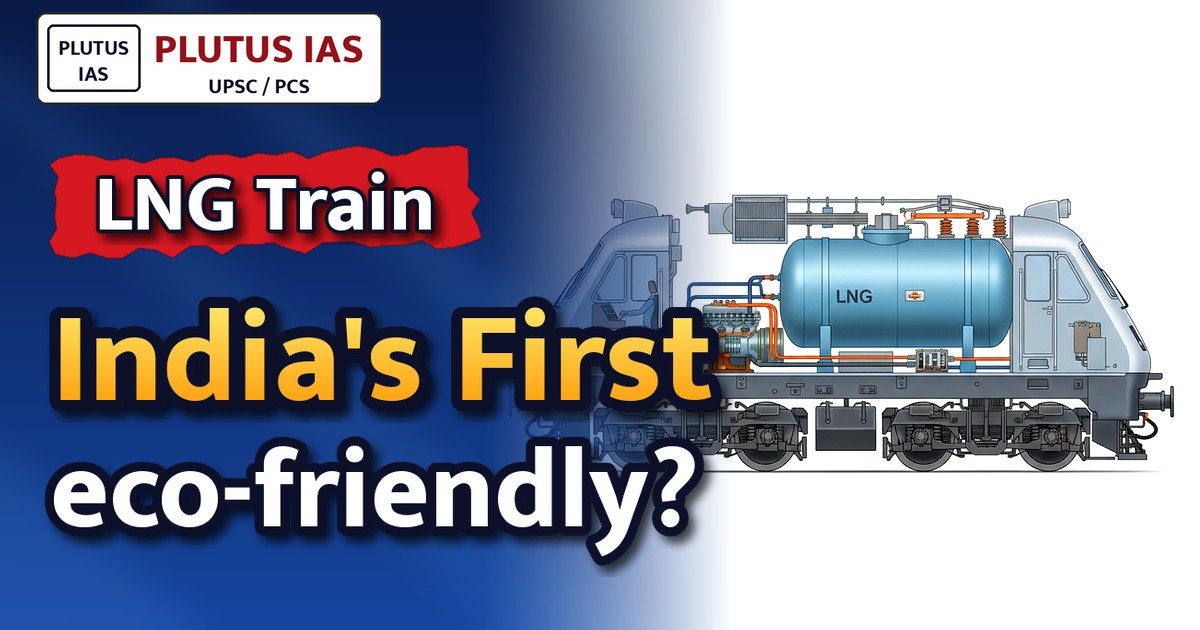
28 Sep Amit Shah flags off India’s first LNG train from Sabarmati
✎ LNG-powered trains reduce CO₂ emissions by ~25% compared to diesel, while the WAG-12 locomotive enhances freight efficiency by replacing multiple diesel units with a single high-power electric engine.
Subject Relevance — Where This Topic Fits
- GS Paper III — Infrastructure: Energy, Transportation | GS Paper III — Environmental Pollution and Degradation
- Prelims: Liquefied Natural Gas (LNG), Dedicated Freight Corridor (DFC), Kavach (Train Collision Avoidance System), WAG-12 Locomotive, Bio-toilets in Railways, Double Stack Container Train, Hydrogen Train
- Essay: Technological innovation as a catalyst for sustainable development in India, Balancing economic growth with environmental conservation in infrastructure projects
Quick Revision: LNG-powered trains reduce CO₂ emissions by ~25% compared to diesel, while the WAG-12 locomotive enhances freight efficiency by replacing multiple diesel units with a single high-power electric engine.
Why is this in the news?
The inauguration of India’s first LNG-powered train and the unveiling of ₹1,472 crore worth of railway infrastructure projects at Sabarmati Railway Station, Ahmedabad, marks a significant milestone in the integration of cleaner energy solutions within the national transport sector. This initiative aligns with broader objectives of reducing carbon emissions in the railway sector while enhancing operational efficiency and safety standards.
Background
- Indian Railways, the world’s fourth-largest rail network, operates over 12,000 passenger trains and 9,000 freight trains daily, contributing approximately 0.5% to national GDP.
- The sector has historically relied on diesel and electric traction, with diesel locomotives accounting for ~30% of freight movement as of 2014.
- Post-2014, the government prioritised electrification, achieving 99.6% coverage by 2026, alongside initiatives to modernise rolling stock and safety systems.
- The Dedicated Freight Corridors (DFCs) and initiatives like the WAG-12 locomotive (12,000 HP twin-section) reflect efforts to enhance freight capacity and efficiency.
- Environmental concerns, particularly emissions from diesel locomotives, have driven exploration of alternative fuels such as LNG and hydrogen in rail transport.
Liquefied Natural Gas (LNG) in Indian Railways: Key Features and Implications
- LNG is natural gas cooled to -162°C, reducing its volume by 600 times for efficient storage and transport, and emits ~25% less CO₂ than diesel.
- The first LNG-powered train in India utilises dual-fuel technology, allowing operation on both LNG and diesel, ensuring operational flexibility during transition phases.
- The ₹700 crore WAG-12 maintenance shed at Sabarmati will ensure optimal upkeep of high-power locomotives, reducing downtime and extending asset life.
- The Kavach (Train Collision Avoidance System) deployment on Sabarmati-Kalol-Sabarmati and Ahmedabad-Palanpur segments enhances safety by preventing collisions through real-time monitoring and automated braking.
- Double-stack container trains, successfully trialled between Mumbai and Vadodara, double freight capacity per train, addressing track congestion and reducing logistics costs.
- The Sabarmati Railway Station redevelopment integrates modern passenger amenities, accessibility, and sustainability features.
- Hydrogen-powered trains, inaugurated earlier, represent a parallel track toward decarbonising rail transport, complementing LNG adoption in the medium term.
Key Features
| Feature | Significance |
|---|---|
| First LNG-powered train in India | Introduces liquefied natural gas (LNG) as a cleaner alternative fuel for rail transport, reducing carbon emissions and dependence on diesel. |
| ₹1472 crore infrastructure projects | Modernisation of Ahmedabad’s Sabarmati Railway Station, including passenger amenities, safety upgrades, and connectivity improvements. |
| WAG-12 Maintenance Shed (₹700 crore) | Establishes a dedicated facility for the maintenance of high-power electric locomotives (WAG-12), enhancing operational efficiency and reducing downtime. |
| Kavach implementation (₹48 crore) | Deployment of India’s indigenous automatic train protection system (Kavach) on Sabarmati-Kalol-Sabarmati and Ahmedabad-Palanpur sections, improving safety standards. |
| Double-tracking of Sabarmati-Sarkhej route | Expands rail capacity by converting a single-track route to double-track, facilitating higher train frequency and reducing congestion. |
| Twin-section WAG-12 locomotive (12,000 HP) | A single locomotive with twin-section capability equivalent to 600 trucks in freight hauling, reducing operational costs and improving efficiency. |
Why it Matters
Economic
- Enhances freight capacity and efficiency through high-power locomotives and double-tracking, reducing logistics costs and improving supply chain resilience.
- Promotes indigenous manufacturing of rail infrastructure (e.g., WAG-12 locomotives) under the ‘Make in India’ initiative, boosting the Atmanirbhar Bharat agenda.
- Supports long-haul double-stack container trains (e.g., Mumbai-Vadodara trial), increasing cargo throughput and revenue generation for Indian Railways.
Environmental
- LNG adoption reduces particulate emissions by ~20-30% compared to diesel, aligning with India’s climate commitments under the Paris Agreement.
- Electrification of rail routes (99.6% completed) further lowers carbon footprint by transitioning from diesel to electric traction.
- Kavach implementation reduces energy wastage through automated speed regulation and collision avoidance, indirectly lowering fuel consumption.
Technological
- Advancement in indigenous train protection systems (Kavach) positions India as a leader in rail safety technology among developing nations.
- Introduction of twin-section WAG-12 locomotives demonstrates progress in high-power electric locomotive technology, reducing dependency on imported diesel engines.
- Establishment of maintenance sheds for WAG-12 locomotives ensures self-sufficiency in high-end rail asset upkeep.
Social/Connectivity
- Modernisation of Sabarmati Railway Station improves passenger experience, safety, and accessibility, fostering urban-rural connectivity in Gujarat.
- Expansion of rail infrastructure (e.g., double-tracking) eases congestion and enhances mobility for commuters and freight movement.
- Integration of LNG trains aligns with sustainable development goals (SDGs) by promoting cleaner transport solutions in densely populated regions.
Challenges
1. Infrastructure Bottlenecks
- Limited track capacity restricts the operationalisation of high-capacity freight trains, necessitating further expansion of dedicated freight corridors.
- Inadequate maintenance infrastructure for advanced locomotives (e.g., WAG-12) may lead to operational inefficiencies without dedicated sheds.
- Electrification gaps in certain routes (0.4% remaining) require accelerated deployment to fully realise environmental benefits.
UPSC Link: Economic Survey: Infrastructure Development
2. Environmental Compliance
- Transition to LNG requires robust supply chain infrastructure, including liquefaction plants, storage facilities, and refuelling stations across rail networks.
- Regulatory frameworks for LNG adoption in rail transport must align with safety standards and emission norms to prevent environmental risks.
- Balancing freight expansion with decarbonisation goals demands policy incentives for cleaner technologies and penal provisions for non-compliance.
UPSC Link: Environmental Governance: Climate Change Policies
3. Safety and Standardisation
- Kavach deployment faces scalability challenges due to high initial costs (~₹50 lakh per km) and the need for interoperability across heterogeneous rail networks.
- Training and skill development for railway staff in operating and maintaining advanced systems (e.g., LNG locomotives, Kavach) are critical to avoid operational failures.
- Standardisation of LNG fuel specifications and refuelling protocols is essential to ensure compatibility with diverse locomotive models.
UPSC Link: Disaster Management: Railway Safety Protocols
4. Financial Sustainability
- High capital expenditure (e.g., ₹1472 crore for Sabarmati projects) requires efficient resource mobilisation, including public-private partnerships (PPPs) and viability gap funding.
- Revenue generation from freight operations must offset maintenance and operational costs of advanced technologies to ensure long-term viability.
- Subsidies or tax incentives for LNG adoption may strain public finances, necessitating cost-benefit analyses and phased implementation.
UPSC Link: Public Finance: Budgetary Allocations
Challenges — UPSC Perspective
| Issue | Concern |
|---|---|
| Limited track capacity | Restricts simultaneous operation of passenger and freight trains, leading to congestion and delays. |
| High Kavach deployment costs | Financial burden on railways may delay nationwide implementation, compromising safety upgrades. |
| LNG supply chain gaps | Lack of refuelling infrastructure and liquefaction plants may hinder the scalability of LNG-powered trains. |
| Skill shortages in maintenance | Inadequate training for WAG-12 and LNG locomotive upkeep risks operational inefficiencies and safety lapses. |
| Electrification lag in remote areas | 0.4% non-electrified routes may become bottlenecks for fully green rail operations. |
| Interoperability challenges | Kavach system must integrate seamlessly with existing signalling and control systems across diverse rail networks. |
Way Forward
- Accelerate the completion of pending electrification projects to achieve 100% coverage, ensuring alignment with decarbonisation goals.
- Expand Kavach deployment to critical rail corridors (e.g., Golden Quadrilateral, Dedicated Freight Corridors) to enhance safety and efficiency.
- Establish LNG refuelling hubs at strategic locations (e.g., major junctions, ports) to support the scalability of LNG-powered trains.
- Develop vocational training programmes for railway staff in operating and maintaining advanced systems (WAG-12, Kavach, LNG locomotives).
- Leverage public-private partnerships (PPPs) to finance high-cost infrastructure projects (e.g., maintenance sheds, double-tracking) and share risks.
- Conduct cost-benefit analyses for LNG adoption in rail transport to identify viable routes and optimise subsidy mechanisms.
- Strengthen inter-ministerial coordination (e.g., Ministry of Railways, Ministry of Petroleum) to streamline regulatory approvals for LNG infrastructure.
- Monitor and evaluate the performance of twin-section WAG-12 locomotives to assess their impact on freight capacity and operational costs.
UPSC Value Addition
Keywords for Mains Answer-Writing
Liquefied Natural Gas (LNG) fuel for railways · WAG-12 locomotive maintenance shed · Kavach train protection system · Indian Railways modernization initiatives · Double-stack container train trials · Railway electrification in India · Railway safety budget enhancement · Bio-toilets in Indian Railways · Make in India in railway manufacturing · Sabarmathi Railway Station redevelopment
Concept Flow
Rise in diesel consumption and carbon emissions in rail transport → Government’s push for cleaner fuels (LNG) and electrification → Launch of first LNG train and near-complete electrification (99.6%) → → Expansion of freight capacity through high-power locomotives (WAG-12) and double-tracking → Reduction in logistics costs and improved supply chain efficiency → → Implementation of indigenous safety systems (Kavach) to mitigate collision risks → Enhanced passenger and freight safety standards → → Modernisation of railway stations (e.g., Sabarmati) with passenger amenities and connectivity improvements → Improved urban-rural integration and economic growth → → Integration of ‘Make in India’ and ‘Atmanirbhar Bharat’ policies in rail infrastructure → Indigenous manufacturing of locomotives and safety systems → → Alignment with India’s climate commitments (Paris Agreement) and SDG 13 (Climate Action) → Reduced carbon footprint and sustainable transport solutions.
Prelims Practice Questions
Q1. Consider the following statements regarding the Liquefied Natural Gas (LNG) train launched recently in India:
1. The LNG train is India’s first such train.
2. LNG as a fuel reduces carbon emissions compared to diesel.
3. The LNG train was inaugurated at Mumbai Central Railway Station.
How many of the above statements are correct?
- Only one
- Only two
- All
- None
Answer: Only two — Statement 1 is correct as the news confirms the launch of India’s first LNG train. Statement 2 is correct because LNG is a cleaner fuel than diesel. Statement 3 is incorrect as the inauguration took place at Sabarmati Railway Station in Ahmedabad.
Q2. Assertion (A): The WAG-12 locomotive maintenance shed inaugurated at Sabarmati is designed to maintain high-power electric locomotives.
Reason (R): The WAG-12 locomotive has a twin-section capacity of 12,000 horsepower and can haul freight equivalent to 600 trucks.
In the context of the above two statements, which one of the following is correct?
- Both A and R are true, and R is the correct explanation of A.
- Both A and R are true, but R is not the correct explanation of A.
- A is true, but R is false.
- A is false, but R is true.
Answer: Both A and R are true, and R is the correct explanation of A. — Assertion (A) is true as the WAG-12 is an electric locomotive requiring specialized maintenance infrastructure. Reason (R) is also true and directly explains the need for such a maintenance shed due to the locomotive’s high power and hauling capacity.
Q3. Match the following railway initiatives with their respective objectives:
Column I (Initiative) | Column II (Objective)
————————————————–|————————————————–
A. Kavach system | 1. Enhancing freight capacity through double-stacking
B. Double-stack container train trials | 2. Reducing carbon emissions in railway operations
C. LNG-powered train | 3. Implementing an indigenous automatic train protection system
D. WAG-12 locomotive maintenance shed | 4. Providing specialized maintenance for high-power electric locomotives
Select the correct match:
- A-3, B-1, C-2, D-4
- A-2, B-1, C-3, D-4
- A-1, B-2, C-3, D-4
- A-4, B-3, C-2, D-1
Answer: A-3, B-1, C-2, D-4 — A matches with 3 (Kavach is India’s indigenous train protection system), B matches with 1 (Double-stack trials aim to enhance freight capacity), C matches with 2 (LNG trains reduce carbon emissions), and D matches with 4 (WAG-12 maintenance shed supports high-power electric locomotives).
Mains Practice Question
✍ The inauguration of India’s first LNG-powered train and the launch of multiple railway modernization projects at Sabarmati Railway Station represent a significant shift in India’s railway sector. Critically examine the role of technological innovation and infrastructure development in transforming Indian Railways into a sustainable, efficient, and globally competitive transport system. (15 Marks)
Approach: MODEL-ANSWER SKELETON:
1. **Introduction** (2 Marks):
– Briefly define the context: India’s railway sector as the backbone of freight and passenger mobility.
– Highlight the dual objectives of modernization: sustainability (LNG trains, electrification) and efficiency (double-stack trials, Kavach, WAG-12 locomotives).
2. **Technological Innovation** (5 Marks):
– **LNG-powered trains**: Explain the environmental benefits (lower CO₂, NOₓ emissions) and operational advantages (lower fuel costs, higher energy density). Compare with diesel and electric alternatives.
– **WAG-12 locomotives**: Discuss their 12,000 HP twin-section capacity, hauling capability (600 trucks), and role in reducing the need for multiple locomotives. Reference the Make in India initiative for indigenous manufacturing.
– **Kavach system**: Explain its indigenous development, features (automatic braking, collision avoidance), and alignment with global best practices (e.g., European Train Control System).
– **Double-stack container trains**: Highlight the trial run from JNPT to Vadodara, its potential to double freight capacity, and alignment with Dedicated Freight Corridors (DFCs).
3. **Infrastructure Development** (5 Marks):
– **Electrification**: Cite the jump from 30% electrification in 2014 to 99.6% in 2026, its impact on reducing diesel dependency and carbon footprint.
– **Maintenance infrastructure**: Discuss the 700 crore WAG-12 maintenance shed at Sabarmati, its role in ensuring operational reliability and reducing downtime.
– **Station redevelopment**: Reference Sabarmati Railway Station’s transformation as a model for passenger amenities, safety, and connectivity (e.g., reduced distances for amenities).
– **Safety and budget enhancement**: Note the 67% increase in railway safety budgets and the deployment of bio-toilets (98% coverage) and LHB coach production (57% increase).
4. **Challenges and Critique** (2 Marks):
– **Implementation gaps**: Highlight the need for widespread adoption of LNG trains beyond pilot routes, challenges in retrofitting existing infrastructure, and the economic viability of LNG over diesel/electric.
– **Policy coherence**: Discuss the alignment of these initiatives with broader goals like Atmanirbhar Bharat, climate commitments (Paris Agreement), and the National Rail Plan 2030.
5. **Conclusion** (1 Mark):
– Summarize the transformative potential of these innovations while acknowledging the need for sustained investment, policy support, and technological adaptation to fully realize the vision of a modern, sustainable, and globally competitive Indian Railways.
Source: PIB (Press Information Bureau)
Gujarat PCS (GPSC) — State PCS Practice
Prelims: Which of the following statements is correct regarding the inauguration of development works and India’s first LNG train by Union Home and Cooperation Minister Amit Shah at Sabarmati Railway Station in Ahmedabad?
- The total cost of the inaugurated development works is ₹1472 crore.
- This is the first LNG train in the world, launched globally.
- The LNG train was inaugurated at Ahmedabad Junction Railway Station.
- The development works were inaugurated by the Chief Minister of Gujarat.
Answer: The total cost of the inaugurated development works is ₹1472 crore. — The Union Home and Cooperation Minister inaugurated development works worth ₹1472 crore at Sabarmati Railway Station in Ahmedabad.
Mains: Discuss the significance of the inauguration of India’s first LNG train and the associated development works at Sabarmati Railway Station in Ahmedabad from the perspective of Gujarat’s transportation infrastructure and economic growth.
Generated by AanyaAi for educational purpose.
Related guides on our sites
- How to prepare for GS paper 1 for UPSC CSE mains exam
- Best UPSC coaching for IFOS exam
- Best mentorship programme for upsc
- UPSC+BA degree

- Rajasthan Panchayati Raj Elections: New Rules, Fines & Disqualification - September 28, 2026
- सेना प्रमुख का बड़ा बयान: जीत जमीन से ही तय होती है, तकनीक नहीं बदल सकती युद्ध की प्रकृति - September 28, 2026
- UPSC Alert: Government Cracks Down on Patwaris for SVAMITVA Scheme Refusals - September 28, 2026

No Comments