


26 Sep Amit Shah Launches SHE-Mart & NCCF Schemes in Kerala for Women Empowerment
✎ She-Mart is a market-linkage initiative under the She-Mart Mission to empower rural women entrepreneurs by integrating their products directly into NCCF’s 2,500+ retail outlets and 300+ dedicated stores, ensuring fair pricing and…
Subject Relevance — Where This Topic Fits
- GS Paper II — Governance and Cooperative Federalism | GS Paper III — Issues relating to Direct and Indirect Farm Subsidies and Minimum Support Prices; Food Processing and Related Industries
- Prelims: Self-Help Groups (SHGs), National Cooperative Consumers’ Federation of India (NCCF), Minimum Support Price (MSP), Organic Farming, Women Entrepreneurship, Rural Market Integration
- Essay: Role of Cooperatives in Rural Transformation, Women-led Development: Policy and Practice
Quick Revision: She-Mart is a market-linkage initiative under the She-Mart Mission to empower rural women entrepreneurs by integrating their products directly into NCCF’s 2,500+ retail outlets and 300+ dedicated stores, ensuring fair pricing and enhanced market access.
Why is this in the news?
The launch of the She-Mart initiative and the unveiling of multiple cooperative schemes by the Union Home and Cooperation Minister in Kerala’s Kollam district underscore the Government of India’s renewed focus on leveraging the cooperative sector to empower rural women, integrate small producers with formal markets, and strengthen agricultural value chains through direct consumer outreach. The initiatives align with the Union Budget 2026-27 announcements and reflect the policy emphasis on cooperative federalism and women-led economic inclusion.
Background
- Kerala has a long-standing tradition of cooperative movements, with over 23,000 cooperative societies operating in sectors such as dairy, agriculture, and retail, forming a robust institutional framework for grassroots economic activity.
- The Union Budget 2026-27 introduced the She-Mart Mission as a dedicated programme to empower women entrepreneurs through market linkages, with a focus on products manufactured by Self-Help Groups (SHGs) and rural enterprises.
- The NCCF, in collaboration with NAFED, has been implementing price stabilisation measures such as the ‘Bharat Atta’ and ‘Bharat Onion’ schemes to ensure affordable access to essential food items across states.
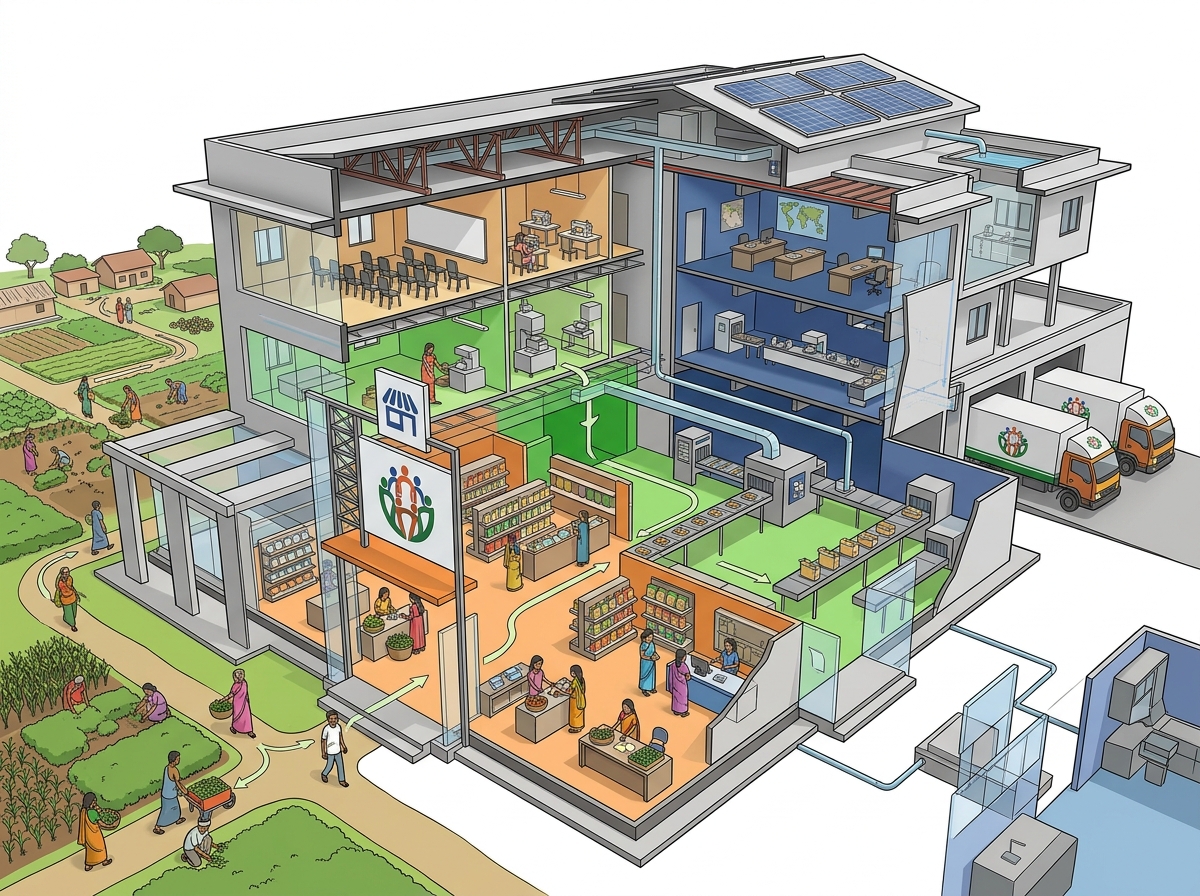
- The She-Mart initiative is conceptualised as a digital and physical retail network to bridge the gap between rural producers and urban consumers, thereby enhancing value realisation for small-scale women-led producers.
What are the She-Mart Initiative and NCCF Cooperative Schemes?
- She-Mart Initiative: A centrally sponsored programme launched under the She-Mart Mission to integrate rural women entrepreneurs, particularly those associated with Self-Help Groups (SHGs), directly with retail markets through a dedicated retail network. The initiative aims to transform women from credit recipients to market participants by providing them with platforms to sell their products.
- Market Integration Mechanism: She-Mart will utilise over 2,500 NCCF retail outlets across India to showcase and sell products manufactured by rural women and small producers. Additionally, 300+ dedicated She-Mart stores are proposed in Kerala, Tamil Nadu, and Karnataka to enhance local market penetration.
- These include the distribution of essential commodities such as Bharat Atta (wheat flour) and Bharat Onion through mobile vans and retail outlets, ensuring price stability and accessibility in rural and semi-urban areas.
- Digital Platform Integration: The initiative incorporates digital tools to facilitate seamless transactions, market access, and supply chain transparency, enabling women entrepreneurs to manage orders, pricing, and logistics efficiently.
- Organic and Local Product Promotion: The schemes prioritise the marketing of organic and locally produced goods, aligning with the Government’s push for sustainable agriculture and value addition in rural economies.
- Women Empowerment Focus: By focusing on women-led enterprises, the programmes aim to enhance financial independence, decision-making autonomy, and socio-economic status of rural women, in line with national policies on gender-inclusive growth.
- Cooperative Federalism: The initiatives exemplify cooperative federalism by leveraging the existing cooperative infrastructure in states like Kerala to implement centrally sponsored schemes, ensuring grassroots participation and ownership.
Key Features
| Feature | Significance |
|---|---|
| She-Mart Initiative | Aims to integrate rural women entrepreneurs directly with markets through 300+ dedicated retail outlets in Kerala, Tamil Nadu, and Karnataka, reducing intermediaries and enhancing income generation. |
| NCCF Retail Outlets (2,500+) | Provides a platform for local and Indian-branded products, including agricultural produce, to reach consumers at competitive prices, strengthening cooperative supply chains. |
| Swasthya Bharat Mobile Vans | Distributes essential commodities like onions, fortified atta, and rice at subsidised rates, ensuring food security and price stability in rural areas. |
| NEFED Kalyan Scholarship Scheme | Supports education of daughters of farmer families, promoting human capital development in agricultural communities. |
| Digital Integration of Cooperatives | Leverages technology to streamline procurement, distribution, and market linkages for cooperative enterprises, enhancing operational efficiency. |
Why it Matters
Economic Empowerment
- Enhances income-generating opportunities for rural women by linking them directly to markets, thereby reducing dependence on informal credit systems.
- Strengthens the cooperative sector by integrating small producers into formal value chains, improving bargaining power and profitability.
- Promotes localised economic growth through the distribution of indigenous products, fostering self-reliance in rural economies.
Social Inclusion
- Facilitates gender-inclusive economic participation by prioritising women-led enterprises within the She-Mart framework.
- Supports marginalised farmer families through scholarships, addressing inter-generational poverty in agricultural communities.
- Ensures equitable access to essential commodities via subsidised distribution, mitigating price volatility impacts on vulnerable households.
Institutional Strengthening
- Revitalises the cooperative movement in Kerala, a state with a historically strong cooperative ecosystem, by aligning it with national schemes.
- Leverages existing retail infrastructure (NCCF/NEFED outlets) to scale impact without duplicating administrative overheads.
- Encourages state-centre synergy in implementing cooperative policies, ensuring harmonised execution across jurisdictions.
Policy Alignment
- Reflects the Union Budget 2026-27’s emphasis on women-led entrepreneurship and cooperative sector reforms.
- Complements initiatives under the Ministry of Cooperation, such as the National Cooperative Policy, by operationalising grassroots linkages.
- Supports the Sustainable Development Goals (SDGs), particularly SDG 5 (Gender Equality) and SDG 8 (Decent Work and Economic Growth).
Challenges
1. Market Access Barriers
- Rural women entrepreneurs often face limited access to credit, training, and market information, constraining their ability to scale operations.
- Dependence on intermediaries can erode profit margins; She-Mart aims to bypass these but requires robust logistics support.
- Consumer awareness of locally produced goods may be low, necessitating awareness campaigns to drive demand.
UPSC Link: GS-III: Agricultural Marketing
2. Supply Chain Bottlenecks
- Seasonal fluctuations in agricultural produce can disrupt consistent supply to retail outlets, affecting product availability.
- Inadequate cold storage and processing facilities in rural areas may lead to post-harvest losses, undermining efficiency.
- Cooperative governance structures may struggle with decision-making delays, impacting agility in response to market dynamics.
UPSC Link: GS-III: Food Processing and Supply Chain
3. Digital Divide
- Limited digital literacy among rural women and small cooperatives may hinder adoption of e-commerce and digital payment platforms.
- Infrastructure gaps in rural connectivity can restrict real-time data exchange and market integration.
- Training programs must be tailored to local contexts to ensure inclusivity and prevent exclusion of marginalised groups.
UPSC Link: GS-III: Digital Infrastructure
4. Policy Implementation Gaps
- Cooperative societies in some regions may lack the administrative capacity to fully utilise centrally sponsored schemes.
- Inter-state coordination challenges could arise in harmonising procurement, distribution, and quality standards across states.
- Monitoring and evaluation mechanisms need strengthening to ensure transparency and accountability in fund utilisation.
UPSC Link: GS-II: Centre-State Relations
5. Sustainability Concerns
- Over-reliance on subsidies (e.g., for essential commodities) may create dependency rather than fostering self-sufficiency.
- Environmental sustainability of agricultural practices (e.g., chemical inputs) could undermine long-term viability of cooperative enterprises.
- Climate change impacts (e.g., erratic rainfall) pose risks to raw material availability, requiring climate-resilient strategies.
UPSC Link: GS-III: Sustainable Agriculture
Challenges — UPSC Perspective
| Issue | Concern |
|---|---|
| Limited Access to Credit | Rural women entrepreneurs struggle to secure loans due to lack of collateral and formal financial records. |
| Post-Harvest Losses | Inadequate storage and processing facilities lead to spoilage and reduced marketable surplus. |
| Digital Literacy Gaps | Low adoption of e-commerce platforms among rural cooperatives due to technological barriers. |
| Inter-State Coordination | Differences in state-level cooperative regulations may complicate pan-India market linkages. |
| Consumer Awareness | Lack of familiarity with locally produced goods may limit uptake despite availability. |
| Governance Bottlenecks | Bureaucratic delays in cooperative societies can slow down decision-making and implementation. |
Government Initiatives — Must-Memorise for Prelims
- She-Mart Initiative (Union Budget 2026-27)
- National Cooperative Consumers’ Federation (NCCF) Retail Expansion Programme
- NEFED Kalyan Scholarship Scheme
Way Forward
- Strengthen last-mile delivery networks by partnering with local self-help groups (SHGs) and women cooperatives for logistical support.
- Expand digital literacy programs tailored for rural women entrepreneurs, focusing on e-commerce and financial inclusion tools.
- Develop climate-resilient agricultural practices within cooperatives to mitigate risks from erratic weather patterns.
- Enhance inter-state coordination mechanisms to streamline procurement, quality control, and market access across regions.
- Establish a real-time monitoring dashboard for She-Mart and NCCF outlets to track inventory, sales, and feedback for data-driven improvements.
- Promote public-private partnerships to upgrade rural storage and processing infrastructure, reducing post-harvest losses.
- Conduct periodic awareness campaigns to educate consumers on the benefits of locally produced goods and cooperative enterprises.
- Integrate skill development programs (e.g., organic farming, value addition) into cooperative training modules to enhance product diversity.
UPSC Value Addition
Keywords for Mains Answer-Writing
She-Mart initiative · National Cooperative Consumers’ Federation (NCCF) · women empowerment through cooperatives · rural entrepreneurship · self-help groups (SHGs) · cooperative retail outlets · organic and local produce marketing · cooperative federalism · Ministry of Cooperation · digital platforms for cooperatives · Kerala cooperative movement · PM Kisan SAMPADA Yojana · organic farming and exports · cooperative governance model · UN Sustainable Development Goal 5 (Gender Equality) · UN Sustainable Development Goal 12 (Responsible Consumption and Production)
Concept Flow
Policy Announcement (Union Budget 2026-27) → Allocation of funds for She-Mart and cooperative schemes → Launch in Kerala (state with strong cooperative legacy) → Integration of rural women entrepreneurs with NCCF retail outlets → Direct market linkage for local products → Income generation and empowerment → Reinforcement of cooperative governance structures → Scalability to other states.
Prelims Practice Questions
Q1. Consider the following statements regarding the She-Mart initiative launched by the Government of India:
1. It aims to connect rural women entrepreneurs directly with consumers through cooperative retail outlets.
2. The initiative was announced in the Union Budget 2026-27.
3. It mandates the establishment of 5,000 retail outlets across India within one year of launch.
4. The initiative is implemented under the aegis of the Ministry of Rural Development.
How many of the above statements are correct?
- Only one
- Only two
- Only three
- All four
Answer: Only three — Statements 1 and 2 are correct. Statement 1 aligns with the stated objective of linking rural women to markets. Statement 2 is factually accurate as the initiative was announced in the Union Budget 2026-27. Statement 3 is incorrect as the target is 2,500 outlets, not 5,000. Statement 4 is incorrect as the initiative is under the Ministry of Cooperation.
Q2. Assertion (A): The National Cooperative Consumers’ Federation (NCCF) is mandated to promote organic and local produce through its retail outlets.
Reason (R): The NCCF operates under the administrative control of the Ministry of Cooperation, Government of India.
In the context of the above two statements, which one of the following is correct?
- Both A and R are true, and R is the correct explanation of A.
- Both A and R are true, but R is not the correct explanation of A.
- A is true, but R is false.
- A is false, but R is true.
Answer: Both A and R are true, but R is not the correct explanation of A. — Assertion (A) is true as NCCF promotes organic and local produce through its retail network. Reason (R) is also true and correctly explains A, as NCCF functions under the Ministry of Cooperation, which oversees cooperative policies and schemes.
Q3. Match the following initiatives with their respective ministries/departments:
Column I (Initiative) | Column II (Ministry/Department)
— | —
A. She-Mart | 1. Ministry of Cooperation
B. PM Kisan SAMPADA Yojana | 2. Ministry of Agriculture and Farmers’ Welfare
C. One District One Product (ODOP) | 3. Ministry of Food Processing Industries
D. Digital India Land Records Modernization Programme (DILRMP) | 4. Ministry of Rural Development
Choose the correct match:
- A-1, B-3, C-2, D-4
- A-1, B-2, C-3, D-4
- A-2, B-3, C-1, D-4
- A-4, B-1, C-2, D-3
Answer: A-1, B-3, C-2, D-4 — A matches with 1 (Ministry of Cooperation), B with 3 (Ministry of Food Processing Industries), C with 2 (Ministry of Agriculture and Farmers’ Welfare), and D with 4 (Ministry of Rural Development).
Mains Practice Question
✍ The She-Mart initiative and the National Cooperative Consumers’ Federation (NCCF) schemes represent a paradigm shift in India’s cooperative governance model, emphasizing women-led entrepreneurship and localised market integration. Critically examine the potential of these initiatives to achieve the twin objectives of rural women empowerment and sustainable consumption patterns. Also, analyse how such initiatives align with the constitutional framework of cooperative federalism and the Sustainable Development Goals (SDGs). (15 Marks)
Approach: MODEL-ANSWER SKELETON:
1. **Introduction (2 marks)**
– Define She-Mart and NCCF schemes in 1-2 sentences.
– State their twin objectives: rural women empowerment and sustainable consumption.
– Mention their legal-institutional basis: Ministry of Cooperation (established 2021), constitutional provisions (Art. 243ZH to Art. 243ZT for cooperatives), and SDG linkages (SDG 5: Gender Equality, SDG 12: Responsible Consumption and Production).
2. **Women Empowerment through Cooperatives (4 marks)**
– Mechanism: Linking SHGs to retail outlets, providing market access, and promoting entrepreneurship.
– Data: 2,500+ NCCF outlets, 300+ She-Mart stores in Kerala, Tamil Nadu, Karnataka.
– Constitutional basis: Directive Principles (Art. 43) and Fundamental Duties (Art. 51A) on promoting cooperative enterprises.
– Challenges: Access to credit, digital literacy, supply chain bottlenecks, and gender-based barriers in rural markets.
3. **Sustainable Consumption and Localised Market Integration (4 marks)**
– Promotion of organic and local produce: Reduces carbon footprint, supports local economies.
– Alignment with SDG 12: Encourages responsible production and consumption through transparent supply chains.
– Contrast with conventional agri-chains: Highlights reduced intermediation and fair pricing for producers.
– Limitations: Scalability, quality certification, and consumer trust in organic/local labels.
4. **Cooperative Federalism and Constitutional Framework (3 marks)**
– Art. 243ZH to Art. 243ZT: Empowers states to regulate cooperatives while Centre provides policy direction.
– Role of Ministry of Cooperation: Facilitates inter-state cooperation, digital integration, and funding.
– Federal tensions: State autonomy vs. Centre’s policy push (e.g., Kerala’s strong cooperative legacy vs. Centre’s schemes).
– Judicial precedents: Refer to Supreme Court judgments on cooperative governance (e.g., *State of U.P. v. All U.P. Sugar Mills Association*, 2017).
5. **Critical Assessment and Way Forward (2 marks)**
– Strengths: Market linkage, women-led growth, and alignment with global goals.
– Weaknesses: Implementation gaps, digital divide, and need for state-specific adaptations.
– Way forward: Strengthen state-cooperative partnerships, invest in digital infrastructure, and promote consumer awareness campaigns.
Source: amarujala.com
Kerala PCS (Kerala PSC (KAS)) — State PCS Practice
Prelims: Which of the following initiatives was launched by Union Home Minister Amit Shah in Kerala to empower women by connecting them with market opportunities?
- A. She-Mart Initiative
- B. Kudumbashree Mission
- C. Mahila E-Haat Scheme
- D. Nari Shakti Mission
Answer: A. She-Mart Initiative — Amit Shah launched the ‘She-Mart’ initiative in Kerala to connect women with market opportunities, emphasizing their economic empowerment.
Mains: Discuss the significance of the ‘She-Mart’ initiative launched by Amit Shah in Kerala, highlighting its potential impact on women’s economic empowerment and market integration. Also, explain how this initiative aligns with the broader goals of the National Cooperative Development Corporation (NCDC) in promoting cooperative-based economic models.
Generated by AanyaAi for educational purpose.
Related guides on our sites
- Best PSIR optional coaching for upsc
- Best PSIR optional teacher for upsc
- Best teacher of PSIR optional for upsc
- Best PSIR optional coaching in delhi for UPSC

- केरल में अमित शाह ने शुरू की शी-मार्ट पहल, महिलाओं को मिलेगा बाज़ार तक सीधा पहुँच - September 26, 2026
- Amit Shah Launches SHE-Mart & NCCF Schemes in Kerala for Women Empowerment - September 26, 2026
- यूएस-चीन एआई हॉटलाइन: क्यों शी जिनपिंग-ट्रम्प शिखर वार्ता में टैरिफ से आगे बढ़ा ‘सुपर इंटेलिजेंस’ का मुद्दा - September 26, 2026

No Comments