


19 Aug Andhra Pradesh Amends Organ Transplant Law to Curb Trafficking
✎ The Transplantation of Human Organs Act, 1994 (renamed 'Transplantation of Human Organs and Tissues Act' by the 2011 amendment), regulates organ and tissue donation in India, expands the definition of ‘near relative’ for living…
Subject Relevance — Where This Topic Fits
- GS Paper II — Social Justice and Welfare | GS Paper III — Science and Technology (Health Sector) | GS Paper IV — Ethics, Integrity and Aptitude (Medical Ethics)
- Prelims: Transplantation of Human Organs and Tissues Act, 1994, Organ trafficking, Brain death certification, Swap donation, Authorisation Committee, Near relative donor, Cornea transplantation, Bone marrow donation
- Essay: Ethical dimensions of medical advancements in organ transplantation, Balancing medical innovation with ethical safeguards in healthcare governance
Quick Revision: The Transplantation of Human Organs Act, 1994 (renamed ‘Transplantation of Human Organs and Tissues Act’ by the 2011 amendment), regulates organ and tissue donation in India, expands the definition of ‘near relative’ for living donors, introduces ‘swap donations’, and strengthens safeguards against trafficking while addressing organ demand-supply gaps.
Why is this in the news?
The Andhra Pradesh Legislative Assembly passed the A.P. Transplantation of Human Organs (Amendment) Bill, 2026 to align the State’s regulatory framework with the amended Central legislation, thereby expanding the scope of permissible organ and tissue donations, enhancing procedural safeguards, and addressing the persistent gap between organ demand and supply while curbing illegal trafficking. The amendment reflects the State’s commitment to ethical medical practices and the implementation of national health policies in response to evolving medical and ethical challenges.
Background
- The Transplantation of Human Organs Act, 1994 (Central Act) was enacted to regulate the removal, storage, and transplantation of human organs to prevent commercialisation and unethical practices.
- The Central Act was amended in 2011 to include human tissues such as skin, cornea, heart valves, tendons, and bone marrow, broadening the legal framework beyond organs to address medical advancements and ethical concerns. The 2011 amendment also renamed the act to ‘Transplantation of Human Organs and Tissues Act’.
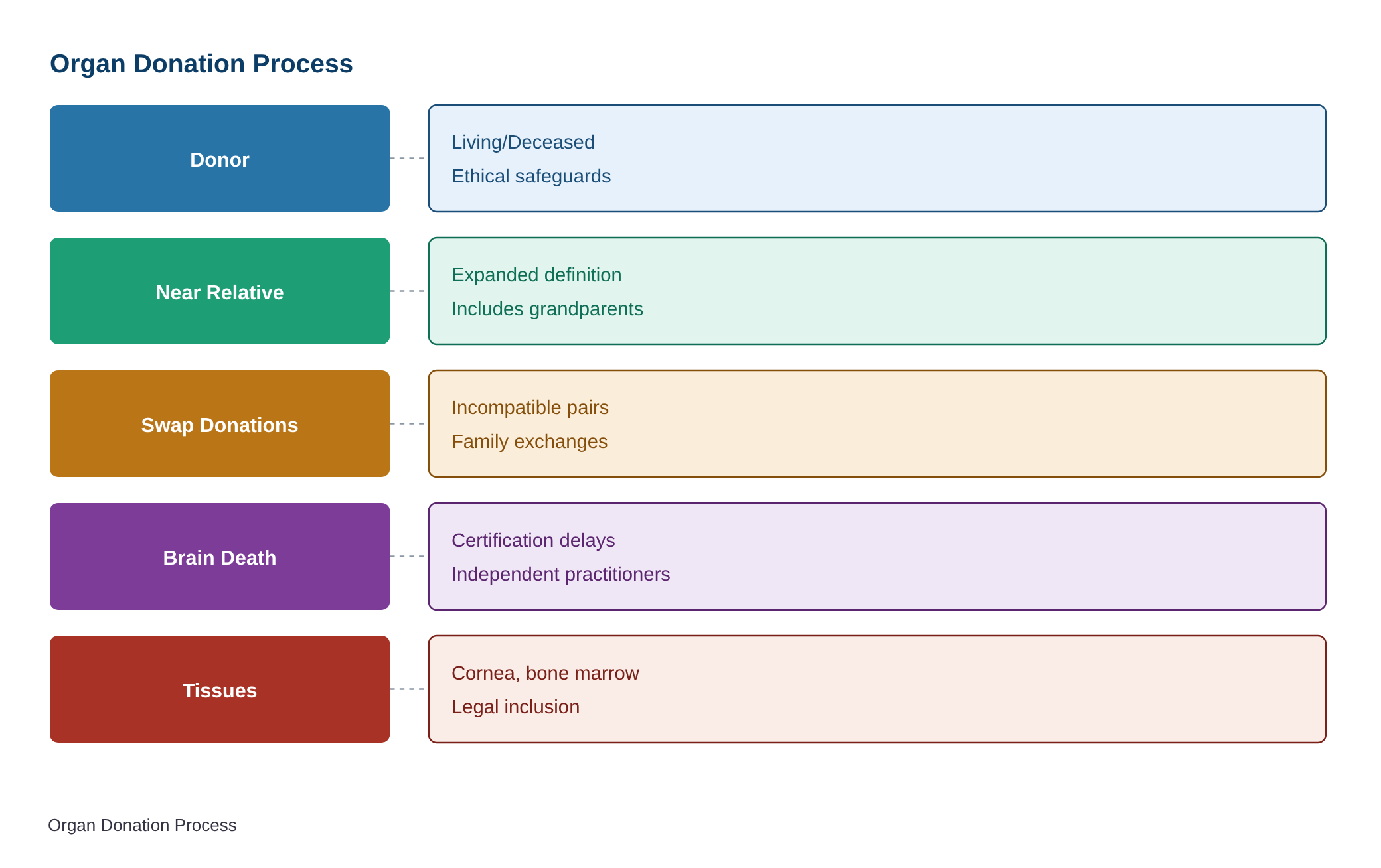
- The 2011 Amendment Act introduced critical provisions such as the expansion of the definition of ‘near relative’ to include grandparents and grandchildren, enabling more living donor transplants without stringent unrelated donor approval processes.
- The amendment also introduced ‘swap donations’, allowing incompatible donor-recipient pairs within families to exchange donors, thereby increasing the feasibility of successful transplants.
- Procedural safeguards were strengthened to protect vulnerable populations, including prohibitions on organ removal from mentally challenged persons and minors, and restrictions on donations to foreign nationals unless they are near relatives.
- The amendments also addressed delays in brain death certification by permitting the nomination of independent practitioners when specialised neurologists are unavailable, provided they are not part of the transplant team.
What is the Transplantation of Human Organs and Tissues Act, and its Amendments?
- The Transplantation of Human Organs Act, 1994 (Central Act) was the primary legal framework governing the removal, storage, and transplantation of human organs in India. It was renamed ‘Transplantation of Human Organs and Tissues Act’ by the 2011 amendment.
- The 2011 Amendment Act expanded the scope of the legislation to include human tissues such as skin, cornea, heart valves, tendons, and bone marrow, recognising advancements in medical science and the growing need for tissue transplants.
- The 2011 Amendment Act expanded the definition of ‘near relative’ to include grandparents and grandchildren, facilitating more living donor transplants while maintaining ethical standards.
- ‘Swap donation’ is a provision introduced to enable two incompatible donor-recipient pairs to exchange donors, thereby increasing the likelihood of successful transplants within families without resorting to unrelated donors.
- Procedural safeguards under the Act prohibit the removal of organs or tissues from mentally challenged persons and minors, ensuring protection for vulnerable groups from exploitation.
- The Act mandates Authorisation Committee approval for foreign nationals seeking organ or tissue transplants in India, and prohibits Indian nationals from donating to foreigners unless they are near relatives, thereby preventing organ trafficking.
- For brain death certification, the Act permits the nomination of independent practitioners when specialised neurologists are unavailable, provided they are not part of the transplant team, to avoid delays in life-saving procedures.
- The Act also establishes stringent penalties for violations, including imprisonment and fines, to deter unethical practices such as organ trafficking and commercialisation.
Key Features
| Feature | Significance |
|---|---|
| Expansion of legal framework to include human tissues (e.g., cornea, bone marrow) | Broadens the scope of regulated transplantation beyond organs, addressing a critical gap in medical needs and ethical oversight. |
| Revised definition of ‘near relative’ to include grandparents and grandchildren | Expands the pool of eligible living donors while maintaining familial safeguards, reducing reliance on unrelated donors and associated ethical risks. |
| Introduction of swap donations for incompatible donor-recipient pairs | Enhances the feasibility of living-donor transplantation within families by enabling mutual exchanges, thereby increasing successful outcomes. |
| Prohibition of organ/tissue removal from mentally challenged persons and restrictions on donations from minors | Strengthens protections for vulnerable populations, aligning with ethical and human rights standards in medical practice. |
| Authorisation Committee approval for foreign nationals and restrictions on Indian nationals donating to foreigners (unless near relatives) | Mitigates risks of organ trafficking and commercialisation while ensuring transparency in cross-border donations. |
| Provision for nomination of independent practitioners for brain death certification in the absence of specialised neurologists | Reduces procedural delays in deceased-donor transplantation, improving the efficiency of organ procurement systems. |
Why it Matters
Ethical and Human Rights
- The amendments reinforce the principle of voluntary donation by eliminating coercion or exploitation of vulnerable groups, aligning with the WHO Guiding Principles on Human Cell, Tissue and Organ Transplantation.
- Prohibitions on donations from minors and mentally challenged persons uphold the ethical doctrine of ‘do no harm’ and protect fundamental rights under Article 21 of the Constitution.
- Stricter oversight for cross-border donations addresses concerns of organ trafficking, a violation of human dignity and international law.
Public Health and Medical Infrastructure
- Expansion of the legal framework to include tissues addresses unmet medical needs, particularly in corneal transplants and bone marrow therapies, reducing preventable blindness and blood disorders.
- Procedural streamlining (e.g., independent certification for brain death) improves the efficiency of organ procurement, potentially increasing the number of transplants performed annually.
- The amendments incentivise deceased-donor registrations by clarifying legal pathways, which could alleviate pressure on living-donor systems.
Legal and Governance Framework
- Harmonisation of the State Act with the central legislation ensures uniformity in transplantation laws, reducing regulatory fragmentation and enhancing compliance.
- The inclusion of swap donations introduces a structured mechanism to navigate immunological incompatibilities, reducing the ethical dilemmas associated with unrelated donations.
- Tightened authorisation processes for foreign nationals reduce the risk of commercial exploitation while maintaining transparency in international collaborations.
Societal Impact
- By expanding the donor pool within families, the amendments reduce the psychological and financial burden on patients awaiting transplants, particularly in rural and underserved regions.
- The amendments may indirectly promote awareness of organ donation, as the legalisation of swap donations and broader donor definitions could stimulate public discourse on ethical transplantation.
Challenges
1. Implementation and Enforcement Gaps
- Ensuring strict compliance with the amended provisions, particularly in rural and tribal areas where awareness of transplantation laws may be limited.
- Monitoring Authorisation Committees to prevent delays or biases in approving donations, including those involving foreign nationals.
- Addressing the shortage of trained medical professionals for brain death certification and organ procurement, especially in government hospitals.
UPSC Link: GS2-Governance-Issues
2. Ethical Dilemmas in Swap Donations
- Balancing the benefits of swap donations with the risk of coercion or undue influence within families, particularly in cases of financial dependence.
- Ensuring that swap donations do not inadvertently exploit socio-economically disadvantaged donors who may feel obligated to participate.
UPSC Link: GS4-Ethics
3. Cross-Border Organ Trafficking Risks
- Monitoring the movement of organs across borders to prevent illegal trafficking networks from exploiting loopholes in the authorisation process.
- Ensuring that restrictions on Indian nationals donating to foreigners do not inadvertently push transplant tourism to less regulated jurisdictions.
UPSC Link: GS3-Economic-Issues
4. Public Awareness and Behavioural Change
- Overcoming cultural and religious taboos associated with organ donation, particularly in regions with low registration rates for deceased donors.
- Educating potential donors and recipients about the legal pathways for swap donations and the ethical safeguards in place.
UPSC Link: GS2-Social-Issues
5. Resource Constraints in Healthcare
- Addressing the lack of infrastructure for tissue preservation and transplantation in government hospitals, which may limit the practical impact of the amendments.
- Ensuring equitable access to transplantation services across socio-economic groups, as costs may remain prohibitive for marginalised populations.
UPSC Link: GS2-Health
Challenges — UPSC Perspective
| Issue | Concern |
|---|---|
| Rural-Urban Divide in Awareness | Limited dissemination of the amendments in rural areas may lead to underutilisation of legal provisions. |
| Authorisation Committee Delays | Bureaucratic hurdles in approving donations could defeat the purpose of streamlining processes. |
| Shortage of Specialised Medical Personnel | Insufficient neurologists and transplant surgeons may hinder the implementation of brain death certification and organ procurement. |
| Socio-Economic Disparities in Access | High costs of transplantation may exclude economically weaker sections despite legal provisions. |
| Cultural and Religious Barriers | Deep-seated beliefs may impede public acceptance of organ donation, particularly for deceased donors. |
| Cross-Border Trafficking Risks | Loopholes in enforcement could allow illegal organ trade to persist despite stricter regulations. |
Way Forward
- Conduct state-wide awareness campaigns in local languages to educate the public about the legal provisions, ethical safeguards, and procedural pathways for organ donation and transplantation.
- Strengthen the capacity of Authorisation Committees by providing training on ethical guidelines, legal provisions, and anti-trafficking measures, with regular audits to ensure compliance.
- Expand the network of transplant centres in government hospitals, particularly in rural and tribal districts, to improve access and reduce out-of-pocket expenses for patients.
- Establish a digital platform for deceased-donor registration and organ allocation, integrated with Aadhaar and health records, to streamline the process and reduce delays.
- Collaborate with medical colleges and NGOs to conduct workshops on brain death certification and organ procurement, addressing the shortage of specialised personnel.
- Enhance inter-state coordination to prevent organ trafficking, including sharing of donor-recipient data and joint enforcement mechanisms with neighbouring states.
- Introduce financial incentives for deceased-donor families (e.g., tax benefits or priority in government schemes) to encourage registration, while ensuring these do not compromise voluntariness.
- Monitor and evaluate the impact of swap donations on family dynamics and ethical compliance, with periodic reviews to address emerging concerns.
UPSC Value Addition
Keywords for Mains Answer-Writing
Transplantation of Human Organs and Tissues Act, 1994 · Transplantation of Human Organs (Amendment) Act, 2011 · Organ trafficking regulation · Brain death certification norms · Near-relative definition expansion · Swap donation mechanism · Authorisation Committee for foreign nationals · Mentally challenged persons and organ donation · Minor donors and transplantation safeguards · Ethical challenges in medical transplantation · Demand-supply gap in human organs · Andhra Pradesh Legislative Assembly amendments
Constitutional & Policy Linkages
- [‘Article 21: Right to Life and Personal Liberty’, ‘Protects the right to refuse or consent to organ donation, ensuring voluntariness.’]
- [‘Article 14: Equality before Law’, ‘Ensures non-discriminatory access to transplantation services and fair authorisation processes.’]
- [‘Article 39(f): Directive Principles of State Policy’, ‘Guides the state to protect children and vulnerable groups from exploitation in medical procedures.’]
Concept Flow
Demand-supply gap in organs → Legislative response (Transplantation of Human Organs Act, 1994) → State adaptation (AP Act, 1995) → Central amendments (2011) to include tissues and expand donor definitions → State-level amendments (2026) to harmonise with central provisions → Enhanced legal framework for ethical and efficient transplantation → Implementation challenges in enforcement, awareness, and infrastructure → Way forward: capacity building, digital integration, and public education.
Prelims Practice Questions
Q1. Consider the following statements regarding the Transplantation of Human Organs and Tissues Act, 1994 and its amendments:
1. The 2011 Amendment Act expanded the legal framework to include human tissues such as skin, cornea, and bone marrow.
2. The definition of ‘near relative’ was expanded to include grandparents and grandchildren under the 2011 Amendment.
3. The Act prohibits organ donation by minors under any circumstances.
4. Authorisation Committee approval is required for foreign nationals seeking organ transplants in India.
How many of the above statements are correct?
- Only one
- Only two
- Only three
- All four
Answer: All four — Statements 1, 2, and 4 are correct. Statement 3 is incorrect as the Act permits organ donation by minors under specific safeguards, not an absolute prohibition.
Q2. Assertion (A): The Transplantation of Human Organs (Amendment) Act, 2011 introduced provisions for swap donations to increase opportunities for successful transplantation within families.
Reason (R): Swap donations enable two incompatible donor-recipient pairs to exchange donors, thus ensuring compatibility for both recipients.
In the context of the above two statements, which one of the following is correct?
- Both A and R are true, and R is the correct explanation of A.
- Both A and R are true, but R is not the correct explanation of A.
- A is true, but R is false.
- A is false, but R is true.
Answer: Both A and R are true, and R is the correct explanation of A. — Both the assertion and reason are true, and the reason correctly explains the assertion. Swap donations were indeed introduced to facilitate compatible transplants within families.
Q3. Match the following provisions of the Transplantation of Human Organs and Tissues Act, 1994 with their corresponding descriptions:
Column I (Provisions)
A. Definition of ‘near relative’
B. Swap donation mechanism
C. Authorisation Committee for foreign nationals
D. Brain death certification norms
Column II (Descriptions)
1. Allows two incompatible donor-recipient pairs to exchange donors for compatibility.
2. Expanded to include grandparents and grandchildren under the 2011 Amendment.
3. Requires approval for foreign nationals seeking organ transplants in India.
4. Permits nomination of independent practitioners for certification when neurologists are unavailable.
Select the correct match:
- A-2, B-1, C-3, D-4
- A-1, B-2, C-3, D-4
- A-3, B-1, C-2, D-4
- A-4, B-2, C-1, D-3
Answer: A-2, B-1, C-3, D-4 — The correct matches are: A-2 (near relative definition), B-1 (swap donation), C-3 (Authorisation Committee), and D-4 (brain death certification norms).
Mains Practice Question
✍ The Transplantation of Human Organs and Tissues Act, 1994, as amended in 2011, represents a significant evolution in India’s regulatory framework to address ethical challenges and bridge the organ demand-supply gap. Critically examine the key provisions of the Act and their implications for medical ethics, governance, and the prevention of organ trafficking. Also, evaluate the effectiveness of the Authorisation Committee mechanism in balancing accessibility and ethical safeguards. (15 Marks)
Approach: MODEL-ANSWER SKELETON:
1. **Introduction (2 marks)**: Briefly outline the organ demand-supply gap in India and the need for regulatory intervention. Mention the Transplantation of Human Organs and Tissues Act, 1994, and the 2011 Amendment Act as the legal backbone.
2. **Key Provisions and Their Implications (8 marks)**:
– **Expansion of ‘near relative’ definition**: Include grandparents and grandchildren; discuss ethical implications of broadening the donor pool while preventing coercion.
– **Swap donation mechanism**: Explain how it facilitates compatible transplants within families; cite its role in reducing waitlist mortality.
– **Tissue inclusion**: Expansion to include skin, cornea, bone marrow; discuss how this addresses broader medical needs.
– **Safeguards for vulnerable groups**: Prohibition on organ removal from mentally challenged persons and restrictions on minors; evaluate the balance between protection and accessibility.
– **Authorisation Committee for foreign nationals**: Discuss its role in preventing organ trafficking and ensuring ethical compliance.
– **Brain death certification norms**: Permitting independent practitioners; assess the implications for reducing delays and maintaining ethical standards.
3. **Prevention of Organ Trafficking (3 marks)**:
– Discuss the Act’s provisions to curb trafficking, including the prohibition on unrelated donations without Authorisation Committee approval.
– Evaluate the effectiveness of the Authorisation Committee mechanism in balancing accessibility for legitimate foreign nationals while preventing exploitation.
4. **Conclusion (2 marks)**: Summarise the Act’s strengths in addressing ethical and supply-side challenges, while acknowledging limitations such as enforcement gaps or regional disparities in implementation.
Source: The Hindu
Generated by AanyaAi for educational purpose.

- मद्रास उच्च न्यायालय में ‘वेट्ट्री पयणम’ योजना को असंवैधानिक घोषित करने की मांग - October 4, 2026
- Gurugram’s groundwater extraction exceeds limit by 212%; HC seeks ban - October 4, 2026
- स्वतंत्रता सेनानी श्यामजी कृष्ण वर्मा की जन्म जयंती पर पीएम का श्रद्धांजलि - October 4, 2026

No Comments