


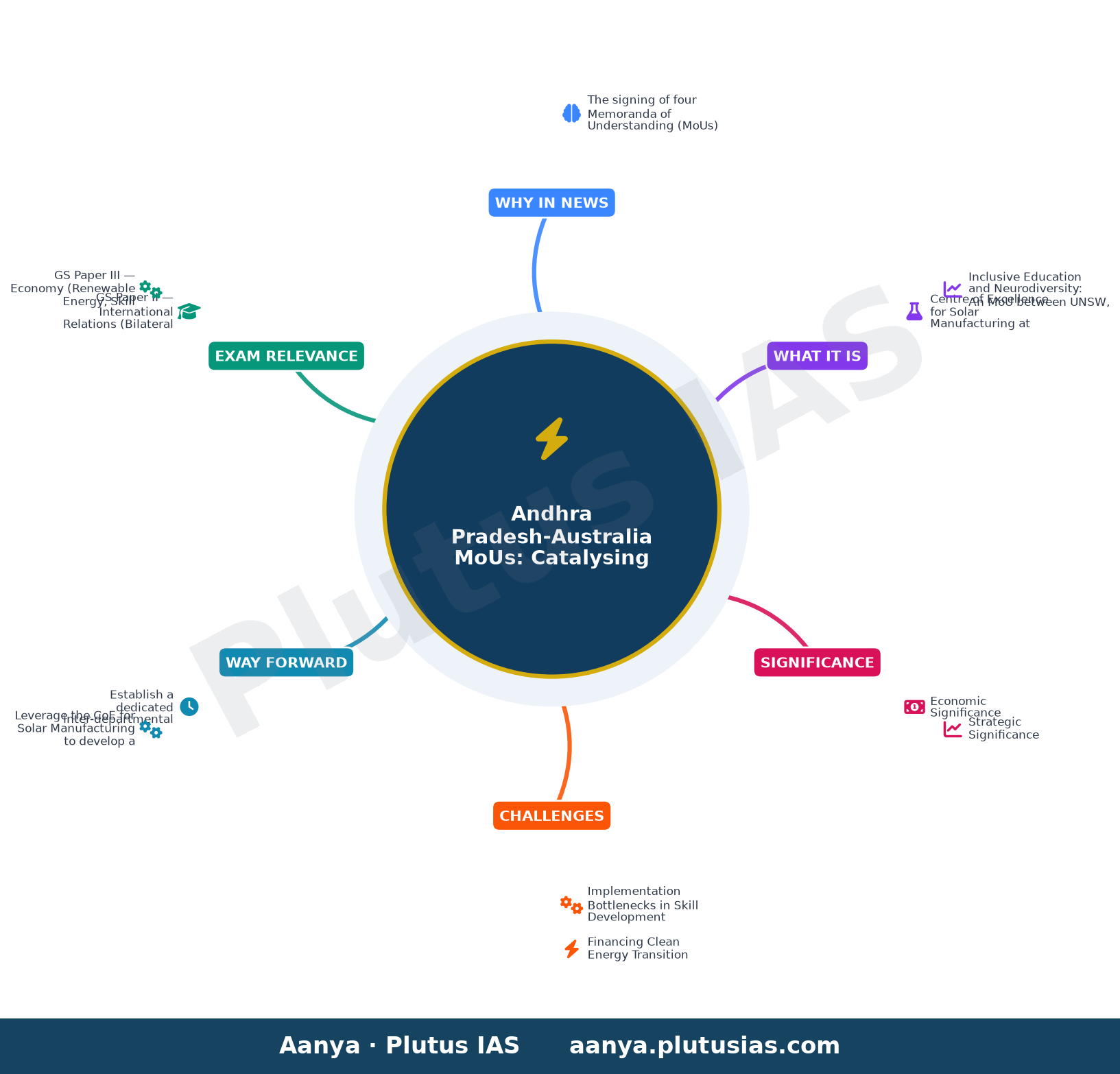
09 Aug Andhra Pradesh-Australia MoUs: Boosting Clean Energy & Education for UPSC 2026
✎ The Andhra Pradesh-Australia MoUs represent a strategic convergence of clean energy innovation, inclusive education, and skill development, positioning Andhra Pradesh as a key player in India’s renewable energy transition and…
Subject Relevance — Where This Topic Fits
- GS Paper II — International Relations (Bilateral Relations: India-Australia) | GS Paper III — Economy (Renewable Energy, Skill Development, Manufacturing) | GS Paper III — Environment (Clean Energy Transition, Climate Change Mitigation)
- Prelims: Memorandum of Understanding (MoU), Centre of Excellence (CoE), Solar Manufacturing, Neurodiversity, Skill Development, Renewable Energy, IIT-Tirupati, UNSW Sydney, Araku Coffee, Andhra Pradesh Economic Growth
- Essay: India’s Renewable Energy Transition: Opportunities and Challenges, Global Education and Skill Partnerships: A Pathway to Sustainable Development
Quick Revision: The Andhra Pradesh-Australia MoUs represent a strategic convergence of clean energy innovation, inclusive education, and skill development, positioning Andhra Pradesh as a key player in India’s renewable energy transition and global educational partnerships.
Why is this in the news?
The signing of four Memoranda of Understanding (MoUs) between Andhra Pradesh and Australia on 8 August 2026 marks a significant milestone in bilateral cooperation, focusing on clean energy, advanced manufacturing, inclusive education, student mental health, and skill development. These agreements, formalised in the presence of high-level officials from both governments, underscore Andhra Pradesh’s strategic vision to position itself as a global hub for renewable energy innovation and a skilled workforce, while addressing neurodiverse educational needs and fostering bilateral ties with Australia.
Background
- Andhra Pradesh has emerged as a frontrunner in India’s renewable energy transition, with ambitious targets to scale up solar and wind energy capacity under its State Action Plan on Climate Change.
- Australia, a global leader in clean energy innovation and research, has been actively seeking international partnerships to advance its own decarbonisation goals and strengthen educational and technological exchanges.
- The bilateral relationship between India and Australia has deepened in recent years, particularly in the domains of education, trade, and climate action, as evidenced by the 2020 Comprehensive Strategic Partnership.
- Andhra Pradesh’s Chief Minister N. Chandrababu Naidu has prioritised economic growth through investment in advanced manufacturing, innovation ecosystems, and skill development, aligning with the State’s ‘Vision 2030’ development agenda.
- The Australian delegation’s visit to Amaravati reflects the growing interest of developed economies in collaborating with Indian States to leverage India’s demographic dividend and emerging market potential.
- The MoUs build on prior engagements, including Minister Nara Lokesh’s visit to Australia in October 2025, which laid the groundwork for these strategic partnerships.
Key Dimensions of the Andhra Pradesh-Australia MoUs
- Centre of Excellence for Solar Manufacturing at IIT-Tirupati: A tripartite MoU between Andhra Pradesh’s Centre of Excellence for Energy Transition (CoEET), IIT-Tirupati, and the University of New South Wales (UNSW) Sydney to establish a dedicated research and innovation hub focused on solar manufacturing. The Centre aims to drive cutting-edge research, technology transfer, and workforce development to support India’s clean energy transition and reduce dependence on imported solar components.
- Inclusive Education and Neurodiversity: An MoU between UNSW, Sri Padmavati Mahila Visvavidyalayam (Tirupati), and Samagra Shiksha, Andhra Pradesh, to enhance teacher training and pedagogical strategies for supporting children with autism and other neurodiverse learning needs. This aligns with the Right to Education Act, 2009, and India’s National Education Policy 2020, which emphasise inclusive and equitable education.
- Skill Development and Advanced Manufacturing: The agreements are expected to facilitate knowledge exchange, joint certification programmes, and industry-academia collaborations in advanced manufacturing, renewable energy technologies, and digital skills. This aligns with the National Skill Development Mission and the Skill India initiative.
- Bilateral Diplomatic Engagement: The visit of Australia’s Assistant Minister for International Education and Citizenship, Julian Hill, to Amaravati, and the ceremonial exchange of traditional shawls and Araku Coffee, symbolise the strengthening of people-to-people ties and cultural diplomacy alongside economic and educational cooperation.
- State-Level Innovation Ecosystem: The MoUs are part of Andhra Pradesh’s broader strategy to position itself as a ‘Centre of Excellence’ in clean energy and advanced manufacturing, leveraging its geographical advantages, industrial corridors, and research institutions like IIT-Tirupati.
- Research and Innovation Collaboration: The partnerships with UNSW Sydney, a globally ranked university in engineering and technology, highlight the role of international collaborations in accelerating India’s transition to a knowledge-driven economy and achieving its climate commitments under the Paris Agreement.
Key Features
| Feature | Significance |
|---|---|
| Centre of Excellence (CoE) for Solar Manufacturing at IIT-Tirupati | Establishes a globally competitive research and manufacturing hub, aligning with Andhra Pradesh’s clean energy transition and fostering innovation in solar technology. |
| Inclusive Education MoU with UNSW and SPMVV | Enhances teacher training for neurodiverse learners, promoting equitable access to education and addressing the needs of children with autism and other learning differences. |
| Skill Development Partnerships | Focuses on upskilling the workforce to meet the demands of advanced manufacturing and clean energy sectors, ensuring a talent pipeline for industrial growth. |
| State-Level Clean Energy Transition Framework | Integrates renewable energy capacity building with advanced manufacturing and research, positioning Andhra Pradesh as a leader in India’s energy transition. |
Why it Matters
Economic Significance
- Accelerates Andhra Pradesh’s transition to a green economy by leveraging solar manufacturing and clean energy innovation.
- Attracts foreign direct investment (FDI) through high-tech partnerships, boosting industrialization and job creation.
- Strengthens the State’s position as a hub for advanced manufacturing, aligning with the ‘Make in India’ initiative while tailoring it to renewable energy.
Strategic Significance
- Deepens bilateral cooperation between India and Australia in critical sectors like clean energy, education, and skill development.
- Positions Andhra Pradesh as a model for sub-national diplomacy, demonstrating how states can lead international partnerships independently.
- Enhances India’s energy security by fostering domestic solar manufacturing capabilities and reducing reliance on imports.
Social Significance
- Promotes inclusive education by addressing the needs of neurodiverse learners, aligning with the Right to Education (RTE) Act’s provisions.
- Supports skill development for marginalized communities, contributing to equitable economic growth and reducing regional disparities.
- Improves mental health support for students through targeted initiatives, addressing a growing concern in India’s education system.
Challenges
1. Implementation Bottlenecks in Skill Development
- Ensuring alignment between industry demand and skill development programmes to avoid a mismatch in workforce capabilities.
- Addressing the scalability of inclusive education initiatives to cover all districts and socio-economic groups.
- Overcoming bureaucratic hurdles in cross-border collaborations, particularly in technology transfer and joint research.
UPSC Link: GS3: Skill Development and Employment
2. Financing Clean Energy Transition
- Securing long-term funding for large-scale solar manufacturing and research infrastructure.
- Balancing public-private partnerships (PPPs) to ensure sustainable investment without overburdening the State exchequer.
- Mitigating risks associated with technological obsolescence in rapidly evolving renewable energy sectors.
UPSC Link: GS3: Infrastructure and Energy
3. Regulatory and Policy Gaps
- Harmonizing State-level policies with national frameworks (e.g., National Education Policy 2020, National Solar Mission) to avoid conflicts.
- Ensuring compliance with environmental and labor standards in advanced manufacturing hubs.
- Streamlining approval processes for setting up CoEs and skill development centres.
UPSC Link: GS2: Centre-State Relations
Challenges — UPSC Perspective
| Issue | Concern |
|---|---|
| Workforce Skill Mismatch | Industry demand for advanced manufacturing and clean energy skills may outpace supply, leading to underemployment or unemployment. |
| Infrastructure Deficits | Inadequate physical and digital infrastructure in rural areas may hinder the effective implementation of inclusive education and skill programmes. |
| Policy Fragmentation | Divergent State and Central policies could create regulatory confusion, delaying project execution. |
| Funding Sustainability | Over-reliance on foreign partnerships may lead to dependency, while domestic funding could be constrained by fiscal pressures. |
Way Forward
- Establish a dedicated inter-departmental task force to monitor the implementation of MoUs and address bottlenecks in real time.
- Leverage the CoE for Solar Manufacturing to develop a State-level solar policy roadmap, integrating R&D, manufacturing, and skill development.
- Expand inclusive education programmes by partnering with NGOs and international organizations to scale teacher training initiatives.
- Create a skill development fund with contributions from State, Central, and private sectors to ensure sustainable financing.
- Conduct periodic reviews of industry-academia collaborations to align curricula with evolving market needs.
- Enhance digital infrastructure in rural and tribal areas to support remote learning and skill development.
- Strengthen bilateral dialogues with Australia to explore additional sectors for collaboration, such as water management and agriculture technology.
UPSC Value Addition
Keywords for Mains Answer-Writing
Andhra Pradesh-Australia MoUs · Centre of Excellence for Solar Manufacturing · IIT-Tirupati · clean energy transition · inclusive education · neurodiverse learning needs · skill development · Australia-India bilateral cooperation · State Centre of Excellence for Energy Transition (CoEET) · University of New South Wales (UNSW) · Sri Padmavati Mahila Visvavidyalayam · Samagra Shiksha · advanced manufacturing · workforce development
Constitutional & Policy Linkages
- [‘Article 246: State List (Education)’, ‘Empowers State governments to legislate on education policies and skill development.’]
- [‘Article 29 and 30: Cultural and Educational Rights’, ‘Protects the right of minorities to establish and administer educational institutions, relevant for inclusive education initiatives.’]
Concept Flow
Bilateral diplomatic engagement between Andhra Pradesh and Australia → Identification of shared priorities: clean energy, education, and skill development → Signing of MoUs to formalize cooperation in identified sectors → Establishment of CoE for Solar Manufacturing at IIT-Tirupati → Implementation of inclusive education programmes for neurodiverse learners → Skill development initiatives to upskill workforce for advanced manufacturing → Creation of a talent pipeline to support Andhra Pradesh’s clean energy transition
Prelims Practice Questions
Q1. Consider the following statements regarding the MoUs signed between Andhra Pradesh and Australia:
1. One MoU establishes a Centre of Excellence for Solar Manufacturing at IIT-Tirupati.
2. Another MoU focuses on strengthening inclusive education for children with autism and other neurodiverse learning needs.
3. The agreements also include a partnership between the State Centre of Excellence for Energy Transition (CoEET) and the University of New South Wales (UNSW).
How many of the above statements are correct?
- Only one
- Only two
- All three
- None
Answer: All three — Statements 1 and 3 are correct as they directly reference the MoUs signed. Statement 2 is also correct as it aligns with the reported focus on inclusive education. Thus, all three statements are accurate.
Q2. Assertion (A): The Centre of Excellence for Solar Manufacturing at IIT-Tirupati is intended to drive cutting-edge research and innovation in clean energy.
Reason (R): The partnership aligns with Andhra Pradesh’s vision to build a complete ecosystem of renewable energy, advanced manufacturing, and skilled professionals.
Options:
A. Both A and R are true, and R is the correct explanation of A.
B. Both A and R are true, but R is not the correct explanation of A.
C. A is true, but R is false.
D. A is false, but R is true.
Answer: ? — Both the Assertion (A) and Reason (R) are true, and R correctly explains A. The establishment of the Centre of Excellence is explicitly designed to support clean energy innovation and aligns with the State’s broader ecosystem-building goals.
Q3. Match the following MoUs signed between Andhra Pradesh and Australia with their respective focus areas:
Column I (MoU Focus Area)
1. Clean energy and advanced manufacturing
2. Inclusive education for neurodiverse learners
3. Student mental health and skill development
Column II (Partner Institutions)
A. University of New South Wales (UNSW), IIT-Tirupati
B. UNSW, Sri Padmavati Mahila Visvavidyalayam, Samagra Shiksha
C. UNSW, State Centre of Excellence for Energy Transition (CoEET)
Choose the correct match:
- 1-A, 2-B, 3-C
- 1-C, 2-B, 3-A
- 1-A, 2-C, 3-B
- 1-B, 2-A, 3-C
Answer: 1-C, 2-B, 3-A — 1-C: The Centre of Excellence for Solar Manufacturing involves UNSW and CoEET. 2-B: The inclusive education MoU involves UNSW, Sri Padmavati Mahila Visvavidyalayam, and Samagra Shiksha. 3-A: The clean energy and advanced manufacturing MoU involves UNSW and IIT-Tirupati.
Mains Practice Question
✍ Critically examine the significance of the recent MoUs signed between Andhra Pradesh and Australia for India’s clean energy transition and inclusive education. Also, discuss the potential challenges in translating these agreements into tangible outcomes. (15 Marks)
Approach: MODEL-ANSWER SKELETON:
1. **Introduction (2 marks)**
– Briefly outline the MoUs signed: Centre of Excellence for Solar Manufacturing at IIT-Tirupati, inclusive education for neurodiverse learners, and skill development.
– State the broader context: Andhra Pradesh’s ambition to become a hub for clean energy innovation and advanced manufacturing.
2. **Significance for Clean Energy Transition (5 marks)**
– **Technology and Innovation**: The Centre of Excellence at IIT-Tirupati will drive cutting-edge research in solar manufacturing, aligning with India’s renewable energy targets (e.g., National Solar Mission).
– **Workforce Development**: The partnership aims to create a globally competitive talent pipeline, addressing the skilled labour gap in the clean energy sector.
– **Ecosystem Building**: The MoU with the State Centre of Excellence for Energy Transition (CoEET) and UNSW will foster a complete ecosystem of research, manufacturing, and innovation.
– **Bilateral Cooperation**: Strengthens India-Australia ties in critical sectors, leveraging Australia’s expertise in renewable energy and education.
3. **Significance for Inclusive Education (4 marks)**
– **Addressing Neurodiversity**: The MoU between UNSW, Sri Padmavati Mahila Visvavidyalayam, and Samagra Shiksha aims to improve teacher training for supporting children with autism and other neurodiverse needs.
– **Policy Alignment**: Aligns with the Rights of Persons with Disabilities Act, 2016, and the National Education Policy (NEP) 2020, which emphasize inclusive education.
– **Long-term Impact**: Enhances equitable access to quality education, reducing disparities in learning outcomes.
4. **Potential Challenges (4 marks)**
– **Implementation Gaps**: Risk of bureaucratic delays, lack of coordination between state and central agencies, and insufficient monitoring mechanisms.
– **Funding and Sustainability**: Dependence on external funding (e.g., from Australia) may pose sustainability challenges post-MoU period.
– **Skill Mismatch**: Ensuring the workforce developed aligns with industry needs in the clean energy sector.
– **Inclusive Education Barriers**: Overcoming stigma, lack of trained special educators, and resource constraints in rural areas.
– **Geopolitical Factors**: Potential shifts in Australia-India relations or global energy policies could impact the MoUs’ execution.
5. **Conclusion (2 marks)**
– Summarize the transformative potential of the MoUs while emphasizing the need for robust implementation frameworks, inter-ministerial coordination, and sustained funding to realize their objectives.
Source: The Hindu
Generated by AanyaAi for educational purpose.

- आईआईडब्ल्यूडब्ल्यू 2026: भारत-नीदरलैंड ने जल साझेदारी मजबूत की, कल्पसर परियोजना पर समझौता - September 24, 2026
- IIWW 2026: India-Netherlands Strengthen Water Partnership for UPSC Mains - September 24, 2026
- डीआरडीओ ने क्वांटम तकनीक के लिए 20 मिलीकेल्विन रेफ्रिजरेटर विकसित किया: जानिए क्यों है यह उपलब्धि महत्वपूर्ण - September 24, 2026

No Comments