


03 Sep Andhra Pradesh Cabinet Approves ₹4,054 Cr Rural Water Works & ₹94 Cr Tobacco Support
✎ Jal Jeevan Mission 2.0 rationalises rural water supply schemes to eliminate duplication and accelerate ‘Har Ghar Jal’, while price deficiency support for tobacco farmers under PM-AASHA-like mechanisms stabilises agricultural…
Subject Relevance — Where This Topic Fits
- GS Paper II — Government Policies and Interventions for Development in various sectors | GS Paper III — Agriculture, Food Processing and Related Issues | GS Paper III — Infrastructure: Energy, Ports, Roads, Airports, Railways, etc.
- Prelims: Jal Jeevan Mission (JJM) 2.0, Har Ghar Jal, Price Deficiency Payment Scheme (PDPS), APTRANSCO, APGENCO, AP MARKFED, PM-KUSUM Scheme, Single Village Scheme (SVS), Multi Village Scheme (MVS), Fire Precautionary Fee, Totapuri mangoes
- Essay: Agricultural distress and state interventions: Balancing equity and fiscal prudence, Sustainable rural infrastructure: The role of fiscal federalism in water and energy security
Quick Revision: Jal Jeevan Mission 2.0 rationalises rural water supply schemes to eliminate duplication and accelerate ‘Har Ghar Jal’, while price deficiency support for tobacco farmers under PM-AASHA-like mechanisms stabilises agricultural incomes.
Why is this in the news?
The Andhra Pradesh Cabinet’s approval of ₹4,054 crore for rural water supply rationalisation under Jal Jeevan Mission 2.0 and ₹94 crore for tobacco price support reflects the state’s dual focus on rural infrastructure development and agricultural market stabilisation. The decisions also include institutional arrangements such as government guarantees for power sector loans and flood-damage restoration, highlighting the interplay between fiscal policy, sectoral governance, and disaster resilience in state administration.
Background
- The Jal Jeevan Mission (JJM), launched by the Government of India in 2019, aims to provide tap water supply to every rural household by 2024.
- Andhra Pradesh, a predominantly agrarian state, has historically faced challenges in water distribution efficiency due to fragmented schemes and overlapping administrative jurisdictions, necessitating rationalisation of rural water supply works.
- The Power Finance Corporation (PFC) and Rural Electrification Corporation (REC) are central public sector undertakings providing financial assistance to state power utilities for infrastructure development.
- Floods in Krishna, NTR, Guntur, and Bapatla districts in recent years have underscored the need for targeted restoration and resilient infrastructure planning in disaster-prone regions.
Key Components of the Andhra Pradesh Cabinet Decisions
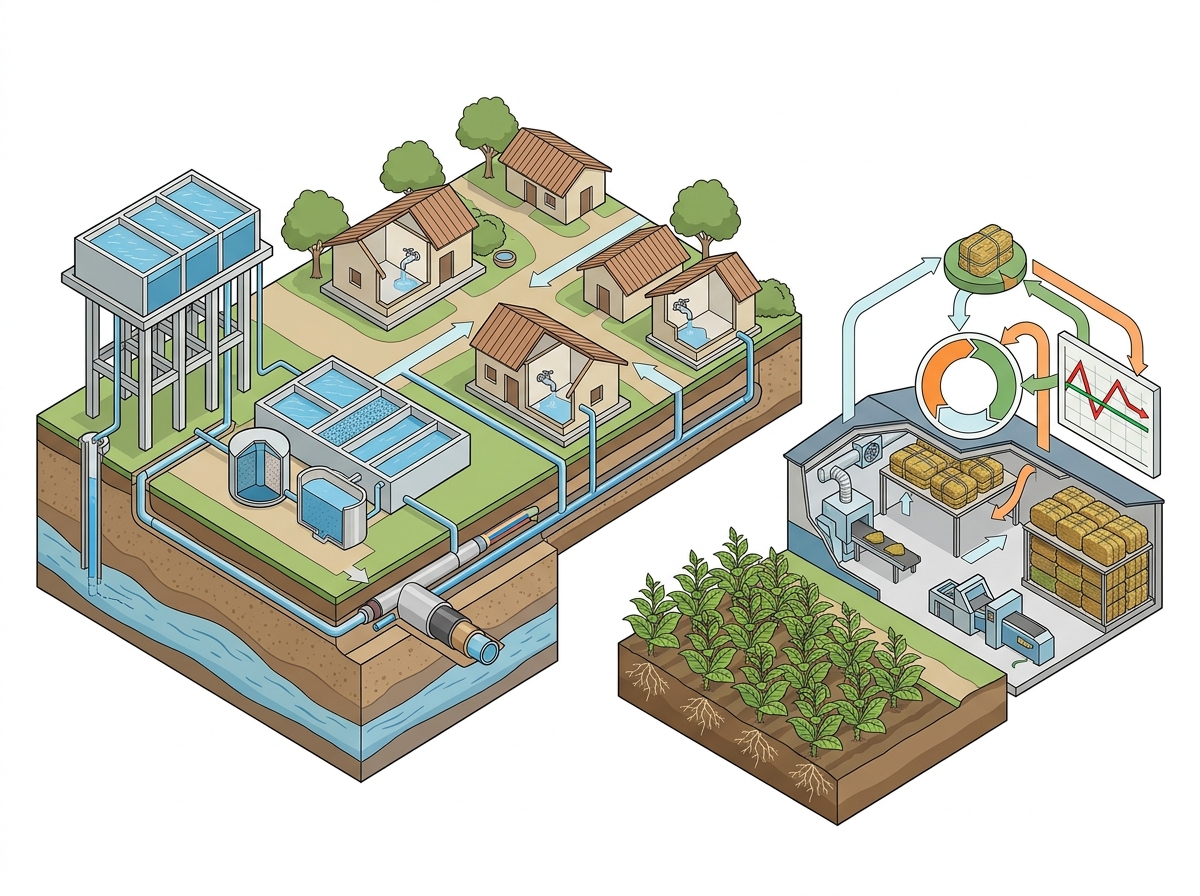
- Rationalisation of Rural Water Supply Works: The Cabinet approved restructuring 13,252 rural water supply works under JJM 2.0, converting 13,247 Single Village Schemes (SVS) into 7,439 schemes at ₹3,046 crore and five Multi Village Schemes (MVS) covering 334 villages at ₹1,007 crore. This rationalisation aims to eliminate duplication, improve operational efficiency, and accelerate the ‘Har Ghar Jal’ target.
- Price Deficiency Support for Tobacco Farmers: ₹94 crore was sanctioned to AP MARKFED to provide ₹10 per kg as price deficiency support for 94 million kg of low and off-style tobacco during the 2026 season, ensuring income stabilisation for farmers amid market fluctuations.
- Government Guarantees for Power Sector Loans: A ₹950-crore government guarantee was approved for APTRANSCO’s medium-term loan from PFC, alongside corporate guarantees of ₹500 crore (to PFC) and ₹550 crore (to REC) for APGENCO and APPDCL loans, respectively. These guarantees facilitate access to institutional credit for state power utilities.
- Policy Adjustments for Power Sector: The Cabinet approved the NHPC methodology for calculating price variation in Polavaram Hydroelectric Project works (₹558 crore including GST) and exempted APGENCO’s Sileru complex power stations from Fire Precautionary Fee, aligning state policies with central institutional frameworks.
- Cancellation of 800-MW Avuku Pumped Storage Project: The allotment to RVR Projects Private Limited under G.O.Ms.No.62 (July 28, 2025) was cancelled, indicating a reassessment of project viability or strategic priorities in the power sector.
Key Features
| Feature | Significance |
|---|---|
| Rationalisation of 13,252 rural water supply works under Jal Jeevan Mission (JJM) 2.0 | Optimises resource allocation by reducing redundant schemes, ensuring sustainable water supply to rural households under the ‘Har Ghar Jal’ target. |
| ₹4,054 crore allocation for rural water works | Enhances infrastructure resilience, reduces water scarcity, and aligns with Sustainable Development Goal 6 (Clean Water and Sanitation). |
| ₹94 crore price deficiency support for tobacco farmers | Mitigates income volatility for marginal farmers, stabilises rural livelihoods, and supports agricultural price policy mechanisms. |
| ₹950 crore government guarantee for APTRANSCO loan (PFC) | Facilitates credit access for state-owned power utilities, ensuring uninterrupted electricity supply and grid stability. |
| 78 flood-damage restoration works in Krishna, NTR, Guntur, and Bapatla districts | Accelerates post-disaster recovery, reduces economic losses, and reinforces climate resilience in flood-prone regions. |
| Approval of industrial land transfers for MSME parks and solar projects | Promotes industrialisation, employment generation, and renewable energy adoption under PM-KUSUM feeder-level solarisation. |
Why it Matters
Economic
- Enhances rural infrastructure, reducing agricultural and industrial bottlenecks through improved water and power access.
- Stabilises farmer incomes via price support mechanisms, reducing rural distress and migration pressures.
- Facilitates industrial growth through land allocation for MSME parks and renewable energy projects, boosting local economies.
Social
- Ensures equitable water access under JJM 2.0, aligning with constitutional directive principles of state policy (Article 47).
- Supports marginalised tobacco farmers, a key agrarian community, through direct benefit transfers.
- Improves public health by reducing water-borne diseases in rural areas.
Institutional
- Strengthens inter-departmental coordination between rural development, agriculture, and power sectors for integrated governance.
- Leverages public-private partnerships (e.g., loans from PFC/REC) to mobilise resources for state infrastructure.
Environmental
- Promotes sustainable water management through rationalisation of water supply schemes and solar energy projects.
- Supports climate resilience via flood-damage restoration and renewable energy integration.
Challenges
1. Fiscal Sustainability of Subsidies
- Price deficiency support for tobacco farmers may strain state finances if market prices remain depressed.
- Government guarantees for power utilities (APTRANSCO/APGENCO) expose the exchequer to debt risks if repayment defaults occur.
UPSC Link: GS3: Fiscal Policy
2. Implementation Bottlenecks in Rural Water Supply
- Rationalisation of 13,252 schemes requires meticulous planning to avoid delays in execution and fund misallocation.
- Geographical disparities in water scarcity may necessitate differential funding models across districts.
UPSC Link: GS2: Governance
3. Climate Vulnerability and Flood Risks
- Frequent flooding in Krishna, NTR, Guntur, and Bapatla districts demands adaptive infrastructure planning and early warning systems.
- Restoration works may face delays due to recurring monsoon disruptions or resource constraints.
UPSC Link: GS3: Disaster Management
4. Agricultural Price Volatility
- Tobacco price support may incentivise overproduction, leading to long-term market distortions.
- Dependence on government interventions risks crowding out private investment in alternative crops.
UPSC Link: GS3: Agriculture
5. Power Sector Financial Health
- APTRANSCO’s reliance on government guarantees highlights structural issues in DISCOM finances and tariff rationalisation.
- Cancellation of the 800-MW Avuku Pumped Storage Project may delay energy storage solutions, affecting grid stability.
UPSC Link: GS3: Energy
Challenges — UPSC Perspective
| Issue | Concern |
|---|---|
| Fiscal burden of subsidies | Potential strain on state budget due to recurring price support and loan guarantees. |
| Rural water supply implementation gaps | Risk of delays or misallocation in rationalising 13,252 schemes under JJM 2.0. |
| Climate-induced flood damage | Recurring disruptions to restoration works and infrastructure in flood-prone districts. |
| Agricultural market distortions | Long-term risks of over-reliance on price support mechanisms for tobacco farmers. |
| Power sector viability | Structural weaknesses in DISCOM finances despite government interventions. |
Government Initiatives — Must-Memorise for Prelims
- Jal Jeevan Mission (JJM) 2.0
Way Forward
- Constitute a multi-departmental task force to oversee the rationalisation of rural water supply schemes under JJM 2.0, ensuring time-bound execution and transparency in fund utilisation.
- Develop a dynamic pricing model for tobacco support to balance farmer incomes with market realities, avoiding long-term distortions.
- Strengthen flood risk assessment frameworks in Krishna, NTR, Guntur, and Bapatla districts, integrating real-time monitoring and adaptive infrastructure design.
- Rationalise power sector tariffs to reduce dependence on government guarantees, improving the financial health of APTRANSCO and APGENCO.
- Promote diversification of tobacco-growing regions towards high-value, low-water crops to reduce agricultural vulnerability.
- Enhance public-private partnerships in renewable energy projects to accelerate solar park development under PM-KUSUM.
- Establish a dedicated corpus for post-disaster restoration to ensure rapid disbursement of funds during emergencies.
- Conduct periodic audits of government guarantees to PFC/REC to mitigate fiscal risks and ensure accountability.
UPSC Value Addition
Keywords for Mains Answer-Writing
Jal Jeevan Mission 2.0 · Har Ghar Jal · Rural water supply rationalisation · Price Deficiency Payment Scheme · AP MARKFED · APTRANSCO loan guarantee · Polavaram Hydroelectric Project · Flood damage restoration · PM-KUSUM scheme · Veterinary dispensary infrastructure · Price stabilisation for agricultural commodities · Government guarantees for power sector loans · Multi Village Schemes in water supply
Concept Flow
State Cabinet approves rural water works rationalisation under JJM 2.0 → Rationalisation reduces redundant schemes, optimising ₹4,054 crore allocation → Improved water access enhances rural livelihoods and public health (SDG 6). → Cabinet sanctions ₹94 crore price deficiency support for tobacco farmers → Direct benefit transfer stabilises incomes for marginal farmers → Reduces rural distress and migration pressures. → Government guarantees ₹950 crore for APTRANSCO loan from PFC → Facilitates credit access for power utility → Ensures uninterrupted electricity supply and grid stability. → Cabinet approves 78 flood-damage restoration works → Post-disaster recovery accelerates in Krishna, NTR, Guntur, and Bapatla districts → Reinforces climate resilience and economic continuity. → Industrial land transfers for MSME parks and solar projects → Promotes local industrialisation and renewable energy adoption → Aligns with PM-KUSUM and ‘Make in India’ objectives.
Prelims Practice Questions
Q1. Consider the following statements regarding the Jal Jeevan Mission (JJM) 2.0 in Andhra Pradesh:
1. The Cabinet approved rationalisation of 13,252 rural water supply works into 7,439 schemes under JJM 2.0.
2. Five Multi Village Schemes under JJM 2.0 will benefit 334 villages at a cost of ₹1,007 crore.
3. The earlier G.O.Ms.No.94 dated July 22, 2026 sanctioned 2,943 works at ₹1,811 crore, which was cancelled following rationalisation.
How many of the above statements are correct?
- Only one
- Only two
- All
- None
Answer: All — Statements 1 and 2 are correct as per the Cabinet approvals. Statement 3 is incorrect because the earlier G.O.Ms.No.94 dated July 22, 2026 sanctioned 2,943 works at ₹1,811 crore, which was cancelled after rationalisation, but the date mentioned in the statement is incorrect (July 22, 2026 is the correct date).
Q2. Assertion (A): The Andhra Pradesh Cabinet approved a ₹950-crore government guarantee to the Power Finance Corporation (PFC) for a loan obtained by APTRANSCO.
Reason (R): This guarantee is intended to facilitate medium-term financing for the power sector in Andhra Pradesh.
Options:
A. Both A and R are true, and R is the correct explanation of A.
B. Both A and R are true, but R is not the correct explanation of A.
C. A is true, but R is false.
D. A is false, but R is true.
Answer: ? — Both the Assertion (A) and Reason (R) are factually correct. The government guarantee is indeed intended to facilitate medium-term financing for the power sector, making R the correct explanation of A.
Q3. Match the following initiatives approved by the Andhra Pradesh Cabinet with their respective sectors:
Column I (Initiative) | Column II (Sector)
—————————————————|——————-
1. Rationalisation of rural water supply works | A. Agriculture
2. Price Deficiency Support for tobacco farmers | B. Power
3. ₹950-crore government guarantee to PFC | C. Water Supply
4. Flood-damage restoration works | D. Disaster Management
Options:
A. 1-C, 2-A, 3-B, 4-D
B. 1-D, 2-C, 3-B, 4-A
C. 1-B, 2-A, 3-C, 4-D
D. 1-C, 2-B, 3-A, 4-D
Answer: ? — The correct matches are: 1-C (Rationalisation of rural water supply works falls under Water Supply), 2-A (Price Deficiency Support for tobacco farmers falls under Agriculture), 3-B (₹950-crore government guarantee to PFC falls under Power), and 4-D (Flood-damage restoration works fall under Disaster Management).
Mains Practice Question
✍ The Andhra Pradesh Cabinet has approved significant measures for rural water supply rationalisation under Jal Jeevan Mission 2.0 and price deficiency support for agricultural commodities. Critically examine the rationale behind these initiatives and their potential impact on rural livelihoods and agricultural sustainability. (15 Marks)
Approach: MODEL-ANSWER SKELETON:
1. **Rationale for Jal Jeevan Mission 2.0 rationalisation** (4 points):
– Highlight the objective of ‘Har Ghar Jal’ and the need for efficient resource utilisation.
– Explain how rationalisation of 13,252 works into 7,439 schemes and 5 Multi Village Schemes improves coverage and reduces duplication.
– Reference the cancellation of earlier G.O.Ms.No.94 to underscore the need for restructuring.
– Cite the cost implications (₹3,046 crore for Single Village Schemes and ₹1,007 crore for Multi Village Schemes) and the expected benefits (334 villages covered).
2. **Price Deficiency Support for agricultural commodities** (4 points):
– Define the Price Deficiency Payment Scheme (PDPS) and its alignment with the central government’s Price Support Scheme (PSS).
– Explain the mechanism: ₹10 per kg support for 94 million kg of low and off-style tobacco via AP MARKFED and DBT.
– Discuss the role of AP MARKFED in mobilising working capital for Totapuri mangoes (2026-27 season) to stabilise prices.
– Link to agricultural sustainability: ensuring minimum support prices (MSP) and reducing distress sales.
3. **Potential impact on rural livelihoods and agricultural sustainability** (4 points):
– **Rural livelihoods**: Improved water access under JJM 2.0 enhances agricultural productivity, reduces drudgery for women, and supports allied activities.
– **Agricultural sustainability**: Price deficiency support stabilises farm incomes, incentivises crop diversification, and reduces vulnerability to price fluctuations.
– **Challenges**: High fiscal burden (₹4,054 crore for water works and ₹94 crore for tobacco support), implementation bottlenecks, and ensuring last-mile connectivity.
– **Comparative perspective**: Contrast with other states’ models (e.g., Maharashtra’s Jalyukt Shivar) and central schemes (PM-KUSUM for solarisation).
4. **Conclusion** (3 points):
– Summarise the dual focus on water security and price stability as pillars of rural development.
– Emphasise the need for robust monitoring (e.g., National Rural Drinking Water Programme guidelines) and community participation (e.g., Gram Panchayat involvement in JJM).
– Conclude with a balanced view: while the initiatives are transformative, their success hinges on effective execution, transparency, and adaptive governance.
Source: The Hindu
Generated by AanyaAi for educational purpose.

- केरल में लिंग-अनुरूप बच्चों के मुद्दों पर ध्यान देना चाहिए: एनएचआरसी विशेष निगरानीकर्ता - September 3, 2026
- Kerala Urged to Address Gender Non-Conforming Children’s Rights: NHRC - September 3, 2026
- स्वच्छ डेटा और टिकाऊ AI: क्यों हैं ये UPSC-राज्य PCS के लिए महत्वपूर्ण? - September 3, 2026

No Comments