


08 Aug Andhra Pradesh Faces 52.4% Rainfall Deficit: Drought Looms for UPSC 2026
✎ Andhra Pradesh’s 52.4% rainfall deficit by July-end 2026, driven by El Niño and suppressed monsoon activity, threatens kharif crops, water resources, and necessitates urgent policy interventions including drought declarations and…
Subject Relevance — Where This Topic Fits
- GS Paper I — Geography of India including Water Resources | GS Paper III — Agriculture and Food Security, Disaster Management
- Prelims: Southwest Monsoon, Rainfall Deficiency, El Niño, Drought, IMD, Water Stress, Crop Failure, Mandal-level Drought Declaration, Rainfed Agriculture
- Essay: Climate Change and its Impact on Indian Agriculture: A Case Study of Andhra Pradesh, Water Security in India: Balancing Development and Sustainability
Quick Revision: Andhra Pradesh’s 52.4% rainfall deficit by July-end 2026, driven by El Niño and suppressed monsoon activity, threatens kharif crops, water resources, and necessitates urgent policy interventions including drought declarations and farmer support.
Why is this in the news?
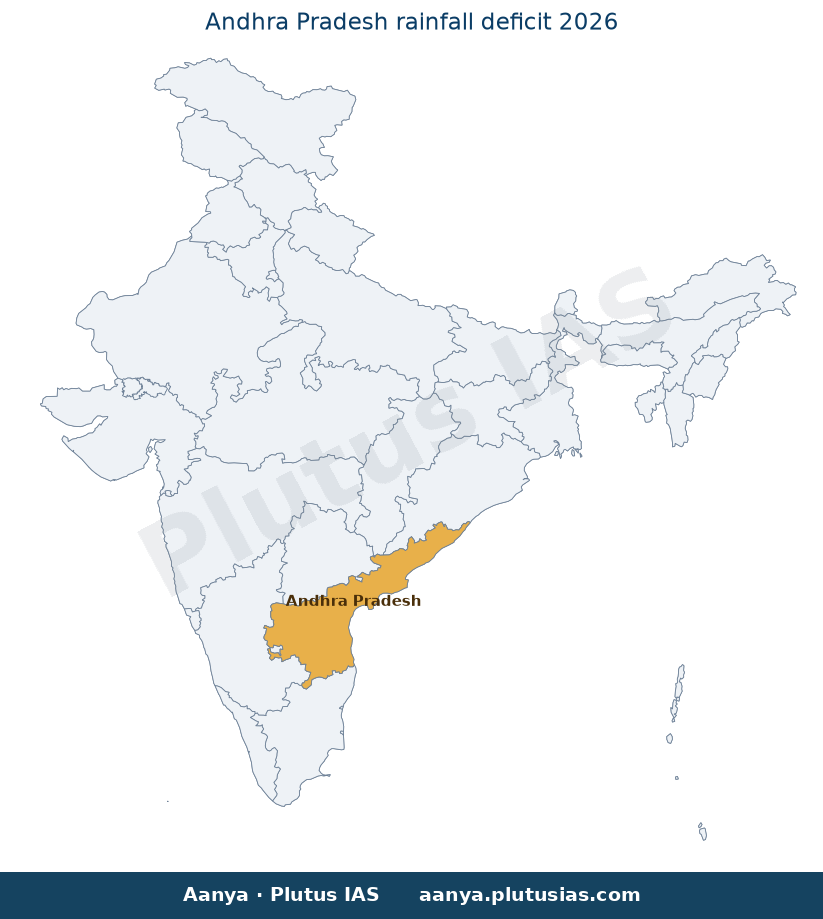
As of July 30, 2026, Andhra Pradesh has recorded a 52.4% rainfall deficit, with no district reporting normal rainfall, triggering concerns over agricultural output, water resource management, and potential drought conditions. The India Meteorological Department (IMD) has forecasted minimal rainfall until August 3, exacerbating the crisis, while the state government faces calls to declare drought-hit mandals and initiate relief measures.
Background
- Andhra Pradesh, a predominantly agrarian state, relies heavily on the Southwest Monsoon (June–September) for agricultural activities, with 60% of its net sown area being rainfed.
- The state’s average annual rainfall is approximately 930 mm, with Coastal Andhra Pradesh and Rayalaseema regions receiving 1,000–1,200 mm and 600–800 mm respectively.
- The Southwest Monsoon contributes 75–80% of the state’s annual rainfall, critical for kharif crops such as paddy, groundnut, and pulses.
- El Niño conditions, associated with suppressed monsoon rainfall over India, have been a recurring concern in recent years, including 2023–2024, which saw widespread droughts in several states.
- The IMD classifies rainfall as ‘normal’ if it is within ±19% of the Long Period Average (LPA); ‘deficient’ if between -20% and -59%; and ‘large deficient’ if below -60%.
- The state government’s response includes directives for comprehensive support to farmers and potential mandal-level drought declarations, as advocated by political parties like the CPI.
What is Rainfall Deficiency and its Implications?
- Rainfall Deficiency: A deviation of actual rainfall from the Long Period Average (LPA), measured as a percentage. Deficiency above 20% is classified as ‘deficient,’ while below -60% is ‘large deficient.’
- Southwest Monsoon: The primary source of rainfall for Andhra Pradesh, critical for kharif sowing and reservoir replenishment. Its variability is influenced by global phenomena like El Niño and La Niña.
- El Niño-Southern Oscillation (ENSO): A climate pattern where warming of the Pacific Ocean (El Niño) suppresses monsoon rainfall over India, while cooling (La Niña) enhances it. The 2026 monsoon season has been impacted by El Niño conditions.
- Agricultural Impact: Rainfed agriculture in Andhra Pradesh is highly vulnerable to monsoon failures. Paddy, the state’s staple crop, requires 1,200–1,500 mm of water, making it particularly susceptible to rainfall deficits.
- Water Resource Management: Deficient rainfall reduces reservoir storage, groundwater recharge, and river flows, exacerbating water stress for irrigation and drinking purposes. Major reservoirs like Srisailam and Nagarjunasagar are likely to witness reduced inflows.
- Drought Declaration: The Andhra Pradesh government may declare drought-hit mandals under the National Disaster Management Authority (NDMA) guidelines, enabling relief measures such as input subsidies, waivers, and employment generation schemes.
- IMD Forecasting: The IMD provides short-range and long-range forecasts, including weekly and monthly outlooks, to aid agricultural planning and disaster preparedness. Its predictions are based on dynamic models and satellite data.
- Policy Responses: States adopt measures such as crop insurance (PMFBY), water conservation techniques (micro-irrigation, farm ponds), and alternative cropping patterns (short-duration varieties) to mitigate monsoon failures.
Key Features
| Feature | Significance |
|---|---|
| Rainfall Deficit of 52.4% by July-end | Indicates severe meteorological drought, disrupting agricultural cycles and water availability for kharif sowing. |
| Uniform Deficiency Across All Districts | Contrasts with normal rainfall in NTR and SPSR Nellore earlier, now showing significant deterioration. |
| IMD Forecast of No Rain Until August 3 | Exacerbates soil moisture stress, delaying sowing and increasing risk of crop failure. |
| Strong Surface Winds (40-50 kmph) | Accelerates evapotranspiration, worsening moisture deficit in already stressed soils. |
| Deep Depression Over Bay of Bengal | Expected to bring rainfall to Odisha and Chhattisgarh, leaving Andhra Pradesh largely untouched. |
Why it Matters
Agricultural Impact
- Disruption of kharif sowing season due to insufficient soil moisture, threatening crop yields of paddy, pulses, and oilseeds.
- Increased reliance on groundwater extraction, accelerating depletion of aquifers in districts like Prakasam and Chittoor.
- Potential rise in input costs (e.g., diesel for irrigation) and distress among small and marginal farmers.
- Risk of delayed Rabi season preparation if kharif output is compromised.
Hydrological Consequences
- Reduction in reservoir and tank water levels, affecting irrigation and drinking water supply.
- Increased pressure on inter-state water-sharing agreements, particularly with Telangana (Krishna and Godavari basins).
- Groundwater table decline, with long-term implications for sustainability of agriculture in Rayalaseema and Coastal Andhra.
Economic Implications
- Contraction in rural demand, affecting allied sectors such as dairy, poultry, and agro-processing.
- Potential inflationary pressures on food prices due to reduced agricultural output.
- Increased fiscal burden on the state government for drought relief and subsidy disbursement.
Ecological and Social Dimensions
- Stress on forest ecosystems due to reduced soil moisture and increased fire risk.
- Migration of rural labor to urban areas in search of livelihoods, exacerbating demographic imbalances.
- Health risks from water scarcity, including vector-borne diseases and heat stress.
Challenges
1. Agricultural Drought
- Delayed or failed kharif sowing, leading to crop losses and income insecurity for farmers.
- Increased vulnerability of rainfed agriculture, particularly in districts like Visakhapatnam and Annamayya.
- Risk of farmer distress and potential agrarian unrest if relief measures are inadequate.
UPSC Link: GS Paper 3: Agriculture and Drought Management
2. Groundwater Depletion
- Accelerated extraction in deficit districts, threatening long-term agricultural sustainability.
- Competition for water resources between agriculture, industry, and domestic sectors.
- Legal and regulatory challenges in enforcing groundwater management policies.
UPSC Link: GS Paper 3: Water Resources and Groundwater
3. Inter-State Water Disputes
- Potential strain on Krishna and Godavari water-sharing agreements with Telangana.
- Risk of unilateral actions by states to secure water for irrigation and drinking purposes.
- Need for robust inter-state coordination mechanisms to prevent conflicts.
UPSC Link: GS Paper 2: Inter-State Relations
4. Climate Variability and El Niño
- El Niño conditions exacerbate rainfall deficits, increasing vulnerability to prolonged droughts.
- Limited predictability of monsoon patterns, complicating agricultural planning and water management.
- Need for climate-resilient agricultural practices and early warning systems.
UPSC Link: GS Paper 1: Climate Change and Monsoon Variability
5. Public Health and Livelihoods
- Increased incidence of waterborne and vector-borne diseases due to water scarcity.
- Rural-urban migration and pressure on urban infrastructure, including housing and sanitation.
- Loss of livelihoods in allied sectors such as livestock and fisheries.
UPSC Link: GS Paper 2: Health and GS Paper 3: Rural Development
Challenges — UPSC Perspective
| Issue | Concern |
|---|---|
| Delayed Kharif Sowing | Risk of crop failure and reduced agricultural output. |
| Groundwater Depletion | Threat to long-term agricultural sustainability and water security. |
| Inter-State Water Disputes | Potential for conflict with Telangana over Krishna and Godavari waters. |
| Public Health Risks | Increased incidence of waterborne and vector-borne diseases. |
| Rural Distress and Migration | Pressure on urban infrastructure and livelihood insecurity. |
Way Forward
- Implement targeted drought relief measures, including input subsidies and direct benefit transfers to farmers.
- Promote water-efficient irrigation techniques (e.g., drip irrigation) and crop diversification to mitigate drought impact.
- Strengthen groundwater management through regulatory measures and community-based water conservation initiatives.
- Enhance inter-state coordination with Telangana to manage water-sharing agreements and prevent conflicts.
- Deploy early warning systems for droughts and heatwaves, coupled with community awareness campaigns.
- Invest in rural employment schemes to provide alternative livelihoods and reduce migration pressures.
- Accelerate the construction and maintenance of minor irrigation projects and farm ponds to enhance water storage.
- Integrate climate-resilient agricultural practices into extension services and farmer training programs.
UPSC Value Addition
Keywords for Mains Answer-Writing
Andhra Pradesh rainfall deficit · Southwest Monsoon variability · El Niño-Southern Oscillation (ENSO) impact on India · Drought management in India · Agricultural distress in Andhra Pradesh · India Meteorological Department (IMD) rainfall classification · Depression systems in Bay of Bengal · Climate change and monsoon patterns · State-level disaster response mechanisms · Agricultural contingency plans in India · Groundwater depletion in Andhra Pradesh · El Niño and Indian monsoon correlation · Drought declaration norms in India · Agricultural subsidies and relief measures · Climate resilient agriculture in India
Constitutional & Policy Linkages
- [‘Article 244: Scheduled Areas and Tribal Welfare (if drought affects tribal regions).’]
- [‘Article 39(b): Directive Principle of State Policy on equitable distribution of resources.’]
Concept Flow
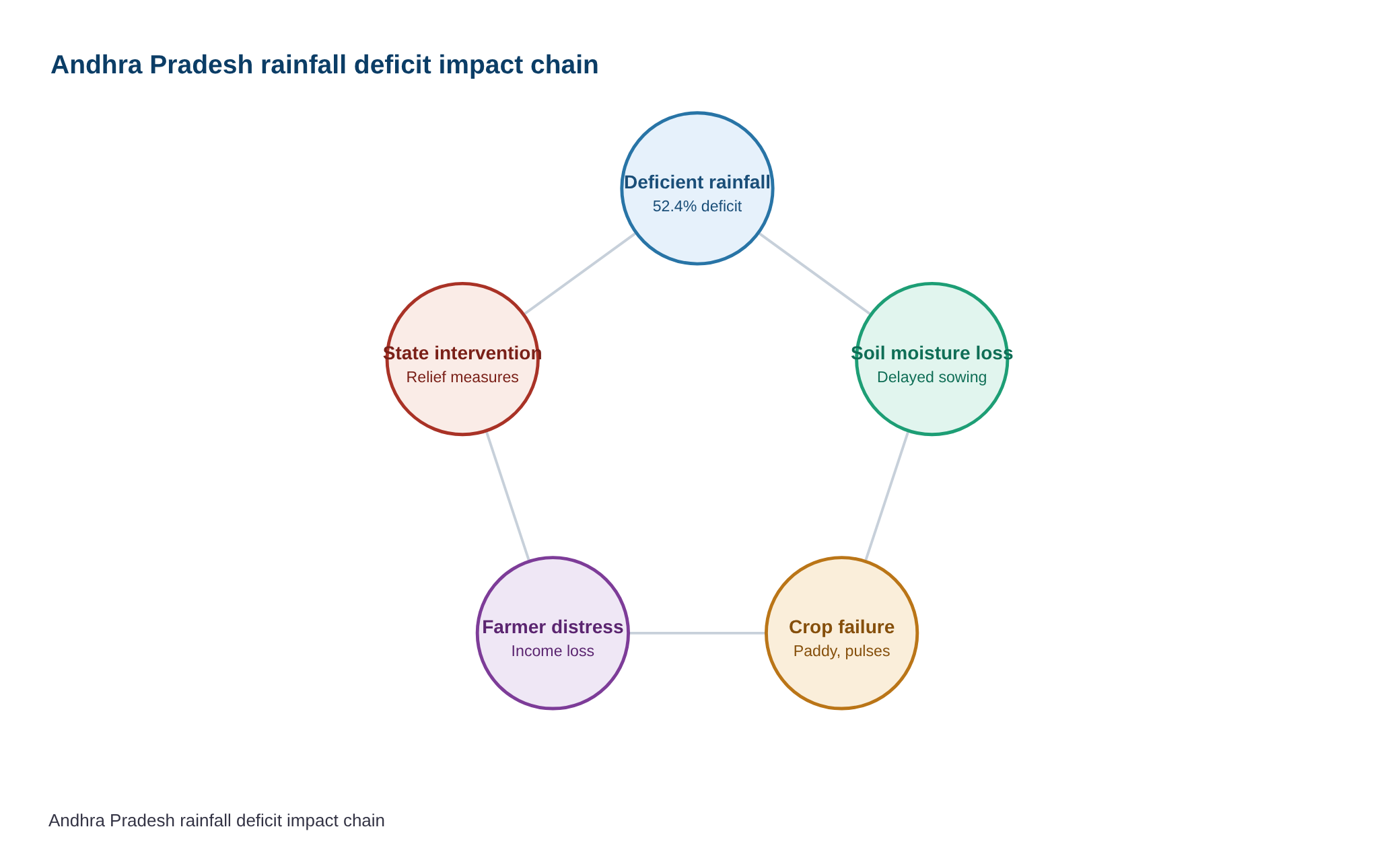
Deep depression in Bay of Bengal → Rainfall diverted to Odisha/Chhattisgarh → Andhra Pradesh receives minimal rainfall. → Deficient rainfall → Reduced soil moisture → Delayed kharif sowing and crop stress. → Groundwater extraction increases → Aquifer depletion accelerates. → Crop failure and income loss → Farmer distress and rural migration. → Water scarcity → Public health risks and inter-state disputes. → State intervention required → Drought relief, subsidy disbursement, and policy reforms.
Prelims Practice Questions
Q1. Consider the following statements regarding the classification of rainfall by the India Meteorological Department (IMD):
1. Normal rainfall is defined as rainfall that is within ±19% of the Long Period Average (LPA).
2. Deficient rainfall is defined as rainfall that is between 51% and 70% of the LPA.
3. Large deficient rainfall is defined as rainfall that is less than 50% of the LPA.
4. Excess rainfall is defined as rainfall that is more than 20% of the LPA.
How many of the above statements are correct?
- Only one
- Only two
- Only three
- All
Answer: All — Statements 1, 3, and 4 are correct. Statement 2 is incorrect because deficient rainfall is defined as rainfall that is between 51% and 70% of the LPA, and large deficient rainfall is defined as rainfall that is less than 50% of the LPA.
Q2. Assertion (A): The El Niño-Southern Oscillation (ENSO) phenomenon is the primary driver of inter-annual variability in the Indian Southwest Monsoon.
Reason (R): During El Niño years, the Walker circulation weakens, leading to reduced convection over the Indian Ocean and diminished monsoon rainfall over India.
Options:
A. Both A and R are true, and R is the correct explanation of A.
B. Both A and R are true, but R is not the correct explanation of A.
C. A is true, but R is false.
D. A is false, but R is true.
- A
- B
- C
- D
Answer: A — Both the assertion and reason are true. The El Niño-Southern Oscillation (ENSO) is a significant driver of Indian monsoon variability. During El Niño years, the weakening of the Walker circulation reduces convection over the Indian Ocean, leading to diminished monsoon rainfall over India. The reason correctly explains the assertion.
Q3. Match the following districts of Andhra Pradesh with their respective rainfall status as reported in the news:
Column I (District) | Column II (Rainfall Status)
——————————-|——————————-
1. Prakasam | A. Large Deficient
2. East Godavari | B. Deficient
3. Visakhapatnam | C. Deficient
4. NTR District | D. Large Deficient
5. SPSR Nellore | E. Normal (initially)
Options:
A. 1-A, 2-A, 3-A, 4-E, 5-E
B. 1-A, 2-A, 3-A, 4-B, 5-B
C. 1-A, 2-A, 3-A, 4-B, 5-E
D. 1-A, 2-A, 3-A, 4-E, 5-B
- A
- B
- C
- D
Answer: D — The correct matching is: Prakasam (Large Deficient), East Godavari (Large Deficient), Visakhapatnam (Large Deficient), NTR District (initially Normal, now Deficient), SPSR Nellore (initially Normal, now Deficient).
Mains Practice Question
✍ Critically examine the causes and consequences of the deficient rainfall in Andhra Pradesh, with particular reference to the role of the El Niño-Southern Oscillation (ENSO) and the India Meteorological Department’s (IMD) monsoon forecast. Also, outline the institutional mechanisms available for drought management in India. (15 Marks)
Approach: MODEL-ANSWER SKELETON:
1. **Causes of Deficient Rainfall in Andhra Pradesh:**
– **ENSO Impact:** Explain the El Niño phenomenon and its correlation with reduced monsoon rainfall in India (Walker circulation, suppressed convection over the Indian Ocean).
– **IMD Forecast:** Discuss the IMD’s role in monsoon prediction, including the classification of rainfall (Normal, Deficient, Large Deficient) and the current forecast for Andhra Pradesh (IMD’s August 3 outlook).
– **Meteorological Factors:** Highlight the absence of active depression systems in the Bay of Bengal and their diversion towards Odisha/Chhattisgarh.
2. **Consequences for Andhra Pradesh:**
– **Agricultural Distress:** Impact on kharif crops (paddy, maize, pulses), groundwater depletion, and farmer livelihoods.
– **Economic Impact:** Reduced agricultural GDP, increased input costs (irrigation, diesel), and debt burden on farmers.
– **Social Impact:** Migration, rural distress, and food security concerns.
3. **Institutional Mechanisms for Drought Management:**
– **National Framework:** National Disaster Management Authority (NDMA) guidelines, National Drought Management Policy (2016), and the National Crop Insurance Scheme (PMFBY).
– **State-Level Mechanisms:** Andhra Pradesh’s State Disaster Response Fund (SDRF), drought declaration norms, and relief measures (subsidies, input support).
– **Agricultural Contingency Plans:** Crop substitution, water conservation techniques, and groundwater regulation (Andhra Pradesh’s Water Resources Department initiatives).
4. **Critical Analysis:**
– Evaluate the effectiveness of IMD’s long-range forecasts and their limitations in predicting intra-seasonal variability.
– Assess the adequacy of institutional mechanisms in addressing localized droughts (e.g., mandal-level interventions).
– Discuss the role of climate-resilient agriculture (e.g., drought-resistant crop varieties, micro-irrigation).
5. **Conclusion:**
– Summarize the need for adaptive governance, early warning systems, and community-based drought preparedness.
– Emphasize the intersection of climate change, ENSO variability, and policy responses.
Source: The Hindu
Generated by AanyaAi for educational purpose.

- महिलाओं के पास डिग्रियाँ, गोल्ड मेडल, फिर भी नौकरी में क्यों नहीं? राष्ट्रपति मुर्मू का सवाल - September 23, 2026
- President Murmu Highlights Women’s Workforce Gap Despite Academic Success - September 23, 2026
- ओडिशा में विवाह रिकॉर्ड में हेराफेरी: निर्माण श्रमिक कल्याण योजना का दुरुपयोग - September 23, 2026

No Comments