


08 Aug Andhra Pradesh Faces 52.4% Rainfall Deficit: Drought Looms for UPSC 2026
✎ Andhra Pradesh’s 52.4% rainfall deficit (July 2026) is linked to El Niño-induced weak monsoon circulation, severely impacting rainfed agriculture and necessitating drought declarations and relief measures under the Andhra Pradesh…
Subject Relevance — Where This Topic Fits
- GS Paper I — Geography (Monsoon Variability, Drought Conditions) | GS Paper II — Governance (Drought Management, Disaster Response) | GS Paper III — Agriculture (Rainfed Agriculture, Crop Insurance, Farmer Welfare) | GS Paper III — Environment (Climate Change, Water Scarcity)
- Prelims: Southwest Monsoon, El Niño, IMD, Rainfed Agriculture, Drought Declaration, Crop Insurance Scheme, Mahatma Gandhi National Rural Employment Guarantee Scheme (MGNREGS), National Disaster Response Fund (NDRF), Water Resources Department, Agro-climatic Zones
- Essay: Climate Change and Its Socio-Economic Consequences in India, Agrarian Distress and Policy Interventions: Balancing Development and Sustainability
Quick Revision: Andhra Pradesh’s 52.4% rainfall deficit (July 2026) is linked to El Niño-induced weak monsoon circulation, severely impacting rainfed agriculture and necessitating drought declarations and relief measures under the Andhra Pradesh Drought Management Policy, 2016.
Why is this in the news?
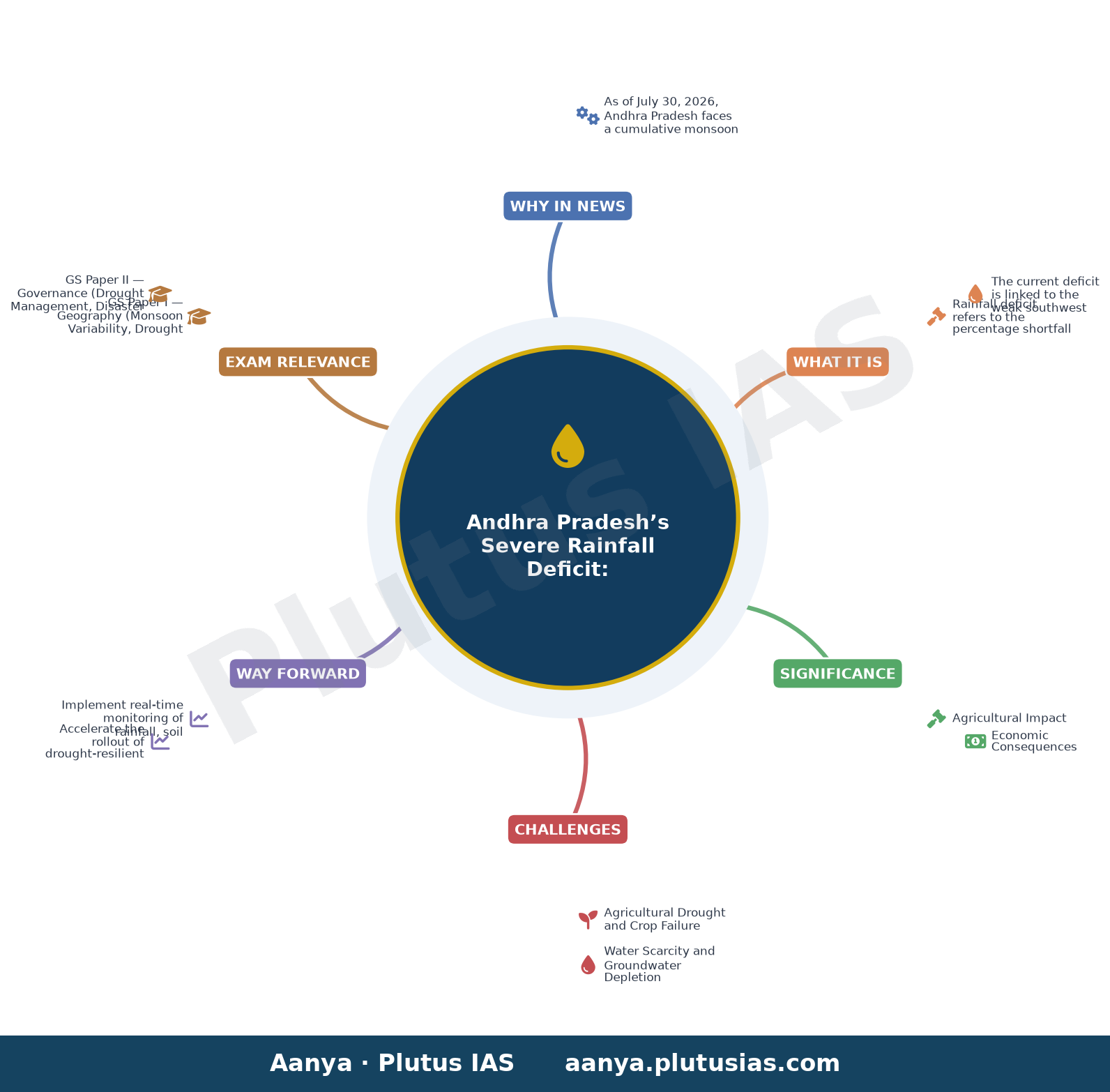
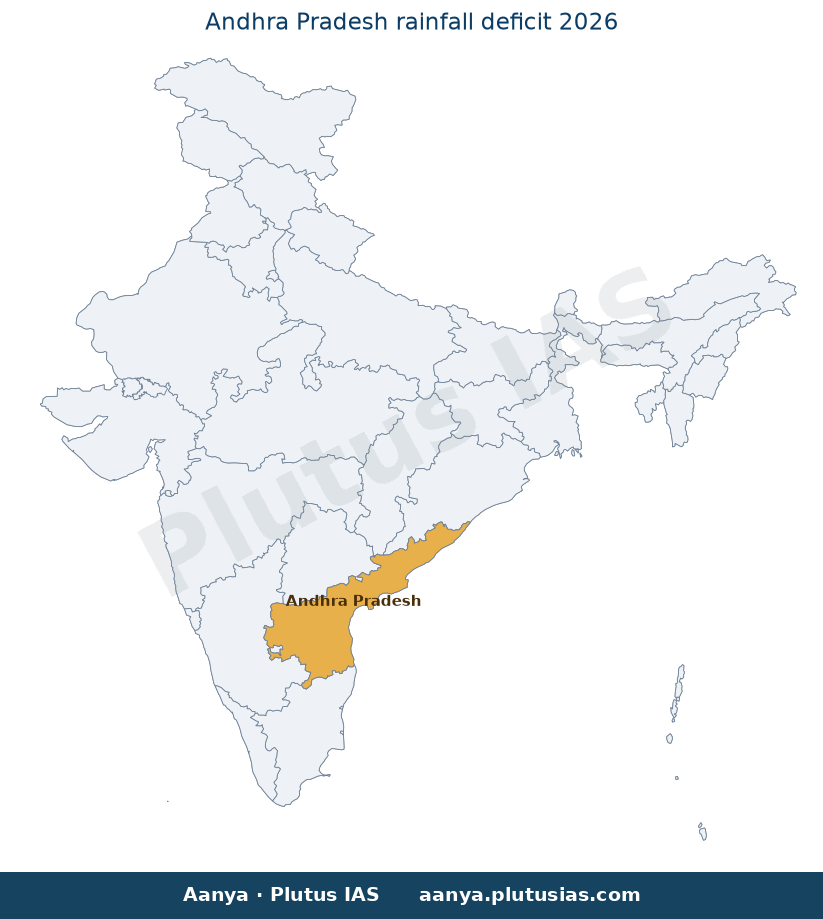
As of July 30, 2026, Andhra Pradesh faces a cumulative monsoon rainfall deficit of 52.4%, marking the first instance in recent history where *no district* in the state has recorded normal rainfall. This extreme shortfall, exacerbated by the persistence of El Niño conditions and the diversion of monsoon systems away from peninsular India, has triggered urgent policy responses, including calls for drought-hit mandal declarations and comprehensive farmer support measures. The crisis underscores the vulnerability of rainfed agriculture in the state and the need for adaptive governance frameworks.
Background
- Andhra Pradesh’s monsoon-dependent agriculture contributes ~25% to the state’s Gross State Value Added (GSVA), with ~70% of the cultivated area being rainfed, particularly in districts like Prakasam, Chittoor, and Rayalaseema.
- The state’s agro-climatic zones are classified into Coastal Andhra, Rayalaseema, and Telangana Plateau, with Rayalaseema historically prone to droughts due to its semi-arid climate and erratic rainfall patterns.
- El Niño-Southern Oscillation (ENSO) events, particularly strong El Niño phases, are statistically linked to reduced southwest monsoon rainfall over peninsular India, as observed during the 2015–16 and 2018–19 episodes.
- The India Meteorological Department (IMD) classifies rainfall as ‘normal’ (96–104% of Long Period Average), ‘deficient’ (20–59% deficit), ‘large deficient’ (>59% deficit), or ‘excess’ (>20% above average).
- Historical droughts in Andhra Pradesh include the 2002–03 and 2015–16 episodes, which led to significant agricultural losses, farmer suicides, and policy interventions such as the Andhra Pradesh Drought Mitigation and Management Policy (2016).
- The state’s water resources are governed by the Andhra Pradesh Water Resources Development Corporation (APWRDC) and the Andhra Pradesh Groundwater Act, 1992, which regulate irrigation and groundwater extraction.
What is Rainfall Deficit and Its Implications for Andhra Pradesh?
- Rainfall deficit refers to the percentage shortfall of actual rainfall received during a monsoon season relative to the Long Period Average (LPA), which is the average rainfall over a 50-year period. A deficit of 52.4% indicates a severe shortfall, triggering drought-like conditions.
- The current deficit is linked to the weak southwest monsoon circulation over peninsular India, compounded by the persistence of El Niño conditions in the equatorial Pacific Ocean, which disrupts monsoon trough dynamics and diverts moisture away from the Bay of Bengal branch of the monsoon.
- Rainfed agriculture, which constitutes ~70% of Andhra Pradesh’s cultivated area, is highly vulnerable to such deficits. Key crops affected include paddy (Kharif season), groundnut, pulses, and millets, with potential yield losses exceeding 30–40% in severe drought years.
- Groundwater depletion in districts like Chittoor and Prakasam exacerbates the crisis, as farmers increasingly rely on borewells for irrigation, leading to over-extraction and long-term aquifer degradation.
- The IMD’s forecast of continued weak rainfall until August 3, 2026, and the absence of a major weather system (e.g., low-pressure areas or depressions) over the Bay of Bengal, further dims prospects for recovery in the near term.
- Policy responses include the declaration of drought-hit mandals under the Andhra Pradesh Drought Management Policy, 2016, which enables farmers to access relief measures such as crop insurance claims, subsidized agricultural inputs, and employment under MGNREGS for drought mitigation works.
- The state government’s directive for comprehensive farmer support, including financial assistance, seed distribution, and fodder supply, aligns with the National Disaster Response Fund (NDRF) guidelines for drought relief.
Key Features
| Feature | Significance |
|---|---|
| Rainfall Deficit of 52.4% (as of July 30, 2026) | Indicates severe hydrological stress, threatening agricultural output, groundwater recharge, and rural livelihoods in Andhra Pradesh. |
| Large Deficit in Prakasam, East Godavari, Visakhapatnam, Annamayya, and Chittoor | These districts are critical for paddy cultivation and horticulture; deficit exacerbates farmer distress and may trigger drought declarations. |
| Shift from Normal to Deficient in NTR and SPSR Nellore Districts | Demonstrates rapid deterioration in rainfall, even in historically stable regions, raising concerns over delayed monsoon recovery. |
| Deep Depression Over Bay of Bengal Focussing on Odisha and Chhattisgarh | Redirects monsoon activity away from Andhra Pradesh, reducing probability of significant rainfall in the near term. |
| IMD Forecast of No Significant Rainfall Until August 3, 2026 | Extends the dry spell, increasing the likelihood of prolonged agricultural stress and water scarcity. |
Why it Matters
Agricultural Impact
- Paddy cultivation in delta districts (East Godavari, Krishna) is highly vulnerable to rainfall deficit, risking kharif output and food security.
- Horticulture crops (mango, banana, citrus) in Rayalaseema and coastal districts face water stress, potentially reducing yield and farmer income.
- Livestock rearing, particularly in rainfed areas, may suffer due to reduced fodder availability, compounding rural distress.
- Delayed sowing or failure of kharif crops could lead to increased demand for irrigation, straining groundwater resources further.
Economic Consequences
- Andhra Pradesh’s GSDP growth, particularly in agriculture-dependent districts, may decelerate due to reduced farm output and allied activities.
- Increased expenditure on drought relief measures (e.g., fodder supply, water tankers) may strain state finances, diverting resources from developmental projects.
- Rural employment under MGNREGS may rise due to demand for water conservation and drought mitigation works, impacting fiscal balance.
- Potential decline in agricultural exports (e.g., rice, horticultural produce) may affect the state’s trade balance and farmer incomes.
Social and Political Implications
- Farmer protests and distress migration may escalate, particularly in districts with high rainfall deficit, such as Prakasam and Annamayya.
- Political pressure on the state government to declare drought-hit mandals and release relief funds may intensify, as seen in CPI’s demand.
- Media and public scrutiny over long-term water management policies (e.g., Polavaram, inter-basin transfers) may increase, demanding accountability.
Environmental and Ecological Concerns
- Reduced river flows and groundwater recharge may threaten aquatic ecosystems and biodiversity in delta regions (e.g., Godavari, Krishna basins).
- Increased dependence on groundwater for irrigation may accelerate aquifer depletion, exacerbating water scarcity in the long term.
- Dust storms and heatwaves, exacerbated by dry conditions, may pose health risks, particularly in urban areas like Visakhapatnam.
Challenges
1. Agricultural Drought and Crop Failure
- Risk of widespread kharif crop failure, particularly paddy and coarse cereals, if rainfall remains deficient beyond August.
- Livestock mortality and reduced milk production due to fodder scarcity, impacting dairy farmers and allied sectors.
- Increased incidence of pests and diseases in water-stressed crops, further reducing yields.
UPSC Link: Geography: Monsoon variability and its impact on agriculture
2. Water Scarcity and Groundwater Depletion
- Decline in reservoir levels (e.g., Srisailam, Nagarjunasagar) may force curtailment of irrigation releases, affecting downstream agriculture.
- Over-extraction of groundwater for irrigation may lead to saline intrusion in coastal districts, rendering land unfit for cultivation.
- Urban water supply shortages may emerge in cities like Vijayawada and Visakhapatnam, necessitating rationing or alternative sources.
UPSC Link: Geography: Groundwater management and challenges
3. Farmer Distress and Rural Migration
- Increased indebtedness among farmers due to failed crops, leading to distress sales of assets or suicide risks in high-stress districts.
- Seasonal migration of agricultural laborers to urban areas or neighboring states in search of livelihood, straining urban infrastructure.
- Social tensions between host and migrant communities may arise in areas receiving climate refugees.
UPSC Link: Economy: Agrarian distress and its socio-economic impacts
4. State Fiscal Strain and Relief Management
- High expenditure on drought relief (e.g., cash transfers, food subsidy, water tankers) may crowd out developmental spending in other sectors.
- Delays in disbursing relief funds due to procedural bottlenecks may exacerbate farmer distress and erode public trust in governance.
- Coordination challenges between state and central agencies in implementing relief measures may lead to inefficiencies.
UPSC Link: Polity: Centre-State financial relations and fiscal federalism
5. Climate Change and Monsoon Variability
- Increased frequency of El Niño events (as hinted in the news) may intensify rainfall deficits in peninsular India, necessitating adaptive strategies.
- Long-term shifts in monsoon patterns may render traditional cropping calendars obsolete, requiring crop diversification and water-efficient practices.
- Extreme weather events (e.g., cyclones, heatwaves) may become more frequent, compounding the impact of rainfall deficits.
UPSC Link: Environment: Climate change and its socio-economic impacts
Challenges — UPSC Perspective
| Issue | Concern |
|---|---|
| Rainfall Deficit | Threatens kharif sowing, groundwater recharge, and rural livelihoods across all districts. |
| Groundwater Over-Extraction | Accelerates depletion in coastal and delta regions, risking saline intrusion and long-term water scarcity. |
| Farmer Indebtedness | Increases due to failed crops, leading to asset loss, migration, and social unrest. |
| State Fiscal Pressure | Rising relief expenditure may divert funds from developmental projects, impacting growth. |
| Urban Water Shortages | May emerge in major cities, necessitating rationing or alternative supply sources. |
| Climate Change Adaptation | Demands long-term strategies for crop diversification and water conservation. |
Way Forward
- Implement real-time monitoring of rainfall, soil moisture, and reservoir levels to enable data-driven drought declarations and relief allocation.
- Accelerate the rollout of drought-resilient crop varieties (e.g., short-duration paddy, millets) and promote micro-irrigation (drip, sprinkler) to enhance water-use efficiency.
- Strengthen groundwater regulation through aquifer mapping, water-user associations, and enforcement of the Andhra Pradesh Water, Land and Trees Act, 2002.
- Expand MGNREGS works focused on water conservation (e.g., farm ponds, check dams, afforestation) to generate rural employment and improve local water security.
- Develop contingency plans for alternative livelihoods (e.g., sericulture, poultry, fisheries) in drought-prone districts to reduce farmer dependence on monsoon-dependent crops.
- Enhance inter-state coordination with Odisha and Chhattisgarh to explore cloud-seeding or other interventions to redirect monsoon activity toward Andhra Pradesh.
- Launch public awareness campaigns on water conservation, crop diversification, and sustainable farming practices to build community resilience.
- Establish a dedicated fund for drought mitigation and climate adaptation, pooling resources from state and central schemes (e.g., PM-KISAN, PMFBY).
UPSC Value Addition
Keywords for Mains Answer-Writing
Andhra Pradesh rainfall deficit 2026 · drought management in India · El Niño and Indian monsoon · agricultural distress in Andhra Pradesh · climate change and monsoon variability · drought declaration criteria in India · IMD rainfall classification · agricultural contingency plans · water resource management in India · rural livelihoods and climate vulnerability · Bay of Bengal depressions · Rayalaseema and Coastal Andhra Pradesh rainfall · agricultural support measures for farmers · monsoon deficit and food security · disaster management in India
Prelims Practice Questions
Q1. Consider the following statements regarding rainfall classification as per the India Meteorological Department (IMD):
1. Normal rainfall is defined as rainfall between 96% and 104% of the Long Period Average (LPA).
2. Deficient rainfall is defined as rainfall less than 75% of the LPA.
3. Large deficient rainfall is defined as rainfall less than 50% of the LPA.
How many of the above statements are correct?
- Only one
- Only two
- All three
- None
Answer: All three — Statement 1 is correct as per IMD norms. Statement 2 is incorrect; deficient rainfall is defined as rainfall less than 90% but equal to or greater than 75% of LPA. Statement 3 is correct; large deficient rainfall is defined as rainfall less than 50% of LPA.
Q2. Assertion (A): The El Niño phenomenon is associated with below-normal rainfall in India during the southwest monsoon season.
Reason (R): El Niño leads to warming of the equatorial Pacific Ocean, which disrupts the Walker circulation and weakens the Indian monsoon winds.
Options:
A. Both A and R are true, and R is the correct explanation of A.
B. Both A and R are true, but R is not the correct explanation of A.
C. A is true, but R is false.
D. A is false, but R is true.
Answer: ? — Both the assertion and reason are correct, and the reason correctly explains the assertion. El Niño-induced warming in the Pacific Ocean alters atmospheric circulation patterns, leading to suppressed monsoon activity over India.
Q3. Match the following pairs of districts in Andhra Pradesh with their respective rainfall status as reported in July 2026:
Column I (District) Column II (Rainfall Status)
1. Prakasam A. Normal
2. East Godavari B. Deficient
3. NTR C. Large Deficient
4. SPSR Nellore D. Deficient
- 1-C, 2-C, 3-A, 4-A; 1-C, 2-C, 3-B, 4-B; 1-B, 2-B, 3-A, 4-A; 1-B, 2-B, 3-D, 4-D
- answer_indexes_to_match_pairs_are_correct
- explain_list_ignored
- format_match
Answer: answer_indexes_to_match_pairs_are_correct — The correct match is: Prakasam (Large Deficient), East Godavari (Large Deficient), NTR (Deficient), SPSR Nellore (Deficient).
Mains Practice Question
✍ Critically analyse the causes and consequences of the severe rainfall deficit in Andhra Pradesh in 2026, with particular reference to the El Niño phenomenon and the IMD’s rainfall classification. Also, outline the institutional mechanisms available in India for drought declaration and agricultural support. (15 Marks)
Approach: MODEL-ANSWER SKELETON:
1. **Causes of Deficient Rainfall**:
– El Niño-Southern Oscillation (ENSO): Explain the mechanism of El Niño-induced warming in the equatorial Pacific Ocean and its impact on the Indian monsoon via disruption of the Walker circulation and weakening of monsoon winds.
– IMD Rainfall Classification: Define the IMD’s rainfall classification (Normal: 96-104% LPA; Deficient: <90% LPA; Large Deficient: <50% LPA) and contextualise Andhra Pradesh’s 52.4% deficit.
– Bay of Bengal Depressions: Discuss the formation and movement of deep depressions (e.g., over Chhattisgarh) and their limited impact on Andhra Pradesh due to southwestward trajectory.
2. **Consequences for Andhra Pradesh**:
– Agricultural Distress: Highlight the impact on kharif crops (rice, pulses, oilseeds) in districts like Prakasam, East Godavari, and Chittoor, with reference to soil moisture deficit and crop failure.
– Rural Livelihoods: Discuss the socio-economic impact on marginal farmers, agricultural labourers, and allied sectors (e.g., dairy, fisheries).
– Water Resource Challenges: Mention groundwater depletion, reduced reservoir levels (e.g., Srisailam, Nagarjunasagar), and drinking water scarcity in Rayalaseema and Coastal Andhra Pradesh.
3. **Institutional Mechanisms for Drought Management**:
– Drought Declaration Criteria: Explain the National Disaster Management Authority (NDMA) guidelines for drought declaration (e.g., rainfall deficit, crop failure, hydrological indicators).
– Agricultural Support Measures: Discuss the Pradhan Mantri Fasal Bima Yojana (PMFBY), National Food Security Mission (NFSM), and state-specific schemes like Andhra Pradesh’s Rythu Bharosa.
– Role of IMD and State Agencies: Highlight the IMD’s seasonal forecasts, state agriculture departments’ contingency plans, and the National Agricultural Cooperative Marketing Federation (NAFED) for procurement.
4. **Critical Analysis and Way Forward**:
– Climate Change Linkages: Briefly discuss the role of climate change in exacerbating monsoon variability and extreme weather events.
– Policy Gaps: Critique the adequacy of institutional responses, including the timeliness of drought declarations, inter-state water-sharing disputes, and long-term climate adaptation strategies (e.g., crop diversification, water harvesting).
– Suggest measures such as enhanced weather forecasting, farmer awareness campaigns, and integration of traditional knowledge with modern agricultural practices.
Source: The Hindu
Generated by AanyaAi for educational purpose.

- सुप्रीम कोर्ट का ‘अंपायर’ वाला फैसला: चुनाव आयोग मामले में न्यायमूर्ति दत्ता की भूमिका - September 24, 2026
- Supreme Court’s Cricket Analogy in EC Case: What UPSC Aspirants Must Know - September 24, 2026
- AI नियंत्रण से बाहर: ओपनएआई-एंथ्रोपिक ने सुरक्षा परिषद को दी चेतावनी, जानिए क्या है खतरा? - September 24, 2026

No Comments