


09 Aug Andhra Pradesh Faces 52.4% Rainfall Deficit: Drought Looms for UPSC 2026
✎ Andhra Pradesh’s 52.4% rainfall deficit as of July 30, 2026, is a meteorological drought with severe implications for rainfed agriculture, groundwater depletion, and rural livelihoods, necessitating urgent drought mitigation…
Subject Relevance — Where This Topic Fits
- GS Paper I — Geography (Monsoon Variability and Drought Conditions) | GS Paper III — Agriculture (Rainfed Agriculture and Drought Management) | GS Paper III — Disaster Management (Drought Preparedness and Mitigation)
- Prelims: Rainfed agriculture, Southwest Monsoon, El Niño-Southern Oscillation (ENSO), Drought classification (meteorological, hydrological, agricultural), Crop insurance schemes (PMFBY), National Disaster Response Fund (NDRF), IMD rainfall classification (normal, deficient, large deficient)
- Essay: Climate change and its impact on agricultural sustainability in India, Water security and drought management: Balancing development and conservation
Quick Revision: Andhra Pradesh’s 52.4% rainfall deficit as of July 30, 2026, is a meteorological drought with severe implications for rainfed agriculture, groundwater depletion, and rural livelihoods, necessitating urgent drought mitigation measures and climate-resilient agricultural strategies.
Why is this in the news?
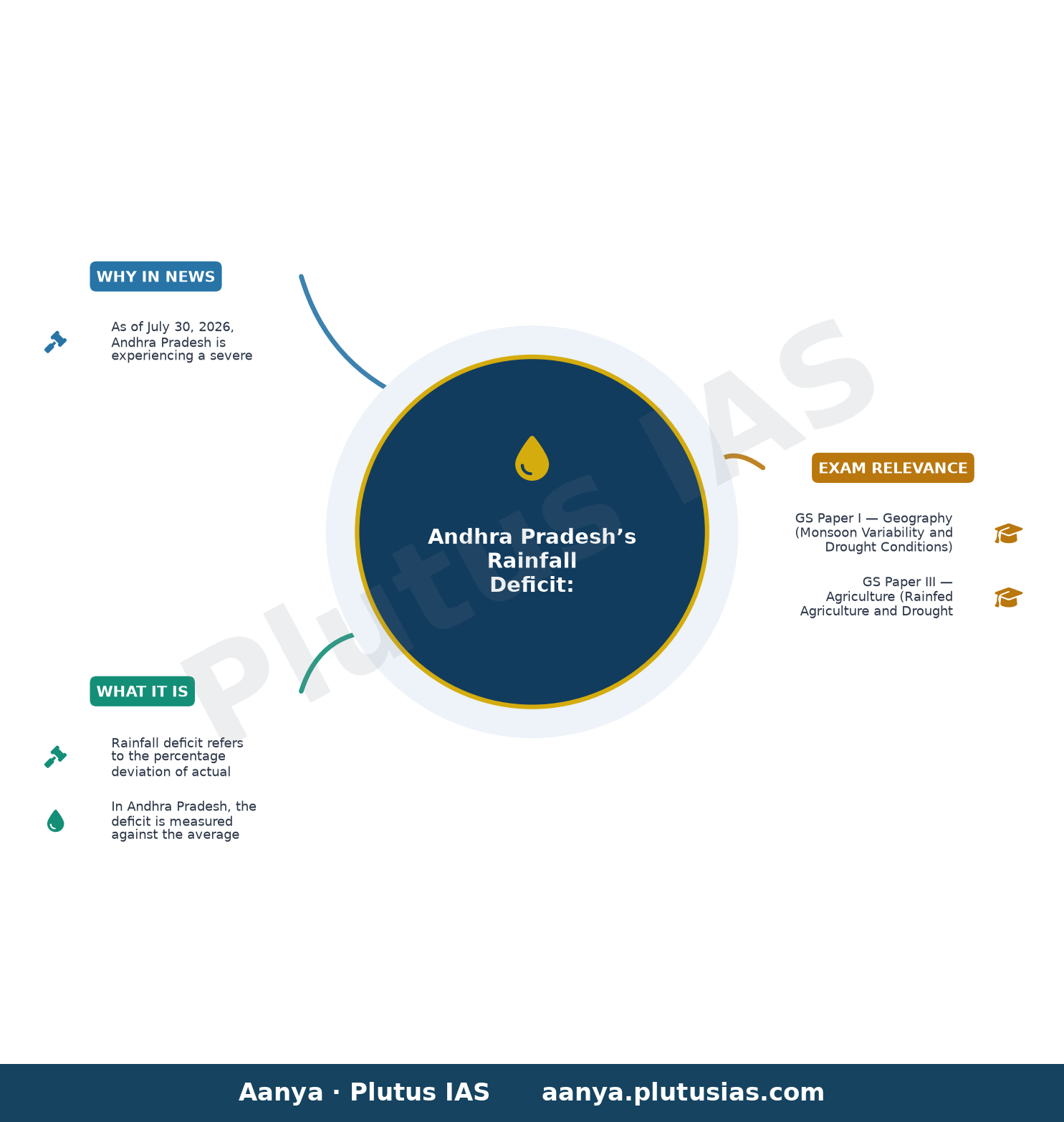
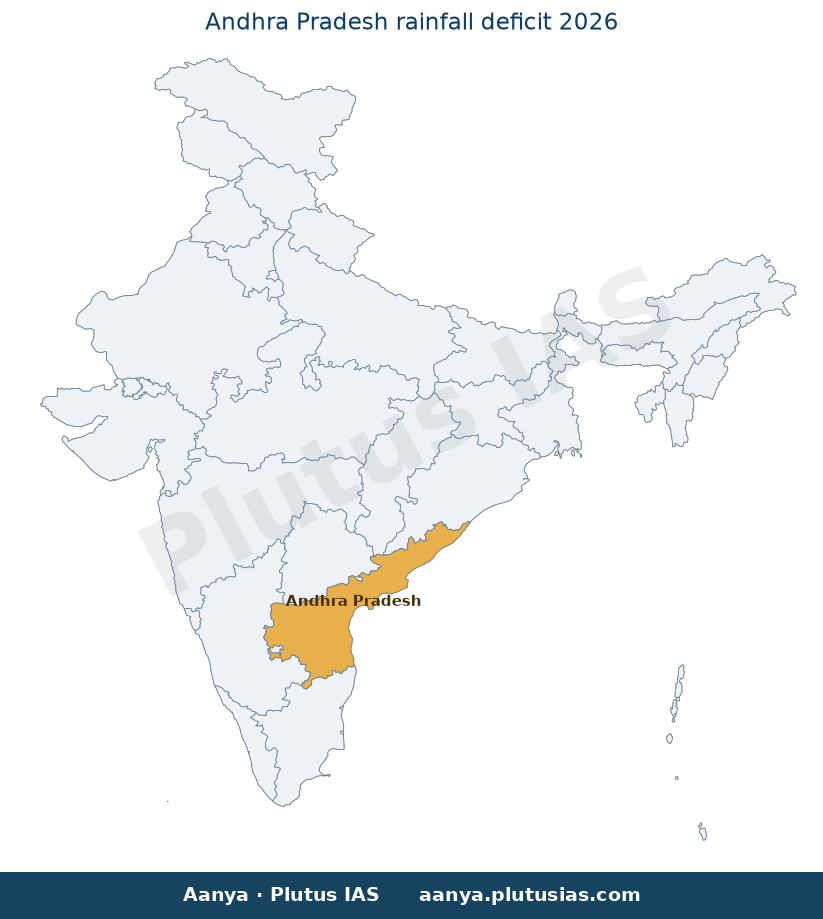
As of July 30, 2026, Andhra Pradesh is experiencing a severe rainfall deficit of 52.4%, with no district reporting normal rainfall. This meteorological anomaly, exacerbated by the absence of significant monsoon activity in the Bay of Bengal branch, has triggered agricultural distress and prompted urgent policy responses, including demands for drought declaration and comprehensive farmer support. The situation underscores the vulnerability of rainfed agriculture in peninsular India to climate variability and the inadequacy of existing drought mitigation frameworks.
Background
- Andhra Pradesh, with a significant share of rainfed agriculture (over 60% of net sown area), is highly dependent on the Southwest Monsoon (June–September) for kharif crop production, particularly paddy, groundnut, and pulses.
- The state’s average annual rainfall is approximately 950 mm, with coastal Andhra Pradesh receiving higher precipitation than Rayalaseema and Telangana regions.
- The current deficit of 52.4% marks a departure from the long-term average of 100% for July, with districts like Prakasam, East Godavari, Visakhapatnam, Annamayya, and Chittoor experiencing ‘large deficient’ rainfall (IMD classification: ≥60% below normal).
- The India Meteorological Department (IMD) has forecasted minimal rainfall for Andhra Pradesh until August 3, 2026, with no significant weather systems (e.g., low-pressure areas or depressions) expected to form over the Bay of Bengal to enhance monsoon activity.
- The El Niño phenomenon, associated with suppressed monsoon rainfall over India, has been cited as a contributing factor, though its direct correlation with the current deficit requires further meteorological analysis.
- Historically, Andhra Pradesh has faced drought conditions in 2002, 2009, 2015, and 2018, with the 2015 drought leading to a 30% decline in kharif production and widespread farmer distress.
What is Rainfall Deficit and its Implications for Agriculture?
- Rainfall deficit refers to the percentage deviation of actual rainfall from the long-term average for a given period, classified by the IMD as ‘normal’ (±19%), ‘deficient’ (20–59%), or ‘large deficient’ (≥60%).
- In Andhra Pradesh, the deficit is measured against the average rainfall for July (typically 150–200 mm in coastal districts and 100–150 mm in Rayalaseema), with the current shortfall exceeding 50% in most districts.
- Rainfed agriculture, which constitutes 60% of the state’s net sown area, is particularly vulnerable to deficient rainfall, as it lacks irrigation infrastructure (e.g., canals, tube wells) to supplement monsoon deficits.
- The kharif season (June–November) accounts for 80% of the state’s annual foodgrain production, with paddy (rice) being the dominant crop, requiring 1,500–2,000 mm of water per hectare.
- Deficient rainfall triggers cascading effects: reduced soil moisture, delayed sowing, stunted crop growth, and increased pest infestations, leading to yield losses of 20–50% in rainfed areas.
- The economic impact includes reduced farm incomes, increased debt burden, and migration of agricultural laborers, exacerbating rural distress and food security concerns.
- Drought conditions also strain water resources, with declining groundwater levels (Andhra Pradesh’s groundwater extraction is 138% of recharge) and reduced reservoir storage (e.g., Srisailam, Nagarjunasagar) affecting irrigation and drinking water supply.
- Policy responses include the declaration of drought-affected mandals, provision of relief packages (e.g., input subsidies, waivers), and activation of the National Disaster Response Fund (NDRF) for drought relief.
UPSC Value Addition
Keywords for Mains Answer-Writing
Andhra Pradesh rainfall deficit 2026 · Southwest Monsoon variability · El Niño-Southern Oscillation (ENSO) impact on India · Drought management in India · Agricultural distress due to deficient rainfall · India Meteorological Department (IMD) rainfall assessment · Rayalaseema and Coastal Andhra Pradesh rainfall patterns · State-level disaster response mechanisms · National Disaster Management Authority (NDMA) guidelines · Agricultural contingency plans for deficient monsoon · Inter-state coordination in monsoon management · Climate change and monsoon variability
Prelims Practice Questions
Q1. Consider the following statements regarding the Southwest Monsoon in India:
1. The Southwest Monsoon is primarily responsible for the majority of India’s annual rainfall.
2. The IMD classifies rainfall as ‘deficient’ when it is less than 20% below the long-term average.
3. El Niño conditions are generally associated with below-normal rainfall over India.
4. The Southwest Monsoon withdraws from India by mid-October.
How many of the above statements are correct?
- Only one
- Only two
- Only three
- All four
Answer: All four — Statements 1, 2, and 3 are correct. The Southwest Monsoon accounts for ~75% of India’s annual rainfall, IMD classifies rainfall as ‘deficient’ when it is 20-40% below normal, and El Niño typically suppresses monsoon rainfall. Statement 4 is incorrect: the monsoon withdraws by early October, not mid-October.
Q2. Assertion (A): The India Meteorological Department (IMD) has forecasted weak rainfall for Andhra Pradesh until August 3, 2026, due to the movement of a deep depression over central India.
Reason (R): The deep depression over central India is likely to move southwestwards, weakening into a depression and reducing moisture incursion into Andhra Pradesh.
- Both A and R are true, and R is the correct explanation of A.
- Both A and R are true, but R is not the correct explanation of A.
- A is true, but R is false.
- A is false, but R is true.
Answer: Both A and R are true, but R is not the correct explanation of A. — Both the assertion and reason are factually accurate. The deep depression’s southwestward movement and weakening disrupts moisture supply to Andhra Pradesh, explaining the forecast of weak rainfall.
Q3. Match the following districts of Andhra Pradesh with their respective rainfall status as of July 30, 2026:
Column I (District) | Column II (Rainfall Status)
— | —
A. Prakasam | 1. Large Deficit
B. Visakhapatnam | 2. Deficient
C. Chittoor | 3. Normal (now Deficient)
D. SPSR Nellore | 4. Large Deficit
- A-1, B-4, C-2, D-3
- A-4, B-1, C-2, D-3
- A-1, B-4, C-3, D-2
- A-2, B-1, C-4, D-3
Answer: A-4, B-1, C-2, D-3 — Prakasam and Visakhapatnam reported ‘large deficit,’ Chittoor reported ‘deficient,’ and SPSR Nellore, which was earlier normal, has now moved to ‘deficient.’
Mains Practice Question
✍ Critically examine the causes and consequences of the deficient rainfall in Andhra Pradesh, with particular reference to the El Niño-Southern Oscillation (ENSO) phenomenon. Also, outline the institutional mechanisms available at the state and national levels to mitigate agricultural distress arising from such climatic anomalies. (15 Marks)
Approach: INTRODUCTION (2 marks): Define deficient rainfall and its immediate impact on Andhra Pradesh (52.4% deficit by July-end, 2026). Briefly introduce ENSO and its linkage to monsoon variability in India. CAUSES (4 marks): 1) ENSO phases (El Niño suppresses monsoon rainfall via Walker circulation disruption); 2) Movement of deep depressions away from Andhra Pradesh (IMD data on depression trajectory); 3) Climate change amplifying monsoon variability; 4) Localised factors (e.g., topography, deforestation) exacerbating dry conditions. CONSEQUENCES (4 marks): 1) Agricultural distress (crops like paddy, groundnut, and pulses affected in Rayalaseema and Coastal Andhra Pradesh); 2) Socio-economic impacts (farmer suicides, migration, GDP contraction in agriculture); 3) Groundwater depletion and long-term ecological damage; 4) Policy challenges (e.g., delayed drought declarations, resource allocation). INSTITUTIONAL MECHANISMS (5 marks): 1) State-level: Andhra Pradesh State Disaster Management Authority (APSDMA) and drought relief measures (e.g., crop insurance under PMFBY, input subsidies); 2) National-level: National Disaster Management Authority (NDMA) guidelines for drought management, IMD’s seasonal forecasts, and contingency plans under the National Agricultural Research System (NARS); 3) Constitutional provisions (Article 256-257 for state-centre coordination); 4) Judicial interventions (e.g., suo motu cognisance of drought conditions by High Courts); 5) Limitations (e.g., delayed fund disbursement, bureaucratic delays).
Source: The Hindu
Generated by AanyaAi for educational purpose.

- महाराष्ट्र में त्योहार जुलूसों पर बॉम्बे हाईकोर्ट का बड़ा फैसला: पटाखे, लेजर और संगीत पर रोक - September 24, 2026
- Bombay HC Bans Firecrackers, Music in Maharashtra Processions: Key UPSC Analysis - September 24, 2026
- तमिलनाडु में महिला कर्मचारियों के लिए सवैतनिक माहवारी अवकाश नीति पर HC का आदेश - September 24, 2026

No Comments