


08 Aug Andhra Pradesh Faces 52.4% Rainfall Deficit: Drought Threat Looms for UPSC 2026
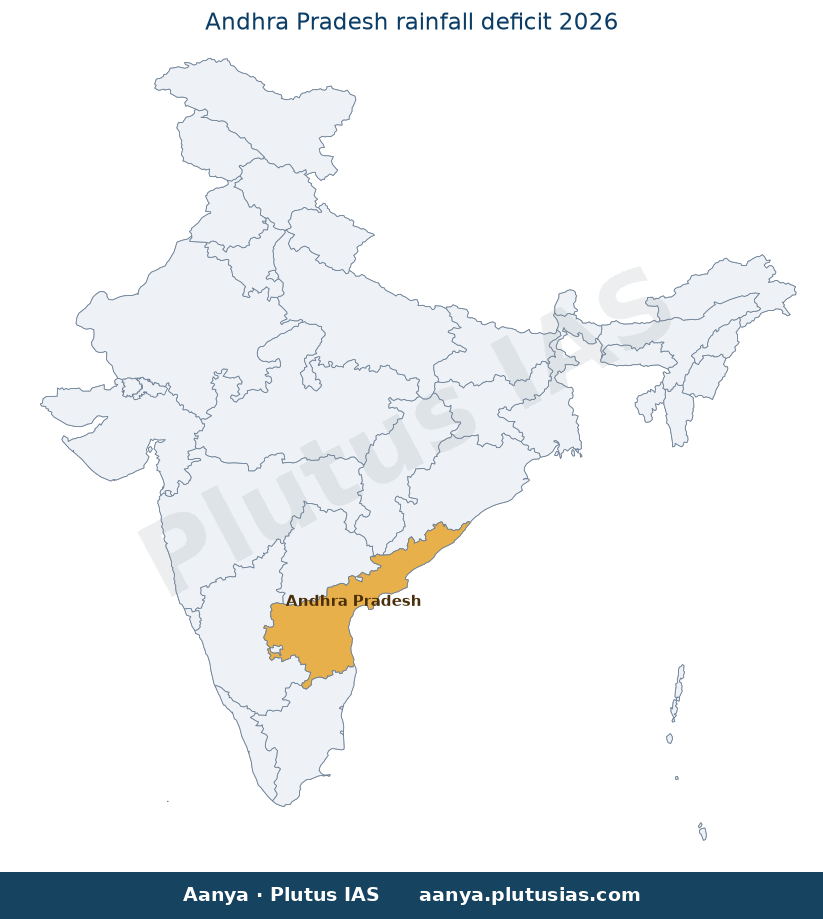
✎ Andhra Pradesh's rainfall deficit by July-end 2026, driven by El Niño and suppressed Bay of Bengal convection, poses severe risks to kharif agriculture, necessitating urgent drought mitigation and water resource management.
Subject Relevance — Where This Topic Fits
- GS Paper III — Agriculture | GS Paper III — Environment and Disaster Management | GS Paper III — Water Resources | GS Paper I — Geography
- Prelims: Rainfall deficit, El Niño, drought, IMD, agriculture productivity, water stress, mandal-level drought declaration, surface winds, monsoon variability
- Essay: Climate Change and Its Impact on Monsoon Patterns in India, Agrarian Distress and Policy Interventions in India
Quick Revision: Andhra Pradesh’s rainfall deficit by July-end 2026, driven by El Niño and suppressed Bay of Bengal convection, poses severe risks to kharif agriculture, necessitating urgent drought mitigation and water resource management.
Why is this in the news?
This unprecedented situation has triggered concerns over agricultural output, water scarcity, and the need for drought mitigation measures, particularly as El Niño conditions threaten to exacerbate the deficit. The Chief Minister of Andhra Pradesh has directed comprehensive support for farmers, while the CPI has urged the government to declare drought-hit mandals. The absence of normal rainfall in even a single district underscores the severity of the crisis.
Background
- Andhra Pradesh, a predominantly agrarian state, relies heavily on the southwest monsoon (June–September) for agricultural operations, with over 60% of its net sown area dependent on rainfall.
- The southwest monsoon contributes approximately 75% of the state’s annual rainfall, making it critical for kharif crops such as paddy, maize, and pulses.
- El Niño events are historically associated with below-normal monsoon rainfall in India, particularly in southern and eastern regions, due to altered wind patterns and suppressed convection over the Bay of Bengal.
- The IMD’s long-range forecast for the 2026 southwest monsoon indicated a high probability of below-normal rainfall for Andhra Pradesh, aligning with observed trends.
- The state has experienced recurring droughts in recent decades, with 2015–16 and 2018–19 being particularly severe, leading to significant agricultural losses and migration pressures.
- Water storage in major reservoirs such as Srisailam and Nagarjunasagar has been critically low in previous deficit years, necessitating inter-state water sharing agreements and demand-side management.
What is a Rainfall Deficit and How is it Measured?
- A rainfall deficit occurs when actual precipitation during a monsoon season falls short of the long-period average (LPA) for a region, typically measured as a percentage deviation from the LPA.
- The IMD classifies rainfall as ‘normal’ if the deficit is within ±19% of the LPA; ‘deficient’ if the deficit is between 20% and 59%; and ‘large deficient’ if the deficit exceeds 60%.
- Rainfall data is collected from a network of rain gauges across districts, and deficits are calculated on a cumulative basis from June 1 to July 31, with updates provided weekly by the IMD and state agencies.
- The IMD’s seasonal forecast for the southwest monsoon (issued in April) provides a probabilistic outlook for rainfall distribution, which is refined with monthly and weekly updates based on atmospheric conditions.
- El Niño-Southern Oscillation (ENSO) is a key driver of monsoon variability, with El Niño phases (warm ocean temperatures in the equatorial Pacific) typically correlating with reduced rainfall in India, while La Niña phases enhance monsoon activity.
- Drought conditions are declared at the district or mandal level based on cumulative rainfall deficits, soil moisture levels, and crop stress assessments, often leading to relief measures such as input subsidies and employment generation schemes.
UPSC Value Addition
Keywords for Mains Answer-Writing
Andhra Pradesh rainfall deficit · Southwest Monsoon variability · El Niño impact on India · Drought management in India · Agrarian distress in Andhra Pradesh · IMD rainfall assessment · Bay of Bengal depressions · Rainfed agriculture challenges · Disaster management framework · Climate-resilient agriculture · NITI Aayog’s drought advisory · Constitutional provisions for drought relief · National Disaster Response Fund (NDRF) · Agricultural contingency plans · Sustainable water resource management
Prelims Practice Questions
Q1. Consider the following statements regarding the South-West Monsoon in India:
1. The South-West Monsoon is primarily driven by the differential heating of land and sea.
2. The Bay of Bengal branch of the monsoon contributes more rainfall to Andhra Pradesh than the Arabian Sea branch.
3. El Niño conditions are historically associated with below-normal rainfall over India.
4. The IMD classifies rainfall as ‘deficient’ when the deficit is between 26% and 50% of the long-period average.
How many of the above statements are correct?
- Only one
- Only two
- Only three
- All four
Answer: All four — Statements 1, 2, and 3 are correct. Statement 4 is incorrect: IMD classifies ‘deficient’ rainfall as a deficit of 26% to 50% of the long-period average, while ‘large deficient’ is a deficit of more than 50%.
Q2. Assertion (A): The formation of a deep depression over the Bay of Bengal is a primary driver of rainfall in Andhra Pradesh during the South-West Monsoon.
Reason (R): The Bay of Bengal branch of the monsoon is the dominant contributor to rainfall in coastal Andhra Pradesh and Rayalaseema regions.
- Both A and R are true, and R is the correct explanation of A
- Both A and R are true, but R is not the correct explanation of A
- A is true, but R is false
- A is false, but R is true
Answer: A is true, but R is false — Both A and R are true, but R is not the correct explanation of A. While deep depressions over the Bay of Bengal can bring rainfall, the assertion oversimplifies the monsoon dynamics, as other factors like El Niño and wind patterns also play critical roles.
Q3. Match the following pairs related to rainfall classification and their corresponding deficit percentages as per the India Meteorological Department (IMD):
Column I (Rainfall Classification)
A. Normal
B. Deficient
C. Large Deficient
D. Scanty
Column II (Deficit Percentage)
1. 26% to 50%
2. Less than 26%
3. 51% to 99%
4. 0% to 19%
- {‘A’: 4, ‘B’: 1, ‘C’: 3, ‘D’: 2}
- {‘A’: 2, ‘B’: 1, ‘C’: 3, ‘D’: 4}
- {‘A’: 4, ‘B’: 2, ‘C’: 1, ‘D’: 3}
- {‘A’: 1, ‘B’: 2, ‘C’: 3, ‘D’: 4}
Answer: {‘A’: 4, ‘B’: 1, ‘C’: 3, ‘D’: 2} — The correct match is: A (Normal) – 4 (0% to 19% deficit), B (Deficient) – 1 (26% to 50% deficit), C (Large Deficient) – 3 (51% to 99% deficit), D (Scanty) – 2 (less than 26% deficit).
Mains Practice Question
✍ Critically examine the causes and implications of the deficient rainfall in Andhra Pradesh during the South-West Monsoon season. Also, outline the constitutional and institutional mechanisms available in India to address drought conditions. (15 Marks)
Approach: MODEL-ANSWER SKELETON:
1. **Causes of Deficient Rainfall in Andhra Pradesh (5 Marks)**
– **Meteorological Factors**: El Niño-Southern Oscillation (ENSO) and its impact on the Indian monsoon; weakening of the Bay of Bengal branch of the monsoon; reduced frequency of deep depressions over the Bay of Bengal.
– **Climatological Trends**: Long-term shifts in monsoon patterns, including delayed onset and early withdrawal, leading to reduced cumulative rainfall.
– **Geographical Vulnerability**: Coastal Andhra Pradesh and Rayalaseema regions’ dependence on monsoon rainfall for agriculture and water resources.
2. **Implications of Deficient Rainfall (5 Marks)**
– **Agrarian Distress**: Impact on kharif crops (e.g., paddy, pulses, oilseeds); rise in farmer suicides and rural indebtedness; migration to urban areas.
– **Water Scarcity**: Depletion of groundwater tables; reduced reservoir levels (e.g., Srisailam, Nagarjuna Sagar); drinking water shortages in rural and urban areas.
– **Economic Consequences**: Decline in agricultural GDP; inflation in food prices; strain on state exchequer due to relief measures.
– **Ecological Impact**: Deterioration of soil health; increased vulnerability to forest fires and dust storms.
3. **Constitutional and Institutional Mechanisms (5 Marks)**
– **Constitutional Provisions**: Article 297 (exclusive power of the Union over inter-state rivers), Article 355 (duty of the Union to protect states against external aggression and internal disturbance), and Article 21 (right to life and livelihood).
– **Institutional Frameworks**:
– **National Disaster Management Authority (NDMA)**: Guidelines for drought management and mitigation.
– **National Disaster Response Fund (NDRF)**: Financial assistance for drought-affected states.
– **State Disaster Response Fund (SDRF)**: Allocation for immediate relief measures.
– **Agricultural Contingency Plans**: Prepared by the Ministry of Agriculture and Farmers’ Welfare; includes crop diversification, water conservation, and insurance schemes (e.g., PMFBY).
– **NITI Aayog**: Provides advisory support and monitors drought conditions through the Drought Early Warning System (DEWS).
– **Judicial Interventions**: Supreme Court directives on drought relief (e.g., *Swajaldhara v. Union of India*, 2016) and suo motu cognizance of agrarian distress.
4. **Way Forward (Optional, if time permits)**:
– Promotion of climate-resilient agriculture (e.g., drought-resistant crop varieties, micro-irrigation).
– Strengthening of groundwater management through participatory approaches (e.g., Atal Bhujal Yojana).
– Integration of traditional water conservation practices (e.g., *ahars* and *pynes* in Bihar) with modern techniques.
Source: The Hindu
Generated by AanyaAi for educational purpose.

- मद्रास उच्च न्यायालय ने एआईएडीएमके के व्हिप के मामले को खारिज किया, मेकेदातू संशोधन पर तमिलनाडु विधानसभा का फैसला बरकरार - September 23, 2026
- Madras HC Rejects AIADMK Plea Against Mekedatu Resolution Amendment - September 23, 2026
- कर्नाटक में उद्योग-आधारित पाठ्यक्रम तैयार करेगा विशेष समिति: मुख्यमंत्री - September 23, 2026

No Comments