


08 Aug Andhra Pradesh Faces 52.4% Rainfall Deficit: UPSC Exam Relevance Explained
✎ A rainfall deficit of 52.4% in Andhra Pradesh by July-end, driven by a weak Southwest Monsoon and El Niño conditions, poses severe risks to rainfed agriculture, water security, and farmer livelihoods, necessitating urgent drought…
Subject Relevance — Where This Topic Fits
- GS Paper I — Geography (Monsoons, Droughts, and Climatic Variability) | GS Paper III — Agriculture (Rainfed Agriculture, Drought Management, and Farmer Welfare)
- Prelims: Rainfed agriculture, Southwest Monsoon, El Niño-Southern Oscillation (ENSO), Drought declaration criteria, Krishna and Godavari river basins, Andhra Pradesh’s agro-climatic zones, IMD rainfall classification, Surface winds and cyclonic depressions
- Essay: Climate change and its impact on agricultural sustainability in India, Water security: A critical challenge for India’s development
Quick Revision: A rainfall deficit of 52.4% in Andhra Pradesh by July-end, driven by a weak Southwest Monsoon and El Niño conditions, poses severe risks to rainfed agriculture, water security, and farmer livelihoods, necessitating urgent drought mitigation and adaptive agricultural strategies.
Why is this in the news?
As of July 30, 2026, Andhra Pradesh has recorded a rainfall deficit of 52.4%, with all districts experiencing deficient or large deficient rainfall. This meteorological anomaly, exacerbated by the absence of significant rainfall despite the formation of a deep depression over the Bay of Bengal, has triggered concerns over agricultural output, water scarcity, and potential drought conditions. The situation has prompted political and administrative responses, including calls for drought-hit mandals to be declared and directives for comprehensive support to farmers, particularly amid threats posed by El Niño. The deficit underscores the vulnerability of rainfed agriculture in the state and highlights the need for integrated drought mitigation strategies.
Background
- Andhra Pradesh is predominantly an agrarian state, with over 60% of its cultivated area dependent on rainfall, particularly the Southwest Monsoon.
- The state’s agro-climatic zones include Coastal Andhra and Rayalaseema, each with distinct rainfall patterns and cropping systems.
- The Southwest Monsoon (June–September) is the primary source of rainfall, contributing to 70–80% of the annual precipitation in the state.
- El Niño conditions, associated with suppressed monsoon rainfall in India, have been a recurring concern in recent years, with 2023 and 2025 also witnessing weak monsoons.
- The Krishna and Godavari river basins, critical for irrigation in Andhra Pradesh, are currently experiencing low water levels due to deficient rainfall.
- Historically, Andhra Pradesh has faced droughts in 2002, 2009, 2015, and 2018, with the 2015 drought leading to significant agricultural losses and farmer distress.
What is Rainfall Deficiency and Its Implications?
- Rainfall deficiency refers to a shortfall in precipitation compared to the long-term average for a given period. In India, the India Meteorological Department (IMD) classifies rainfall as ‘deficient’ (20–59% below normal), ‘large deficient’ (60% or more below normal), or ‘normal’ (±19% of normal).
- A 52.4% deficit in Andhra Pradesh by July-end indicates a severe meteorological drought, which can escalate to agricultural and hydrological droughts if prolonged.
- Rainfed agriculture, which constitutes 60% of Andhra Pradesh’s cultivated area, is highly vulnerable to rainfall variability, with crops like paddy, groundnut, and pulses being particularly affected.
- The Southwest Monsoon’s performance is influenced by global climatic phenomena such as El Niño (warming of Pacific waters) and La Niña (cooling of Pacific waters), with El Niño typically associated with weaker monsoons in India.
- The current deficit is exacerbated by the formation of a deep depression over the Bay of Bengal, which is essential for drawing moisture into peninsular India.
- Deficient rainfall leads to reduced soil moisture, stunted crop growth, and increased reliance on groundwater, which is already depleting in many parts of the state.
- The IMD’s forecast of light rainfall until August 3 and strong surface winds (40–50 kmph) over Coastal Andhra Pradesh and Rayalaseema suggests limited relief in the near term.
- Drought conditions can trigger cascading effects, including reduced agricultural GDP, increased farmer indebtedness, migration, and pressure on public distribution systems.
Key Features
| Feature | Significance |
|---|---|
| Rainfall Deficit of 52.4% (July-end) | Indicates severe hydrological stress, threatening agricultural output, groundwater recharge, and rural livelihoods across all districts of Andhra Pradesh. |
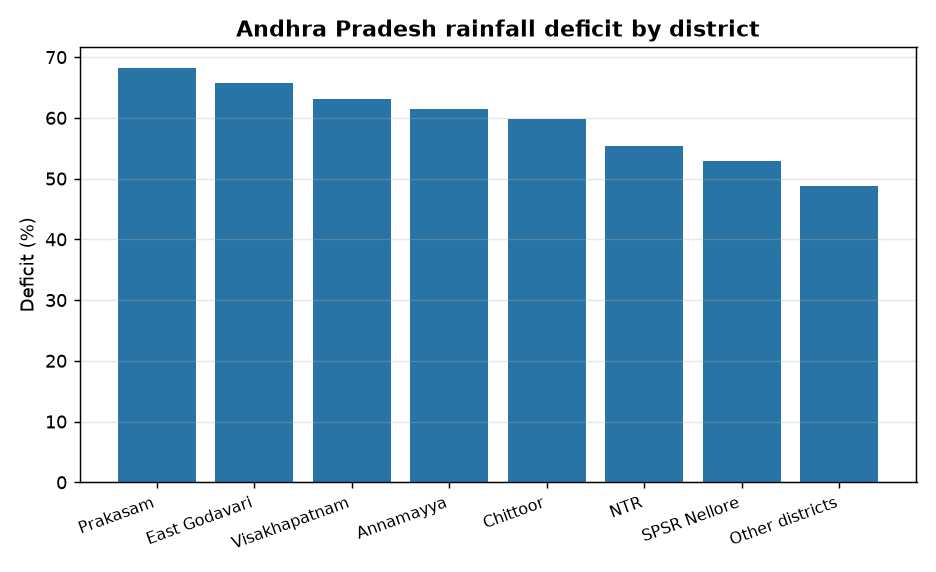
| District-wise Classification of Deficit | Differentiates between ‘large deficit’ (Prakasam, East Godavari, Visakhapatnam, Annamayya, Chittoor) and ‘deficient’ categories, enabling targeted drought mitigation strategies. |
| El Niño Threat (IMD Forecast) | Persistent El Niño conditions suppress monsoon dynamics, reducing probability of rainfall recovery in August, exacerbating long-term agricultural and water security risks. |
| Surface Wind Patterns (40-50 kmph) | Enhances evapotranspiration, accelerating soil moisture depletion and stressing rainfed crops, particularly in Rayalaseema and Coastal Andhra Pradesh. |
| Mandals in NTR and SPSR Nellore Districts | Initially resilient districts now experiencing rising deficit, highlighting spatial and temporal variability in monsoon performance within the state. |
Why it Matters
Economic
- Agricultural output decline: Rainfed kharif crops (paddy, groundnut, pulses) face yield reductions, impacting farm incomes and GDP growth in the agriculture-dependent state.
- Input cost inflation: Increased reliance on groundwater irrigation escalates electricity and diesel costs for farmers, straining rural economies.
- Market disruptions: Shortages in staple crops may trigger price volatility, affecting food security and inflation metrics at the national level.
- Fiscal burden: State exchequer faces higher expenditure on drought relief, subsidies, and employment guarantee schemes (e.g., MGNREGS).
Agricultural
- Crop failure risk: Critical for kharif season (July-October), with paddy (major crop) requiring 150-200 cm rainfall; current deficit threatens 30-40% yield loss.
- Soil moisture stress: Depleting groundwater tables in Rayalaseema and Telangana-border districts reduce sowing windows for rabi crops.
- Livestock vulnerability: Reduced fodder availability triggers distress sales, impacting animal husbandry and allied sectors.
- Fisheries impact: Declining reservoir water levels reduce fish breeding grounds, affecting inland fisheries productivity.
Environmental
- Groundwater depletion acceleration: Over-extraction for irrigation depletes aquifers, risking long-term water scarcity even in normal monsoon years.
- Biodiversity loss: Wetland ecosystems (e.g., Kolleru Lake) face reduced inflow, threatening migratory bird habitats and ecological balance.
- Soil degradation: Increased wind erosion in dry spells degrades topsoil, reducing agricultural productivity in semi-arid regions.
Social
- Migration pressures: Rural distress may accelerate distress migration to urban centres (Hyderabad, Bengaluru), straining peri-urban infrastructure.
- Gender disparities: Women bear disproportionate burden in water collection and agricultural labour, exacerbating socio-economic inequalities.
- Nutritional deficits: Reduced crop diversity and income loss increase household vulnerability to malnutrition, particularly among marginalised communities.
Challenges
1. Hydrological Stress and Water Scarcity
- Depletion of major reservoirs (e.g., Srisailam, Nagarjunasagar) below 50% storage capacity, limiting irrigation and drinking water supply.
- Over-reliance on groundwater in Rayalaseema districts, where aquifers are already overexploited (stage of groundwater development > 100%).
- Inadequate inter-basin water transfers due to deficient monsoon, reducing water-sharing benefits from Krishna and Godavari basins.
UPSC Link: Geography: Drought Management and Water Conservation
2. Agricultural and Livelihood Crisis
- Failure of contingency crops (e.g., millets, pulses) due to delayed and erratic rainfall, pushing farmers toward high-cost alternatives.
- Distress sales of livestock and assets as farmers liquidate resources to meet debt obligations, increasing rural indebtedness.
- Collapse of informal credit systems in rural areas, exacerbating farmer suicides and mental health crises.
UPSC Link: Economy: Agricultural Distress and Rural Economy
3. Institutional and Policy Gaps
- Delayed declaration of drought-affected mandals, hindering timely relief under the National Disaster Response Fund (NDRF).
- Inadequate integration between IMD forecasts and state-level agricultural advisory systems, reducing adaptive capacity.
- Limited convergence between MGNREGS and drought relief programs, leading to suboptimal employment generation.
UPSC Link: Polity: Role of State vs. Central Agencies in Disaster Management
4. Climate Variability and Long-Term Risks
- Increased frequency of El Niño events (linked to Pacific Ocean warming) amplifying monsoon variability and drought recurrence.
- Shift in monsoon patterns: Delayed onset and early withdrawal of southwest monsoon, compressing the effective cropping season.
- Rise in extreme weather events (e.g., heatwaves, cyclones) post-drought, compounding agricultural losses.
UPSC Link: Environment: Climate Change and Monsoon Variability
5. Economic and Fiscal Strain
- State budget reallocation from development to relief expenditure, crowding out investments in irrigation and rural infrastructure.
- Reduced tax revenues from agriculture and allied sectors, constraining fiscal space for social sector spending.
- Increased borrowing by state government to fund drought relief, risking debt sustainability.
UPSC Link: Economy: Fiscal Federalism and State Finances
Challenges — UPSC Perspective
| Issue | Concern |
|---|---|
| Reservoir Storage Levels | Critical water shortages for irrigation and drinking water, with Srisailam at 38% and Nagarjunasagar at 42% (as of July 2026). |
| Groundwater Depletion | Overexploitation in Rayalaseema districts (e.g., Anantapur at 130% stage of development), leading to well failures and increased pumping costs. |
| Crop Insurance Claims | Delayed settlement of Pradhan Mantri Fasal Bima Yojana (PMFBY) claims due to deficient rainfall documentation, delaying farmer compensation. |
| Employment Guarantee Schemes | Underutilisation of MGNREGS in non-drought years due to lack of convergence with agricultural distress mitigation programs. |
| Market Price Volatility | Potential hoarding and speculative pricing of essential commodities (rice, pulses) due to supply chain disruptions. |
| Health Impacts | Rise in waterborne diseases (e.g., cholera, diarrhoea) due to contaminated water sources and poor sanitation in drought-affected regions. |
Government Initiatives — Must-Memorise for Prelims
- Pradhan Mantri Fasal Bima Yojana (PMFBY)
- Mahatma Gandhi National Rural Employment Guarantee Scheme (MGNREGS)
- National Disaster Response Fund (NDRF)
Way Forward
- Constitute State-Level Drought Monitoring Committees under the Disaster Management Act, 2005, to expedite mandal-wise drought declarations and relief disbursal.
- Leverage remote sensing (e.g., ISRO’s VEDAS) and IMD’s extended range forecasts to issue early warnings for farmers, enabling crop substitution strategies.
- Accelerate the implementation of the Andhra Pradesh Drought Mitigation and Water Security Mission, focusing on micro-irrigation (drip/sprinkler) and rainwater harvesting.
- Expand the coverage of PM-KISAN and PMFBY with zero-premium options for small and marginal farmers in drought-affected districts.
- Promote climate-resilient agriculture through the National Mission for Sustainable Agriculture (NMSA), including drought-tolerant seed varieties and soil health cards.
- Enhance convergence between MGNREGS and agricultural distress programs (e.g., fodder banks, community water storage) to generate rural employment and reduce distress migration.
- Strengthen groundwater regulation by enforcing the Andhra Pradesh Water, Land and Trees Act, 2002, and promoting participatory groundwater management in overexploited blocks.
UPSC Value Addition
Keywords for Mains Answer-Writing
Andhra Pradesh rainfall deficit 2026 · Southwest Monsoon variability · Drought management in India · El Niño and Indian monsoon · Agricultural distress in Andhra Pradesh · IMD rainfall classification · Drought declaration criteria · Inter-state monsoon dynamics · Climate resilience in agriculture · Disaster management framework
Constitutional & Policy Linkages
- [‘Article 21: Right to Life and Livelihood’, ‘Drought-induced distress violates the right to a dignified life and sustainable livelihoods.’]
- [‘Article 39(b): Directive Principles of State Policy’, ‘State obligation to ensure equitable distribution of resources during scarcity.’]
- [‘Article 47: Duty to Raise Nutrition Levels’, ‘Government responsibility to mitigate malnutrition risks from agricultural distress.’]
Concept Flow
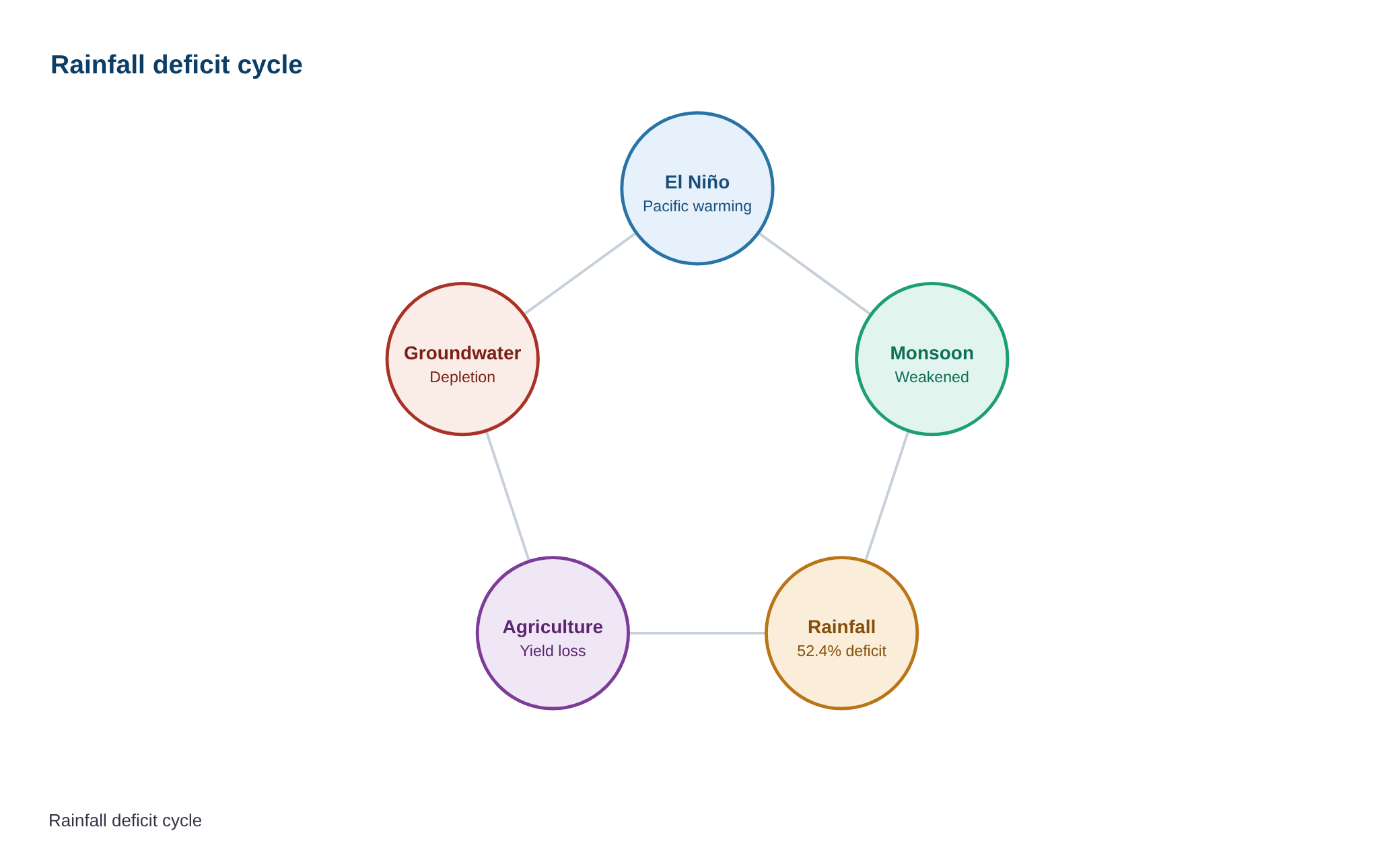
El Niño-induced Pacific Ocean warming → Disruption of Walker Circulation → Weakening of Indian Summer Monsoon → Deficient rainfall in Andhra Pradesh (52.4% deficit by July-end). → Deficient rainfall → Reduced soil moisture and groundwater recharge → Stress on rainfed crops (paddy, groundnut) → Crop failure and yield reduction. → Crop failure → Decline in farm incomes → Distress sales of assets and livestock → Increased rural indebtedness and migration. → Reduced reservoir storage → Water scarcity for irrigation and drinking → Over-extraction of groundwater → Long-term aquifer depletion. → Institutional delays in drought declaration → Inadequate relief under NDRF → Escalation of socio-economic vulnerabilities (health, nutrition, employment). → Climate variability (El Niño recurrence) → Persistent drought risk → Need for climate-resilient agriculture and water security policies.
Prelims Practice Questions
Q1. Consider the following statements regarding the classification of rainfall by the India Meteorological Department (IMD):
1. ‘Deficient’ rainfall is defined as a departure from the long-period average (LPA) between -20% and -59%.
2. ‘Large deficient’ rainfall is defined as a departure from the LPA of -60% or more.
3. ‘Excess’ rainfall is defined as a departure from the LPA of +20% or more.
4. ‘Normal’ rainfall is defined as a departure from the LPA between -19% and +19%.
How many of the above statements are correct?
- Only one
- Only two
- Only three
- All
Answer: All — Statements 1, 2, and 3 are correct as per IMD’s rainfall classification norms. Statement 4 incorrectly defines ‘Normal’ rainfall, which is between -19% and +19% departure from LPA.
Q2. Assertion (A): The El Niño phenomenon is associated with the warming of sea surface temperatures in the central and eastern tropical Pacific Ocean.
Reason (R): El Niño events typically lead to below-normal rainfall over India during the Southwest Monsoon season.
Options:
A. Both A and R are true, and R is the correct explanation of A.
B. Both A and R are true, but R is not the correct explanation of A.
C. A is true, but R is false.
D. A is false, but R is true.
Answer: ? — Assertion (A) is correct as El Niño is characterised by warming of central and eastern Pacific waters. Reason (R) is also correct, but the warming itself does not directly explain the mechanism; the associated atmospheric changes (e.g., Walker Circulation disruption) cause below-normal rainfall in India.
Q3. Match the following pairs related to drought management in India:
Column I (Institutions/Schemes)
1. National Disaster Response Force (NDRF)
2. National Agricultural Drought Assessment and Monitoring System (NADAMS)
3. Mahatma Gandhi National Rural Employment Guarantee Scheme (MGNREGS)
4. National Disaster Management Authority (NDMA)
Column II (Functions)
A. Provides immediate relief and rescue operations during disasters
B. Monitors agricultural drought using remote sensing and GIS
C. Implements drought mitigation through employment generation
D. Formulates and enforces disaster management policies
Select the correct match:
- 1-A, 2-B, 3-C, 4-D
- 1-B, 2-A, 3-D, 4-C
- 1-C, 2-D, 3-A, 4-B
- 1-D, 2-C, 3-B, 4-A
Answer: 1-A, 2-B, 3-C, 4-D — 1-A (NDRF provides rescue operations), 2-B (NADAMS monitors agricultural drought), 3-C (MGNREGS provides employment during droughts), 4-D (NDMA formulates policies).
Mains Practice Question
✍ The persistent deficient rainfall in Andhra Pradesh, with a 52.4% deficit by July-end 2026, has triggered demands for drought declaration and comprehensive farmer support. Critically examine the institutional and policy frameworks in India for drought management, with particular reference to the role of the India Meteorological Department (IMD), the National Disaster Management Authority (NDMA), and state-level mechanisms. Also, analyse the challenges in translating meteorological drought into agricultural drought and the socio-economic consequences for farmers. (15 Marks)
Approach: MODEL-ANSWER SKELETON:
1. **Introduction (2 marks)**: Define meteorological drought (IMD’s classification: deficient/large deficient/excess rainfall) and its distinction from agricultural drought. State the 2026 Andhra Pradesh deficit (52.4%) and its districts (Prakasam, East Godavari, etc.).
2. **IMD’s Role (3 marks)**:
– Explain IMD’s mandate for monsoon forecasting (e.g., Long Range Forecasts, short-range warnings).
– Discuss limitations: forecast accuracy for intra-seasonal variability, El Niño-Southern Oscillation (ENSO) influence, and regional disparities.
– Cite recent IMD data on 2026 monsoon performance (e.g., weak Bay of Bengal branch, deep depression over Chhattisgarh).
3. **NDMA and State Mechanisms (4 marks)**:
– NDMA’s role under the Disaster Management Act, 2005: policy framework, Standard Operating Procedures (SOPs) for drought, and coordination with states.
– State-level mechanisms: Andhra Pradesh’s Drought Management Plan, use of NADAMS for agricultural drought assessment, and MGNREGS for employment generation.
– Critique: Gaps in real-time data integration, delayed declaration of drought, and inter-departmental coordination failures.
4. **Meteorological to Agricultural Drought (3 marks)**:
– Define agricultural drought: soil moisture deficit affecting crop yield.
– Challenges in translation: lag between rainfall deficit and soil moisture depletion, crop-specific water requirements, and groundwater dependence (e.g., Rayalaseema region).
– Role of remote sensing (NADAMS) and ground validation in bridging this gap.
5. **Socio-Economic Consequences (3 marks)**:
– Farmer distress: crop loss, debt cycles, migration (e.g., Rayalaseema’s historical droughts).
– Policy responses: crop insurance (PMFBY), input subsidies, and relief measures under the National Food Security Act.
– Long-term: Need for climate-resilient agriculture (e.g., drought-resistant varieties, water harvesting).
6. **Conclusion (2 marks)**: Summarise the need for a multi-tiered, proactive approach combining IMD’s early warnings, NDMA’s policy framework, and state-level adaptive measures. Highlight the urgency of addressing data gaps and institutional coordination to mitigate farmer distress.
Source: The Hindu
Generated by AanyaAi for educational purpose.

- तमिलनाडु के लिए क्या है ‘एल नीनो’ और उत्तर-पूर्वी मानसून का खतरा? - September 23, 2026
- El Nino & Northeast Monsoon: Impact on Tamil Nadu for UPSC 2026 - September 23, 2026
- हिमाचल में डिजिटल भुगतान क्रांति: बिलासपुर अव्वल, महिलाओं की भागीदारी 93% तक पहुंची - September 23, 2026

No Comments