


08 Aug Andhra Pradesh Launches Digital Mental Health Platform in Schools: UPSC & PCS Notes
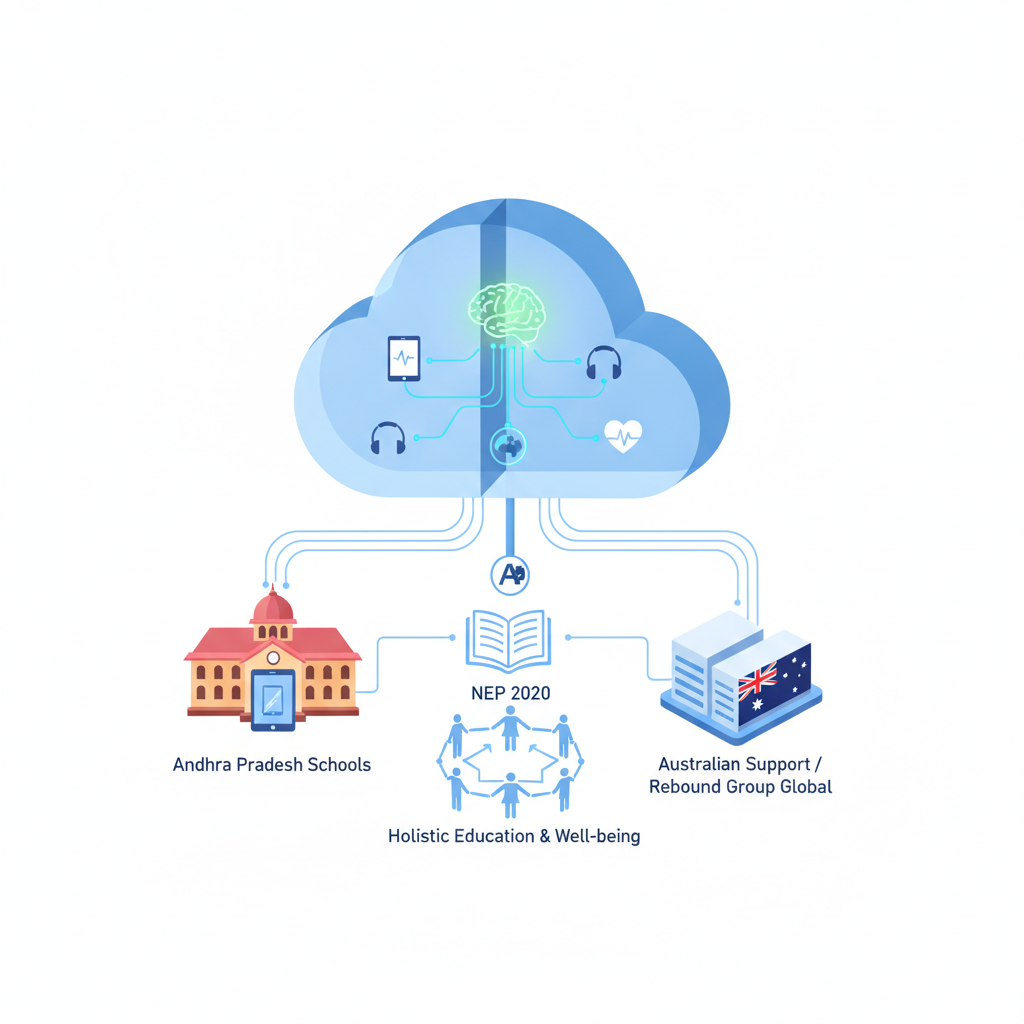
Digital Mental Health PlatformSchoolsRebound Group GlobalNEP 2020✎ The Digital Mental Health Platform (DIMPLE) in Andhra Pradesh exemplifies the integration of digital innovation and mental health care in schools, aligning with the NEP 2020’s holistic education framework and the Supreme Court’s…
Subject Relevance — Where This Topic Fits
- GS Paper II — Social Justice and Governance (Health and Education) | GS Paper IV — Ethics, Integrity and Aptitude (Public Health and Mental Health Challenges)
- Prelims: Digital India, Mental Health Care, School Education, NEP 2020, National Mental Health Programme, UN Sustainable Development Goal 3, Samagra Shiksha, LEAP initiative, Human Resource Development Department, Supreme Court directives on student welfare
- Essay: The intersection of technology and mental health: A paradigm shift in India’s education system, Equity in access to mental health services: Bridging the urban-rural divide in India
Quick Revision: The Digital Mental Health Platform (DIMPLE) in Andhra Pradesh exemplifies the integration of digital innovation and mental health care in schools, aligning with the NEP 2020’s holistic education framework and the Supreme Court’s directives on student well-being.
Why is this in the news?
The Government of Andhra Pradesh, in collaboration with Australia’s Rebound Group Global Ltd. and the Australian Government, launched the Digital Mental Health Platform (DIMPLE) as a pilot initiative in selected schools. This initiative underscores the State’s commitment to integrating digital innovation with mental health care in education, aligning with the Supreme Court’s emphasis on student well-being and the broader objectives of the National Education Policy (NEP) 2020.
Background
- The National Education Policy (NEP) 2020 explicitly recognises the importance of mental health and well-being as critical components of holistic education, mandating the integration of socio-emotional learning and mental health support in school curricula.
- Andhra Pradesh’s unified Human Resource Development (HRD) Department consolidates school, intermediate, higher, and skill education under a single administrative framework to enable coordinated reforms.
- The Learning Excellence in Andhra Pradesh (LEAP) initiative focuses on digital integration, teacher recruitment, professional development, and modernisation of learning systems to enhance educational outcomes.
- Australia has been a key partner in India’s education and health sectors, with collaborations in digital health, vocational training, and mental health initiatives, particularly under the Australia-India Strategic Research Fund (AISRF).
- The DIMPLE platform aligns with global frameworks such as the United Nations Sustainable Development Goal 3 (SDG 3), which emphasises ensuring healthy lives and promoting well-being for all at all ages.
What is the Digital Mental Health Platform (DIMPLE)?
- Digital Mental Health Platform (DIMPLE) is a pilot digital mental health intervention launched in Andhra Pradesh’s schools, developed in partnership with Australia’s Rebound Group Global Ltd. and supported by the Australian Government.
- The platform provides students with anonymous access to mental health resources, including self-assessment tools, psychoeducational content, and guided interventions tailored to adolescent mental health needs.
- A critical feature of DIMPLE is its confidential counselling module, enabling students to connect with trained mental health professionals via secure, digital channels without disclosing their identity, thereby reducing stigma and barriers to seeking help.
- The platform is designed to be scalable and adaptable, with a modular architecture that allows for integration with existing school management systems and State-level health databases.
- DIMPLE incorporates evidence-based frameworks such as Cognitive Behavioural Therapy (CBT) and mindfulness practices, ensuring interventions are grounded in clinical best practices for adolescent mental health.
- The pilot phase, launched in selected schools in Vijayawada, will be evaluated for effectiveness, reach, and scalability before any decision on statewide or national replication is made.
- The initiative reflects a broader trend in India’s education system toward leveraging technology to address non-academic challenges, such as mental health, in line with the NEP 2020’s emphasis on ‘learning without fear’ and ‘inclusive education’.
- Australia’s involvement underscores the potential for international collaboration in addressing shared challenges, particularly in leveraging digital innovation to bridge gaps in mental health service delivery.
Key Features
| Feature | Significance |
|---|---|
| Anonymity in access | Enables students to seek mental health support without fear of stigma or disclosure, fostering early intervention. |
| Confidential counsellor network | Provides trained professionals for real-time, evidence-based guidance, ensuring quality and safety in mental health services. |
| Digital integration with school systems | Aligns with LEAP initiative, leveraging technology for scalable, data-driven mental health interventions in education. |
| Pilot evaluation mechanism | Facilitates evidence-based decision-making on scaling up, in compliance with judicial emphasis on student well-being. |
| Cross-border collaboration | Demonstrates international best practices in mental health governance, enhancing India’s soft power in education and public health. |
Why it Matters
Educational Governance
- Unified HRD Department enables integrated policy design across school, intermediate, higher education, and skill development sectors.
- LEAP initiative’s digital integration aligns with NEP 2020’s emphasis on technology-enabled learning ecosystems.
Public Health
- Addresses rising mental health burdens among adolescents, a critical demographic group per WHO and NIMHANS reports.
- Early intervention through digital platforms can mitigate long-term economic costs of untreated mental health disorders.
International Relations
- Strengthens educational and health diplomacy with Australia, showcasing India’s openness to global partnerships.
- Serves as a model for South-South cooperation in mental health governance, particularly in the Indo-Pacific region.
Judicial and Policy Alignment
- Responds to Supreme Court’s directives on student mental health, reinforcing constitutional obligations under Article 21 (right to life and personal liberty).
- Complements India’s National Mental Health Policy 2014 and the Mental Healthcare Act 2017.
Challenges
1. Digital Divide and Accessibility
- Risk of excluding students without internet connectivity or digital devices, particularly in rural and tribal regions of Andhra Pradesh.
- Requires infrastructure augmentation under schemes like PM-WANI and BharatNet to ensure equitable access.
UPSC Link: GS-II: E-governance & Digital Divide
2. Data Privacy and Security
- Sensitive mental health data necessitates robust cybersecurity frameworks to prevent breaches or misuse.
- Compliance with the Digital Personal Data Protection Act 2023 and IT Rules 2021 is critical.
UPSC Link: GS-III: Cybersecurity & Data Governance
3. Cultural Stigma and Awareness
- Deep-rooted societal taboos around mental health may deter student participation despite anonymity features.
- Requires concurrent community awareness campaigns in local languages.
UPSC Link: GS-II: Social Justice & Inclusion
4. Scalability and Sustainability
- Pilot phase evaluation must assess cost-effectiveness and resource allocation for statewide rollout.
- Dependence on external partners (e.g., Rebound Group) raises questions about long-term ownership and funding.
UPSC Link: GS-II: Centre-State Relations
5. Integration with Existing Systems
- Need for seamless interoperability with school management systems and health databases (e.g., Ayushman Bharat Digital Mission).
- Teacher training on mental health first aid and platform usage is essential for adoption.
UPSC Link: GS-II: Education & Health Infrastructure
Challenges — UPSC Perspective
| Issue | Concern |
|---|---|
| Infrastructure gaps | Limited digital access in rural areas may exclude marginalised students. |
| Data localisation | Cross-border data flows require compliance with Indian regulations. |
| Stakeholder buy-in | Teachers and parents may resist due to lack of awareness or perceived intrusion. |
| Monitoring and evaluation | Absence of standardised metrics for mental health outcomes in digital platforms. |
| Ethical concerns | Potential for algorithmic bias in counsellor allocation or resource prioritisation. |
Way Forward
- Conduct a rigorous impact assessment of the DIMPLE pilot, including student participation rates, counsellor efficacy, and cost-benefit analysis.
- Expand digital infrastructure in underserved districts through convergence with BharatNet and PM-WANI to ensure last-mile connectivity.
- Develop a multi-lingual awareness campaign in collaboration with local NGOs and educational institutions to address stigma.
- Integrate DIMPLE with existing school health programmes (e.g., Ayushman Bharat Health and Wellness Centres) for holistic care.
- Establish a state-level mental health task force to oversee implementation, monitoring, and grievance redressal mechanisms.
- Train teachers and counsellors in mental health first aid and platform utilisation under the LEAP initiative’s professional development modules.
- Pilot a peer-support model within schools to complement counsellor-led interventions, leveraging adolescent resilience.
- Document and disseminate best practices to other states and UTs, positioning Andhra Pradesh as a model for student mental health governance.
UPSC Value Addition
Keywords for Mains Answer-Writing
Digital Mental Health Platform · student mental health · adolescent psychological well-being · UN Sustainable Development Goal 3 · National Education Policy 2020 · digital public health infrastructure · Australia-India educational cooperation · Supreme Court directives on student welfare · School Mental Health Programme · counselling services for adolescents · technology-enabled mental health interventions · human resource development in education
Constitutional & Policy Linkages
- Article 21: Right to life and personal liberty (mental well-being as part of dignified existence).
- Article 45: Directive Principles of State Policy (provision for free and compulsory education includes safeguarding mental health).
Concept Flow
Rising adolescent mental health burdens → Recognition by Supreme Court and policymakers → Need for scalable, stigma-free interventions → Digital mental health platforms as solution → Pilot in Andhra Pradesh with international collaboration → Evaluation and scaling → Integration with education and health systems → Long-term societal and economic benefits.
Prelims Practice Questions
Q1. Consider the following statements regarding the Digital Mental Health Platform (DIMPLE) launched in Andhra Pradesh:
1. The platform was developed in collaboration with Australia’s Rebound Group Global Ltd.
2. It enables students to access mental health resources anonymously and connect with trained counsellors.
3. The initiative is part of the Learning Excellence in Andhra Pradesh (LEAP) programme.
4. The platform was inaugurated by the Chief Justice of India.
How many of the above statements are correct?
- Only one
- Only two
- Only three
- All four
Answer: Only three — Statements 1, 2, and 3 are correct. Statement 4 is incorrect as the platform was inaugurated by the Commissioner of Higher Education, not the Chief Justice of India.
Q2. Assertion (A): The Digital Mental Health Platform (DIMPLE) in Andhra Pradesh prioritises student mental health through digital tools.
Reason (R): The Supreme Court of India has emphasised the importance of student mental health in recent directives.
In the context of the above two statements, which one of the following is correct?
- Both A and R are true, and R is the correct explanation of A.
- Both A and R are true, but R is not the correct explanation of A.
- A is true, but R is false.
- A is false, but R is true.
Answer: A is true, but R is false. — Both A and R are true, but R is not the correct explanation of A. While the Supreme Court has emphasised student mental health, the DIMPLE initiative is a proactive state-level intervention, not a direct consequence of judicial directives.
Q3. Match the following initiatives with their respective objectives:
Column I (Initiative) | Column II (Objective)
———————————————–|———————————————–
A. Digital Mental Health Platform (DIMPLE) | 1. To modernise learning systems through digital integration
B. Learning Excellence in Andhra Pradesh (LEAP)| 2. To provide mental health resources and counselling for students
C. National Education Policy 2020 | 3. To promote inclusive and equitable quality education
D. School Health Programme | 4. To address physical and mental health of school-going children
Select the correct match:
- A-2, B-1, C-3, D-4
- A-1, B-2, C-3, D-4
- A-4, B-3, C-2, D-1
- A-2, B-1, C-4, D-3
Answer: A-2, B-1, C-3, D-4 — Correct matches: A-2 (DIMPLE focuses on mental health resources), B-1 (LEAP aims at digital integration and modernisation), C-3 (NEP 2020 promotes inclusive and equitable education), D-4 (School Health Programme addresses physical and mental health).
Mains Practice Question
✍ Critically examine the significance of the Digital Mental Health Platform (DIMPLE) launched in Andhra Pradesh for adolescent mental health in India. How does this initiative align with the broader objectives of the National Education Policy 2020 and the Sustainable Development Goal 3? (15 Marks)
Approach: MODEL-ANSWER SKELETON:
1. **Introduction (2 marks)**: Define adolescent mental health and its importance in India, citing WHO data on prevalence of mental health issues among adolescents (e.g., 1 in 7 adolescents globally). Highlight the mental health crisis in Indian schools (e.g., rising cases of anxiety, depression, and suicides).
2. **DIMPLE Initiative (4 marks)**:
– Purpose: Digital platform for anonymous access to mental health resources and confidential counselling for students.
– Features: Anonymity, trained counsellors, integration with school systems, and alignment with Supreme Court directives on student welfare.
– Pilot phase: Launched in selected schools in Andhra Pradesh with Australian support, indicating a model for scalability.
– Link to technology: Leverages digital public health infrastructure to address gaps in traditional mental health services.
3. **Alignment with NEP 2020 (4 marks)**:
– **Holistic Development (Para 4.1)**: NEP 2020 emphasises the importance of physical, mental, and emotional well-being of students. DIMPLE directly addresses the mental health component.
– **Digital Integration (Para 5.1)**: NEP 2020 advocates for the use of technology in education, including digital tools for learning and well-being. DIMPLE exemplifies this.
– **Equity and Inclusion (Para 6.1)**: NEP 2020 aims to reduce disparities in access to quality education and health services. DIMPLE can bridge gaps in mental health services for marginalised students.
4. **Alignment with SDG 3 (3 marks)**:
– **SDG 3.4**: By 2030, reduce premature mortality from non-communicable diseases through prevention and promotion of mental health. DIMPLE contributes to this by early identification and intervention.
– **SDG 3.7**: Ensure universal access to sexual and reproductive health-care services, including for mental health. DIMPLE can integrate such services.
– **SDG 4.7**: Ensure inclusive and equitable quality education and promote lifelong learning opportunities for all. Mental health is a prerequisite for effective learning.
5. **Challenges and Criticisms (2 marks)**:
– **Digital Divide**: Risk of excluding students without access to digital devices or internet.
– **Privacy Concerns**: Anonymity may raise ethical and legal questions about data protection.
– **Scalability**: Pilot phase success does not guarantee effectiveness at scale.
– **Cultural Sensitivity**: Mental health services must be culturally adapted to Indian contexts.
6. **Conclusion (2 marks)**: Summarise the transformative potential of DIMPLE as a model for India, while acknowledging the need for robust implementation, monitoring, and evaluation. Emphasise the importance of integrating mental health into broader educational reforms.
Source: The Hindu
Generated by AanyaAi for educational purpose.

- विकलांग सैन्य कैडेटों को पेंशन देने से रोक रही सरकार की नीति: केंद्र ने सुप्रीम कोर्ट में बताया - September 23, 2026
- Centre Tells SC: Policy Blocks Disability Pension for Outboarded Cadets - September 23, 2026
- यूपीएससी तैयारी: स्कूलों में स्वच्छता सुविधाओं की कमी, 5 करोड़ बच्चे प्रभावित - September 23, 2026

No Comments