


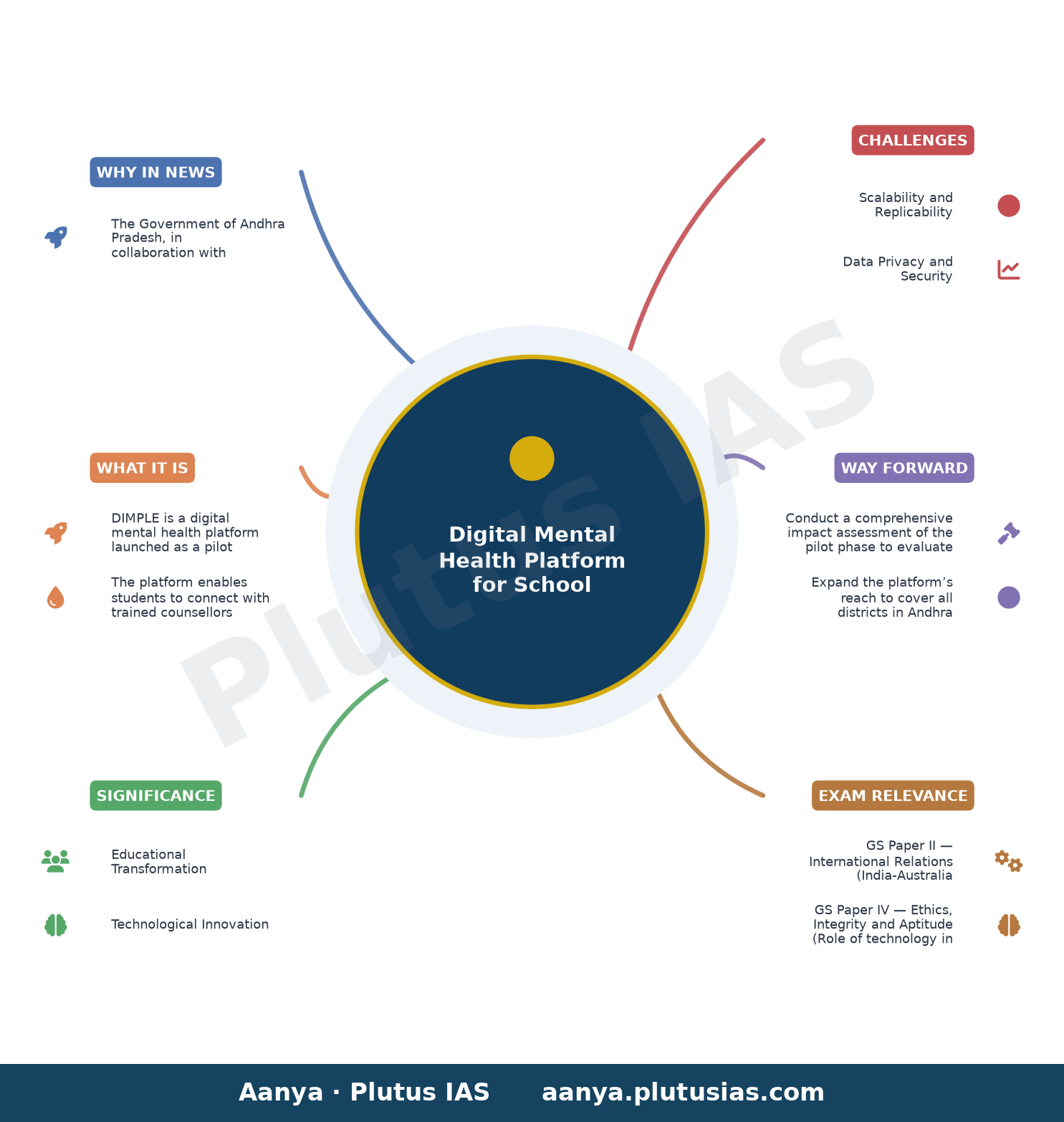
08 Aug Andhra Pradesh Launches DIMPLE: Digital Mental Health Platform for Schools
✎ DIMPLE represents a convergence of technology, governance, and public health, offering a scalable model for student mental health support that aligns with the Supreme Court’s directives.
Subject Relevance — Where This Topic Fits
- GS Paper II — International Relations (India-Australia bilateral cooperation) | GS Paper IV — Ethics, Integrity and Aptitude (Role of technology in addressing societal challenges)
- Prelims: Digital Public Infrastructure (DPI), School Mental Health Programme (SMHP), National Education Policy (NEP) 2020, Human Resource Development (HRD) Department, Rebound Group Global Ltd., Samagra Shiksha Abhiyan
- Essay: The intersection of technology and public health: Opportunities and ethical dilemmas, The role of education systems in fostering holistic development of students
Quick Revision: DIMPLE represents a convergence of technology, governance, and public health, offering a scalable model for student mental health support that aligns with the Supreme Court’s directives.
Why is this in the news?
The Government of Andhra Pradesh, in collaboration with Australia’s Rebound Group Global Ltd. and the Australian Government, launched the Digital Mental Health Platform (DIMPLE) as a pilot initiative in selected schools. This initiative underscores the State’s commitment to integrating digital solutions for student well-being, aligning with the Supreme Court’s emphasis on mental health in educational institutions. The programme’s launch in Vijayawada and its potential to serve as a model for India and South Asia have drawn significant attention, highlighting the intersection of technology, governance, and public health in India’s education sector.
Background
- The Supreme Court of India, in its directives, has repeatedly underscored the need for mental health support systems in schools to address rising stress, anxiety, and depression among students.
- Andhra Pradesh has consolidated its education, skill development, and higher education sectors under a unified Human Resource Development (HRD) Department to enable coordinated policy implementation and resource allocation.
- The State’s Learning Excellence in Andhra Pradesh (LEAP) initiative aims to modernise education through digital integration, teacher training, and systemic reforms to enhance learning outcomes.
- Australia’s engagement in India’s education sector reflects its broader strategy to strengthen educational ties and promote mental health awareness, particularly in the context of growing digitalisation and its associated challenges.
- The pilot phase of DIMPLE in selected schools will be evaluated before any decision on scaling up, ensuring evidence-based policy formulation.
What is the Digital Mental Health Platform (DIMPLE)?
- DIMPLE is a digital mental health platform launched as a pilot initiative in selected schools in Andhra Pradesh to provide students with accessible, anonymous, and confidential mental health resources.
- The platform enables students to connect with trained counsellors through a digital interface, ensuring privacy and reducing the stigma associated with seeking mental health support.
- Developed by Australia’s Rebound Group Global Ltd. after several years of research, DIMPLE integrates technology to address the mental health challenges faced by school-going adolescents, including stress, anxiety, and depression.
- The platform aligns with the Supreme Court’s directives on student mental health.
- DIMPLE is designed to be scalable and adaptable, with the potential to serve as a model for other States in India and the wider South Asian region, particularly in addressing mental health challenges in educational settings.
- The platform’s anonymity feature ensures that students can seek help without fear of disclosure, fostering a culture of openness and support within schools.
- The initiative is part of Andhra Pradesh’s broader LEAP initiative, which aims to modernise education through digital integration and systemic reforms.
- The pilot phase will be evaluated to assess its effectiveness and feasibility before any decision on scaling up is taken, ensuring a data-driven approach to policy implementation.
Key Features
| Feature | Significance |
|---|---|
| Anonymised access to mental health resources | Ensures confidentiality, reducing stigma and encouraging early intervention among students. |
| Confidential counselling via trained professionals | Provides evidence-based support while maintaining student privacy, aligning with Supreme Court directives on mental health. |
| Pilot implementation in selected schools | Facilitates rigorous evaluation before potential statewide or national scaling, minimising systemic risks. |
| Integration with LEAP initiative | Leverages existing digital education reforms to create a holistic approach to student well-being. |
| Collaboration with Australian entities | Brings international expertise in mental health technology and policy, enhancing the platform’s robustness. |
Why it Matters
Educational Transformation
- Demonstrates Andhra Pradesh’s commitment to holistic education by addressing mental health as a core component of learning excellence.
- Aligns with the Supreme Court’s emphasis on student mental health, setting a precedent for other states.
- Enhances the effectiveness of the Learning Excellence in Andhra Pradesh (LEAP) initiative through digital integration.
Technological Innovation
- Introduces a scalable digital platform for mental health support, reducing barriers to access in rural and urban schools.
- Leverages anonymity and confidentiality to overcome traditional barriers in seeking mental health assistance.
International Cooperation
- Strengthens educational and technological ties with Australia, fostering knowledge exchange and capacity building.
- Showcases India’s openness to global partnerships in addressing critical social challenges.
Policy Implications
- Highlights the need for state-led mental health policies in education, complementing central initiatives like the National Mental Health Programme.
- Demonstrates the role of technology in bridging gaps in mental health service delivery, particularly for adolescents.
Challenges
1. Scalability and Replicability
- Ensuring equitable access across diverse socio-economic and geographic contexts within Andhra Pradesh.
- Adapting the platform to varying levels of digital literacy among students and educators.
UPSC Link: GS2: Social Justice, GS3: Technology & Governance
2. Data Privacy and Security
- Protecting sensitive student data from breaches or misuse, particularly given the anonymised nature of interactions.
- Compliance with India’s Digital Personal Data Protection Act, 2023, and other relevant regulations.
UPSC Link: GS3: Technology & Governance
3. Sustainability and Funding
- Securing long-term funding for maintenance, updates, and expansion beyond the pilot phase.
- Balancing public-private partnerships without compromising accessibility or quality.
UPSC Link: GS2: Social Justice, GS3: Technology & Governance
4. Cultural and Social Acceptance
- Overcoming stigma associated with mental health issues in conservative or traditional communities.
- Ensuring cultural sensitivity in counselling approaches and resource content.
UPSC Link: GS1: Indian Society
5. Integration with Existing Systems
- Aligning DIMPLE with other state-led initiatives like LEAP and Samagra Shiksha to avoid duplication or fragmentation.
- Training educators and counsellors to effectively utilise the platform within existing workflows.
UPSC Link: GS2: Education, GS3: Technology & Governance
Challenges — UPSC Perspective
| Issue | Concern |
|---|---|
| Digital Divide | Unequal access to devices and internet connectivity may exclude marginalised students from benefiting equally. |
| Counsellor Shortage | Limited availability of trained mental health professionals to staff the platform effectively. |
| Monitoring and Evaluation | Difficulty in measuring long-term impact on student mental health outcomes due to lack of standardised metrics. |
| Language Barriers | Ensuring multilingual support to cater to diverse linguistic groups within Andhra Pradesh. |
| Political and Bureaucratic Hurdles | Potential delays in scaling up due to administrative or funding constraints. |
| Ethical Concerns | Balancing anonymity with the need for parental or guardian consent in cases of minors. |
Government Initiatives — Must-Memorise for Prelims
- Learning Excellence in Andhra Pradesh (LEAP)
- Samagra Shiksha Abhiyan (as referenced in the source)
Way Forward
- Conduct a comprehensive impact assessment of the pilot phase to evaluate effectiveness and identify areas for improvement.
- Expand the platform’s reach to cover all districts in Andhra Pradesh, ensuring equitable access across rural and urban areas.
- Develop a robust data privacy framework in compliance with the Digital Personal Data Protection Act, 2023, and other relevant laws.
- Integrate DIMPLE with existing school health programmes, such as Ayushman Bharat’s School Health Programme, for a unified approach.
- Train school counsellors and educators in using the platform and recognising early signs of mental health issues.
- Establish a dedicated helpline or support system for students requiring immediate assistance.
- Collaborate with NGOs and civil society organisations to enhance community awareness and reduce stigma.
- Document the initiative’s outcomes and best practices to share with other states and international partners for replication.
UPSC Value Addition
Keywords for Mains Answer-Writing
Digital Mental Health Platform (DIMPLE) · student mental health · School Health Programme · National Mental Health Programme (NMHP) · Article 21 right to health · UNESCO Education 2030 · SDG 3 (Good Health and Well-being) · SDG 4 (Quality Education) · counselling services in schools · psychosocial support · digital public infrastructure · Australia-India educational collaboration · Supreme Court directives on student welfare · Learning Excellence in Andhra Pradesh (LEAP) · Samagra Shiksha Abhiyan
Concept Flow
Increased academic and social pressures on students → Rise in mental health issues among adolescents → Recognition of the need for structured mental health support in schools → Development of DIMPLE platform → Pilot implementation in selected schools → Evaluation of effectiveness and scalability → Potential statewide or national replication → Integration with broader educational and health policies → Long-term improvement in student well-being and academic outcomes.
Prelims Practice Questions
Q1. Consider the following statements regarding the Digital Mental Health Platform (DIMPLE) launched in Andhra Pradesh:
1. DIMPLE is a pilot initiative for school students developed in partnership with Australia’s Rebound Group Global Ltd.
2. The platform enables students to access mental health resources anonymously and connect with trained counsellors.
3. The Supreme Court has not issued any directives regarding student mental health in recent years.
4. The platform is aligned with the Learning Excellence in Andhra Pradesh (LEAP) initiative.
How many of the above statements are correct?
- Only one
- Only two
- Only three
- All four
Answer: Only three — Statements 1, 2, and 4 are correct. Statement 3 is incorrect as the Supreme Court has emphasized student mental health in recent directives.
Q2. Assertion (A): The Digital Mental Health Platform (DIMPLE) in Andhra Pradesh is designed to provide psychosocial support exclusively through in-person counselling sessions.
Reason (R): The platform enables students to access mental health resources anonymously and connect confidentially with trained counsellors digitally.
Options:
A. Both A and R are true, and R is the correct explanation of A.
B. Both A and R are true, but R is not the correct explanation of A.
C. A is true, but R is false.
D. A is false, but R is true.
Answer: ? — Assertion (A) is false because DIMPLE provides digital, not exclusively in-person, counselling. Reason (R) is true and correctly explains the nature of the platform.
Q3. Match the following initiatives with their respective objectives:
Column I (Initiative) | Column II (Objective)
———————|———————-
1. Digital Mental Health Platform (DIMPLE) | A. To provide digital mental health resources and counselling for school students
2. Learning Excellence in Andhra Pradesh (LEAP) | B. To strengthen education through digital integration, teacher recruitment, and modernisation
3. Samagra Shiksha Abhiyan | C. To integrate school education, intermediate education, higher education, and skill development under a unified department
4. National Mental Health Programme (NMHP) | D. To provide equitable and inclusive quality education from pre-school to senior secondary level
Options:
A. 1-A, 2-B, 3-D, 4-C
B. 1-A, 2-B, 3-C, 4-D
C. 1-B, 2-A, 3-D, 4-C
D. 1-D, 2-C, 3-A, 4-B
Answer: ? — Correct matches: 1-A (DIMPLE provides digital mental health resources), 2-B (LEAP focuses on digital integration and modernisation), 3-D (Samagra Shiksha Abhiyan aims for inclusive education), 4-C (NMHP integrates mental health services under a unified framework).
Mains Practice Question
✍ Critically analyse the significance of the Digital Mental Health Platform (DIMPLE) launched in Andhra Pradesh, in the context of India’s obligations under the Sustainable Development Goals (SDGs) and the constitutional right to health. Also, examine the potential challenges in scaling up such digital mental health interventions in India’s education system. (15 Marks)
Approach: MODEL-ANSWER SKELETON:
1. **Context and Initiative**: Briefly describe DIMPLE as a digital mental health platform for school students in Andhra Pradesh, developed with Australian support, and its alignment with the Supreme Court’s emphasis on student mental health.
2. **SDG and Constitutional Framework**:
– **SDG 3 (Good Health and Well-being)**: Link DIMPLE to Target 3.4 (reduce premature mortality from non-communicable diseases and promote mental health) and Target 3.7 (ensure universal access to sexual and reproductive health-care services, including mental health).
– **SDG 4 (Quality Education)**: Highlight Target 4.7 (ensure all learners acquire knowledge and skills needed for sustainable development, including mental health literacy).
– **Article 21 (Right to Health)**: Discuss the Supreme Court’s interpretation of Article 21 to include the right to mental health as part of the right to life and personal liberty (e.g., *Vishaka Guidelines*, *Puttaswamy* case).
3. **Strengths of Digital Mental Health Platforms**:
– **Accessibility**: Overcome geographical and socio-economic barriers to mental health services.
– **Anonymity and Confidentiality**: Reduce stigma and encourage early intervention (cite the platform’s design features).
– **Integration with Education Systems**: Align with initiatives like LEAP and Samagra Shiksha Abhiyan to create a holistic approach.
– **Evidence-Based Design**: Mention the platform’s development through research and collaboration with trained counsellors.
4. **Challenges in Scaling Up**:
– **Digital Divide**: Unequal access to technology across socio-economic groups and regions.
– **Data Privacy and Security**: Risks of breaches in sensitive mental health data (link to *Personal Data Protection Bill, 2023* or *Digital Personal Data Protection Act, 2023*).
– **Cultural and Linguistic Barriers**: Need for culturally sensitive and multilingual content.
– **Teacher and Counsellor Training**: Ensuring adequate capacity-building for educators to support students.
– **Sustainability and Funding**: Long-term financial viability and integration into existing health and education systems.
– **Monitoring and Evaluation**: Establishing robust mechanisms to assess impact and outcomes.
5. **Comparative Perspective**: Briefly compare DIMPLE with other digital mental health initiatives in India (e.g., *iCall* by TISS, *eSanjeevani* for telemedicine) and global models (e.g., Australia’s *Headspace*).
6. **Conclusion**: Summarise the transformative potential of DIMPLE while acknowledging the need for a multi-stakeholder approach to address challenges.
Source: The Hindu
Generated by AanyaAi for educational purpose.

- आरबीआई ने सरकारी प्रतिभूतियों की ओएमओ बिक्री की घोषणा, जानिए पूरा विवरण - September 23, 2026
- RBI to Sell ₹25,000 Crore Govt Securities via OMO on Sept 28, 2026 - September 23, 2026
- भारत-श्रीलंका नौसैनिक अभ्यास ‘स्लाईनेक्स-26’: विशाखापत्तनम में संपन्न, जानें प्रमुख बिंदु - September 23, 2026

No Comments