


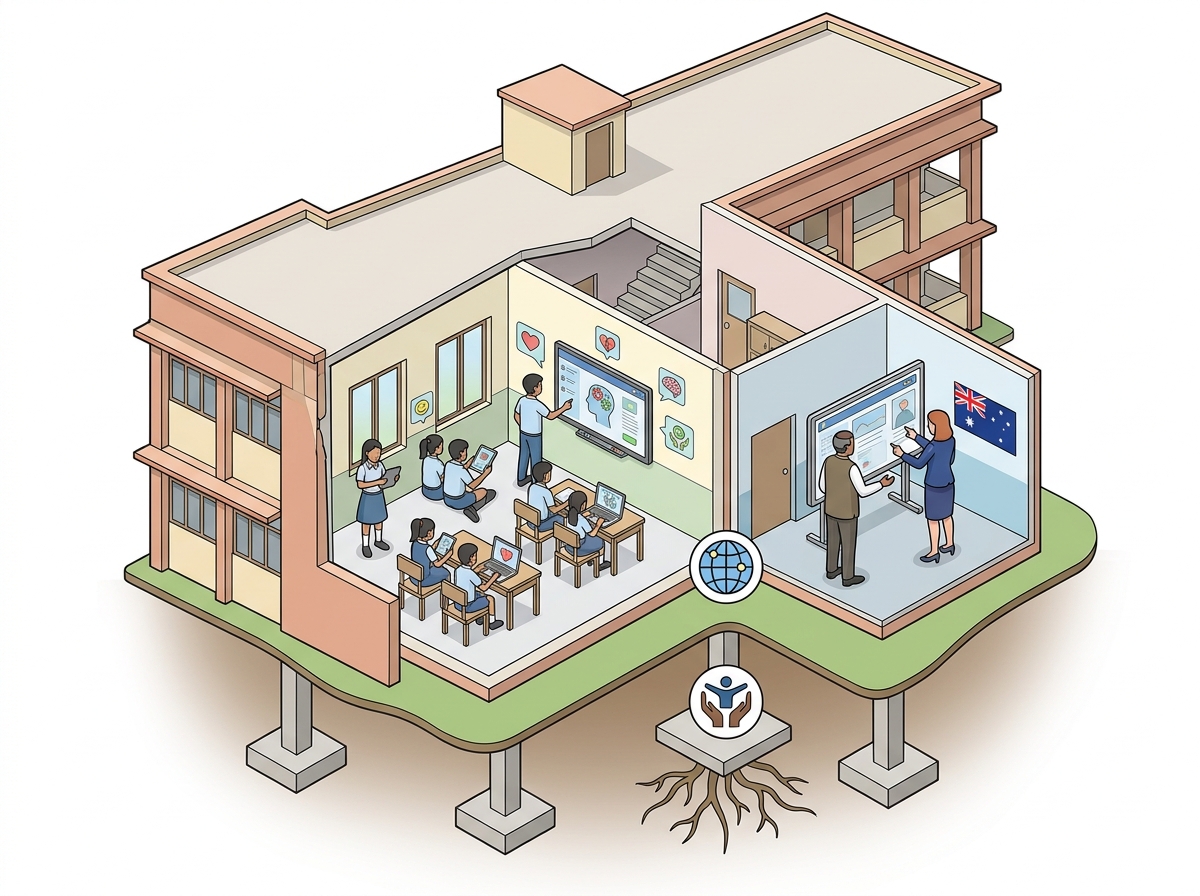
08 Aug Andhra Pradesh Launches DIMPLE: Digital Mental Health Platform for Schools
Digital Mental Health PlatformRebound Group GlobalHRD DepartmentStudent mental healthAcademic stress support✎ DIMPLE is a digital mental health platform in Andhra Pradesh schools, enabling anonymous access to mental health resources and confidential counselling, developed through a public-private partnership with Australian support, and…
Subject Relevance — Where This Topic Fits
- GS Paper II — Governance, Administration and Challenges (e.g., Digital Governance, Public-Private Partnerships) | GS Paper III — Science and Technology (e.g., Digital Health, AI in Mental Health) | GS Paper IV — Ethics and Human Interface (e.g., Ethical Implications of Digital Health, Privacy in Mental Health Data)
- Prelims: Digital Mental Health Platform (DIMPLE), Human Resource Development (HRD) Department, Andhra Pradesh, Learning Excellence in Andhra Pradesh (LEAP), Supreme Court directives on student mental health, Rebound Group Global Ltd., Samagra Shiksha Abhiyan, SCERT (State Council of Educational Research and Training), Digital integration in education, Anonymity in mental health services, UN Sustainable Development Goal 3 (Good Health and Well-being)
- Essay: The role of technology in addressing societal challenges: A case study of digital mental health platforms in education, Public-private partnerships in governance: Evaluating the Andhra Pradesh model
Quick Revision: DIMPLE is a digital mental health platform in Andhra Pradesh schools, enabling anonymous access to mental health resources and confidential counselling, developed through a public-private partnership with Australian support, and aligned with the Supreme Court’s emphasis on student well-being.
Why is this in the news?
The Government of Andhra Pradesh, in collaboration with Australia’s Rebound Group Global Ltd. and the Australian Government, has launched the Digital Mental Health Platform (DIMPLE) as a pilot initiative in selected schools. This initiative is significant as it aligns with the Supreme Court’s emphasis on student mental health and represents a coordinated effort under the unified Human Resource Development (HRD) Department of Andhra Pradesh. The platform’s focus on anonymity and confidential access to mental health resources underscores the growing recognition of digital tools in addressing mental health challenges among students, particularly in the context of rising stress linked to academic pressures and social media.
Background
- The Government of Andhra Pradesh has consolidated school education, intermediate education, higher education, and skill development under a single Human Resource Development (HRD) Department, enabling a unified approach to educational reforms.
- The Learning Excellence in Andhra Pradesh (LEAP) initiative aims to strengthen education through digital integration, teacher recruitment, professional training, and modernisation of learning systems.
- The Supreme Court of India has, in recent judgments, underscored the importance of mental health in educational institutions, directing states to implement measures for student well-being.
- Australia’s Rebound Group Global Ltd. has developed the DIMPLE platform after years of research, highlighting the global interest in leveraging technology for mental health interventions.
- The pilot initiative in Andhra Pradesh reflects a broader trend of integrating digital health solutions into public service delivery, particularly in the aftermath of the COVID-19 pandemic, which exacerbated mental health challenges among youth.
- The collaboration with the Australian Government and Rebound Group Global Ltd. exemplifies the potential of international partnerships in addressing domestic policy challenges through technology and innovation.
What is the Digital Mental Health Platform (DIMPLE)?
- DIMPLE (Digital Mental Health Platform for Education) is a pilot digital mental health platform launched in selected schools in Andhra Pradesh, developed in partnership with Australia’s Rebound Group Global Ltd. and supported by the Australian Government.
- The platform enables students to access mental health resources anonymously, ensuring confidentiality and reducing stigma associated with seeking mental health support.
- Students can connect confidentially with trained counsellors through the platform, facilitating early intervention and support for mental health concerns.
- The platform is designed to address the rising mental health challenges among students, including stress, anxiety, and depression, exacerbated by academic pressures and social media use.
- DIMPLE aligns with the Supreme Court’s directives on student mental health and is part of Andhra Pradesh’s broader educational reforms under the unified HRD Department.
- The platform will be evaluated during the pilot phase before any decision on scaling it up across the state or replicating it in other regions.
- The initiative reflects a public-private partnership model, combining governmental commitment to education reform with technological innovation and international expertise.
- The platform’s development is rooted in research, indicating a data-driven approach to addressing mental health challenges in educational settings.
Key Features
| Feature | Significance |
|---|---|
| Anonymous access to mental health resources | Ensures confidentiality, reducing stigma and encouraging early intervention among students. |
| Confidential counselling via trained professionals | Provides evidence-based support while maintaining student privacy, aligning with adolescent mental health best practices. |
| Pilot initiative in selected schools | Allows for rigorous evaluation of efficacy before potential statewide or national scaling. |
| Integration with LEAP initiative | Leverages existing digital education reforms to create a holistic ecosystem for student well-being. |
| Multi-stakeholder collaboration (state, Australia, private sector) | Demonstrates a coordinated approach to addressing complex societal challenges through shared expertise. |
Why it Matters
Educational Policy
- Reinforces the Supreme Court’s directives on prioritising student mental health within the Right to Education (RTE) framework.
- Aligns with the National Education Policy (NEP) 2020’s emphasis on holistic development and digital integration in education.
- Demonstrates state-level innovation in addressing non-cognitive dimensions of learning, complementing academic reforms under LEAP.
Public Health
- Addresses the rising prevalence of adolescent mental health disorders, which account for 16% of the global burden of disease in this age group (WHO).
- Provides a scalable model for early detection and intervention, potentially reducing long-term healthcare costs.
- Highlights the role of digital tools in bridging gaps in mental health service delivery, particularly in underserved regions.
International Cooperation
- Showcases successful public-private partnerships between India and Australia, fostering knowledge exchange in health-tech innovation.
- Serves as a case study for South-South cooperation in addressing global challenges like youth mental health.
- Demonstrates Australia’s commitment to global education and health initiatives, aligning with its ‘India Economic Strategy’ priorities.
Technological Innovation
- Illustrates the application of AI and data analytics in mental health, enabling personalised and scalable interventions.
- Underscores the potential of anonymised digital platforms to overcome barriers to mental health care access.
- Provides a template for integrating mental health tools within existing educational technology ecosystems.
Challenges
1. Digital Divide and Accessibility
- Risk of excluding students from socio-economically disadvantaged backgrounds due to limited device or internet access.
- Ensuring equitable reach across rural and remote areas remains a critical implementation challenge.
UPSC Link: GS Paper 2: Governance, GS Paper 3: Technology
2. Data Privacy and Security
- Safeguarding sensitive student data from breaches or misuse is paramount, given the anonymised nature of the platform.
- Compliance with India’s Digital Personal Data Protection Act, 2023, and global standards (e.g., GDPR) is essential.
UPSC Link: GS Paper 2: Fundamental Rights, GS Paper 3: Cybersecurity
3. Stigma and Cultural Barriers
- Persistent societal stigma around mental health may deter students from utilising the platform despite anonymity.
- Cultural nuances in different regions of Andhra Pradesh may require tailored awareness campaigns.
UPSC Link: GS Paper 1: Social Issues
4. Scalability and Sustainability
- Ensuring long-term funding and institutional commitment post-pilot phase is critical for sustained impact.
- Training and retaining a sufficient pool of mental health professionals to meet demand is a logistical hurdle.
UPSC Link: GS Paper 2: Centre-State Relations, GS Paper 3: Public Expenditure Management
5. Integration with Existing Systems
- Seamless integration with school management systems and teacher training programs is necessary for effectiveness.
- Avoiding duplication with other mental health initiatives (e.g., Manodarpan) requires clear delineation of roles.
UPSC Link: GS Paper 2: Governance
Challenges — UPSC Perspective
| Issue | Concern |
|---|---|
| Digital Divide | Exclusion of students without access to devices or internet, exacerbating inequities. |
| Data Privacy | Risk of unauthorised access or leakage of sensitive student information. |
| Cultural Sensitivity | Potential mismatch between platform design and local beliefs about mental health. |
| Resource Constraints | Limited availability of trained counsellors to meet demand across schools. |
| Sustainability | Ensuring continued funding and political will beyond the pilot phase. |
Way Forward
- Conduct a rigorous impact assessment of the pilot phase, focusing on reach, effectiveness, and cost-efficiency.
- Develop a phased rollout strategy, prioritising schools in underserved and high-need regions.
- Strengthen digital infrastructure in rural areas through collaborations with BharatNet and other connectivity initiatives.
- Establish a robust data governance framework, including regular audits and compliance with privacy laws.
- Launch targeted awareness campaigns in local languages to address stigma and promote platform utilisation.
- Integrate the platform with existing school health programmes (e.g., Ayushman Bharat) for a unified approach.
- Foster public-private partnerships to ensure sustainable funding and technological upgrades.
- Document and disseminate lessons learned to inform similar initiatives across other states and countries.
UPSC Value Addition
Keywords for Mains Answer-Writing
Digital Mental Health Platform for Schools · Student mental health and well-being · Supreme Court directives on mental health · Digital integration in education · Andhra Pradesh education reforms · Human Resource Development Department · Learning Excellence in Andhra Pradesh (LEAP) · Mental health counselling for adolescents · Anonymity and confidentiality in mental health services · Australia-India educational cooperation · Digital counselling infrastructure · School-based mental health interventions
Constitutional & Policy Linkages
- [‘Article 21: Right to Life and Personal Liberty’, ‘Encompasses mental well-being as part of dignified existence.’]
- [‘Article 45: Directive Principle of State Policy’, ‘Calls for free and compulsory education, including holistic development.’]
- [‘Article 47: Duty of State to improve public health’, ‘Extends to mental health as a component of overall well-being.’]
Concept Flow
Rising adolescent mental health disorders → Supreme Court directives on student well-being → State-level policy innovation (LEAP, DIMPLE) → Multi-stakeholder collaboration (Australia, private sector) → Digital platform development → Pilot implementation in schools → Impact assessment and scaling considerations.
Prelims Practice Questions
Q1. Consider the following statements about the Digital Mental Health Platform (DIMPLE) launched in Andhra Pradesh:
1. DIMPLE is a pilot initiative developed in partnership with Australia’s Rebound Group Global Ltd.
2. The platform enables students to access mental health resources anonymously and connect with trained counsellors.
3. DIMPLE is part of the Learning Excellence in Andhra Pradesh (LEAP) initiative.
4. The Supreme Court has not issued any directives regarding student mental health in recent years.
How many of the above statements are correct?
- Only one
- Only two
- Only three
- All four
Answer: Only three — Statements 1, 2, and 3 are correct. Statement 4 is incorrect as the Supreme Court has emphasised student mental health, as noted in the context of the DIMPLE initiative.
Q2. Assertion (A): The Digital Mental Health Platform (DIMPLE) prioritises anonymity and confidentiality for students accessing mental health services.
Reason (R): The platform was developed after several years of research by Rebound Group Global Ltd. in collaboration with the Australian Government.
Options:
A. Both A and R are true, and R is the correct explanation of A.
B. Both A and R are true, but R is NOT the correct explanation of A.
C. A is true, but R is false.
D. A is false, but R is true.
Answer: ? — Both Assertion (A) and Reason (R) are true. The platform’s design prioritises anonymity and confidentiality (A), and its development involved years of research (R). However, R does not directly explain why anonymity and confidentiality are prioritised.
Q3. Match the following initiatives with their respective descriptions:
Initiative:
1. Learning Excellence in Andhra Pradesh (LEAP)
2. Digital Mental Health Platform (DIMPLE)
3. Human Resource Development (HRD) Department
4. Supreme Court directives on student mental health
Description:
A. A unified department integrating school, intermediate, higher education, and skill development in Andhra Pradesh.
B. A pilot project providing digital mental health resources and counselling for students.
C. An initiative to strengthen education through digital integration, teacher recruitment, and professional training.
D. Judicial emphasis on prioritising mental health and well-being of students.
Options:
1-A, 2-B, 3-C, 4-D
1-C, 2-B, 3-A, 4-D
1-B, 2-C, 3-A, 4-D
1-D, 2-A, 3-B, 4-C
Answer: ? — 1-C: LEAP is described as an initiative to strengthen education through digital integration, teacher recruitment, and professional training. 2-B: DIMPLE is the digital mental health platform. 3-A: The HRD Department integrates education and skill development. 4-D: The Supreme Court’s directives emphasise student mental health.
Mains Practice Question
✍ The Government of Andhra Pradesh, in partnership with Australia, has launched a Digital Mental Health Platform (DIMPLE) for school students, emphasising anonymity and confidentiality in mental health services. Critically examine the significance of such digital mental health interventions in the Indian education system, with reference to the Supreme Court’s directives on student well-being. Also, analyse the potential challenges in scaling such initiatives across India. (15 Marks)
Approach: MODEL-ANSWER SKELETON:
1. **Introduction (2 marks)**
– Define digital mental health platforms and their relevance in contemporary education.
– Cite the Supreme Court’s emphasis on student mental health (e.g., recent judgments or directives on child welfare and well-being).
2. **Significance of Digital Mental Health Interventions (5 marks)**
– **Accessibility and Reach**: Digital platforms overcome geographical and resource barriers, especially in rural and underserved areas.
– **Anonymity and Confidentiality**: Reduces stigma and encourages students to seek help without fear of social repercussions.
– **Early Intervention**: Enables timely identification and support for mental health issues, preventing long-term consequences.
– **Integration with Education Reforms**: Aligns with Andhra Pradesh’s LEAP initiative and HRD Department’s coordinated approach to education.
– **Global Best Practices**: Highlights India’s adoption of international models (e.g., Australia’s collaboration) to address mental health.
3. **Supreme Court Directives and Legal Framework (3 marks)**
– Reference specific Supreme Court judgments or observations on student mental health (e.g., rights of children under Article 21, 39(f), and 45 of the Constitution).
– Discuss the role of the judiciary in directing policies for child welfare and mental health.
4. **Challenges in Scaling Up (4 marks)**
– **Digital Divide**: Unequal access to technology and internet connectivity across regions.
– **Privacy and Data Security**: Risks of data breaches and misuse of sensitive mental health information.
– **Cultural and Social Stigma**: Persistent taboos around mental health may limit participation.
– **Capacity Building**: Need for trained counsellors and mental health professionals to sustain the platform.
– **Policy Coordination**: Requires inter-departmental and inter-state collaboration for uniformity and effectiveness.
5. **Conclusion (1 mark)**
– Summarise the transformative potential of digital mental health platforms while acknowledging the need for robust implementation frameworks.
Source: The Hindu
Generated by AanyaAi for educational purpose.

- तमिलनाडु के लिए क्या है ‘एल नीनो’ और उत्तर-पूर्वी मानसून का खतरा? - September 23, 2026
- El Nino & Northeast Monsoon: Impact on Tamil Nadu for UPSC 2026 - September 23, 2026
- हिमाचल में डिजिटल भुगतान क्रांति: बिलासपुर अव्वल, महिलाओं की भागीदारी 93% तक पहुंची - September 23, 2026

No Comments